Procuring Seismic Bracing for Data Center Cable Trays and Busway: Loads, Evidence and What to Verify
Quick Answer: Seismic bracing is not a bracket you add at the end. It is a support system with its own load case, its own anchor qualification and its own inspection regime, and it changes what you order from the tray and busway suppliers. The usual failure on a data center project is not a brace that falls down, it is a support package bought from a catalogue when the specification required a qualified system, discovered at inspection when the anchors cannot be shown to hold.
Introduction
A cable tray in a data hall is doing two jobs at once. It carries the cables, and it is the only thing stopping a few tonnes of them from moving independently of the building during an earthquake. The second job is the one that gets under-specified, because the tray arrives as a mechanical item and the braces usually arrive as someone else’s package.
The consequence is a common pattern. Tray and busway are ordered from one supplier, supports from another, anchors from a third, and no single party owns the load case. Our notes on cable tray for high-density halls and on riser cable in shafts cover the load and support questions from the tray side; this note covers what makes a support package seismic and how the requirement changes the order.
What the Code Actually Requires
Seismic requirements are written as performance objectives, and the procurement has to translate them into products.
An owner objective first. Data centers are usually classified as a high importance category, because losing them has consequences beyond the building. That classification is what produces the load case, and it should be stated in the specification rather than inferred by a supplier.
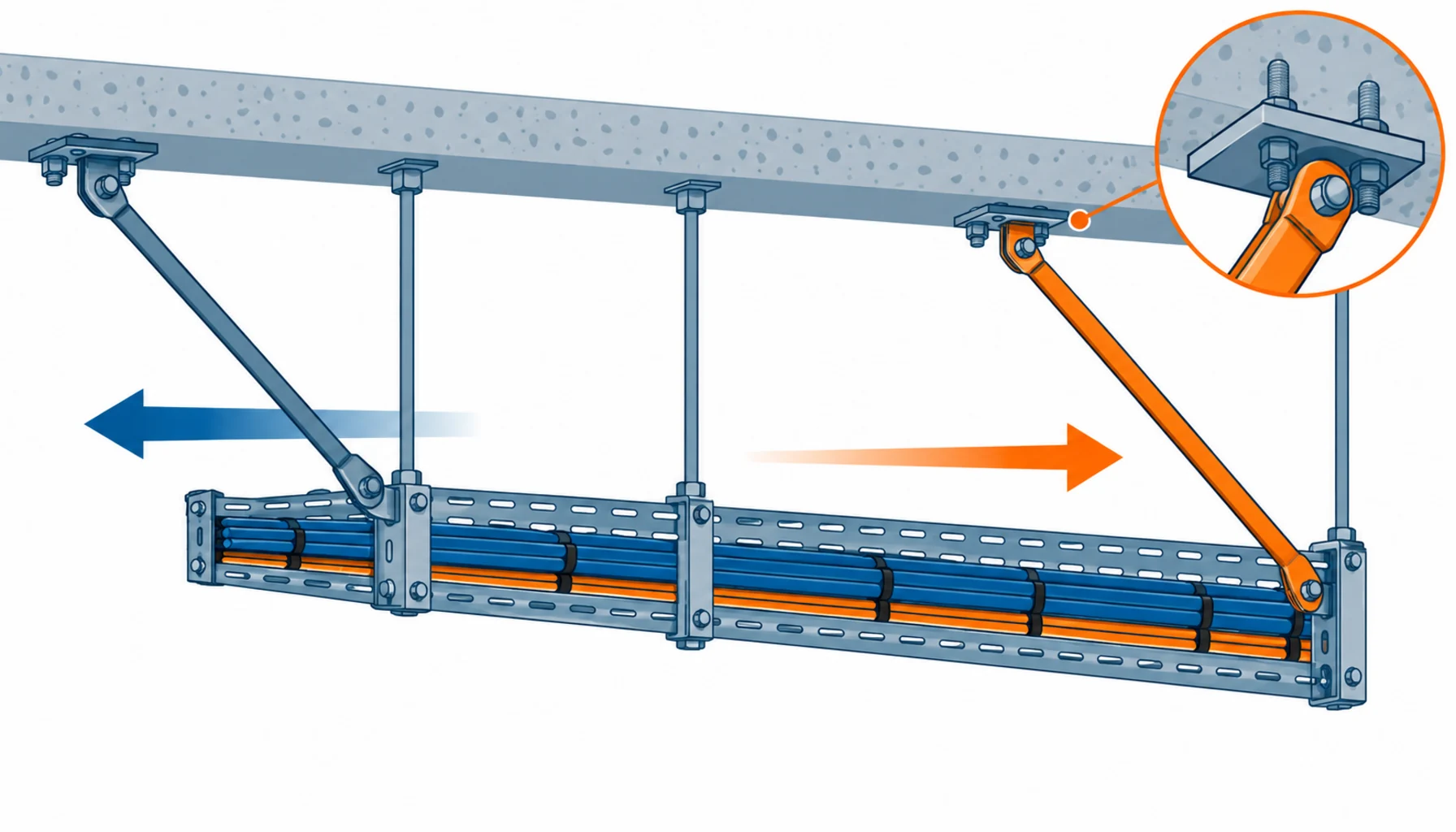
Two load directions, and rarely just one. Horizontal seismic force is applied along the run and across it, and the bracing has to deal with both. A brace arrangement designed for one direction is a partial answer, and it is a common one where the support package is bought from a general catalogue.
Longitudinal restraint, not only lateral. Tray and busway runs are long, and the fittings that allow thermal movement are also the places where unrestrained longitudinal movement appears during an event. Expansion joints and their restraint are part of the seismic system, not a separate thermal detail.
Anchors as qualified components. The weak point in most support systems is the connection to the structure, and anchor qualification data is a document that must be requested rather than assumed. Where the project requires special seismic certification for components, the equipment and its anchors need a certificate that covers the tested configuration, not merely the product family.
Functional requirements after the event. Some installations have to remain serviceable, not merely stay in place. That is a design input that changes brace spacing and redundancy, and it should appear as a stated requirement rather than as an expectation.
The Decision Table: Four Bracing Approaches and What Each One Costs
The table compares the approaches a buyer actually chooses between. The first column is the approach, and the last two columns are the ones that decide the tender.
| Approach | What You Are Buying | What to Specify | Evidence You Should Receive | Cost and Delivery Shape |
|---|---|---|---|---|
| Catalogue braces, site fitted | Standard struts and fittings selected from a supplier catalogue by the installer | Required load case, spacing, anchor type and the qualification standard the components must hold | Component qualification data, anchor test data, as-built bracing layout drawing | Lowest material cost, highest dependence on site judgement; usually the cause of inspection findings |
| Engineered bracing package | A designed support system with calculations produced for the actual run, loads and structure | The design inputs: run geometry, cable weights, structure type and the performance objective | Signed calculations, layout drawings, component and anchor qualification for the stated configuration | Modest premium against catalogue hardware; the calculations are the deliverable that protects the schedule |
| Certified system with shake table evidence | A proprietary bracing family whose assembly has been tested as a system and certified | The certification standard, the tested configuration and the maximum spacing the certificate covers | Certificates naming the tested assembly, with the configuration and the anchorage used in the test | Highest component cost; fewest arguments at inspection because the evidence is a document |
| Tray or busway supplied with integrated supports | Support and bracing designed by the tray or busway manufacturer as part of the same order | Single supplier responsibility for load path, with the interface to structure and to expansion joints named | Structural calculations, tested support assemblies and a single set of installation instructions | Highest unit price, lowest coordination cost; the cleanest route where the run is long and the loading is heaviest |
What Each Approach Changes in the Order
Whichever route is chosen, four items move out of the installer’s scope and into the purchase.
Load information travels with the tray order. The bracing designer needs cable weights, fill and tray loading. Where the tray is bought without that data recorded, the support design starts from an assumption. Our note on the busway and cable comparison covers why busway and cable runs of the same capacity present different support problems.
Spacing becomes a number in the specification. Brace spacing follows from the load case and the component rating, and it should be stated as a maximum with the basis attached. Leaving the spacing to the installer means the spacing is whatever fits, and the first thing an inspector asks for is the calculation that produced it.
The interface to the structure is specified, not assumed. Whether the brace fixes to a slab soffit, a downstand beam or a steel member changes both the anchor type and the qualification evidence. Where the structure is post-tensioned, or where the embedded items were not cast in, the anchor solution is a design decision with a deadline attached.
Expansion fittings are part of the seismic scope. A run long enough to need thermal movement accommodation is also a run that needs longitudinal restraint at the right points. Buying expansion joints and bracing as separate packages is how a run ends up restrained in the wrong direction. Our note on firestop cable penetrations covers the equivalent coordination problem where a braced run passes through a rated wall.
Where Seismic Programmes Fail
Bracing bought after the tray is installed. Retro-fitting bracing into a filled tray is slow, access-dependent work, and it competes with the fit-out that is trying to energise. Braces specified with the tray arrive with the tray.
Calculations produced by the wrong party. Where the installer selects components but nobody signs a calculation, the project has hardware and no design. The calculation is the item that turns a pile of struts into an engineered system, and it should be a named deliverable with a date.
Anchors specified by type rather than by qualification. The difference between two anchors of the same diameter is documented in test data rather than in a datasheet. Asking for the qualification report at tender is a five-minute question; asking for it after installation is a problem with no cheap answer.
Testing at the wrong stage. Where functional requirements apply, the sequence of installation, inspection and sign-off matters. Bracing that gets covered by ceiling services before inspection is bracing that will be inspected from a photograph.
What to Freeze Before the Support Order
| Item | What to State | Evidence to Attach | Cost of Leaving It Open |
|---|---|---|---|
| Performance objective | The importance category, the load case and whether the installation must remain serviceable | The design basis statement referenced in the specification | A support system sized for the wrong objective, discovered at review or after an event |
| Run data | Cable weights, fill, tray or busway type and the geometry of each run | The tray and busway schedules with loading recorded | Bracing designed on assumed loading, with spacing that cannot be defended |
| Brace spacing and direction | Maximum spacing, lateral and longitudinal restraint, and the basis for each | Spacing calculation with the component rating it relies on | Spacing chosen on site, and an inspection finding that has to be corrected in a filled tray |
| Component qualification | Which qualification standard each component must satisfy, and for which configuration | Qualification reports or certificates checked against the assembly used | Hardware that performs, but cannot be shown to comply |
| Anchor qualification | Anchor type, base material, edge distance and the seismic qualification required | Anchor test data for the substrate and embedment used | A support system whose weakest element has no supporting document |
| Structure interface | What the brace fixes to, and whether cast-in items are required | Structural coordination drawings with embedment shown | Site drilling into a post-tensioned member, or an anchor solution designed after the pour |
| Expansion and restraint points | Where movement is accommodated and where it is restrained | A run drawing marking expansion fittings and restraint locations | Longitudinal movement during an event, on a run that was detailed only for thermal effects |
| Inspection and sign-off | Inspection points, witnessing party and the sequence relative to ceiling closure | An inspection plan with hold points named | Work that is closed up before inspection and cannot be verified afterwards |
When Seismic Bracing Is Not the Answer
Where the site is genuinely outside a seismic design category and the specification still imports the requirement. Applying a high importance seismic load case to a low seismicity site is not conservative design, it is unexamined design. The requirement should follow the site, and the site classification belongs in the design basis.
Where the bracing is being bought to satisfy an inspection rather than a load case. Hardware selected to make a walk-down pass, with no calculation behind it, is the most expensive version of the purchase, because it will be bought twice. The calculation costs less than the second purchase.
Where a single supplier is asked to cover a load path it does not control. A tray supplier cannot certify the anchorage into a structure designed by someone else, and a support contractor cannot certify tray loading it was never given. The scope boundary has to sit where the information is, and the interfaces have to be named in each order.
Where the support package is left until after the tray award. Bracing designed against a tray that has already been manufactured and shipped is bracing that adapts to the tray rather than the tray adapting to it. The support requirement belongs in the tray enquiry, even when the support itself is bought separately, and the grounding side of a braced run is set out in our note on grounding and bonding verification.
RFQ Checklist
- Performance objective stated, with the importance category and the load case
- Load case given in both directions, with longitudinal restraint addressed separately
- Tray and busway schedules issued with cable weights and fill recorded
- Maximum brace spacing stated with the calculation that produced it
- Component qualification standard named, and applied to the assembly actually used
- Anchor qualification report required for the substrate, embedment and edge distance in use
- Structure interface defined, with cast-in items identified before the pour
- Expansion fittings and restraint locations marked on the run drawing
- Interface responsibilities named where tray, support and anchors come from different suppliers
- Inspection hold points listed with the witnessing party and the sequence relative to ceiling closure
- Functional requirement stated where the installation must remain serviceable after an event
- As-built bracing layout drawing required as a handover deliverable
Conclusion
Seismic bracing is purchased twice on most projects, once as hardware and once as an argument. The way to buy it once is to put the load case, the spacing basis and the qualification requirements into the enquiry, and to require the calculation as a deliverable rather than as an explanation offered after an inspection finding.
Kexingyu Cable Group (KXYE) supplies the cable and distribution equipment that these support systems carry, including the WDZ-YJY, WDZN-YJY, BTTZ, NG-A (BTLY), KVV and YJV ranges, the data center cable range used on tray and busway routes, and the busbar tap-off box used where a busway run is tapped along its length, all from one factory group with copper price linkage available on project-scale orders. Send the run schedules with cable weights and the load case you are designing to, and we will return the ratings and records that the support design has to be based on; the fastest route is a request for quotation.