Buying Agricultural Robot Cable for Field and Greenhouse Duty: What the Weather Decides
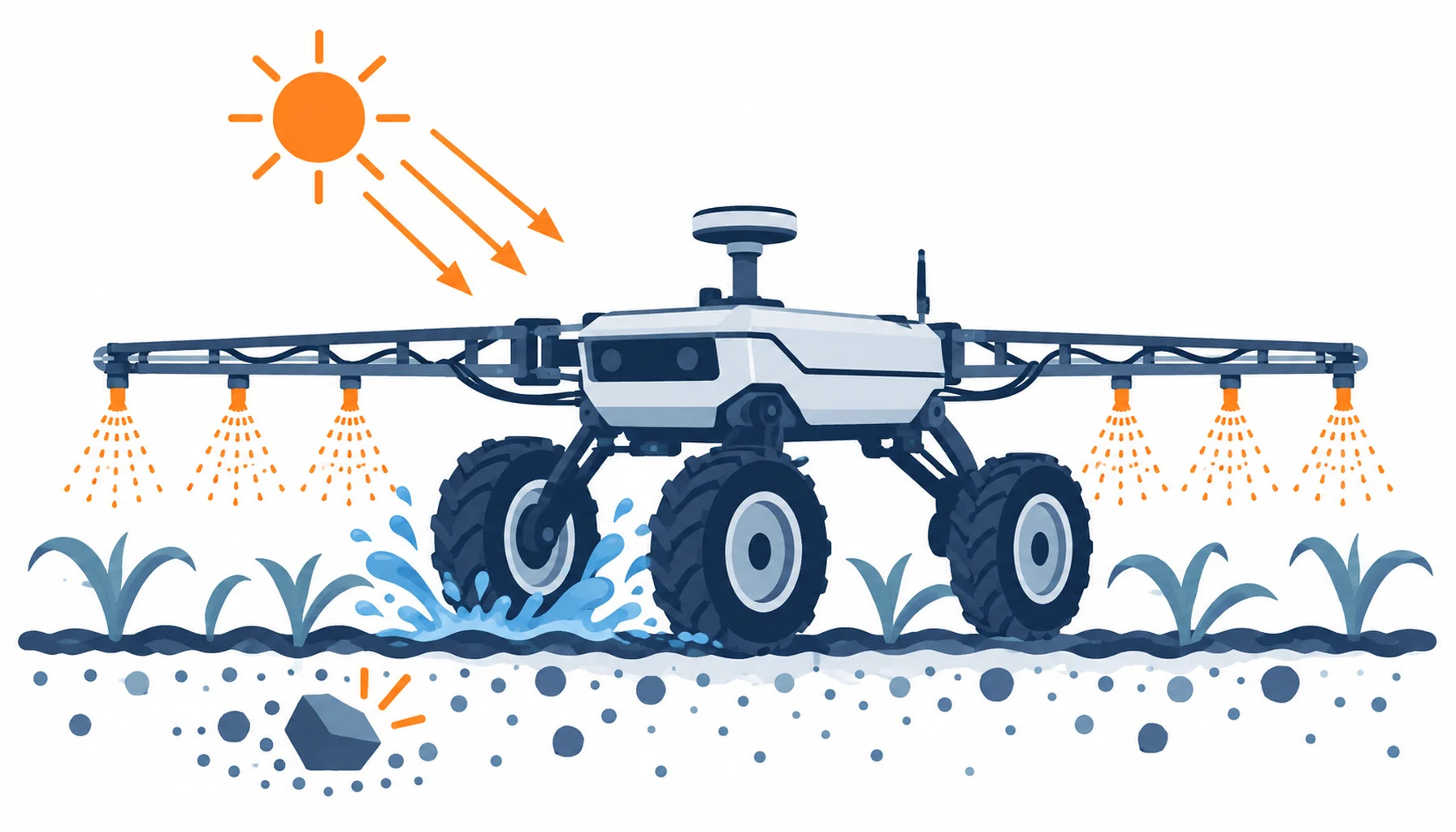
Quick Answer: A farm robot is asked to work outside for a whole season, in ultraviolet light, wet soil, crop chemicals and a temperature range that can move forty degrees in a day. Cable that survives a factory floor will not automatically survive that. The four things to fix before ordering are the sheath compound, the water path, the abrasion figure and the temperature window, and three of the four are decided by the field rather than by the machine.
Introduction
Agricultural robots have moved from demonstration to seasonal deployment, and the duty they face is unlike any other mobile machine. The vehicle works on an uneven surface that changes with the weather, shares its space with crop chemistry and dust, and is expected to run a full season with minimal maintenance.
The general outdoor rules are close to those for street delivery machines, and our note on delivery robot cable covers the basics of UV, splash and kerb impact. What follows is what changes when the surface is soil and the chemical is a crop treatment rather than road salt.
Four Exposures That Decide the Sheath
Ultraviolet light comes first because it acts on the compound rather than the conductor. A field robot in an open row crop can see more than two thousand hours of direct sun in a season, and the damage appears as a chalky surface that cracks along the bend lines. Products built for that duty, such as the UV resistant cable family, exist because a general purpose sheath is not specified for those hours.
Crop chemicals come second. Herbicides, fungicides, fertiliser solutions and crop oils are all aggressive to different polymers, and a machine may be sprayed with a different mix every fortnight. The important question is not whether a sheath resists chemicals in general, but which chemicals, at what concentration and for how long. A general statement is not enough to buy against.
Water arrives in two forms, and they behave differently. Rain and spray fall on the outside of the machine; standing water and irrigation sit under it and travel along the cable. Wicking along the core is the failure that matters, because it delivers water to a connector inside a sealed housing. Water-blocked constructions such as the water blocking cable range are built around that path rather than around a single ingress claim.
Soil abrasion is the fourth, and it does more damage than most buyers expect. Wet soil and grit act as a grinding paste against any cable that touches the ground or runs near a wheel. That is a local problem at a known contact point, and it is better solved with a sleeve or a revised route than with a heavier compound on the whole run. The patterns that identify it are set out in our note on cable damage wear patterns.
Temperature Swing and Cold Morning Starts
A field robot is often started before sunrise, in air cold enough to make a standard flexible jacket stiff. Cold flexibility is a separate property from heat resistance, and a cable specified only for the hot end of the range can crack on the first cold morning of the season. The constructions that carry that property are described in our note on low temperature flexible cable.
Declare both ends of the range and the temperature at which the machine will actually start. A machine that is stored in a shed and started at midday never sees the coldest figure on the datasheet, and buying for a temperature the machine never meets is cost without benefit.
Abrasion resistance is the same story in reverse. It is tempting to buy the hardest jacket available, but a harder compound is usually stiffer, which raises the minimum bend radius on a machine that already has tight routes. Ask for an abrasion figure at the real contact point and let the geometry decide, rather than buying the toughest sheath on the list. The trade is set out in our note on abrasion resistant cable jackets.
Field, Orchard and Greenhouse Are Three Different Duties
The three settings look similar on a purchase order and behave differently in service. A broadacre field machine works in open sunlight, on soil, at speed and over large areas; its cable problem is ultraviolet and abrasion, and its cycle count is dominated by suspension movement rather than by any single joint.
An orchard machine is slow and close to structure. It brushes against branches and trellis wire, which puts abrasion on the upper part of the harness rather than the lower, and it is the setting where chewing damage shows up. Its cycle count is low and its contact damage is high, which is the opposite of the greenhouse case.
A greenhouse or polytunnel robot meets almost no ultraviolet and a great deal of humidity, condensation and, in some houses, aggressive disinfectant. It often runs on a rail or a fixed track, so its cable problem is reeling or festoon duty rather than field wear, and its thermal problem is a warm, damp, still atmosphere rather than direct sun.
Writing one specification across all three usually means over-buying in two of them. Where a single harness genuinely has to serve all three settings, the specification takes the harshest requirement from each column, and the buyer should know that is what the price reflects. If it is not clear which of the three applies, ask the operator before the order, because that single answer decides the sheath compound and the route.
The Decision Table: Four Routing Strategies and What Each One Costs
| Strategy | What to specify | Evidence to demand | Cost and lead time | Where it fails |
|---|---|---|---|---|
| Exposed run on the implement | Sheath compound, UV hours and the contact points | A weathering test stated in hours, plus an abrasion figure | Lowest cost, standard lead time | A chalky jacket and a ground contact worn through in one season |
| Routed inside the boom or frame | Route, entry seals, drain points and clearance at full travel | A drawing checked at both ends of travel | Higher design effort, same build cost | Water collecting in a closed section that has no drain |
| Sleeved or spiral-wrapped external | Sleeve type, coverage and the replacement interval | An abrasion test at the real soil contact point | Add-on cost at assembly | Grit trapped under a sleeve against the sheath |
| Soil-contact or buried section | Water blocking, crush resistance and the burial depth | A water path description plus a crush figure | Higher unit cost, longer lead time | Water wicking along the core into a sealed enclosure |
| Reeling or festoon arrangement | Reel type, retraction force and a reeling-rated core | A reeling life figure at the real extraction length | Highest hardware cost, longest lead time | Paying for reeling hardware where a fixed loop was enough |
What to Freeze Before the Order
| Item | What to state | Evidence to attach | Cost of leaving it open |
|---|---|---|---|
| UV exposure hours | Expected direct sun hours over the service life | A weathering test with hours and conditions stated | A jacket that cracks in season two with no warning |
| Chemical list | Every crop treatment the machine will meet, with concentration | A resistance statement for each agent named | A swollen sheath and a raised minimum bend radius |
| Water path | Where water enters and where the route can drain | A path description plus a drain detail on the drawing | Water reaching a connector inside a sealed housing |
| Temperature range | Coldest start and hottest working condition | A cold flex figure at the coldest start temperature | A stiff jacket that cracks on the first cold morning |
| Abrasion contact points | The points that touch soil, grit or a wheel | An abrasion figure at the real contact point | A worn sheath found only at the end of the season |
| Crush and impact | Where the machine can drive over its own cable | A crush figure plus a protected route drawing | A crushed core that tests fine until it moves |
| Bend radius | The figure for the assembled harness at each pivot | A flex figure at the tightest point of travel | Core and screen damage hidden inside the harness |
| Rodent and bird damage | Whether the route is exposed to chewing in orchards | A conduit or armour specified for those sections | A season interrupted by damage no sheath can resist |
| Cleaning and washdown | How the machine is cleaned between crops | A chemical and pressure statement for that method | A sheath that survives the field but not the wash |
| Spares and season timing | Spare assemblies held before the season starts | A spares list agreed with the operator before planting | A machine out of work during the only weeks it matters |
When an Agricultural Robot Cable Specification Is Not the Answer
When the deployment is one season long. A trial machine working a single crop cycle does not need a compound qualified for five years of ultraviolet. Buy a proven outdoor cable, keep the runs short and accessible, and put the budget into spares and instrumentation. The specification can harden when the machine is expected to come back next year.
When the damage is mechanical rather than chemical. If sheaths are worn through at the same wheel position every season and the electrical tests are clean, the answer is a revised route or a replaceable sleeve, not a harder compound. The same reasoning applies to the dust and impact duty on a building site, which our note on construction robot cable covers.
When the machine is actually used under cover. Greenhouse and polytunnel robots meet humidity and chemistry but a fraction of the ultraviolet dose, and the cold-start requirement usually disappears. Buying a field-grade specification for a covered machine adds stiffness, cost and lead time for a property the machine never tests.
When the operator has no plan for inspection. A seasonal machine needs a pre-season check more than it needs a better cable, because most of what fails in a field is visible before it fails. What to look at on each delivery and each service is set out in our note on robot cable inspection standards, and a continuous outdoor machine raises the same questions as a security patrol robot.
RFQ Checklist
- Ultraviolet exposure hours over the service life, with a weathering test stated in hours
- Every crop chemical named with concentration and contact duration, and a statement for each
- Water path described, including where the run can drain and where it cannot
- Coldest start temperature stated, with a cold flex figure measured there
- Abrasion figure requested at the real soil and wheel contact points
- Crush and impact locations shown on a drawing, with a protected route proposed
- Bend radius given as a harness figure at each pivot, not for a single core
- Sections exposed to chewing protected by conduit or armour, stated as replaceable parts
- Cleaning method and pressure declared, with the sheath checked against both
- Spare assemblies agreed and delivered before the season starts, not during it
Conclusion
An agricultural robot cable is bought on four numbers that come from the field rather than the drawing office: ultraviolet hours, the chemical list, the cold start temperature and the points that touch soil. Get those four into the RFQ and the sheath, the route and the spares level all become straightforward. Leave them to the first season and the season will teach you at the worst possible time.
Kexingyu Cable Group (KXYE) has supplied weather-resistant, water-blocking and abrasion-rated cable since 1996, and can build harnesses so the geometry approved on the first article is the geometry that ships. Send us the exposure hours, the chemical list and the route drawing, and we will return sheath options and sample assemblies for a field trial; the fastest route is a request for quotation.