Buying Patrol Robot Cable for Continuous Outdoor Duty: What to Specify
Quick Answer: A patrol robot is the hardest-duty mobile machine most buyers will ever spec, because it runs nearly all the time and it runs unsupervised. Nobody watches the harness, so a fault is discovered by a missing inspection rather than by an alarm. The four numbers that decide the product are annual cycles, the condensation cycle, the standby temperature and the ability of the machine to tell you the cable is degrading.
Introduction
Security and inspection robots have become a standard item on industrial and utility sites, and their duty is unlike a delivery or cleaning machine. They work long shifts, often overnight, on the same route, with a small number of charging breaks and no operator nearby.
The outdoor basics are shared with other mobile machines, and our note on delivery robot cable covers ultraviolet and splash. What follows is what changes when the duty is continuous and the machine is unattended.
Annual Cycles Beat Datasheet Cycles
Add up what a patrol robot actually does in a year. A route with a handful of turns and a few door thresholds, repeated for several shifts a day, produces cycle counts that no bench test in a datasheet is likely to describe. And because the amplitude of each movement is small, the wear is not the familiar sharp bend at a joint; it is millions of gentle flexes in the same short length of cable.
Declare the count and the amplitude rather than asking for a general flex rating. Then state which length of the harness sees the most of it, because on a patrol machine that is rarely the arm. It is usually the run near the drive, the suspension or the sensor mast, and specifying the whole harness to the worst local duty is how a project pays three times for a problem in one place.
Duty cycle also decides the charging path. A machine that docks several times a day and works through the night runs shallow charge cycles rather than deep ones, repeatedly, and that pattern places its own load on the charging conductors and their terminations. The current side of that decision is covered in our note on robot battery cable.
Condensation Is the Failure Nobody Predicts
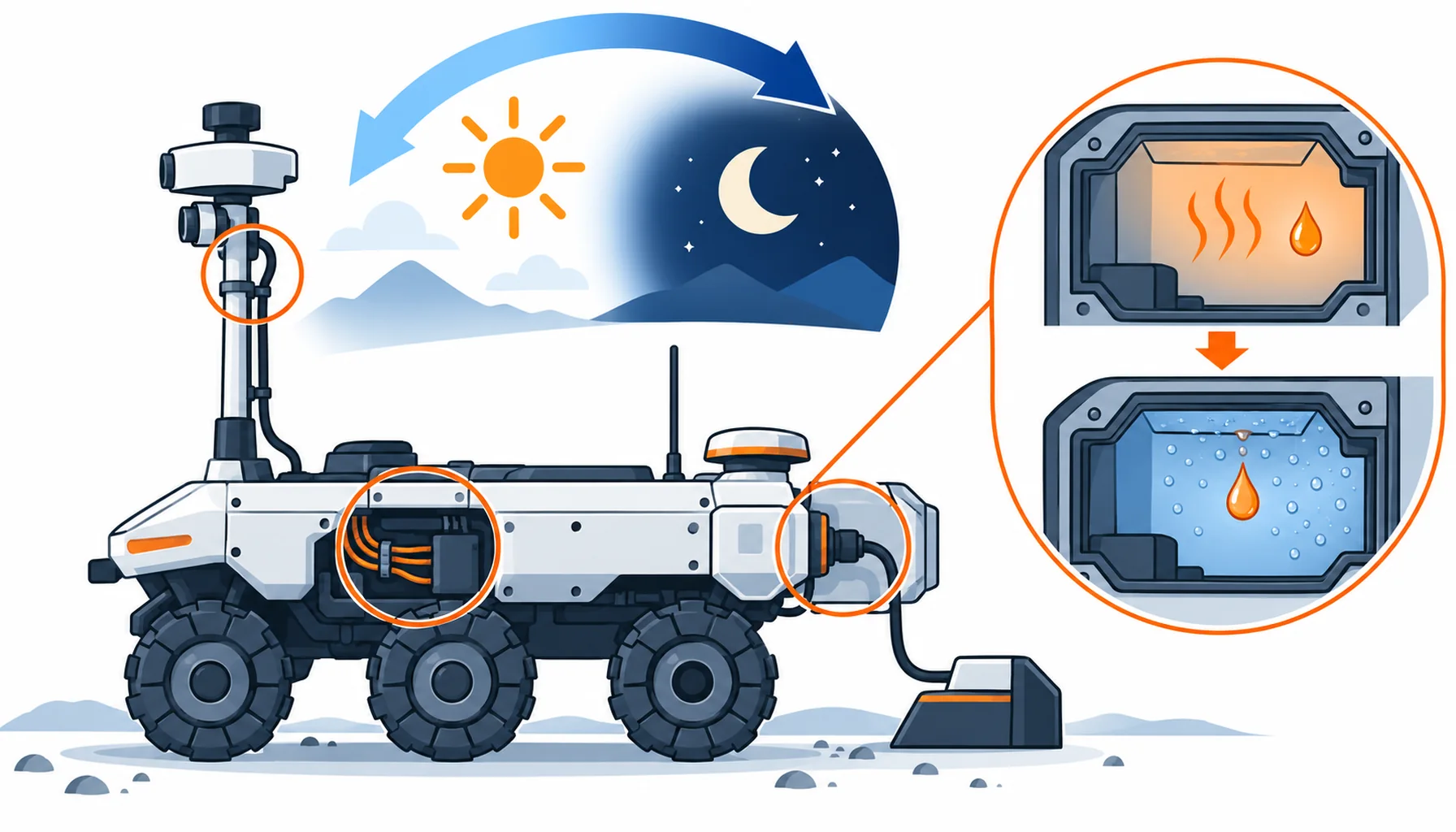
A patrol robot is often warmer than the air around it when it stops, and then cold for hours. Warm, humid air drawn into a housing cools inside and releases water on the coldest surface, which is usually a screen, a connector or a cable entry. The water is not from rain and it does not need a hole to get in.
This is a different problem from ingress and it needs a different answer. A sealed enclosure that breathes will condense; a construction that limits what can travel along the core will limit the damage when it does; and a route that lets any collected water drain back out rather than sit against a joint will decide whether the fault appears this winter or in three years. Where the machine operates across a wide temperature band, a weather resistant cable family that covers the range is a more sensible starting point than a general-purpose sheath.
Cold also changes the mechanical picture. A jacket that is flexible at midday is stiffer at four in the morning, so the cold-start flex figure and the low temperature behaviour are part of the specification rather than an afterthought. The constructions that carry those properties are described in our note on low temperature flexible cable.
Where the Harness Actually Fails on a Patrol Machine
The failure is concentrated, not spread out. Three locations account for most events. The first is the sensor mast or the lift column, where a cable runs to something that moves on every stop. The second is the drive or steer bay, where a short flexible run absorbs suspension travel and sees the highest amplitude of any cable on the machine. The third is the charger tail at the dock, which is wet, dirty and handled by nobody.
Each of the three wants a different response. The mast wants a defined service loop; the drive bay wants a supported loop with a proper strain relief rather than a free-hanging length; and the tail wants a protected entry and a stated replacement interval. Buying one upgraded cable for all three is the most common way a patrol fleet spends money without changing its failure rate.
Heat is the reason the drive bay is not the only hot spot. An enclosed, insulated space with a cable running near a motor accumulates temperature, and the mechanics of that are set out in our note on thermal paths inside robot arms. On a patrol machine the same effect shows up near the drive, in the base and along the charger tail.
The Decision Table: Four Cable Strategies for Patrol Machines
| Strategy | What to specify | Evidence to demand | Cost and lead time | Where it fails |
|---|---|---|---|---|
| One flexible harness, all routes | Flex cycles, amplitude and the exposure hours | A flex figure at the worst local duty and your count | Lowest cost, standard lead time | Over-specifying everywhere and still failing at the dock |
| Per-location constructions | A separate duty figure for mast, drive bay and tail | A flex and temperature record for each location | Higher unit cost, more part numbers | Missing savings if the spares list is not kept separate |
| Drainable routed construction | Where water can enter, and where it drains back out | A route drawing showing drains at every low point | Higher design effort, same build cost | Water collecting in a closed section with no drain |
| Vapour-resistant sealed harness | Sealing method at entries, screens and the tail | An ingress test on the terminated assembly | Highest unit cost, longest lead time | Paying for full sealing where a drain would have been enough |
| Instrumented harness with sensing | What is monitored, the alarm threshold and the data path | A demonstration of the alarm at the threshold | Higher cost, integration lead time | Sensing added without a response procedure behind it |
Making the Machine Tell You the Cable Is Going
An unattended machine needs some way of reporting its own condition, and the cheapest version is not a sensor. It is a baseline. Measure insulation resistance, continuity and the current drawn by each drive at commissioning and record the figures, then check them at each service. A slow drift is visible long before a failure, and a single measurement taken once tells you nothing.
Where the buyer wants more, an instrumented harness can report a temperature or a resistance change, but only if somebody has decided in advance what happens when the alarm goes off. A monitoring feature without a response procedure is a feature that generates tickets. The reasoning behind a staged diagnostic approach is set out in our note on robot cable field diagnostics.
Cost per hour is the honest way to compare options here. A patrol machine that is idle for a week costs the same as a month of cable premium, and on a fleet that arithmetic usually settles the argument faster than any technical comparison. Our note on the real cost of robot downtime sets out how to make that calculation defensible.
What to Freeze Before the Order
| Item | What to state | Evidence to attach | Cost of leaving it open |
|---|---|---|---|
| Annual cycles | Cycles and amplitude per shift, per location | A route study, not a datasheet figure | A rating nobody can verify or use |
| Worst location | Which length of harness sees the most movement | A drawing marking the high-amplitude sections | Paying for a problem the whole harness does not have |
| Condensation | Where the machine is warm then cold, and how it drains | A drain detail on the drawing at every low point | Water sitting against a connector all winter |
| Standby temperature | Coldest start and warmest parked condition | A cold flex figure at the coldest start | A jacket that cracks in the first cold spell |
| Ingress and sealing | Where water and vapour reach the harness, and the mated state | An ingress test on the terminated assembly | A sealed-looking joint that passes vapour when open |
| Charging duty | Docks per day, current and the tail route | A temperature rise record at the docking burst | A wet tail that fails where it enters the machine |
| Bend radius | The figure for the assembled harness at the drive bay | A flex figure at the tightest point of travel | Core damage hidden inside the harness |
| Baseline records | What is measured at commissioning and at each service | A completed baseline sheet from the first article | Drift that is invisible because nobody recorded a start point |
| Monitoring and response | What is alarmed, at what threshold, and who acts | A written response procedure, agreed in advance | Tickets generated by a feature with no owner |
| Spares per site | Assemblies held at each site, and their revision | A spares list agreed with the security operator | A site waiting on a part while patrols are missed |
When a Continuous Duty Specification Is Not the Answer
When the route is short and covered. An indoor machine patrolling a warehouse overnight sees a fraction of the ultraviolet, none of the cold and much less water. Buying the outdoor, drainable, vapour-resistant construction for it adds stiffness and cost for properties it will never test, and a standard flexible build will usually last longer because it loads its terminations less.
When the failures are all at the charger tail. If the records show one location, fix that location. Upgrading the whole harness to solve a tail problem adds cost everywhere and changes nothing where it matters, which is the pattern our note on cable damage wear patterns describes.
When the operator cannot act on an alarm. Condition monitoring is only worth paying for if the site has a procedure and a person behind it. A fleet with no maintenance rota should spend the money on a spare harness per site instead, because that turns a failure into a swap rather than a discovery.
When the site is a temporary deployment. A three-month event or a short construction contract does not justify a fully sealed, instrumented harness. Buy a proven outdoor cable, keep the route drainable and short, and hold spares. Where a similar machine works a gentler outdoor schedule, the comparison is set out in our note on agricultural robot cable.
RFQ Checklist
- Annual cycles and amplitude stated per location, taken from a route study
- High-amplitude sections marked on a drawing rather than described in words
- Condensation path described, with a drain shown at every low point
- Coldest start temperature stated, with a cold flex figure measured there
- Ingress level stated on the terminated assembly, with the mated state declared
- Docks per day and docking current given, with a temperature rise record
- Bend radius given as a harness figure at the drive bay, not for a single core
- Commissioning baseline sheet supplied for insulation, continuity and drive current
- Any monitoring feature matched to a written response procedure and a named owner
- Spare assemblies held at each site, built to the same revision as the installed harness
Conclusion
A patrol robot cable is bought on four numbers that only a route study can supply: annual cycles, the condensation path, the coldest start and the baseline you intend to measure against. Machines that run unattended do not fail dramatically; they drift out of specification while nobody is looking, and the harness is the part with the least instrumentation watching it. Buy the baseline and the drain before you buy the compound.
Kexingyu Cable Group (KXYE) has supplied weather-resistant, cold-flexible and water-blocking cable since 1996, and builds harnesses so the geometry approved on the first article is the geometry that ships. Send us the route study, the exposure hours and the docking profile, and we will return constructions, drain details and sample assemblies for a site trial; the fastest route is a request for quotation.