Humanoid Cable Testing: Which Standards Exist and What Buyers Must Write Themselves
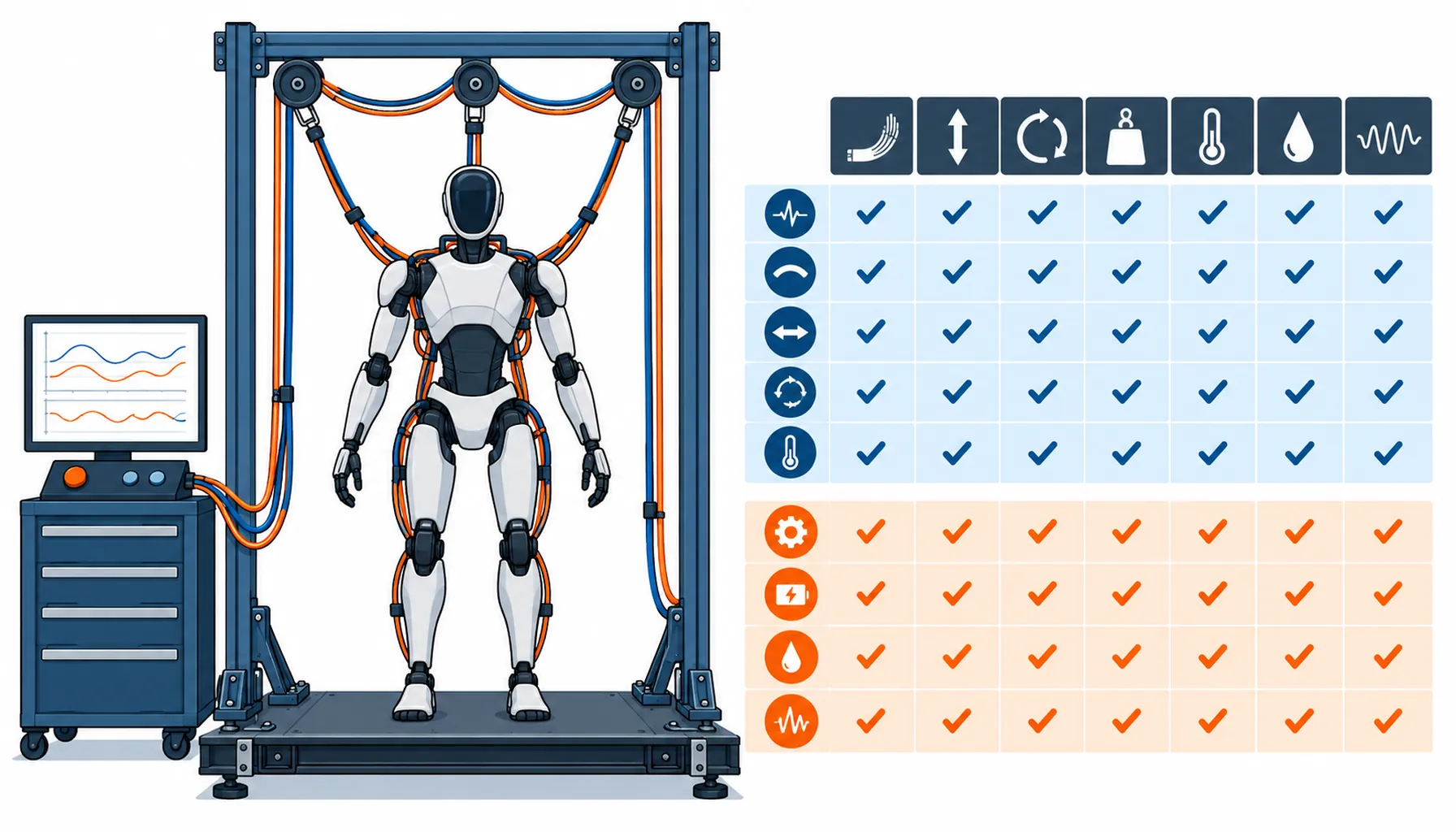
Quick Answer: No dedicated test standard exists for humanoid cabling yet. The industrial robot tests cover flex life at generous radii, but not compound twist at finger-scale bends or whole-limb duty. This guide maps which tests exist, where the gaps are, and the acceptance protocols a buyer should write into the RFQ.
Introduction
Every other guide in this series asks for evidence, and this one asks the fair follow-up: evidence measured against what? For industrial robot cable the answer is a settled family of test methods, and our note on robot cable certification walks through the certificate landscape. For humanoid cabling the honest answer is that the standards have not caught up with the machine, and a buyer who waits for them waits for years.
That gap is not a crisis; it is a procurement task. Where no standard exists, the specification carries the weight, which means the buyer’s test protocol becomes the standard. Programs that understand this buy better cables than the ones that assume a datasheet figure means the same thing everywhere. This guide maps the ground: what is properly standardised, what is tested but unstandardised, and what currently exists nowhere but in your own duty profile.
What Is Actually Covered Today
Construction standards are the safe ground. Conductor classes, insulation and jacket materials, voltage ratings and flame behaviour are all governed by long-standing generic standards, and any reputable cable for a humanoid program carries those. Ingress protection and EMC behaviour likewise have mature methods, and the machine-safety framework that a humanoid eventually lives inside is charted in our note on ISO 10218 robot safety.
Flex life testing exists too, and it is genuinely useful, with the caveat that the established robot-cable methods were written around industrial arms: relatively large bend radii, bending in one plane, millions of cycles at high speed. That regime describes an arm base or a drag chain well. It describes a humanoid wrist, which bends through small radii in several planes while twisting, poorly, and a figure earned in the first regime says little about the second.
Abrasion testing sits in between: real methods exist, real numbers get published, but the counterface, load and stroke of the standard test may look nothing like a finger brushing a work surface. The method matters more than the number everywhere in this field, and the comparison of methods is set out in our note on the cable abrasion test standard.
Where the Gaps Are
The first gap is compound motion: twist and flex applied together at small radii. No mainstream standard prescribes a rig for it, so suppliers who test it do so with proprietary rigs and internal methods. That doesn’t make the data worthless; it makes the method disclosure essential. A cycle count without the rig description, the radius, the twist angle and the load is a marketing sentence, and the buyer’s protocol should say so explicitly.
The second gap is scale. Micro-bend flex at finger dimensions, where a hand harness lives, is below the range the industrial methods contemplate, and fine-strand constructions behave differently down there. The third gap is the duty profile itself: no standard test walks a cable through a representative humanoid sequence of walking, grasping, settling and idle cooling. The closest available substitute is a custom bench that reproduces the program’s own duty, which our note on humanoid actuator cable recommends building early.
Tendon elements fall outside cable standards entirely, because they are machine elements working in tension fatigue, a regime covered (loosely) by mechanical component practice rather than cable practice. The buyer who needs tendon evidence writes a mechanical qualification, not a cable one, and the distinction is worth making in the requirement so nobody invoices a flex test for a tensile question.
The Decision Table: Test Coverage for a Humanoid Program
| Test area | Status | What to demand instead | Cost and lead time | Risk of skipping |
|---|---|---|---|---|
| Construction and safety ratings | Fully standardised | Standard certificates, checked for currency | No added cost | Low, but only if documents are read |
| Flex life at arm radii | Standard methods exist | Method disclosure plus your radius stated | Low, most suppliers have data | False confidence at humanoid radii |
| Compound twist plus flex | No public standard | A custom protocol naming rig, angle and load | Medium, bench time required | Waist and wrist fatigue found in the field |
| Micro-bend flex | No standard at hand scale | Bench cycles at the finger radii, method stated | Medium, custom rig | Fingertip faults after warranty |
| Whole-limb duty profile | Exists nowhere | A program-owned sequence test on the real duty | Higher, engineering time | Every part passing, system still failing |
What Makes a Bench Rig Credible
Read the table as a purchasing sequence. The standardised rows cost nothing extra beyond attention. The gap rows cost bench time and a little engineering, and each is cheap relative to the field failure it prevents. A program that funds the three custom rows once, early, owns that evidence for the life of the product; a program that defers them buys the same tests later, under time pressure, at whatever price the schedule demands.
Writing the Acceptance Protocol Into the RFQ
A custom test is only as good as its rig, and credibility has a short checklist. The rig should use the production termination, not a convenient clamp, because terminations fail before cables do and a lab-friendly end fitting flatters the result. It should run the production cable length between supports, since slack changes how the bend distributes. And it should cycle at the machine’s real speed range, because high-speed rigs finish sooner and age the cable differently than the gait will.
Environment belongs on the same list. A rig in a comfortable laboratory misses what a humanoid sees: the joint warming under continuous walking, the cold start at the beginning of a shift, the jacket at its stiffest exactly when the duty is hardest. Cycling at room temperature is the default everywhere, which is why stating the test temperature in the protocol matters more than most buyers expect. The qualification that finds field failures is the one that reproduces the field’s worst hour, not its average one.
Termination detail deserves its own line item in the protocol, and the practice is the same as for any robot harness: crimp heights, pull-off forces and relief geometry stated and recorded, as set out in our note on terminating robot harnesses. A bench result earned on documented terminations transfers to production; one earned on mystery end-fittings transfers nothing, and the program discovers that at exactly the wrong moment.
What to Freeze Before the Order
A useful protocol is shorter than most people expect. For each test area it states the specimen, the rig geometry, the duty parameters, the pass criterion and the report format, in a page. The discipline is not in the length but in the measurability: “adequate flex life” invites opinion, while “no continuity loss through 500,000 cycles at 12 millimetres radius, 90 degrees simultaneous twist, report the rig photo and raw log” invites a number. The drafting pattern follows the one used in our note on cable flex testing methods.
Then attach the protocol to samples, not just to production. The qualification route that works is the standard one, sample build, bench test, signed approval, with the protocol as the definition of “test”, and the mechanics of that route are covered in our notes on robot cable sample testing and the cable sample approval process. A protocol that only appears at incoming inspection is a trap you set for your own receiving dock.
Share the protocol with more than one supplier. Multiple vendors testing to the same written method is what makes their quotations comparable, and it quietly solves the standardisation problem from the demand side: the market adopts whichever buyer protocols prove workable, which is how most test standards got written in the first place. Consistency of evidence across lots then becomes the ongoing check, as set out in our note on humanoid assembly yield.
When More Testing Is Not the Answer
| Item | What to state | Evidence to attach | Cost of leaving it open |
|---|---|---|---|
| Standard certificates | Which generic standards apply, with currency dates | Copies on file, checked | Assumptions about paperwork nobody read |
| Flex protocol | Radius, amplitude, rate, cycles, pass criterion | A written one-page protocol | Numbers that mean different things |
| Twist protocol | Angle per metre, direction balance, simultaneous flex | Rig description with the report | Waist duty qualified by imagination |
| Micro-bend protocol | Finger radii and amplitudes from the hand design | Bench records at those radii | Hand faults after release |
| Duty sequence test | The program's own representative cycle | A logged sequence run, pass or fail | Parts pass, system fails |
| Method disclosure | Rig geometry and method named in every report | Protocol signed by each supplier | Proprietary numbers nobody can compare |
| Sample stage | Which tests run on samples, which on lots | An approval matrix | Tests that appear too late to matter |
| Retest triggers | What change forces re-running which test | A change-control clause | Silent drift after approval |
| Report format | Raw logs, not verdicts; photos of rigs | A report template in the RFQ | One-line certificates with no substance |
| Archive | Where protocols and reports live, and who owns them | A named document owner | Qualification repeated every revision |
RFQ Checklist
When a standard method already covers the duty. Where the real geometry sits inside a standardised test’s envelope, use the standard and move on. Inventing a proprietary protocol for a case the existing methods handle adds cost and compares against nothing, which is the failure mode our note on the abrasion test standard warns about in the abrasion context.
When the certificate hunt replaces duty thinking. Collecting certifications is satisfying and cheap, and none of it substitutes for testing at the program’s actual radii and duty. A folder of full certificates on a cable that never saw a twist-plus-flex test is paperwork, not qualification, and the incoming checklist should weight accordingly, along the lines of our note on robot cable inspection standards.
When the volume cannot repay the matrix. The full protocol suite makes sense for a design entering production. A research build with three units and a short life needs the two or three tests that cover its real risks, not the matrix, and the discipline is choosing which, in writing, before the order.
When the supplier cannot disclose the method. A vendor who insists on proprietary secrecy for basic flex data is asking you to buy an untestable claim. Some refusal is legitimate for genuinely novel constructions, but the default response is to walk, because unverifiable evidence fails at exactly the moment evidence matters.
Conclusion
- Generic standard certificates requested with currency dates and attached
- Flex protocol written into the RFQ: radius, amplitude, rate, cycles, pass criterion
- Twist-plus-flex protocol stating angle, direction balance and simultaneous flex, with rig description required
- Micro-bend bench test specified at the hand’s actual radii
- A program-owned duty sequence test defined and run before design freeze
- Method disclosure required in every test report, with raw logs and rig photos
- Sample-versus-lot test matrix agreed and attached to the approval route
- Retest triggers written into the change-control clause
- Report template supplied with the RFQ so responses arrive comparable
- Protocols and reports archived under a named owner for the product’s life