Electric Shovels and Draglines: Reel and Trailing Cable Selection
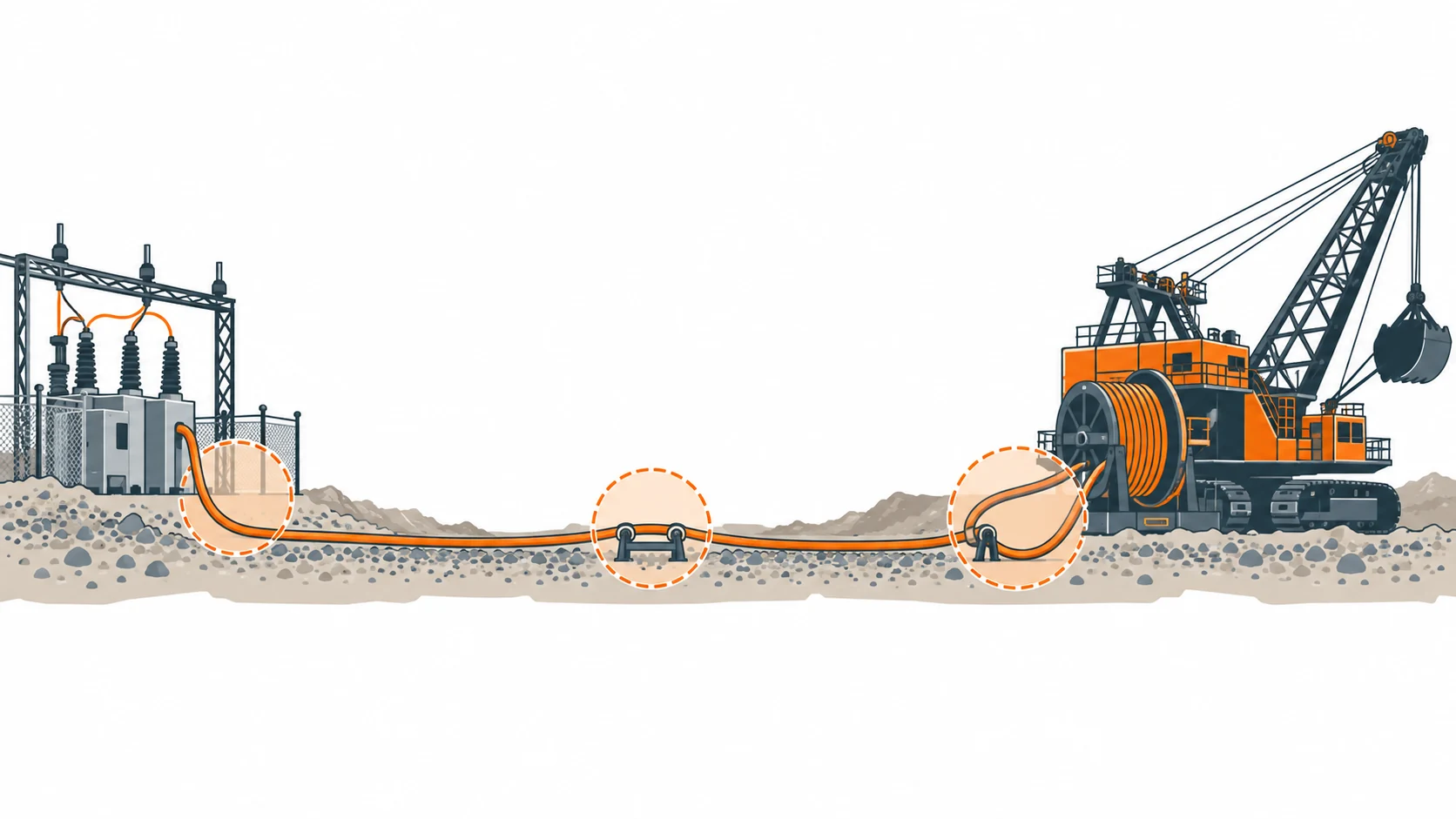
Quick Answer: A shovel or dragline does not simply drag a cable behind it. Power arrives through a reel system, feeds a long trailing run along the bench, and passes a cable handler that takes the slack out of the loop. Each of those three stages loads the cable differently, and a specification that satisfies only the drag duty usually fails at the reel. This guide covers the tension, torsion and spooling numbers to state, the evidence to demand, and what to freeze before the RFQ goes out.
Introduction
Large electric shovels and draglines are the machines that turn mining cable into an engineered system rather than a consumable. A loader drags sixty metres of cable; a shovel manages several hundred metres through a reel, a handler and a bench that moves as the pit advances.
That changes what procurement is buying. The cable is one item in a small assembly that includes the reel, the guides, the handler and the couplers, and the cable’s life is set by how well those parts agree with each other. A drum ordered without the reel geometry is a drum that will be replaced for a reason nobody wrote down.
How a Shovel or Dragline Uses Cable
Power reaches the machine in stages, and each one has its own failure mode.
The pit run. Cable lies along the bench from the last substation or junction, several hundred metres away. It is walked over by light vehicles, crossed by the machine’s own tracks at the switchback, and exposed to sun and rain. Voltage drop over that distance is a design constraint rather than a footnote.
The cable handler. A pivoting arm or loop keeps slack off the ground as the machine swings and advances. If the handler geometry is wrong, the cable is bent tighter at the entry than anywhere else on the run, and the failure appears in the first two metres of every replacement.
The reel. Where the machine carries a reel, the cable is wound and unwound as the bench advances, under tension, on a drum whose diameter and guide spacing decide whether the cable spools evenly or stacks to one side.
Three stages, three different loads, and one cable that has to survive all of them.
Reel Systems: What the Machine Expects
A reel is not a storage device. It is a mechanical system that applies tension, guides the cable onto a drum and takes the pull of the trailing run, and its settings are part of the cable specification.
Tension. Too little and the cable drags on the ground behind the machine; too much and the first metres are pulled straight every cycle, which is where core breakage starts. State the tension range and require reeling cycle data at it, not at a generic figure.
Spooling geometry. The drum diameter sets the bend radius at wind-on, and the guide spacing sets whether the cable lays side by side or crosses itself. A cable wound across previous layers takes torsion it was not designed for unless the construction is torsion-rated.
Drum versus cable rating. If the drum is smaller than the cable’s rated minimum radius, the correct cable will still fail. The geometry is cheaper to change than the replacement cycle, and it belongs in the specification review rather than in the commissioning punch list.
The reeling duty itself is covered in more depth in our note on reel crane cable, which deals with the same physics on a different machine. Where a shovel or dragline reel carries power and control together, the composite option is described in the reeling composite cable range.
Trailing and Cable-Handler Arrangements
The handler deserves more attention than it usually gets, because it is where a correct cable is most often overloaded.
A handler that lifts the cable in a loop close to the machine will bend it at a tighter radius than the reel does. A handler that lets the loop touch the ground leaves the sheath to the gravel. And a handler that pulls the cable sideways as the machine swings adds a lateral load the reel was never designed to take.
The practical check is to walk the machine through a full swing and measure the tightest radius at three points: the reel entry, the handler and the machine junction.
The table below maps the stages of a shovel or dragline cable system against what to specify and how each one fails.
| Stage or component | Duty on Site | What to Specify | Evidence to Demand | Cost and Lead-Time Driver | How It Fails |
|---|---|---|---|---|---|
| Pit run and trailing cable | Lying on the bench for hundreds of metres, walked over and crossed at the switchback | Voltage drop calculation, sheath reinforcement, screen arrangement, declared bend radius | Derated current at the stated conditions, sheath abrasion results, screen continuity | Copper content dominates the price; working lengths add to logistics | Sheath cut to the screen, water ingress, earth fault well after the damage |
| Machine reel | Wound and unwound under tension as the bench advances | Reel tension range, drum diameter against the rated radius, guide spacing, length per drum | Reeling cycle test at the declared tension and geometry, torsion test for the winding pattern | Torsion-rated construction is usually made to order | Corkscrewing after repeated crossing on the drum, core breakage at the drum entry |
| Cable handler or loop | Lifts and guides the cable through the machine's swing | Handler radius, restraint points, strain relief at the machine junction | Measured radius through a full swing, checked against the cable datasheet | A correct handler is cheaper than a repeat cable order | Tight bends at the entry, sheath flattening, repeat failures in the first two metres |
| Junction, couplers and splice | Connected and disconnected on move days, wet and dirty | Rated voltage and current, ingress protection, compatibility with the construction, tooling | Type test evidence, sealing verification for the assembled state, torque values | Kits are cheap against the labour of a joint; incompatible kits are the expensive version | Joints that pass a megger and fail under load, moisture into the screen |
| Substation and feed point | Fixed, and sets the length of the trailing run | Fault level, protection settings and the earth loop impedance the arrangement produces | Single line diagram with the associated settings | Moving the feed point can shorten the copper more cheaply than increasing it | A cable that defeats the earth fault protection, or trips it spuriously |
Sizing a Pit Run
Shovel and dragline runs are long and the loads are heavy and intermittent, so voltage drop at the machine is a specification constraint rather than a margin.
Run length and route. State the route length including the handler loop and the vertical drops, not the distance on the plan. A bench that advances lengthens the run, so quote the longest case.
Load and starting duty. Give the continuous and starting current and how often the machine starts. A shovel digging in hard rock draws a starting current that a table figure does not describe, and a conductor that satisfies steady-state current may still fail the starting voltage requirement at the motor terminals.
Ambient and installation. Cable in sun on a bench, cable lying in a wet sump and cable grouped beside a second run derate differently, so ask for the derated current rather than the catalogue number. Our note on cable derating factors explains where the tables mislead.
Earth fault protection. Protection is set against the circuit’s earth loop impedance, which makes the calculation a pre-order task rather than a commissioning one. Where the run has outgrown what the cable can carry economically, moving the feed point closer to the face often costs less than the extra copper, which is where a prefabricated substation for mining earns its place.
Construction Choices That Move Life
Conductor class. Finely stranded copper for the trailing run, because the cable is bent and pulled daily. The finer stranding costs more and is not optional on a machine that moves its own cable.
Insulation and sheath. Ethylene propylene rubber stays flexible at low temperature and tolerates the working that comes with a moving cable. The sheath carries most of the budget and most of the abuse, and reinforcement is what separates a bench cable from a general-purpose one.
Torsion. Where the cable crosses itself on the drum, a straight reeling construction corkscrews within a few thousand cycles. A torsion-rated construction is the answer, and the alternatives are set out in our note on torsion cable construction.
Screen and earthing. Machine cable carries a screen or pilot core for earth continuity monitoring, and its continuity is a safety function rather than a signal function. How the screen behaves when the sheath is cut matters more than the coverage figure.
What to Freeze Before the Order Goes Out
These five items are cheap at specification stage and expensive once drums are on a truck.
| Decision | What to State | Evidence to Attach | Cost of Leaving It Open |
|---|---|---|---|
| Reel geometry | Drum diameter, guide spacing and length per drum | Dimensions checked against the cable datasheet | A correct cable failing on an undersized drum |
| Tension range | Working tension and its variation across the bench | Reeling cycle data at that tension | Premature core breakage in the first metres |
| Handler radius | The tightest radius measured through a full swing | A sketch with the three measuring points marked | Repeat failures in the first two metres of every drum |
| Run length and derating | Longest route length, installation conditions and derated current | The voltage drop and earth loop calculation | A cable that defeats the protection or drops too much voltage |
| Feed point | The position of the substation or junction in the plan | A single line diagram for the arrangement | Copper bought to cover a distance that could have been shortened |
Cost Structure and Lead Time
Shovel and dragline cable is priced from the copper outward, and the pit run is where the copper content is largest. A flexible class conductor is the single biggest component and the only one that moves between quotation and order, so on a programme that runs long the copper basis and its validity window belong in the comparison rather than in a footnote.
The sheath compound, the reinforcement and a torsion rating are the second lever. A winding pattern that needs a torsion-rated construction, or a submersible service run beside the main cable, each add cost a general-purpose drum avoids.
Lead time follows the pattern of the rest of the mining range. Stock constructions ship in days; made-to-order bench cable runs on the sheath line; anything carrying a certified underground construction is the longest, because the approved compound and the test regime sit on the critical path. Plan back from the shutdown, not forward from the specification date.
Incoming Inspection: What to Witness
Against the drum, before anything is cut. Count drums against the packing list, verify the marked lengths and photograph the markings, including the construction code and drum number.
Electrical and dimensional checks. Conductor resistance and continuity, insulation resistance, and screen continuity end to end; then overall diameter, sheath thickness and conductor cross-section on a cut sample. Measuring the copper area settles arguments about the conductor, and it is best done with both parties present.
Documents and accessories. Match test reports to the drum references, and confirm that couplers, joints and consumables arrived with the cable rather than behind it.
When a Shovel or Dragline Cable Specification Is Not the Answer
When the failure is the handler, not the cable. Damage concentrated in the first two metres is a geometry problem. Our note on cable damage wear patterns is written to separate a routing fault from a cable fault before a heavier drum is bought.
When the reel is the constraint. A drum smaller than the cable’s rated radius will fail a correct cable. Changing the cable to suit the reel is the expensive way round, and it does not fix the torsion that crossing layers imposes.
When a crane reel construction is assumed to fit. Crane reeling duty and shovel reeling duty share physics but not dimensions. Assuming one construction covers both is how a machine ends up with a cable that spools badly at one end of the bench and not the other.
When the protection settings are the real problem. A long bench feeder tripping on earth fault above its setting is telling you about the earth loop, not the cable. Replacing the drum without doing the calculation repeats the fault with newer copper.
When price is the only variable asked about. A bench cable bought on unit price alone is judged in service rather than in the quotation, and the currency is machine downtime on the most expensive unit on site. Tighter bends than the rated radius also shorten sheath life faster than any compound change can recover; our note on cable minimum bend radius explains where suppliers quote that figure optimistically.
RFQ Checklist
- Machine type and its cable system: reel, handler, trailing or mixed
- Longest route length including handler loop and vertical drops
- Reel drum diameter, guide spacing, tension range and length per drum
- Tightest measured bend radius at the reel entry, the handler and the junction
- System voltage, insulation level and prospective fault current
- Continuous and starting current, plus starting frequency per shift
- Ambient and installation conditions, with the derated current required
- Conductor class, insulation and sheath compound, with reinforcement stated
- Torsion rating required, stated against the actual winding pattern
- Screen or pilot core arrangement, plus the monitoring system it supports
- Coupler type, supplier and strain relief arrangement
- Voltage drop and earth loop calculation, with the protection settings it supports
- Working lengths, drum sizes, drum marking, and the copper basis with its validity window
Conclusion
A shovel or dragline cable is bought as part of a system, and the reel, the handler and the feed point are as much a part of the specification as the conductor. State the geometry in numbers, name the tension and the tightest radius, and put the protection calculation in the RFQ rather than in the commissioning plan.
Kexingyu Cable Group (KXYE) has supplied electrical cable from Quanzhou since 1996, including the rubber-sheathed, screened and reeling constructions that open-pit machine duty calls for, along with the couplers, joints and accessories that go with them. Send us the cable system details with the reel geometry, the run lengths, the protection requirements and the site conditions, and we will come back with the constructions, the test evidence that applies to each, and a delivery plan against your shutdown window. The fastest route is a request for quotation.