Hospital Building Cable: Clinical Loads and Safety Circuits
Quick Answer: Hospital cable is bought against two requirements that ordinary buildings do not have. The first is clinical continuity: theatres, critical care and imaging cannot stop for a distribution fault or a planned outage. The second is patient safety: circuits supplying the patient environment sit behind medical isolation systems with monitored insulation and tight equipotential bonding. Get those two right and the rest of the package behaves like any commercial building; get them wrong and the failure is measured on a person rather than a programme.
Introduction
A hospital is a building where the electrical installation is part of the treatment. Theatres, intensive care, imaging suites and laboratories each impose requirements that have no equivalent in an office or a hotel, and they are imposed for reasons that a general building specification does not cover.
The procurement consequence is that hospital cable has to be bought by area and by branch rather than by total conductor length. This guide sets out the circuit families, the requirements that shape each one, the evidence to demand, and what to freeze before the order. The generation and backup arrangement behind the distribution is a separate exercise, covered in our note on hospital backup power planning; this note is about the cable inside the building.
What Makes Hospital Cable Different
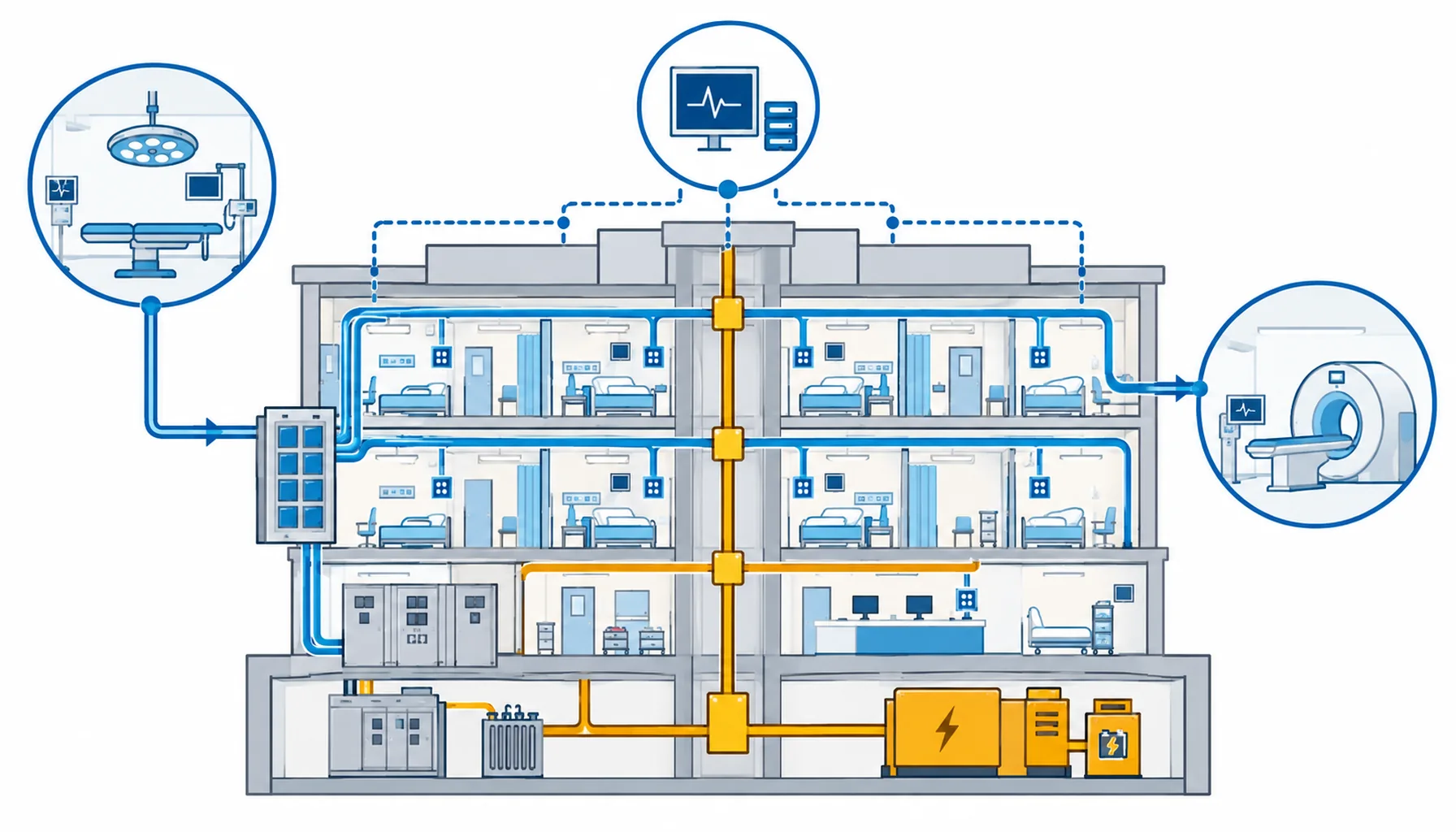
Clinical continuity. The supply has more than one source and a transfer arrangement, and the cable has to be laid out so that a fault, a maintenance operation or a fire in one part of the building does not remove supply from an area that is treating patients. That requirement drives the number of separate distribution routes rather than the size of any one cable.
Patient safety at the socket. In medical locations, circuits supplying equipment attached to a patient sit behind an isolation system with monitored insulation, so that a first fault alarms instead of tripping, and there is no return path through the patient. The cable’s role is to keep the isolated system genuinely separated and to carry the monitoring signals from the panels.
Equipotential bonding. Medical locations require bonding between conductive parts and the protective conductor to a much tighter resistance than a general installation. That is mostly an installation requirement, but the cable selection affects it, because the earth conductor size and the number of separate paths are procurement decisions.
Clinical environments are aggressive. Washdown, disinfectants, humidified air and, in some areas, corrosive or oxygen-enriched atmospheres. The sheath compound and the ingress protection of every termination become part of the specification. Our note on sheath chemistry and fire behaviour covers the trade-offs that apply here as much as anywhere.
Heavy and specialised loads. Imaging equipment draws large, short, harmonic-rich bursts, and the radiology layout changes with each equipment generation. The cable schedule for an imaging suite is usually driven by the equipment supplier’s requirements and by harmonic and screening concerns rather than by a simple current figure.
The Circuit Families and What Each One Needs
| Circuit family | Duty | What to Specify | Evidence to Demand | Cost and Lead-Time Driver | How It Fails |
|---|---|---|---|---|---|
| Theatre and critical care isolated supplies | Patient environment requiring an isolated system with monitored insulation | Separation from the isolated system, conductor sizes from the panel schedule, earth conductor arrangement, sheath for washdown, route inside the essential branch | Medical isolation panel schedule, insulation monitoring compatibility, bonding resistance records, test results per circuit | Modest conductor sizes; the cost is in the number of separate circuits and the cleanliness of the arrangement | A second fault in a patient location, or a monitoring signal that cannot be trusted |
| Imaging and heavy diagnostic feeds | Large short-duration loads with harmonics, plus frequent equipment replacement | Conductor size from the equipment supplier's requirement, harmonic and screening provisions, spare capacity for the next machine, route with the flexibility to re-cable | Equipment supplier's electrical requirements, harmonic assessment, voltage drop at the machine terminals, spare capacity stated | Copper and the redundancy of the route; equipment replacement drives provision more than the load does | A new scanner that cannot be fed without re-cabling a floor, or nuisance tripping from harmonics |
| Ward and clinical small power | Many modest circuits, cleaning and infection control, frequent reconfiguration | Sheath and ingress protection for washdown, circuit numbers and redundancy, socket arrangements per bed position | Construction declaration, dimensional records, circuit test records | Metreage and the number of circuits, not the conductor size | Surface-mounted cable damaged by trolleys and cleaning, or a circuit that cannot be isolated without a ward shutdown |
| Essential and life safety branches | Must run through the incident, for evacuation and for the areas that stay in use | Survival grade and duration per circuit, fire-rated construction and system approval, route inside protected construction | Survival test report, system approval covering terminations and fixings, route drawing with the protected sections marked | The highest grade with the longest duration, plus the approved accessories | Treated as ordinary supply cable, which fails the strategy at the first circuit that had to survive |
| Clinical data, nurse call and monitoring | Signal integrity, screened and frequently fire-rated to keep reporting during an incident | Integrity grade where required, screening and earthing convention, pair counts and spare capacity, separation from power | Integrity test evidence where required, screen continuity records, system compatibility statements | Small conductors; screening and the integrity requirement drive the order | Interference from imaging loads, screen earth loops, or loss of the alarm path during an incident |
Isolation, Bonding and What the Schedule Has to Carry
The medical isolation system is usually bought as a package with the panels, and the cable package has to be written to fit it. Three things belong on the schedule.
The boundary of each isolated system. Which circuits sit inside it, and therefore where the panel, the transformer and the monitoring loop connect. A cable schedule that treats these as ordinary final circuits will not match the panel drawings, and the mismatch surfaces during commissioning.
The monitoring and signalling wiring. The alarm path from each panel back to the monitoring system is a real circuit with its own requirements, and it is frequently omitted from the cable schedule because it is not part of the power design. Our note on the screened instrumentation range covers the constructions normally used for this kind of signal wiring.
The bonding arrangement. Earth conductor sizes, the number of separate paths and the points where they connect are procurement inputs as well as installation ones. Where the requirement is tight, the additional copper is a small cost and it is not worth saving. Our note on insulation resistance testing covers the measurements that verify the arrangement before handover.
Redundancy Without Doubling the Building
Clinical continuity is delivered by separation and redundancy, and both have a cable cost that is worth being deliberate about.
Separate routes, not duplicate cables in one route. Feeding two halves of a building from two sources is worth little if both cables run in the same shaft. The value of the redundancy is in the physical separation of the routes, and that is a design decision the buyer can force into the schedule early. Our note on firestop cable penetrations covers the crossing details that keep separated routes genuinely separated.
Spare capacity. Hospitals change more than most buildings, and a department refit usually adds equipment rather than removing it. Spare capacity in the distribution and in the spare pairs on data circuits is the cheapest flexibility available, and it should be a stated figure rather than an accident. Our note on cable derating factors covers how installed capacity is really determined once grouping and ambient are accounted for.
Maintenance without shutdown. The clinical requirement is often not that nothing fails, but that nothing has to be switched off to work on it. That means enough separate circuits to isolate one at a time, and that count is a procurement decision made on the schedule, not on site.
What to Freeze Before the Order
| Decision | What to State | Evidence to Attach | Cost of Leaving It Open |
|---|---|---|---|
| Circuit family per area | Which family each area belongs to and what that requires | An area schedule mapped to the circuit families | Life safety and clinical circuits bought as ordinary supply |
| Isolated system boundary | Circuits inside each system, with the panel and monitoring connections | The medical isolation panel drawings matched to the cable schedule | A schedule that contradicts the panel design at commissioning |
| Survival grade per circuit | Duration and test conditions for the essential and life safety branches | Survival test report plus the system approval for terminations and fixings | An evacuation strategy with cable that was never rated for it |
| Spare capacity | Spare distribution capacity and spare data pairs per area | The schedule with the spare allowance stated and priced | Re-cabling a department during its next equipment change |
| Equipment interface | The supplier's electrical requirement for imaging and specialist equipment | Written requirements with voltage drop and harmonic provisions | A machine that cannot be commissioned on the supply provided |
| Bonding and earth paths | Earth conductor sizes and the number of separate paths | Bonding schedule with the required resistance and the test plan | A patient environment that cannot be signed off |
Handover Evidence the Hospital Will Ask For
A healthcare project hands over to an estate department that will run the building for decades, and the evidence it wants is wider than a set of circuit test sheets.
As-built circuit schedules. Which circuit serves which room, updated from the design to what was installed. On a hospital this document is used for isolation during maintenance, so an inaccurate schedule becomes a clinical risk rather than an administrative one.
Isolation and monitoring records. Test results for each isolated system, the monitoring loop function, and the alarm path from each panel verified end to end. Our overview of the standards behind building cable requirements covers where those tests come from, and on these circuits the record per system is what the estate team will rely on.
Bonding and earth path records. Resistance measurements at the required points, referenced to the schedule that sets them. This is the item most often incomplete at handover, and it is the one that prevents a clinical area from being signed off.
Fire strategy sign-off. The survival grades actually installed, the routes they run in, and the approval documents for the assemblies. Where a mineral-insulated or similarly robust construction was chosen for the punishing routes, the termination records matter as much as the cable certificate, as our note on mineral insulated cable sets out.
Equipment commissioning evidence. The supplier’s sign-off for the imaging and specialist machines, tied to the feeder that serves them. Without it, a machine that underperforms on harmonic distortion becomes a cable argument that nobody can settle.
Records for the next refit. Spare capacity, spare pairs, spare ways in the boards and the physical space left in each route. Ten years from now that note is the difference between a small alteration and a department shutdown.
When a Cable Specification Is Not the Answer
When the real problem is the number of sources. If a department cannot be maintained without switching off clinical equipment, the answer is more separate circuits and more sources, not a larger cable.
When the fault is interference, not the cable. Nuisance alarms and imaging artefacts are usually a route, screening or earthing problem. Replacing the cable reproduces it. Fix the practice.
When the equipment supplier’s requirement is being second-guessed. Imaging equipment comes with a specific electrical requirement, and substituting an engineering opinion for it is a reliable way to fail a commissioning test that the supplier will not sign off.
When the fire strategy is being met with cable alone. A survival grade assumes a protected route. If the route crosses unprotected space, the answer is the route.
RFQ Checklist
- Area schedule separating clinical, imaging, general, essential and life safety circuits
- Boundary of each medical isolated system, with panel and monitoring connections
- Survival grade and duration for the essential and life safety branches
- Maximum permissible voltage drop at every critical equipment terminal
- Equipment supplier requirements for imaging and specialist machines, in writing
- Harmonic and screening provisions on circuits serving imaging loads
- Bonding arrangement with the required resistance and the test plan
- Spare distribution capacity and spare pairs, stated and priced
- Separation of redundant routes, recorded on the drawings
- Sheath and ingress protection suited to washdown and disinfection
- Tests to be witnessed and the records that ship with each drum
Conclusion
Hospital cable is bought by area and by branch, because the requirements that matter are clinical rather than electrical. Separate the isolated supplies, the imaging feeds, the ward circuits, the life safety branches and the monitoring circuits on the schedule, set the survival grades and the spare capacity deliberately, and make the equipment supplier’s requirements part of the order. Do that and the cable package behaves like any other; skip it and the failures are the ones that do not have a commercial remedy.
Kexingyu Cable Group (KXYE) has manufactured cable in Quanzhou since 1996, supplying the fire-rated, screened, control and building constructions that healthcare projects need, with the test records and terminations their approvals depend on. Send us the area and circuit schedules with the isolation boundaries, the equipment requirements and the survival grades, and we will come back with the constructions, the evidence that applies to each and a delivery plan against your commissioning programme. The fastest route is a request for quotation.