Cable Weather Resistance on Site: Oil, Chemical and UV Requirements
Quick Answer: Cable weather resistance is bought against a written list of exposures, not against a general description of the site. Oil, acid, alkaline washdown chemicals, salt, ozone and ultraviolet light each attack different compounds in different ways, and a cable that resists one may fail against another. Write the list, name the compound that handles each item on it, and ask for the test data rather than a general claim of resistance.
Introduction
Cable that fails outdoors rarely fails because the copper was wrong. It fails because the sheath cracked in sunlight, swelled in hydraulic oil, hardened in the cold, or corroded on an armouring layer that was never meant for the environment it was buried in.
This guide is written for the person raising the requisition. It turns a vague requirement for weather resistance into a list of exposures, the compounds that handle each one, the evidence worth demanding, and the decisions to freeze before the order goes out. How oil resistance is actually demonstrated is covered in our note on cable oil resistance testing.
What the Site Actually Exposes the Cable To
Liquid exposure is continuous, not occasional. A cable in a machine shop sits in hydraulic oil mist and swarf. A cable on a washdown deck is hosed with a caustic cleaner twice a shift. Both are continuous exposures, and both are specified as a fluid rather than as a general environment.
Sunlight is cumulative. Ultraviolet light and the ozone it produces crack elastomer sheaths and embrittle thermoplastics gradually, over years, which is why the material declaration matters more than the colour of the jacket.
Salt and humidity work on the metal layers. On coastal and offshore sites the armouring, the screen and the glands corrode, and the failure usually shows up as a lost earth path rather than as a visible fault. Our note on armoured versus unarmoured cable covers the construction side of that.
Temperature and exposure compound each other. A compound that resists an oil at 20 C may not resist it at 70 C. Any exposure claim is a claim at a temperature, and that temperature belongs in the specification.
Frequency matters as much as chemistry. A splash twice a year and a continuous mist are different duties on the same compound. Write the frequency down, because it is the input that decides whether a resistant compound is worth its cost or whether a local cover and a change of route will do the same job for less money.
Exposure Types and What Handles Them
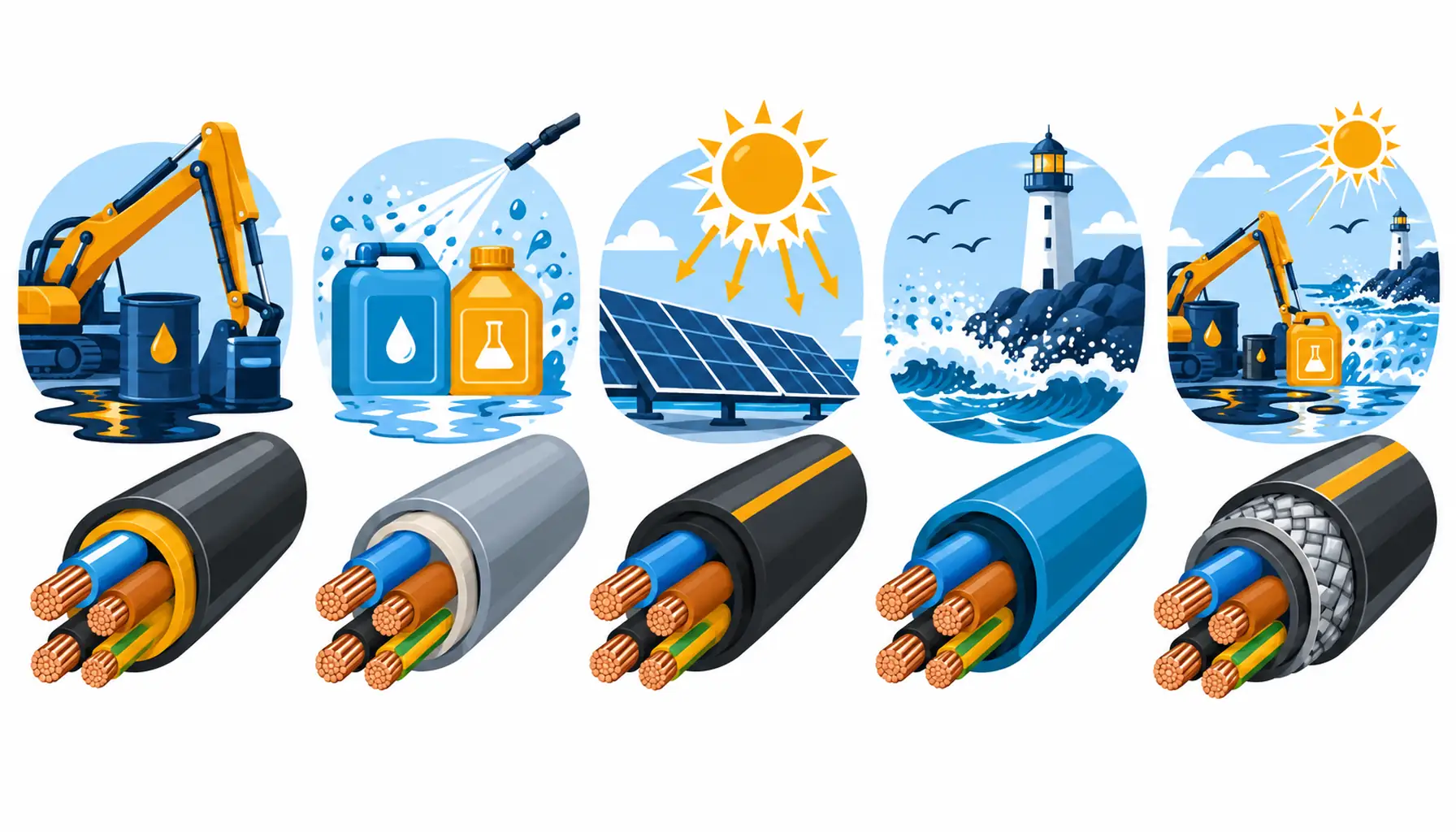
The table below sets out the exposures a site presents, with what to specify, the evidence worth demanding and how each choice fails when it is bought on a general claim.
| Exposure | Typical site | What to Specify | Evidence to Demand | Cost and Lead-Time Driver | How It Fails |
|---|---|---|---|---|---|
| Oil, fuel and hydraulic fluid | Machine shops, press lines, plant maintenance bays, vehicle workshops | Compound type, the specific fluid, the temperature of contact, continuous or intermittent exposure | Immersion or contact test data against the named fluid at the stated temperature | Oil-resistant compounds cost more and extrude slower than PVC | Sheath swelling that loses the gland seal, then water ingress through it |
| Acid, alkali and washdown chemicals | Food and beverage plants, chemical stores, effluent areas, clean-down decks | The chemicals and their concentration, washdown pressure and temperature, frequency | Chemical exposure data for the compound, at the concentration and temperature used | Halogen-free and chemical-resistant compounds carry a premium | Surface cracking, then insulation damage at a bracket or gland |
| Sunlight, ultraviolet and ozone | Outdoor pipe racks, roofs, stockyards, exposed site routes | UV stabilisation required, expected service life, whether the route is shaded or fully exposed | UV ageing data and the material declaration, not a colour description | Stabilised black compounds cost slightly more than unstabilised colours | Surface embrittlement and cracking on an exposed route within a few years |
| Salt, coastal and condensation | Ports, coastal plants, offshore support, cold stores with condensation | Corrosion protection on armour and screens, gland material, water-blocking where condensation collects | Corrosion test results, water-blocking data, gland material declaration | Marine-grade metal layers and glands add cost and lead time | A lost earth path through a corroded armour, faults at glands in wet low points |
| Combined exposure | Washdown decks beside the sea, oily outdoor machinery, hot chemical areas | Every exposure on the route, with the temperature, and the compound that handles the combination | Test data for the compound against each exposure, with the highest temperature stated | The compound that handles the combination is usually the most expensive on the list | A compound chosen for its best property that fails on the second exposure |
How Resistance Is Demonstrated
Exposure data, not adjectives. A general claim of oil resistance is worth nothing at the specification stage. What is worth something is a test result naming the fluid, the concentration, the temperature and the duration, on the compound supplied. Ask for it with the quotation, because asking later means comparing a delivery against a claim.
Ageing tests tell you about the years. Ultraviolet and ozone resistance are demonstrated by accelerated ageing, and the useful part of the report is the retention of properties rather than the fact that the test was run. A compound that survives the exposure and loses half its tensile strength has survived the test and failed the duty.
Mechanical resistance and chemical resistance pull against each other. Soft compounds tolerate heat and chemicals better and abrade faster. Hard compounds abrade well and crack in sunlight. Where a route has both an abrasion duty and a chemical exposure, the sheath is a compromise and the compromise belongs in the specification. Our note on abrasion-resistant cable jackets covers the mechanical half, and our note on cable sheath materials compared covers the families side by side.
Glands and accessories are exposed too. The sheath stops where the gland starts, and a plastic gland in a caustic washdown area is the point that fails first. Where exposure is real, the gland material belongs in the same specification as the cable.
Two exposures at once need a compromise that is written down. A washdown deck beside the sea combines a caustic cleaner, salt and ultraviolet light, and no single compound is best at all three. Name the exposure that governs and accept the weaker performance on the others consciously, rather than discovering later which one the compound was actually chosen for.
What to Freeze Before the Order Goes Out
These six items are cheap at specification stage and expensive once drums are on a truck.
| Decision | What to State | Evidence to Attach | Cost of Leaving It Open |
|---|---|---|---|
| Exposure list per route | Every fluid, chemical, salt and UV exposure the route presents | A route schedule with the exposures and the frequency marked | A compound chosen for one exposure that fails on the second |
| Temperature of contact | The temperature at which each exposure occurs, not the ambient average | Exposure data at the stated temperature, not at room temperature | A claim that holds on the datasheet and not in service |
| Expected service life | How many years the cable must last exposed, and whether it is replaceable | Ageing data with property retention figures | A route that cannot be reached for replacement without a shutdown |
| Armour and metal layers | Corrosion protection required on armour, screens and fixings | Corrosion test data and the material declaration | A lost earth path through a corroded armour in a coastal plant |
| Gland and accessory material | The gland, cleat and fixing materials, matched to the exposure | A compatibility list for the accessories supplied | A failed gland seal that lets water into the cable |
| Evidence and records | The exposure, ageing and corrosion tests required, with records per drum | A written test plan with acceptance criteria | A claim that cannot be defended two years into service |
Constructions and What They Cost
Where a route carries a real exposure list, the answer is usually a construction rather than a jacket grade. Our medium voltage XLPE armoured cable for oil-exposed routes and the lead-sheathed armoured thermocouple cable are supplied with the compound, the armour and the metal barrier matched to the duty, which keeps the exposure evidence and the delivered cable aligned.
Stock cable is generally PVC or standard PE, cheap and fine for sheltered routes. Made-to-order oil, chemical or weather resistant constructions run on the compound, the metal layers and the drum lengths. Certified and marine-grade constructions are the longest line, because the corrosion protection and the exposure evidence are part of the product rather than an add-on. Copper remains the largest single component, so the usual questions apply: how the copper element is calculated and how long the price holds.
The cost comparison that matters is per metre of protected route rather than per metre of cable. Where a washdown zone covers thirty metres of a two hundred metre run, buying one exposure-resistant construction for the whole length costs more than specifying the resistant cable only where the exposure is and jointing at the boundary, provided the joint itself is protected. Put the zone lengths against the price difference before the order is placed.
Incoming Inspection and Site Verification
Against the drum. Count drums against the packing list, verify marked lengths and photograph the drum markings before anything is cut, so the delivery can be linked to the compound declaration and the exposure test reports.
Physical and dimensional checks. Measure overall diameter and sheath thickness on a sample and compare with the construction sheet. A thinner sheath shortens the abrasion life and changes the seal at the gland, and it is the easiest economy for a factory to make without changing the appearance of the cable.
Material evidence. Match the compound declaration and the exposure and ageing test reports to the construction delivered. Where the cable is going into a regulated or coastal plant, confirm the report names the drum construction rather than a product family, and check the sheath marking against the schedule.
After installation. Record the insulation resistance of each circuit at commissioning and keep the figures, because they become the baseline for every later condition check. On an exposed route, note the date and the ambient at which the cable was installed; a wet or cold installation distorts the first set of readings and makes a later comparison misleading. Our note on in service cable testing covers how the results are used after that.
When a Resistant Compound Is Not the Answer
When the exposure is at one point on the route. A single drip point or a single washdown zone can be solved with a sleeve, a cover or a local change of route, which costs less than buying a chemical-resistant cable for the whole run.
When the route should not be there. Cable run through a washdown deck or under a leaking flange is a routing problem. Weather resistance is not a substitute for moving the route out of the discharge.
When the damage is mechanical. Cracking from abrasion at a bracket is not chemical attack, and a softer, more chemically resistant compound makes it worse. Identify the mechanism before choosing the compound.
When the specification already names the compound. Where the client’s standard names a sheath type and an accessory range, the competition moves to delivery, evidence and price rather than material selection. Our weather-resistant welding cable is a typical example of a construction where the duty, the compound and the flex rating are fixed together.
RFQ Checklist
- Exposure list per route: oils, fuels, acids, alkalis, washdown chemicals, salt and UV
- Concentration and temperature for each chemical exposure, and whether contact is continuous
- Expected service life on each exposed route, and whether the route is replaceable
- Sheath compound specified per exposure, with the material declaration required
- Corrosion protection on armour, screens and fixings for coastal or offshore routes
- UV stabilisation required and the ageing data to support it
- Gland, cleat and accessory materials matched to the exposure
- Minimum and maximum service temperatures, including handling during installation
- Exposure, ageing and corrosion tests required, with records per drum
- Construction identification on the certificate, and the copper basis with its validity window
Conclusion
Weather resistance is a list, and the list is what belongs in the RFQ. Name the fluids, the concentrations, the temperatures and the years the cable has to last, put each against the compound that handles it, and buy the glands and fixings out of the same materials. A cable bought on a general claim of resistance is a cable that will be judged by the one exposure nobody wrote down.
Kexingyu Cable Group (KXYE) has manufactured cable in Quanzhou since 1996, supplying oil-resistant, chemical-resistant and weather-resistant constructions with exposure test data, material declarations and corrosion protection that travel with the drums. Send us the exposure list with the routes, the temperatures and the service life required, and we will come back with the constructions, the evidence that applies to each and a delivery plan against your programme. A request for quotation is the fastest route.