Cable Temperature Rating: Turning Site Extremes into a Specification
Quick Answer: A cable temperature rating is three numbers, and a site normally needs all three: the ambient the cable sits in, the conductor temperature the insulation tolerates, and the temperature at which the cable can be handled and bent during installation. Sites that state only one, usually the conductor class, buy cable that either derates below the load or cannot be installed in winter. Write all three into the RFQ and the choice of construction usually becomes obvious.
Introduction
Temperature is the variable that links the electrical design to the physical product. It sets the ampacity of the circuit, it decides which insulation compounds are usable, and it decides whether the cable can be pulled into place on the day it arrives.
This guide is written for the person raising the requisition. It separates the three temperatures that matter, shows how each one lands in a specification, covers derating and cold handling, and lists the evidence to demand and the decisions to freeze. The wider derating calculation is covered in our note on cable derating factors.
The Three Temperatures That Matter
Ambient temperature. The air or ground temperature the cable sits in while it carries current, which is rarely the weather forecast. A roof void, a boiler house, a cable tray above a furnace and a duct in the sun all run far above the design ambient, and the figure that matters is the one at the cable, not the one on the site plan.
Conductor temperature. The temperature the insulation tolerates continuously while the cable carries its rated current. This is the number people quote as the rating: 70 C for standard PVC, 90 C for XLPE and EPR, higher for silicone and for special constructions.
Handling and installation temperature. The lowest temperature at which the cable can be bent and pulled without damage. It has nothing to do with the electrical rating and it is the number that catches sites out, because most cold damage happens on the day of installation rather than in service.
A fourth figure sits behind all three: the short-time overload or fault temperature the insulation tolerates briefly, which is what the protective device coordination assumes. Where the circuit has a high fault level, that number is part of the design and should be confirmed rather than assumed.
Temperature Bands and What Serves Them
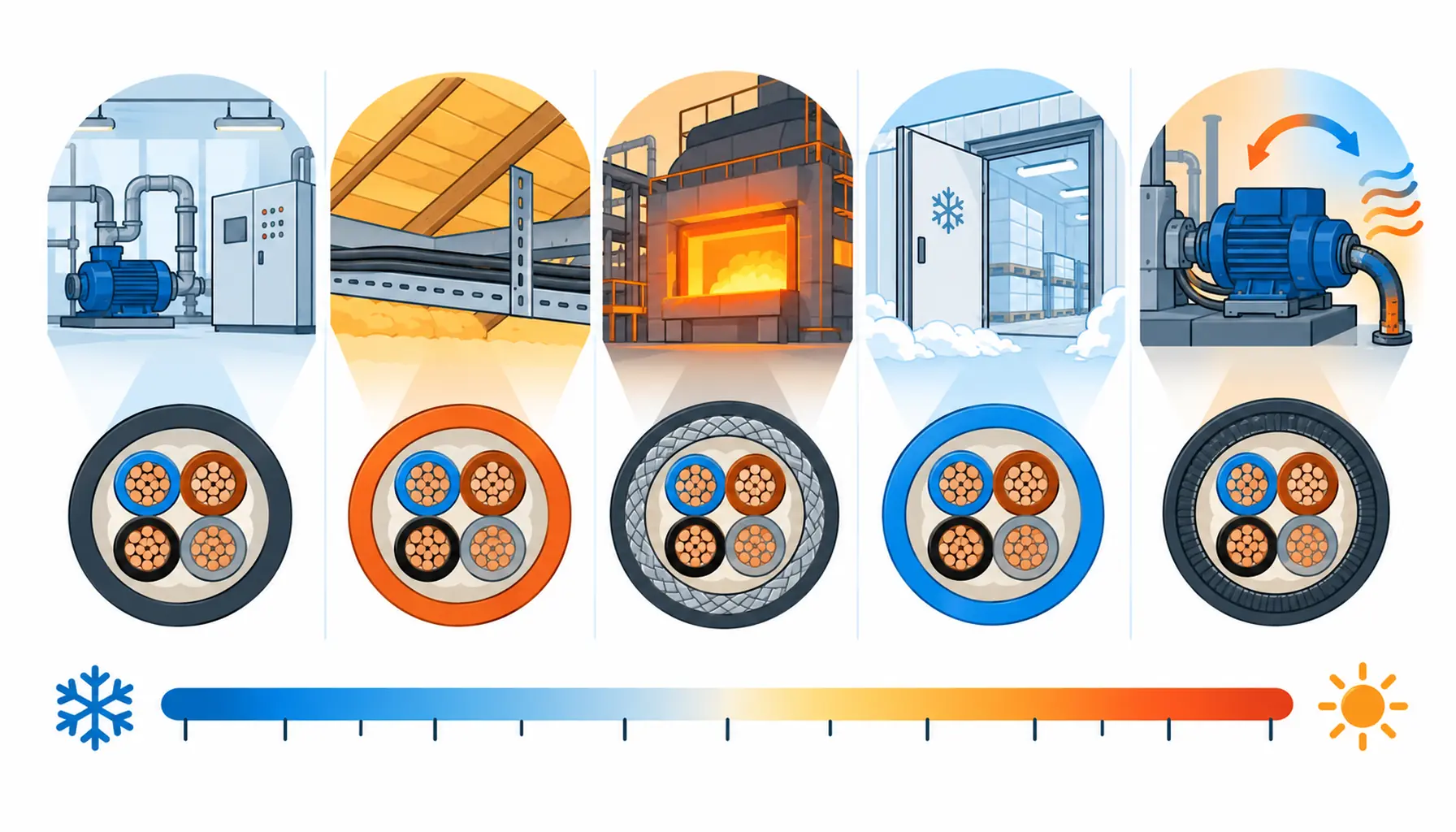
The table below sets out the bands a site presents, the constructions that serve them, the evidence worth demanding and how each choice fails when only one temperature was specified.
| Temperature duty | Typical site | What to Specify | Evidence to Demand | Cost and Lead-Time Driver | How It Fails |
|---|---|---|---|---|---|
| Normal ambient, standard rating | Plant rooms, offices, dry indoor distribution | Ambient at the cable, conductor class required, installation method and grouping | Ampacity basis and the derating calculation, insulation resistance results | Standard PVC or XLPE, usually ex stock and the cheapest band | A circuit that trips on overload because the ambient at the tray was never stated |
| High ambient, elevated conductor class | Boiler houses, roof voids, furnace areas, hot process lines | The measured ambient at the tray, the derating applied, the temperature class of the insulation | Ampacity tables with the ambient correction, insulation temperature class, ageing data | Higher class compounds and possibly a larger cross-section | Insulation ageing accelerated at the hot end, failure within a few years |
| Continuous high conductor temperature | Furnaces, kilns, glass and metal process areas, engine exhaust routes | Continuous and short-time temperature, radiant heat exposure, screening or metallic barrier | Ageing tests at the declared temperature, dielectric results, radiant heat data where relevant | Silicone and specialist constructions cost several times a standard compound | A standard construction embrittling from radiant heat rather than from current |
| Low ambient and cold handling | Cold stores, outdoor winter installation, high-altitude and northern sites | Lowest handling temperature, lowest service temperature, flex duty at that temperature | Cold bend results and flex data at the low temperature, not at room temperature | Rubber-based and PUR compounds cost more than PVC | Sheath shattered during a winter pull, or a fixed cable cracked on first movement |
| Thermal cycling and movement | Machinery, reels, vibrating plant, cyclic process lines | Cycling range and rate, movement at each end, bend radius in service | Thermal cycling and flex results at the declared range and radius | Flexible compounds and factory-fitted ends add cost and days | Core break behind a gland after a few thousand cycles |
Derating and Cold Start
Derating is where ambient turns into cross-section. Above the reference ambient the cable carries less current for the same copper, and the correction applies to the whole order rather than to one circuit. A tray in a hot roof void can justify a larger cross-section on every feeder in it. Ask for the derated current, not only the rating at the reference ambient, and check that the grouped and enclosed conditions were included.
Radiant heat is different from ambient. A cable near a hot surface is heated by radiation, and the temperature at the cable can be far above the air temperature around it. Where the route passes close to a process line, the ambient figure understates the duty, and a metallic barrier or a change of route is often cheaper than the compound that tolerates it.
Cold is an installation problem before it is a service problem. Most low-temperature jacket and insulation damage happens during bending and pulling. Specify the lowest temperature at which the cable may be installed, and if the programme will not move, plan for it: store the drums warm, pull in the warmest part of the day, and never bend a cold cable to its minimum radius. Our note on low-temperature flexible cable covers how that limit is declared, and our note on cold flex testing covers how it is demonstrated.
The low-temperature limit and the flex duty interact. A cable rated to minus 40 C while static may only tolerate a much smaller bend at that temperature, and a cable that flexes must be tested at the low temperature rather than at room temperature.
Thermal cycling is a different duty from steady heat. A cable that heats and cools every shift moves in its cleats and works at its terminations, and the damage shows up as a loose joint or a broken core rather than as an overheated conductor. Where the cycle is short and frequent, the flex and termination duty belongs in the specification alongside the temperature band.
What to Freeze Before the Order Goes Out
These six items are cheap at specification stage and expensive once drums are on a truck.
| Decision | What to State | Evidence to Attach | Cost of Leaving It Open |
|---|---|---|---|
| Ambient at the cable | The measured or calculated ambient at each tray, duct or enclosure, not the site average | A derating calculation showing the ambient used and the margin | Overload trips and a premature replacement on the hottest run |
| Conductor temperature class | The continuous class required, and whether the additional ampacity is actually used | Ampacity tables with the corrections applied | Paying for a class that changes nothing, or needing one that was not bought |
| Radiant and conducted heat | Any nearby hot surface or pipe, and the route distance from it | A route drawing showing the hot sources and the clearances | Insulation ageing at one point on the run |
| Lowest handling temperature | The lowest temperature at which the cable may be bent or pulled on this programme | Cold bend data at that temperature for the compound supplied | A winter installation that damages the cable before it is energised |
| Flex and cycling duty | Where the cable moves or cycles, with the range, rate and radius | Cycling and flex results at the declared range and temperature | Core break behind a gland and repeat termination repairs |
| Test and records | Ageing, cold bend and insulation resistance tests required, with records per drum | A test plan with acceptance criteria and dates | A delivery accepted on a room-temperature sample |
Constructions and What They Cost
Where a route has a temperature duty at both ends, buying a construction rather than a compound is usually the safer route. Our shielded silicone multicore cable and the silicone rubber high-temperature control cable cover the hot end with the screen arrangement and core count already fixed, while the cold-resistant PE jacketed cable covers the low ambient side with the same discipline.
Stock cable is standard PVC and XLPE, which covers the normal band and most of the volume. Made-to-order constructions run on the compound, the core count and the temperature class, and they take longer because silicone and rubber compounds cure slower than thermoplastics. Certified high-temperature constructions are the longest line. Copper remains the largest single component, so the usual questions apply: how the copper element is calculated and how long the price holds.
Incoming Inspection and What to Record
Against the drum. Count drums against the packing list, verify marked lengths and photograph the drum markings before anything is cut, so the delivery links back to the construction certificate and the temperature class quoted.
Dimensional and electrical checks. Measure overall diameter and sheath thickness on a sample against the construction sheet, then run conductor resistance and insulation resistance on the finished lengths. On a hot-route cable, confirm the insulation class marking on the drum matches the class the derating calculation was based on.
Temperature evidence. Match the ageing and cold bend reports to the construction delivered, and check that the low-temperature figure was measured on the same compound and at the temperature the installation plan assumes rather than at room temperature.
Record the installation conditions. On a route with a cold or hot exposure, note the ambient and the date at installation with the commissioning results. Those notes explain the first set of readings and become the baseline for later comparisons, which is the difference between replacing a cable on evidence and replacing it on suspicion.
When a Higher Temperature Class Is Not the Answer
When the extra ampacity is not used. A higher class only saves money where the circuit actually needs the additional current or where it avoids a larger cross-section. On a lightly loaded feeder it is a premium paid for margin nobody consumes.
When the heat is radiant. Where a cable is close to a hot surface, a metallic barrier or a change of route solves it more cheaply than a compound that tolerates the temperature. Buying the compound leaves the heat source in place.
When the problem is one point on the run. A single hot spot is a routing or shielding question. Buying a high-temperature construction for the whole run because of one flange is the expensive version of the same fix.
When the cold limit is an installation scheduling problem. Where the programme is flexible, storing drums warm and pulling in the warm part of the day costs less than upgrading the compound for the whole order. The limit still has to be stated, because the decision only exists if the number is known.
RFQ Checklist
- Ambient temperature at each tray, duct and enclosure, with the basis of the figure
- Maximum ambient where cables are grouped or enclosed, and the derating applied
- Conductor temperature class required, and whether the additional ampacity is used
- Short-time and fault temperature assumed by the protection design
- Radiant or conducted heat sources near the route, with the clearances
- Lowest handling and installation temperature permitted on the programme
- Lowest service temperature, and whether the cable flexes at that temperature
- Cycling range, rate and radius where the cable moves or cycles
- Ageing, cold bend and insulation resistance tests required, with records per drum
- Construction identification on the certificate, and the copper basis with its validity window
Conclusion
Temperature is three numbers, and the buying job is to state all three and then check that the construction answers each of them. Get the ambient into the derating calculation, put the conductor class against the load it will actually carry, and write the handling limit into the installation plan. The cable that fails on a hot tray and the cable that shatters on a cold morning are usually the same purchase, made with one number instead of three.
Kexingyu Cable Group (KXYE) has manufactured cable in Quanzhou since 1996, supplying PVC, XLPE, rubber and silicone constructions for high ambient, low ambient and cycling duty, with ageing and cold bend data that travels with the drums. Send us the route schedule with the ambients, the heat sources, the load and the installation window, and we will come back with the constructions, the evidence that applies to each and a delivery plan against your programme. A request for quotation is the fastest route.