Copper Basis and Price Locking: How Cable Quotes Actually Move
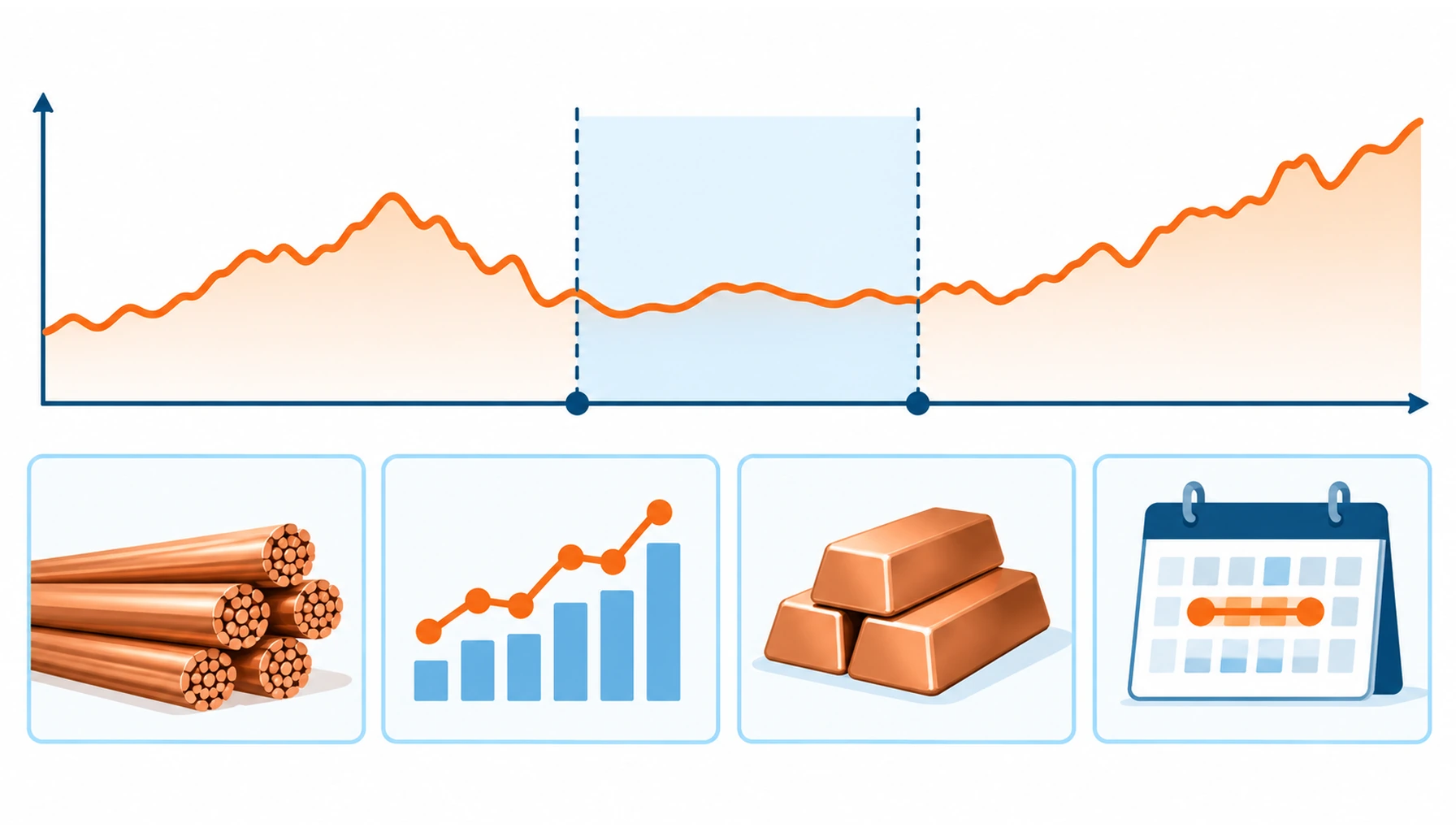
Quick Answer: A cable price lock is an agreement about which copper price your order will settle against and how long that agreement holds. Cable is priced from a metal position, so a quotation with no stated basis and no stated window is not a price at all. It is a snapshot, and it will be revised the moment the metal moves.
Introduction
Buyers compare unit prices. Suppliers compare metal positions. Those two views meet in a document that usually says little more than a number and a date, and the gap between them is where most cable orders lose money without anyone being able to point at the cause.
This page is for procurement engineers and project buyers who have to place industrial cable orders against a budget. It sets out why copper dominates the number, what a basis actually consists of, the routes a supplier can take, how a locking window behaves through a real order, and the six decisions to freeze before you commit. The demand picture behind the metal is covered in our note on copper demand, and the general mechanism is set out in our note on copper price and cable procurement.
Why Copper Dominates a Cable Price
It is the largest material cost by a wide margin. In a copper power cable, the conductor accounts for the majority of the material value even though it is not the majority of the volume. Insulation, screen, armour, bedding and sheath together cost far less per metre, so when the metal moves, the whole cable price moves with it.
A small percentage on copper is a large number on an order. A five per cent move in the copper price on a multi-kilometre purchase is not a rounding error, it is a visible line in the project budget. That is why the basis matters more on cable than on almost any other electrical item you buy.
The metal is bought before the cable is made. A factory buys conductor against its order book, not against your delivery date. By the time your drums are extruded and tested, the copper behind them was purchased weeks earlier at whatever the market was then. Understanding that sequence explains why suppliers price as they do. What is inside the conductor is covered in our note on conductor copper purity.
What a Copper Basis Actually Is
A basis is a set of definitions, not a single number. Six of them have to be pinned down before a quoted figure can be checked, and each is a place where two buyers can think they agree and do not.
The reference source and the grade. A basis names where the price comes from and what metal it describes. Depending on the market that could be an exchange settlement, a published grade A cathode assessment, or a domestic spot quotation for the same metal in the supplier’s currency. The supplier’s own purchase price is sometimes used, and then it has to be evidenced rather than asserted.
The date or averaging window. A single day’s price, the average of a stated month, or the average across the whole supply period will all give different numbers on the same order. Generic wording such as at the prevailing market price means whoever settles the invoice picks the date.
The conversion from metal to metres. A price per tonne has to become a price per metre, and that requires a stated conductor cross-section, a stated density and a stated rule for whether the theoretical or the measured weight is used. This is the quietest variable in the whole exercise, and on a large order it can be worth more than the metal movement itself. What sits behind the number from the factory side is covered in our note on cable price breakdown.
Pricing Routes Compared
The table sets out the routes a supplier can take when quoting cable with a metal element: what each one fixes, what to specify, the evidence to demand, what drives cost and time, and how each fails when it is used carelessly.
| Route | What it fixes | What to Specify | Evidence to Demand | Cost and Lead-Time Driver | How It Fails |
|---|---|---|---|---|---|
| Firm price for a stated period | One number that holds until a date, with the supplier carrying the metal risk | The exact expiry date and time, and what happens if the order slips past it | A written validity clause, dated and signed | The longer the window, the more the supplier has to price for risk | An expiry that falls before your approval process finishes, forcing a re-quote |
| Formula against a published index | The relationship between the index and your price, rather than the price itself | The index, the grade, the currency, the averaging period and the day the claim is taken | The index source and the calculation method in the order documents | Administration on both sides, plus settlement work at invoicing | An index that is not published daily, or a claim date that is ambiguous |
| Metal locked, conversion floating | The metal element, while the conversion and handling element stays revisable | Which element is locked, for how long, and the permitted adjustment to the rest | The metal purchase evidence and the stated conversion element | Requires the buyer to act on the metal at the right moment | A lock that is never called, so the position falls back to the market |
| Buyer's option to call the metal | Your right to fix the metal at a moment of your choosing inside a window | The window, the notice period and the mechanism for the call | A written option agreement with the call procedure | Usually carries a fee, and needs internal discipline to use | An option that nobody exercised, which becomes an expensive formality |
| Open until order placement | Nothing. The price is whatever the market is when the order is confirmed | The basis on which it will be re-priced, at minimum | The re-pricing rule, agreed in advance | No risk premium, and no predictability either | A budget approved on a number that no longer exists by the time of signature |
How the Locking Window Works
The window is the part of the price that is actually a promise. A quotation is a claim about the future, and the window states how far into the future the supplier is prepared to stand behind it. Everything outside the window is a re-quote, whether or not the document says so.
Short windows are not a negotiating position, they are a cost statement. A supplier who holds a price for seven days has taken on almost no metal risk and can quote closer to the current market. One who holds for ninety days has either hedged the position or built a buffer into the number, and both show up in your price. Neither is dishonest, and the shorter one is not automatically better value.
The window should be matched to your own decision time. The right question is not how long the longest quote holds. It is how many days pass between the quote arriving and a purchase order being capable of being issued, including technical approval, budget sign-off and any client review. If that is forty-five days and the quote holds thirty, you have bought an argument.
Working It Through on a Real Order
Start with the conductor mass, not the cable price. Take a four-core 185 mm2 copper construction over four kilometres. The copper content per kilometre is a fixed figure derived from the cross-section and the number of cores, and it does not change when the market moves.
Then apply the movement, not the level. If the metal reference for the month of the claim sits a few per cent above the reference used in the quote, the effect on the order is that percentage applied to the copper element alone, not to the finished cable price. Converting it that way gives a defensible number in a review meeting, and it takes about ten minutes with the conductor mass and the two reference figures.
Finally, price the risk you are asking the supplier to carry. A thirty-day firm price and a formula price settled on your delivery month will not produce the same number, and the difference is the cost of transferring risk. On a schedule where the metal can move either way, the formula route leaves the risk where it belongs, with the party who set the programme.
What to Freeze Before the Order Goes Out
Six decisions decide whether the metal clause settles cleanly or becomes a dispute at invoice. Each belongs in the purchase order, not in a later email.
| Decision | What to State | Evidence to Attach | Cost of Leaving It Open |
|---|---|---|---|
| Reference source and grade | The publication, the metal grade and the currency the basis is expressed in | The stated source, with a worked example of one calculation | A dispute at invoice about which number applied |
| Averaging window or claim date | The month, the day, or the rule that fixes the reference figure | The rule written into the order, not the quotation | Whoever raises the invoice chooses the most favourable date |
| Weight and conversion basis | The conductor cross-section, the density and whether theoretical or measured weight applies | The calculation method with one line shown in full | A quiet difference that outweighs the metal movement it was meant to track |
| Locking mechanism and window | Whether the metal is fixed, floating or optional, and the notice period for a call | A written clause with the window dates stated | A lock that expires unused and a price that reverts to market |
| Adjustment threshold | The movement below which no adjustment is made, and how it is measured | The threshold clause and the rounding rule | Invoicing adjustments for movements too small to be worth administering |
| Evidence and settlement | What the supplier must produce to claim an adjustment, and when it is paid | A purchase record or index extract per claim | Adjustments claimed without support, settled on trust |
Cost and Lead Time
Two costs are being confused when buyers argue about a lock. The first is the metal, which is largely outside anyone’s control. The second is the cost of the risk transfer, which is entirely a commercial choice. A supplier quoting a long firm window has to fund that promise, and a buyer who wants the promise without the cost is asking for something that does not exist.
Lead time adds exposure that the window should cover. If the delivery date sits well beyond the quote validity, the window is too short for the programme regardless of how attractive the number looks. Where the schedule is long, the practical answer is a formula tied to a period near delivery, plus an agreed conversion element that does not move. Our note on MOQ and lead time covers how production scheduling interacts with this.
When a Copper Lock Is Not the Answer
When the order is small. The administration of a formula, a claim and a settlement can cost more than the metal movement on a few hundred metres. Take a firm price over a short window and move on.
When the programme is long and the dates are soft. A lock assumes you know when you will commit. If the site programme is genuinely uncertain, an option window or a formula tied to delivery is a better fit than a firm number you may not be able to use.
When the conductor should not be copper at all. On some circuits the honest engineering answer is a different conductor, and no pricing mechanism fixes a specification that was wrong at the start. Our note on aluminium versus copper sets out where each belongs.
When the quote already covers your decision date. If the validity comfortably exceeds the time your approval takes, the mechanism is doing its job and more negotiation adds cost rather than value. The comparison method is set out in our note on comparing cable quotes.
RFQ Checklist
- The copper reference source and the metal grade it describes
- The currency of the basis, and the currency the order will be settled in
- The averaging window or the claim date, stated as a rule rather than a phrase
- The conductor cross-section and density used to convert metal price into price per metre
- Whether theoretical or measured conductor weight applies to the conversion
- The lock mechanism, whether fixed, floating or optional, and the window dates
- The notice period required to exercise an option, and who may exercise it
- The adjustment threshold below which no invoicing change is made
- The evidence required with an adjustment claim, and the payment timing
- What happens to the price if the order is placed after the validity date
- The conversion element, and confirmation that it does not move with the metal
- A worked example in the order documents showing one full calculation
Conclusion
A cable price lock is not a discount and not a guarantee. It is a written statement of which copper price applies, when it is sampled and how long the figure stands. Buyers who get this right stop discovering, at invoicing, that the number they budgeted against was never fixed in the first place.
Kexingyu Cable Group (KXYE) has manufactured cable in Quanzhou since 1996 and prices against a published domestic spot copper reference in the buyer’s chosen currency, with the basis, the window and the calculation shown on the quotation. Send us the schedule and the purchase volumes, and we will set out the pricing route that fits them. A request for quotation is the fastest route, and our cable and wire range shows the constructions involved.