Cable Sample Approval and Third-Party Testing: A Sequence That Works
Quick Answer: Sample approval and third-party testing fail when they are run in the wrong order. The drawing has to be approved before the sample is made, the sample has to be tested before production starts, and the approved sample has to be retained in a state that still means something a year later. Anything else produces paperwork that cannot be used when it is needed.
Introduction
Every cable order that fails on approval fails in a predictable way. The sample arrives before the drawing is settled, the test report covers a construction that then changed, and by the time the drums are on site nobody can say whether what was approved is what was delivered.
This page is for buyers and quality engineers setting up an approval route for industrial cable. It covers why the sample stage exists, the sequence that works, the testing routes available and what each one actually proves, how to keep an approved sample valid, the records that survive an audit, and the six decisions to freeze before the order is placed. The arrangements on the factory side are described in our note on cable sample approval, and the inspection alternative is set out in our note on third-party cable inspection.
Why the Sample Stage Exists
It converts a description into a physical reference. A specification says the cable has a class 5 conductor in an LSZH sheath with a stated temperature rating. A sample says what that looks like, how flexible it feels and how the layers are actually arranged. When two parties disagree later, the sample is the thing they both point at.
It is the last cheap moment to find a mismatch. A problem found at the sample stage costs a length of cable and a week. The same problem found after four kilometres have been extruded costs the run, the freight and the programme.
It is often a contractual gate rather than a technical need. On many projects the client, the consultant or the insurer requires documented sample approval before goods may be delivered. In that case the sequence has to be built around the approval, not the other way round.
The Sequence That Actually Works
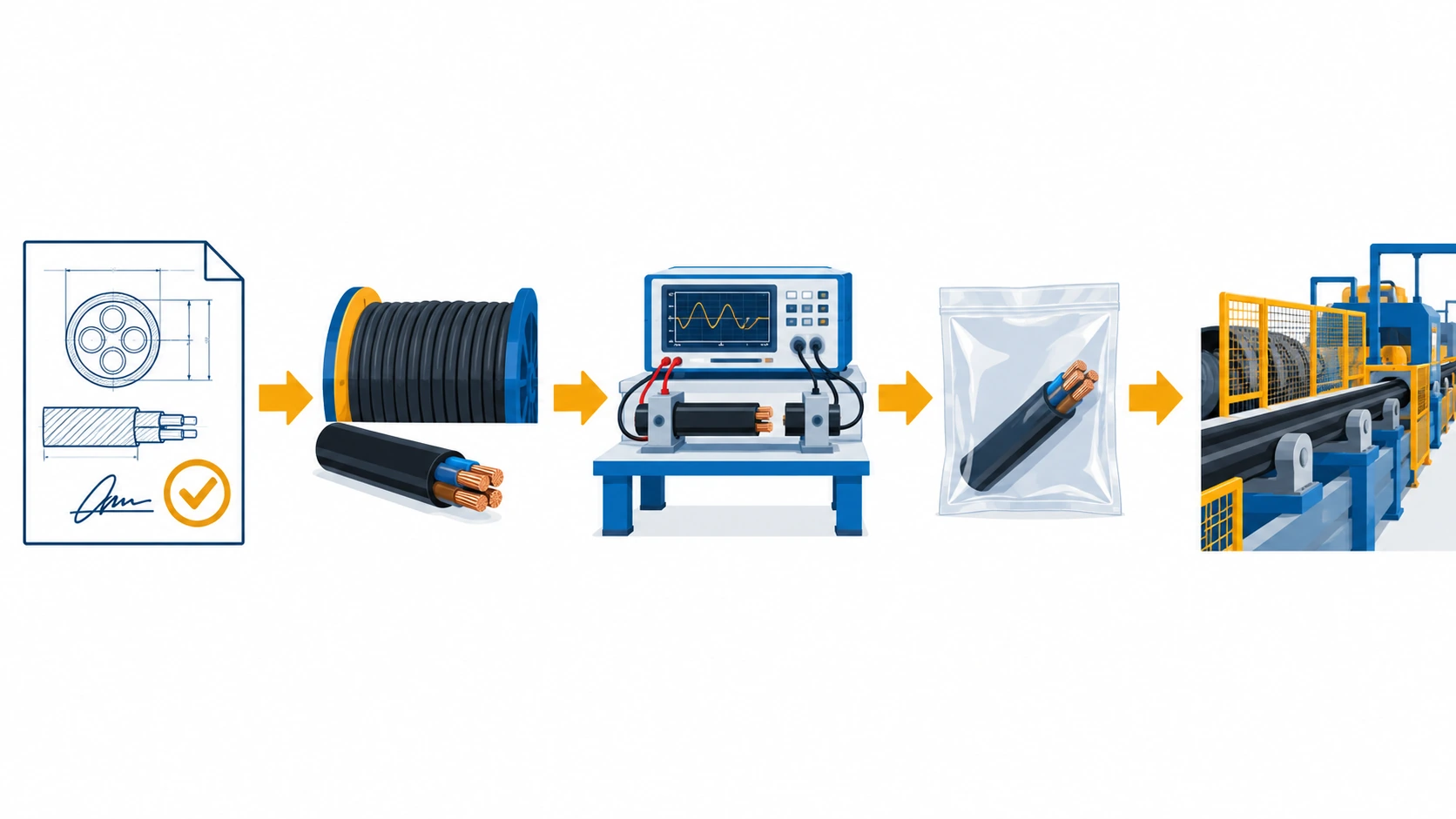
Approve the drawing first. The construction drawing fixes the conductor, the insulation and sheath compounds, the screen, the armour, the dimensions and the standard. Approving a drawing is quick and cheap. Making a sample against an unapproved drawing wastes both.
Then make the sample from production material. A sample made on a laboratory line proves nothing about the plant that will make the order. The useful sample comes off the same machines with the same compound batch, and it should be long enough to allow the tests you intend to run.
Then test, and only then release production. The test results and the approved sample together form the frozen reference. Release to production before this point means the order is running against a description rather than against evidence.
Then retain the sample properly. A sample kept in a cupboard without a label proves nothing. It should be sealed, tagged with the order number, the construction revision and the date, and stored under conditions that will not change it. Retention is the step that is most often skipped and the one that matters most a year later.
Testing Routes Compared
The table sets out the routes available for demonstrating that a cable is what was ordered: what each one proves, what to specify, the evidence to demand, what drives cost and time, and how each one misleads.
| Route | What it proves | What to Specify | Evidence to Demand | Cost and Lead-Time Driver | How It Misleads |
|---|---|---|---|---|---|
| Supplier's own tests | That the factory can measure and test the construction it is making | The tests to be performed, the criteria and the record format | A test sheet with readings, dates and the drum or sample references | Fast and inexpensive, because it uses the plant's own routine | A result that was never independently checked, on a sample chosen by the supplier |
| Independent type testing | That the construction as designed meets the fire, smoke or mechanical requirement | The standard, the test clauses, the sample size and the acceptance figures | A report from an accredited laboratory naming the construction and the standard | Sample preparation, laboratory time and a queue for the test rig | A report for a similar construction read as covering yours |
| Witnessed production sample | That the plant can reproduce the approved construction on the actual line | The line, the compound batch, the sample length and the tests to be run | A witnessed record with the sample identified and sealed | Requires the run to be scheduled and the witness to attend | A sample run on a different line or batch from the eventual order |
| Independent inspection | That a defined scope was inspected by someone not employed by the seller | The scope, the standard, the sampling plan and the reporting format | A signed inspection report with findings and photographs | Inspector time, travel and a report issued after the visit | A scope so narrow that a clean report says almost nothing |
| Certificate review only | That a valid certificate exists somewhere in the supplier's files | The certificate, the scope, the standard edition and the manufacturing address | The scope page, checked against the construction and the site | An office exercise with no effect on the schedule | A genuine certificate whose scope excludes the item being bought |
Keeping the Sample Valid
Record the revision, not just the date. A sample is only meaningful against the exact revision of the drawing it was made to. Any later change to the compound, the screen or the dimensions creates a new construction, and the old sample stops being the reference even though it is still on the shelf.
Store it so it stays comparable. Sunlight, heat, oil and mechanical damage all change a cable sample. A sample kept on a windowsill for a year will not match a fresh length in flexibility, and the comparison will be inconclusive. If the sample has to survive a long project, store it indoors, sealed, in the dark.
Say who holds the reference sample. On a project with several parties, the retained sample should be with the party who will actually use it, and there should be only one. Two samples held in two places is an argument waiting for a trigger. A second sample for the site file is acceptable only if it is clearly marked as a copy. The traceability chain that supports all of this is covered in our note on cable labelling and documentation.
Records That Survive an Audit
Keep the drawing, the sample record and the report together. The three documents are only useful as a set. A report without the drawing it was made to cannot be traced to a construction, and a sample without a record cannot be tied to an order.
Identify the goods against the approval. When the drums arrive, the sheath marking, the drum label and the test sheet all have to match the approved revision. Where an audit or a dispute begins, the first question is whether the delivered cable is the approved cable, and that answer has to be available from the paperwork.
Keep the approval path for the compliance claims as well. Fire performance, restricted substances and market access claims all rest on documents that were valid at a particular date and covered a particular construction. The market and substance routes are covered in our notes on the certification checklist and on restricted substance compliance.
What to Freeze Before the Order Goes Out
Six decisions decide whether the approval route produces a usable record or a folder of dated paper. Each belongs in the purchase order.
| Decision | What to State | Evidence to Attach | Cost of Leaving It Open |
|---|---|---|---|
| Approval drawing revision | The construction revision that everything else is measured against | A signed drawing with the revision number and the date | A sample and a report that cannot be traced to the delivered cable |
| Sample size and source | The length required and that it must come from production material | A sample identification record with the line and batch | A laboratory sample that proves nothing about the plant making the order |
| Test scope and standard edition | Which clauses are tested, to which edition, and the acceptance figures | The test scope document issued before the sample is made | A report that arrives after production has started |
| Laboratory and independence | Whether the laboratory must be accredited and independent of the maker | The laboratory's accreditation scope for the specific test | A test performed in house and presented as independent |
| Sample retention and location | Where the sealed sample is held, how it is labelled and who may open it | A retention record with the seal number and storage location | A reference sample nobody can find, or two that disagree |
| Deviation and re-approval rule | What counts as a change requiring re-approval, and the timescale for it | A written rule with the current revision recorded | A compound substitution made quietly and discovered at handover |
Cost and Lead Time
Testing costs are small against the schedule they protect. An independent type test carries sample preparation, laboratory time and a place in a queue, and that queue is often the longest part. Where the test is on the critical path, book the slot before the sample is made rather than after it passes in house.
The approval sequence adds weeks if it is run in the wrong order. Drawing approval, sample manufacture and testing in series is the correct sequence and the slowest one. It is also the only one that does not risk repeating a stage. Compressing it by starting production early is a decision to accept rework, and that trade belongs in writing. Where a supplier’s capability is the question rather than a single construction, the route is described in our note on cable factory audit.
Re-approval is the hidden cost. Every change after approval reopens the sample and possibly the test. On a project with a long schedule, changes are almost inevitable, so the re-approval rule and its timescale are worth agreeing at the start rather than arguing about later.
When a Sample Approval Is Not the Answer
When the item is a repeat of an approved construction. Re-approving the same cable for the second time adds weeks and no information. Reference the existing approval and move on.
When the supplier already holds a valid report for the exact construction. A current type report for the same design, the same compounds and the same plant is better evidence than a fresh sample rushed through a queue. Check the scope and the date rather than commissioning a duplicate.
When the approval is being used to avoid a design decision. A sample cannot resolve whether the circuit needs a fire-rated construction or which conductor class suits the route. Those decisions belong upstream, and taking them at the sample stage delays everything behind them.
When nobody will use the record. If the project has no audit, no insurer and no client requirement, a full approval dossier is administration. Where the approval does matter is on regulated and export projects, and the independent inspection route for those is described in our note on using a third-party commissioning agent.
RFQ Checklist
- The approval drawing with its revision number and the date of signature
- The sample length required, and confirmation that it comes from production material
- The line and compound batch the sample was taken from
- The standard and edition the tests will be performed to, clause by clause
- The acceptance figures for each parameter, stated as numbers
- Whether the laboratory must be accredited and independent of the manufacturer
- Whether the buyer or an inspector attends the sample test
- The seal number, the storage location and the custodian of the retained sample
- The rule for what counts as a deviation requiring re-approval
- The timescale allowed for re-approval, and who bears the cost
- The way delivered goods are identified against the approved revision
- Where the drawing, sample record and test report are filed and who can access them
Conclusion
Sample approval is not a formality and it is not a substitute for a specification. It is a way of fixing a physical reference at the point where fixing it is still cheap, and of producing a record that can be used twelve months later when the first dispute begins. The sequence is what makes it work: drawing, sample, test, retain, then produce.
Kexingyu Cable Group (KXYE) has manufactured cable in Quanzhou since 1996 and works to buyer approval routes on industrial orders, with construction drawings issued for signature, samples taken from production and retained under seal. Send us the construction and the standard you work to, and we will set out the approval sequence and the sample you will need. A request for quotation is the fastest route, and our note on conductor classes is worth reading before the drawing is approved.