Cable Stock for Sites and Mines: What to Hold and Where
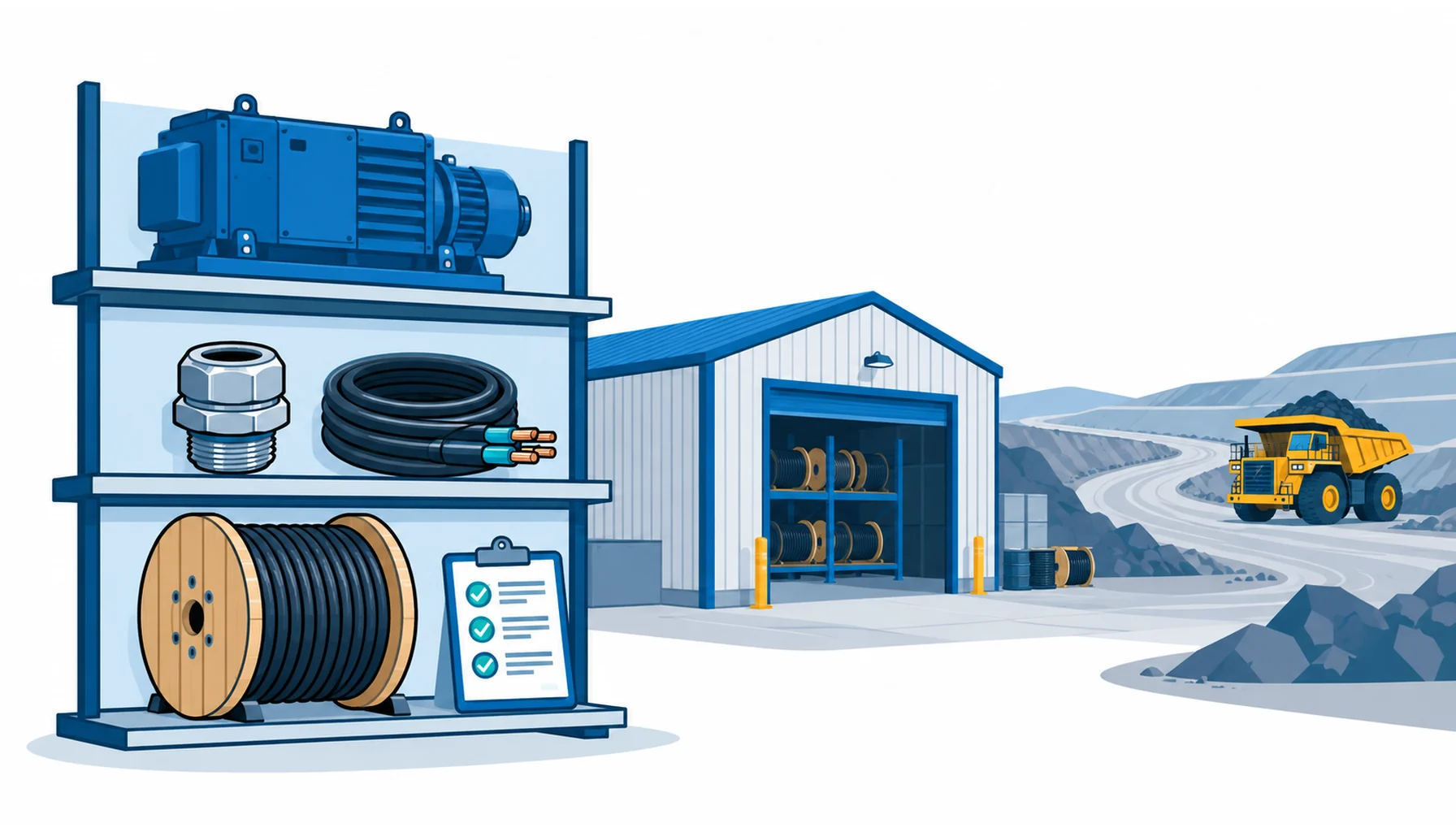
Quick Answer: Site cable stock exists to keep plant running, not to fill a store. The question is not how much cable to hold but which cable, at which location, against which failure, and with which lead time behind it. Holding the wrong 500 metres costs money and saves nothing. Not holding the right 30 metres costs a shift.
Introduction
A construction site and a mine hold cable for different reasons than a factory or a data hall. The environment is uncontrolled, the staff turn over, the store is often a container at the end of a haul road, and the item that stops production is usually a trailing cable on a loader rather than anything on a drawing.
This page is for site and mine maintenance planners and buyers deciding what cable stock to hold. It covers why site stock behaves differently, what actually fails in service, the stock tiers worth funding, the supply routes and what each one costs, how to store and rotate drums on a working site, when to replace rather than re-use, and the six decisions to freeze before the order is placed. The commercial background for re-ordering is in our note on cable MOQ and lead time.
Why Site Cable Stock Behaves Differently
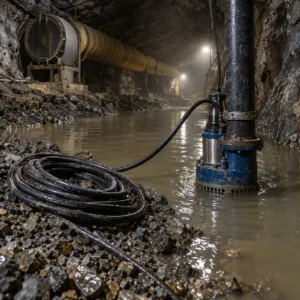
The store is the environment. A container or an open laydown on a mine or a site holds drums in sun, dust, water and rodent range, with no controlled humidity. Cable stored badly for two years can be in worse condition than cable stored well for ten, and the failure that follows is often blamed on the cable rather than the store.
Consumption is driven by damage, not by wear-out. On a working site most cable is replaced because it has been dragged, crushed, cut or hit. That makes consumption lumpy and hard to forecast from history alone, and it makes the case for holding stock strongest at the point where the damage happens rather than in a central store.
The failure you are protecting against has a cost, and it should be written down. A stopped loader, an idle drill rig and a halted conveyor all have an hourly cost well known to the planner. That number, not the price of the cable, is what justifies what is held. The pattern of failures is described in our note on cable damage and wear patterns.
What Actually Fails and What to Hold
Trailing and reeling cable on mobile plant. The single largest user of replacement cable on a mine. Held against the machines that cannot work without it, in the lengths those machines need, with the couplers and glands to match.
Small power, control and instrumentation cable. Damaged during commissioning, when cable is pulled, re-routed and cut repeatedly. Fast-moving, low unit cost, and usually the item that holds up a handover if the store has none.
Terminations, glands, joints and couplers. Not cable at all, but the reason a cable repair stalls. Holding cable without the accessories that terminate it produces a store full of unusable drums, and the accessory set to hold is set out in our note on cable accessories.
Reeling and festoon cable on cranes and stackers. Long lead time, low frequency of failure, very high consequence when it does fail. A candidate for a single held length rather than a re-order, and the construction is described in our note on crane and reeling cable.
The Three Stock Tiers Worth Funding
Critical spares. Items whose lead time exceeds the time the plant can stay down. These are held even at high unit cost, they are held in the exact construction and length required, and they are not released to routine repairs. This is the tier that stops production, and it is the one worth a formal review each year.
Consumable repair stock. The fast-moving small sizes, glands and terminations used by the maintenance team every week. Held in quantity, at the point of use, and replenished on a re-order level rather than a project number.
Project surplus. Cable left over from the build. Whether it becomes stock or is returned is a decision, not an accident, and it should be made while the project is still running. Surplus held with no label, no test record and no owner is the main source of unusable cable in site stores, and the labelling that prevents it is described in our note on cable labelling and documentation.
Deciding the split is easier with the failure record to hand. Where the site runs a formal spares programme, the discipline behind it is described in our note on spare cable programmes.
Stock Routes Compared
The table compares the ways a site or mine can secure cable availability, what each one guarantees, what to specify, the evidence to demand, what drives cost and time, and how each one fails.
| Route | What it guarantees | What to Specify | Evidence to Demand | Cost and Lead-Time Driver | How It Fails |
|---|---|---|---|---|---|
| Hold on site | Immediate availability at the point of failure | The exact construction, length and accessory set per machine | A stock list with drum numbers and test records | Capital tied up plus storage space and storage care | Cable aged in a bad store and unusable when it is called for |
| Regional or central store | Availability within a road journey of several sites | The agreed call-off time and the transport arrangement | A stock report showing the construction and quantity held | Lower total capital, at the cost of transport time | A stock report that does not reflect what is physically there |
| Call-off or vendor-managed stock | Availability without owning the inventory | The minimum level, the replenishment time and who owns the goods | A live stock report with a restock trigger | Holding cost carried in the supplier's price | Levels that drift below the agreed minimum without anyone noticing |
| Framework with a lead-time promise | A defined delivery time against a standing construction | The construction, the price basis and the promised lead time | A signed framework with a delivery commitment | The lowest holding cost, and the longest exposure to a slip | A promised lead time that gives way when the plant is busy |
| Recover from another project | A short-term bridge using cable already bought | The construction, the tested condition and the transfer of records | The original test record and a condition report | Effectively free if the record transfers with the drum | Cable moved without its documentation, so it cannot be used |
Storing Cable on a Working Site or Mine
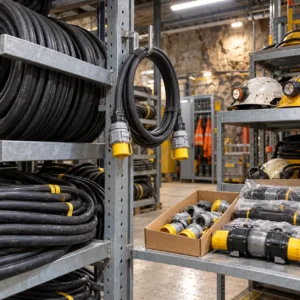
Get the drums off the ground and out of the sun. A drum laid on soil or in standing water draws moisture into the outer layers, and months of direct sun age the sheath and the lagging. A covered, ventilated store with a firm drained floor solves most of the problem, and it costs less than a replacement drum.
Choose the orientation for the way it will be used. A drum that will be paid out into a trench should be faced so the cable leaves the top of the drum, and a drum that will be dragged to a machine should sit on a stand or be laid so it can be rolled out. Orientation decided now saves a handling operation later.
Protect the ends and keep the label readable. The exposed inner end and the outer turns are the parts that take water and abrasion. Seal and cover the ends, and keep the drum label clear, because a drum whose length and construction reference cannot be read is a drum nobody will release for a critical repair.
Keep animals and vehicles out. Rodents damage sheaths and lagging on stored drums, and a store on a traffic route loses drums to impact. Both are avoidable with siting, mesh and a marked exclusion area.
Rotating, Inspecting and Replacing Stock
First in, first out, with the date written on the drum. A store where new cable is issued first leaves the oldest drums to age indefinitely. Mark the receipt date, issue the oldest suitable drum, and review the stock list against the issue record each quarter.
Test what you hold before you need it. An insulation resistance check on the stored ends, a visual check of the sheath and the lagging, and a note of the result. Doing this annually turns a store into a tested reserve, so that the drum pulled out during a breakdown is already known to be sound.
Decide the replacement point in advance. Cable has a service life and a storage life, and both are finite. Setting a rule now, whether by age, by inspection result or by duty, avoids the argument later about whether a drum from six years ago is still fit. The methods for judging remaining life are set out in our note on cable life prediction and in our note on planned replacement.
What to Freeze Before the Order Goes Out
Six decisions decide whether stock will be usable when it is called for. Each belongs in the enquiry that creates it.
| Decision | What to State | Evidence to Attach | Cost of Leaving It Open |
|---|---|---|---|
| What is held and why | The machine or circuit each held drum protects, and its lead time | A stock list with the criticality recorded against each line | A store full of cable that does not match any likely failure |
| Exact construction and length | The construction, class, cores and the length each machine needs | The drawing or machine schedule for the application | A drum that is close but not right, so it cannot be used on the day |
| Accessory set | The glands, joints and couplers that terminate the held cable | An accessory list matched to the drum list | A repair that stops for want of a gland rather than cable |
| Storage condition required | The store standard, its location and who owns it | A store inspection record and a photograph | Cable aged in sun or water and rejected when finally needed |
| Rotation and inspection rule | First-in first-out, the review interval and the test to be done | A stock register with dates and inspection results | Untested cable issued into a critical repair |
| Surplus and disposal basis | Whether project surplus becomes stock, is returned or is recovered | A handover record with the drum list and test records | Unlabelled surplus that cannot be used or credited |
Cost and Lead Time
Price the downtime, then size the stock. A held drum costs capital, space and storage care. A stopped machine costs the hourly rate of an idle production line, sometimes with a crew standing. Where the second figure is large, the first is a rounding error, and where it is small, holding cable is simply capital sitting in a container.
Re-ordering against a breakdown is the expensive route. Emergency orders carry expedited freight, small-quantity penalties and the risk of a substitution. A modest held stock against the two or three constructions that stop the plant is nearly always cheaper over a year, even with the storage cost included.
Plan the disposal, not just the purchase. Cable at the end of its life still has recoverable copper, and a planned disposal route returns value instead of occupying space. Where the site replaces cable on a programme, the recovery side is described in our note on recovering copper at end of life.
When Holding Stock Is Not the Answer
When the lead time is short enough. If the construction can be delivered in the time the plant can tolerate being down, holding it locks up capital for no return. A framework with a firm lead-time promise is the better instrument, and how one is structured is covered in our note on framework agreements.
When the failure is caused by the operation. Cable destroyed weekly by a route that drags over a sharp edge will consume any stock you hold. Fixing the route, the guide or the machine entry removes the consumption, and that is a cheaper answer than holding more cable against it.
When the store cannot protect it. Holding cable in a place that ages it is worse than not holding it, because the stock looks like cover and is not. Either improve the store or hold the inventory at a regional store with the supplier, where the conditions are controlled.
When the item is a slow-moving special. A single length of reeling cable for a stacker may be worth holding, but holding a spread of special constructions across every possible failure is not affordable and not useful. Where the item is unlikely to fail and expensive to hold, put the effort into a qualified supplier and a realistic lead time instead. Our note on field repair kits covers the same logic applied to harness and connector spares.
RFQ Checklist
- The machine or circuit each held construction protects
- The construction, conductor class, cores and voltage rating required
- The exact length each application needs, with the tolerance convention
- The glands, joints and couplers required to terminate the held cable
- The test record and release documents to be issued with stock drums
- The drum labelling and marking required for a site store
- The store standard: cover, ventilation, floor, drainage and segregation
- The rotation rule and the inspection interval for stored cable
- The replacement rule by age, by inspection result or by duty
- Whether a call-off or vendor-managed arrangement is preferred
- The lead time that applies to a re-order of each construction
- The disposal or recovery route for stock at the end of its life
Conclusion
Site cable stock is a downtime decision dressed as a purchasing one. The stocks worth holding are the ones whose lead time exceeds the time the plant can afford to be down, in the exact construction and length the machine needs, with the accessories to fit them, in a store that will not age them. Everything else is better bought against a framework and a firm lead time.
Kexingyu Cable Group (KXYE) has manufactured cable in Quanzhou since 1996 and supplies both project orders and standing stock requirements, with the test records and drum labelling that keep held cable releasable years after delivery. Tell us the machines, the failure history and the store conditions, and we will propose the constructions and quantities worth holding. A request for quotation is the fastest route.