Buying Control and Instrumentation Cables for Power Facilities in Tajikistan
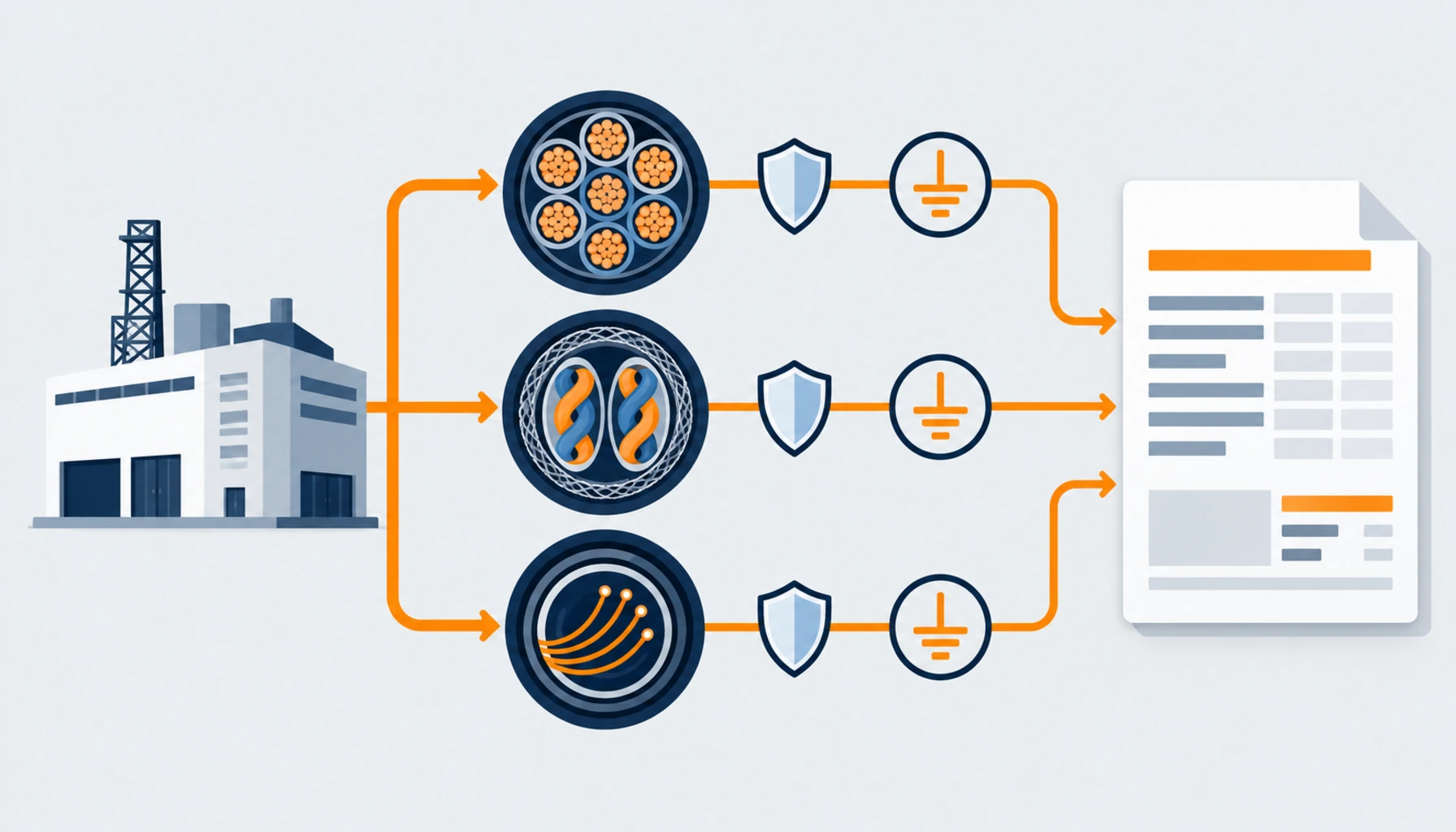
Quick Answer: Control and instrumentation cables are bought as circuits, not as drums, and the purchase for a Tajik power facility starts by grouping the auxiliary world: control circuits that carry commands, measurement circuits that carry signals, and communication circuits that carry neither lightly. Each group decides its own construction, core counts and pair counts, screening, earthing and sheath, and the most expensive mistake is sharing a structure across groups to save a line item. This guide sets out the procurement path: how to group the circuits, what to specify per group, how to question screening and earthing, and what a quote must state before it can be compared.
Introduction
A power facility runs on its auxiliary circuits. The switchgear that clears faults, the measurements that alarm them, and the communications that report them all travel on control and instrumentation cables whose failures are quiet: a command that does not arrive, a reading that drifts, a screen that hums with interference from the power circuit it runs beside. These cables are a small share of the facility’s cable tonnage and a large share of its commissioning arguments, which is why their procurement deserves more specification than their price suggests.
This guide is for project buyers, EPC engineers and facility owners buying control and instrumentation cables for power facilities in Tajikistan: substations, plant auxiliary systems and associated control buildings. It covers grouping the circuits, specifying cores and pairs, individual and overall screening with their earthing, sheath and installation requirements, the question of whether structures can be shared across circuit groups, and the quotation data that makes offers comparable. The distinction the whole guide rests on is set out in our note on control versus instrumentation cable, and the product families it applies to are shown in our control cable range. Country-level supplier screening is covered by the Tajikistan checklist in this series, and the scope here is deliberately limited to auxiliary control and measurement duty; the power and control cable process for plant main circuits is set out in the power cable guides of this series.
Group the Circuits Before Specifying Any Cable
Three groups cover the auxiliary world. Control circuits carry commands between panels and equipment, and their cable is multicore, specified by core count, size and insulation. Measurement circuits carry small signals from instruments to their systems, and their cable is paired, specified by pair count, pair construction and screening. Communication circuits between facility systems carry their own requirements, and where they exist in the scope, they are grouped and specified separately rather than folded into either of the others.
The grouping decides everything downstream. Screening, earthing, separation rules and testing all differ by group, and a specification written per group reads cleanly into a quotation, while a specification written as “control cable, various” reads back as whichever construction the factory had room to run. The grouping sheet, one row per circuit group with its duty and terminations, is the first deliverable of the purchase.
Grouping is also how the sharing question is framed. Facilities sometimes ask whether one construction can serve several circuit groups, and the question is only answerable group by group: a shared structure must meet the most demanding duty in every group it serves, and the savings from sharing are real only when the most demanding duty is already affordable. That analysis is set out later in this guide.
Specify Cores and Pairs Against the Termination Schedule
Core counts come from the drawings, with spares decided, not improvised. The termination schedule states what each circuit connects, and the control cable’s core count follows it plus a stated spare allowance, because spare cores specified at design cost little and spare cores missing at commissioning cost re-cabling. The order sheet carries core count, core size and the insulation per line.
Pair construction is the measurement circuit’s specification. Signal circuits travel in pairs, and the pair’s construction, twist, insulation and any individual screen, is what keeps the signal readable beside the facility’s power circuits. Pair count, pair size and the screening arrangement per pair are the line’s specification, and the difference between a paired and a multicore answer to a measurement duty is the difference between a working loop and an intermittent fault.
Sizes are small, so their discipline matters more. Auxiliary cores and pairs run in small sections where manufacturing and handling tolerances bite hardest, and the conductor class and resistance limits are policed exactly as in larger cable, through batch test results read against the specification. Small cable is not simple cable; it is small cable.
Question Screening and Earthing as a System
Individual and overall screening answer different problems. A screen on each pair quiets the pair against its neighbours; an overall screen quiets the whole cable against the world outside it. The selection follows the interference the routing actually sees, and the logic is set out in our note on shielding and EMC selection. The order sheet states which arrangement each group requires, because “screened” alone does not distinguish the two and quotes priced on the wrong one are not comparable.
A screen works only where it is earthed. The earthing arrangement, at which end or ends, through what terminations, and how the screen is brought out, is part of the cable specification and part of the installation design, and the two must agree. The termination hardware that keeps a screen effective is covered in our note on shielded connectors and EMC, and the order should confirm how the screen is brought out so the gland and the cabinet design can be finished before the cable arrives.
Screen continuity is a testable property. The quotation should commit to screen continuity evidence in the batch reports, and the receipt or commissioning check reads it. A screen specified but never verified is a hope, and hopes interfere badly with instruments.
Specify Sheath and Installation for the Facility's Reality
The sheath answers the route, not the catalogue. Auxiliary cable runs through cable cellars, trays, trenches and ducts, each with its own mechanical and environmental exposure, and the sheath specification follows the worst exposure the group’s routes share. Where armouring is required by the route or the local practice, the armoured versus unarmoured decision is made per route, and the reasoning is set out in our note on armoured versus unarmoured cable.
Installation conditions are part of the cable’s duty. Pulling lengths, bending radii at panels, temperature at installation and separation from power circuits all constrain the construction, and the specification states them so the supplier answers a real routing question rather than a nominal one. Sheath material options and their trade-offs are set out in our note on sheath materials compared.
Separation rules deserve writing down. Control and measurement circuits run beside power circuits everywhere in a facility, and the separation that keeps their signals clean, by distance, by tray division or by screened construction, is an engineering decision the purchase should carry explicitly, so that the cable bought and the installation built enforce the same design.
Decide Deliberately Whether Structures Can Be Shared
Sharing is an engineering decision with an audit trail. Where one construction could serve control and measurement groups alike, the decision weighs the most demanding duty each group imposes, screening, pair discipline, insulation rating, against the production and inventory savings of one structure. The decision belongs in the specification file with its reasoning, because the next project, and the commissioning engineer, will both ask why.
The demanding duty usually wins, and should. A construction that meets the measurement group’s screening and pair discipline usually serves control duty with headroom, and the shared structure prices near the instrumentation cable rather than the control cable. The saving of sharing is then small or absent, and the buyer who ran the analysis knows it; the buyer who did not discovers it in a quote that quietly prices the shared construction at the higher duty throughout.
Where sharing is genuinely economical, the order states the shared scope. Which groups, which circuits, and the evidence the shared construction carries for each group’s requirements. Ambiguous sharing, one product code serving groups nobody named, is how auxiliary systems end up with a cable that is half right everywhere.
Require the Quotation Data That Makes Offers Comparable
The quote answers the grouping sheet, line by line. Construction per group, core and pair counts with sizes, screening arrangement per group, sheath and armour per route, and the standards each construction is produced to. A quote structured that way compares directly with its rivals; a quote priced per drum of “control cable” does not describe a product yet.
Batch evidence and routine tests travel with each construction. Conductor resistance, insulation and screen continuity results per batch, tied to drum numbers, are the delivery’s checkable evidence, and the quotation commits to them in writing. The commissioning team’s insulation and continuity checks read against this evidence, and the measurement discipline is set out in our note on insulation resistance testing.
Marking and documentation close the loop. Core and pair numbering, printing on the insulation, drum labels tied to batch and report, and the document set that lets the as-built file trace every circuit. Auxiliary cable’s small size makes its marking the only durable identity it will ever have, and the specification treats it accordingly.
The enquiry that captures all of this as comparable data is set out in our guide to requesting a cable quotation for Central Asia.
The Circuit Group and Screening Verification Table
The table is the working sheet for the purchase: each circuit group, the construction questions to settle, and the evidence that verifies them.
| Circuit Group | Construction Decisions to Settle | Evidence That Verifies |
|---|---|---|
| Control circuits | Core count and size per line with spare allowance; insulation rating; sheath and armour per route | Batch conductor resistance and insulation results tied to drum numbers |
| Measurement circuits | Pair count and size; pair construction and twist; individual screen where required; overall screen per routing | Screen continuity evidence per batch; pair discipline visible in the sample and the datasheet |
| Communication circuits | Construction per the system's requirements, grouped separately; screening and sheath per route | Reports scoped to the offered construction; termination and gland compatibility confirmed |
| Earthing and EMC | Screen arrangement per group; earthing ends; screen brought out to suit the gland design | Earthing arrangement stated in the order; screen bring-out confirmed with the cabinet design |
| Routing and installation | Sheath per worst exposure; bending radii at panels; separation from power circuits by distance, tray or screen | Installation conditions stated in the specification; separation decision recorded with its reasoning |
| Shared structures, if any | Which groups share which construction, against the most demanding duty in each | Sharing decision recorded with evidence per group; shared scope named in the order |
Cost and Lead Time in Auxiliary Cable Supply
Auxiliary cable is copper-light and specification-heavy. Its price is modest next to power cable, and its cost of failure is not, so the economics favour spending the engineering time the specification needs rather than shopping the price. A few percentage points saved on an ambiguous quote buy weeks of commissioning argument at typical auxiliary circuit counts.
Pair and screen constructions run to order, not to stock. Standard multicore control constructions ship quickly; screened pair constructions with specific screening arrangements run on production slots. The quotation states the lead time per group, and the site programme sequences around the long lines, with the grouping sheet making those visible from the first quote.
Small sections reward consolidation, carefully. Combining the facility’s auxiliary requirements into fewer, larger production runs saves cost, and the sharing analysis from earlier in this guide disciplines which merges are real. Consolidating by stretching one construction across groups it does not suit is the false economy this guide exists to prevent.
Repeat supply follows the as-built file. Extensions, refurbishments and additional bays consume auxiliary cable for years after commissioning, and the buyer who kept the grouping sheet, the constructions and their evidence buys additions against a file rather than a description. The facility’s auxiliary world changes slowly; its records should not.
| Subject | The Offer Must State | Why It Matters |
|---|---|---|
| Construction per group | Cores or pairs, sizes, insulation, sheath, armour per route, production standard | The grouping sheet can only be answered line by line; anything less is a price without a product |
| Screening arrangement | Individual, overall or both, per group, with the screening construction named | "Screened" is not a specification, and the two arrangements answer different interference problems |
| Earthing interface | How the screen is brought out, per construction, for gland and cabinet design | The screen works only where it is earthed, and the termination design waits on this answer |
| Batch evidence | Conductor resistance, insulation and screen continuity per batch, tied to drum numbers | Commissioning reads against this evidence; without it, every fault is a mystery |
| Marking | Core and pair printing, drum labels, batch references, document set | Small cable has no other durable identity, and the as-built file depends on it |
When an Auxiliary Cable Specification Is Not the Answer
When the duty is not auxiliary. Main plant circuits, generator connections and power distribution belong to the power cable process, with its own guides in this series; stretching the auxiliary specification over power duty is a category error with consequences.
When the circuits are ordinary building services. Where the facility’s scope is a control building rather than a power facility, building wire and BMS constructions serve, and the power-facility specification weighs them down without return.
When the interference environment is unknown. Screening requirements written before the routing and the power environment are understood are guesses, and the honest sequence measures or designs the environment first, then specifies the screen.
When no offer can evidence screen continuity. Where the facility’s instruments depend on screening and no bidder will evidence it, the specification has outrun the market, and the remedies are staged acceptance with sample verification or a construction change, decided by engineers rather than by purchasing.
RFQ Checklist
- Circuit grouping sheet: control, measurement and communication groups separated, one row per group
- Core counts and sizes from the termination schedule, with spare allowance stated
- Pair construction and count for measurement circuits, twist and screening per pair
- Screening arrangement per group: individual, overall or both, named in the specification
- Earthing arrangement and screen bring-out confirmed against gland and cabinet design
- Sheath and armour selected per route’s worst exposure, with the decision recorded
- Installation conditions stated: pulling lengths, bending radii, temperature, separation from power circuits
- Sharing decision, if any, recorded with evidence per group and shared scope named
- Batch evidence committed in writing: resistance, insulation, screen continuity, tied to drum numbers
- Marking and documentation specified: core printing, drum labels, batch references, as-built document set
Conclusion
Buying control and instrumentation cables for a power facility is the craft of taking small circuits seriously. The circuits are grouped, the cores and pairs specified against the termination schedule, the screening and its earthing treated as one system, the sheath and installation answered for the facility’s real routes, and the sharing question decided deliberately rather than by default. A quote that answers all of that is comparable, and the facility it serves commissions quietly.
Kexingyu Cable Group (KXYE) manufactures control and instrumentation constructions in Quanzhou and quotes auxiliary cable for power facilities group by group: cores and pairs from the termination schedule, screening arrangements named, screen bring-out confirmed for the gland design, and batch evidence tied to drum numbers. Send us your circuit grouping, quantities and destination, or upload your cable schedule, and we will answer it line by line. A request for quotation is the fastest route to start.