Backup Power Circuits in Central Asian Facilities: Generator Feed and Transfer
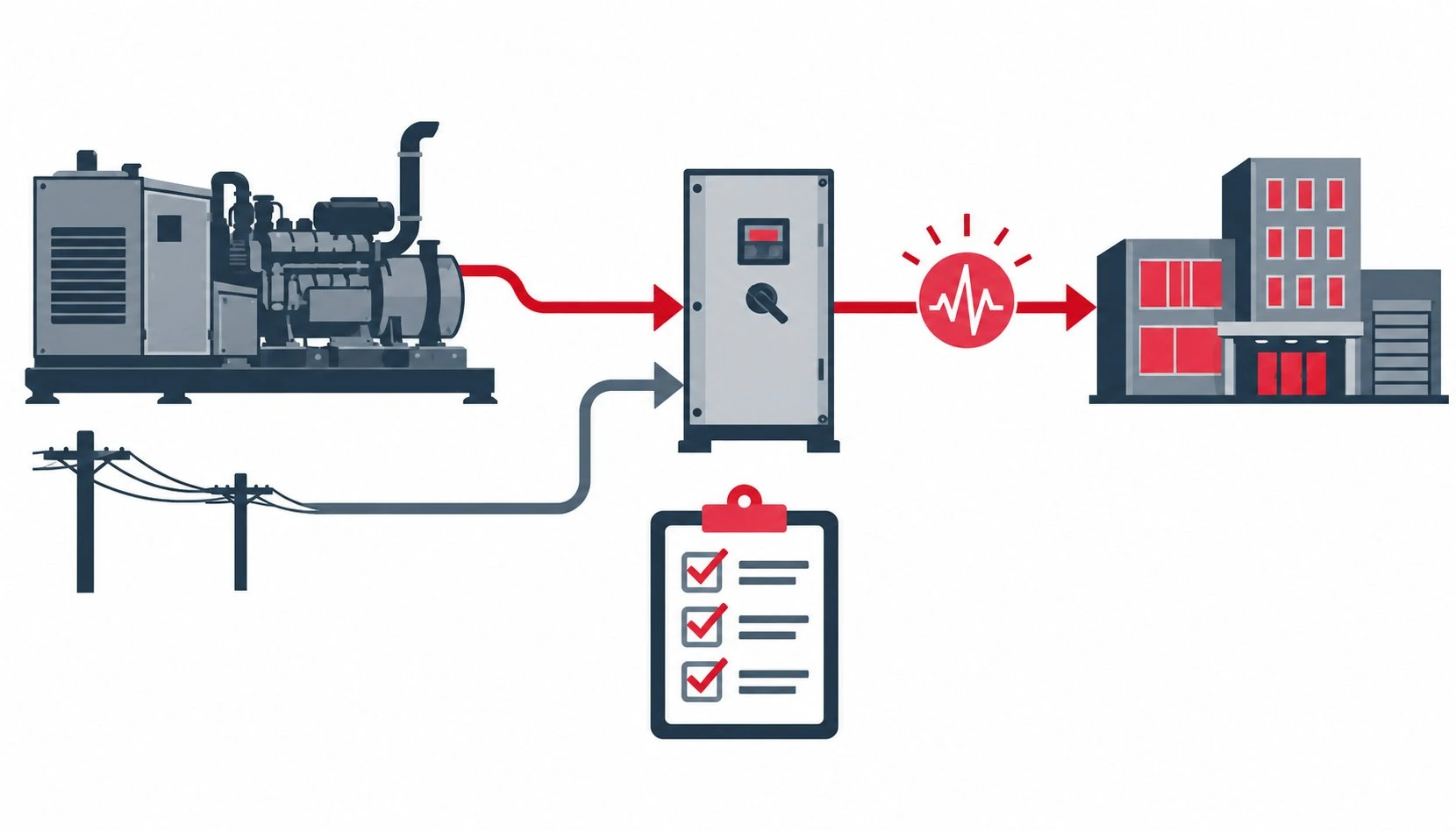
Quick Answer: A backup power circuit is cable that waits. From the generator terminals, through the transfer switch, to the loads it defends, the circuit is specified for two lives: the seconds when it carries starting surges in a dark building, and the years when it stands in a plant room doing nothing but ageing. Size it for the first, protect it for the second, and test it on a calendar.
Introduction
This page covers the cable side of backup power circuits in the region’s facilities: the chain from generator feed through transfer to load, what starting duty does to sizing, what the transfer point demands of the cable interfaces, and the standing and testing discipline that keeps the circuit honest between outages. It is written for the facility engineer, the EPC and the contractor buying the cable.
The regional buying context sits in our Central Asian cable buying hub. Two neighbours divide the rest of the subject: the connection practice at the transfer switch itself is described in our note on generator to ATS cable connections, and the synchronisation equipment that parallels sets is its own discipline in our note on generator synchronisation systems. This page stays with the cable circuit that ties them together.
Why the Backup Circuit Is Specified Separately
The first reason is duty. A feeder that runs eight hours a year has a different failure profile from one that runs eight hours a day: it fails from standing, at terminations and in insulation that never warmed and dried. Standard feeder practice sizes the copper; standby practice adds the standing life, and the two do not share a datasheet line.
The second reason is the transfer event. When the transfer switch moves the load, the circuit sees conditions the normal design does not: starting surges of the largest motor on the backup bus, voltage dip, and a retransfer that lands the same loads on the returning mains. The cable is specified for those seconds as much as for the nameplate, and the sizing method is different from a continuous feeder.
The third reason is accountability. Backup circuits are the ones that get audited, by insurers, regulators and the client’s own engineers, and the audit asks for evidence a normal installation never produces: sizing calculations, test records and the exercise log. Procurement that gathers the evidence with the cable buys the audit answer in the same order.
Mapping the Circuit: Generator, Transfer and Loads
The circuit divides into four cable duties. The generator feed runs from the set terminals to the transfer switch, sized for the set’s output. The load side runs from the transfer switch to the emergency distribution, sized for the backed-up load. The control layer carries start signals, sensing and the transfer command between the set controller and the switch. The earthing and bonding layer completes the circuit’s safety case.
Each duty has a different owner and a different envelope. The generator feed follows the set supplier’s terminal data and the distances on site; the load side follows the emergency design and its protection; the control layer follows the controller maker’s requirements; the bonding follows the earthing design. Keeping the four as separate RFQ lines is what makes each quotable, and the cable’s evidence falls out of the same split.
For most facilities the set stands alone and the transfer is a single step; where several sets run in parallel, the synchronisation equipment adds its own wiring layer, the territory of the synchronisation note cited above. The cable duties on this page are the same either way, and Table 1 lines them up against construction and evidence.
Sizing the Generator Feed: Starting Loads and Drop
The feed is sized for the worst seconds of the year. When the transfer closes on a dark building, the largest motor on the emergency bus draws its starting current through the feed, and the voltage drop across that moment decides whether the motor starts, the contactors hold in, and the controls ride through. The calculation is a starting case, and it belongs in the RFQ as a named document.
Generator behaviour shapes the same calculation from the source end. A set has finite fault current and a softer voltage response than the grid, so the drop budget and the protection settings on the backup circuit are the set’s numbers, not the mains numbers. The sizing logic that this shares with battery-backed systems is set out in our note on UPS and battery cable sizing, where the source, not the load, sets the limits.
Continuous ratings still apply for the hours the set actually runs, with derating for the plant room ambient, grouping and warm routing applied to those hours. A feed that passes the starting case and fails the thermal case, or the reverse, is a design that was never checked both ways.
The Transfer Point: ATS, Switchgear and Cable Interfaces
The transfer switch is where two sources, one set of terminations and every commissioning argument meet, and the cable design treats it as a node with requirements of its own. Terminations are torqued and marked for the audit, lugs match both the set side and the load side conductors, and the bending space at the cabinet is checked before the drum lengths are ordered, because a feed that cannot land cleanly gets improvised.
The choice between transfer technologies belongs to the design, and the comparison is set out in our note on ATS versus STS; for cable purposes the difference lands in the control wiring and the terminal arrangement, both known before the order. The cabinet that hosts the transfer is a standard product family, and the dual source arrangement we supply is described on our dual power ATS cabinet page.
The connection practice at the switch, bolted from the cable ends back, is the craftsman’s topic covered in the connections note cited above. The division of labour is simple: that note explains how to land the cable; this page explains what the cable must be for the landing to matter.
Standing Duty: The Cable That Waits
Most of the backup circuit’s life is standing life, and standing has its own weather. Plant rooms cycle temperature and humidity, terminations relax over seasons, insulation in an unwarmed cable holds moisture a working cable would dry, and the corner where the drum end was coiled becomes the fault nobody scheduled. The specification answers with compounds and classes chosen for the standing environment, not just the running one.
Location does the rest. Backup routes avoid the wet corners, the boiler room wall and the roof drain path, are supported so no joint carries weight, and are labelled so the crew that arrives during an event does not spend it tracing. A half-warm plant room is the textbook case for condensation on standing circuits.
The temporary generator on a construction site faces the same physics with none of the patience, which is why its cable practice is worth reading even for permanent installations; it is described in our note on site temporary generator cable. The permanent circuit can be designed once for standing duty; the advantage is realised only in the specification.
Critical Facilities: Hospitals and Beyond
Critical facilities raise the stakes on the same circuit. Hospitals carry the strictest frameworks, with safety services, segregated routes and the evidence culture that comes with them; the planning structure is set out in our note on hospital backup power planning, and its cable consequences are more redundancy, more documentation and shorter accepted repair times.
Commercial critical spaces buy the same circuit with a lighter compliance wrapper, and the common thread across them is that the cable package must produce its evidence on demand, which is a procurement property, not an installation accident.
Where the facility backs up with batteries and inverters as well as a set, the circuit map gains the DC duties described in the battery sizing note cited above, and the transfer arrangement gains a static or hybrid layer. The RFQ carries both families as separate lines, because the suppliers, tests and failure modes differ.
Testing, Recommissioning and the Annual Exercise
The exercise is the circuit’s real acceptance test, repeated every year for the life of the facility. Cable earns its keep there: terminations re-torqued and thermographed, insulation re-tested on the standing route, and the log recording what carried the load and for how long. The recommissioning discipline for circuits that stood idle is set out in our note on standby cable recommissioning, and the annual exercise is its scheduled form.
Thermography deserves its line in the programme, because a relaxed termination shows itself as heat before it shows itself as an outage. Run under load, during the exercise, the survey turns the annual drill into the circuit’s inspection window, and the findings feed the maintenance list before they feed the incident report.
The procurement tail is the evidence file: sizing calculations, test certificates, torque records and the exercise log, indexed per circuit with the as-builts. The RFQ discipline that gathers all of it with the cable rather than after is the one in our note on the industrial cable RFQ checklist, and Table 2 is the freeze list that makes it contractual.
The Backup Circuit Duty Map
Table 1 lines up the four cable duties of a backup power circuit against construction, the governing input and the evidence that decides acceptance.
| Circuit Duty | Typical Construction | Governing Input | Evidence to Demand |
|---|---|---|---|
| Generator feed | Heavy LV copper, sized for starting | Starting case and set output | Starting calculation, routine tests |
| Load side feeders | Standard LV per emergency design | Backed-up load and protection | Protection coordination sheet |
| Control layer | Screened control per controller manual | Start, sense and transfer signals | Segregation and test records |
| Bonding layer | Earthing conductors per design | Earthing study and fault path | Bonding verification record |
| Standing environment | Compounds and classes for the room | Temperature, humidity, location | Class declaration, exercise log |
The Backup Circuit RFQ Freeze List
Table 2 is what to settle before the enquiry goes out, because these lines are the difference between a circuit that works during the drill and one that works during the event.
| Item to Freeze | How to Write It | Evidence to Attach | Cost of Leaving It Blank |
|---|---|---|---|
| Starting case | Largest motor start through the feed | Calculation sheet per circuit | A motor that will not start in the dark |
| Drop budget | Set-side numbers, not mains numbers | Set datasheet and study | Controls that drop out on transfer |
| Terminal plan | Lugs, bending space and torque per node | Layout with cabinet clearances | A feed that gets improvised |
| Standing standard | Compound and class for the plant room | Class and compound declarations | Ageing blamed on the set |
| Route discipline | Dry, supported, labelled, clear of drains | Routing sheet with photos | The fault in the coiled drum end |
| Test programme | Insulation, torque and thermography schedule | Test plan with intervals | A circuit that fails during the event |
| Evidence file | Indexed per circuit, handed over | File format agreed early | An audit answered from memory |
When Treating Backup Cable Like Ordinary Feeder Cable Is Not the Answer
When the feed is sized from the running load. The worst seconds of the circuit’s year are a motor start in a dark building, not the running amps on the schedule. Without the starting case in the calculation, the feed passes the desk check and fails the first real transfer.
When the drop budget borrows mains numbers. A generator set has a softer source than the grid, and the voltage dip across the feed during starting is the set’s arithmetic. Budgets taken from mains practice leave contactors and controls on the edge of dropping out exactly when the circuit is needed.
When the transfer point is drawn without bending space. Two sources land at one cabinet, and the lugs, clearance and torque access are design facts, not site luck. A feed that cannot land cleanly is improvised, and the improvisation is what the next audit finds.
When standing duty is ignored. A circuit that runs eight hours a year fails from the other 8,752: moisture in unwarmed insulation, relaxed terminations, the wet corner nobody routed away from. The compound, the class and the route are specified for the standing life, and the exercise log proves it.
When the evidence file is assembled for the audit. Retrofitting records after an incident is expensive and rarely convincing. The sizing sheets, test certificates and exercise log belong in the RFQ as deliverables, so the audit answer ships with the drums.
RFQ Checklist
- Starting case calculated for the largest motor through the feed
- Drop budget on set-side numbers, stated per circuit
- Terminal plan per node: lugs, bending space, torque values
- Compound and temperature class for the standing environment
- Route discipline: dry, supported, labelled, clear of water paths
- Control layer per the controller maker’s manual, screened
- Bonding layer per the earthing design, verification included
- Test programme: insulation, torque, thermography under load
- Evidence file indexed per circuit, delivered with as-builts
- Annual exercise format agreed with the facility operator
Conclusion
Backup power cable is bought for two lives at once: the seconds of starting duty in a dark building, and the years of standing duty in between. The starting case sizes the copper, the transfer point fixes the terminations, the standing environment fixes the compounds and routes, and the annual exercise audits all of it. A package written for both lives is the cheapest insurance the facility owns; one written for the running load is a circuit that works until it matters.
Kexingyu Cable Group (KXYE) supplies backup power circuits with generator feeds, transfer interfaces and control layers in one package, sized to your starting case and delivered with the evidence file attached. Send the single line diagram and the set data. A request for quotation is the fastest start.