Busbar Trunking or Cable for Building Mains: Choosing by Building Type
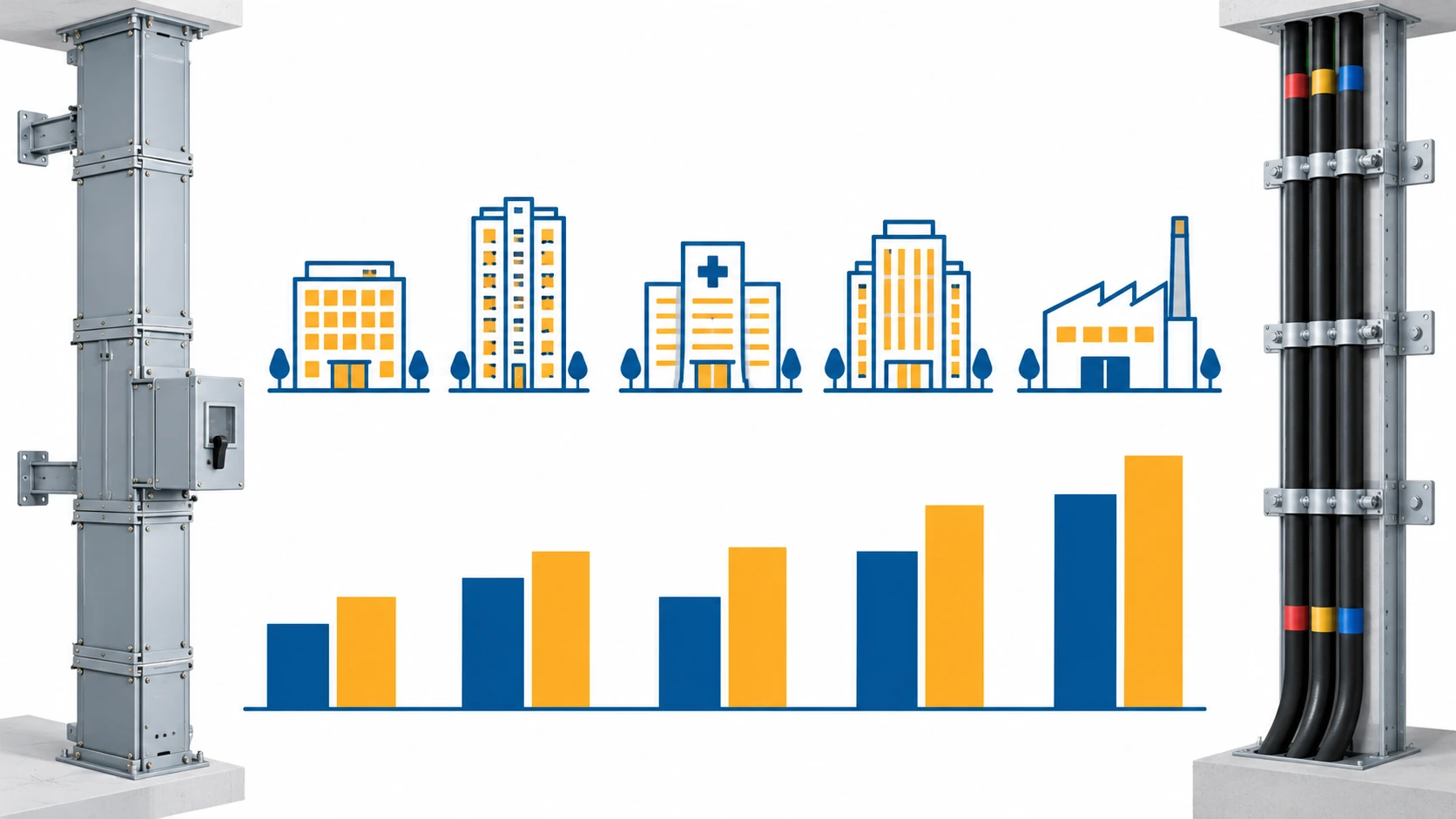
Quick Answer: Busbar trunking and cable are sold on completely different bases, so the comparison that decides the purchase is not the unit rate. Busbar is priced per metre of straight run plus fittings and tap-off boxes, with installation that a mechanical crew can do quickly. Cable is priced per drum, plus cleats, glands, jointing and vertical installation labour. Decide by how the building will be used, then price both on the same basis: installed cost per amp at the floor board, not cost per metre on the quotation.
Introduction
Every tall building has a vertical mains decision in it, and it is usually made late, on price, by whoever is holding the cost plan. That is the wrong moment and the wrong measure. The two technologies solve the same problem in different ways, and which one is cheaper depends on the building, the floor rhythm, how often the loads will change and what the fire strategy demands of the shaft.
The buyer’s job is to force the comparison onto one basis and to get the technical claims documented. This guide sets out where each one wins, what evidence to ask for, and the six decisions to freeze before the order goes out.
The Two Technologies, and What Each One Is Good At
Cable risers are single-core or multicore conductors in an insulated and sheathed construction, cleated to the shaft wall or run in tray. They follow any route, they can be pulled in sections and jointed, they take a rated fire construction directly, and the technology is available from almost every cable maker at every current rating. Where a metallic barrier is wanted, an armoured construction can be specified instead of adding separate mechanical protection. What a cable riser cannot do is offer an easy point to tap power off part way up.
Busbar trunking is a factory-made assembly of conductors in a metal enclosure, delivered in standard lengths with joints and plug-in tap-off positions. It is mechanically fixed rather than pulled, it takes a tap-off box anywhere the design allows, and its enclosure can be built to a fire rating. It is less forgiving of route changes, and it depends on a joint being made correctly at every connection.
The two are not substitutes in every situation, and the honest answer on some projects is a cable riser up the shaft with busbar on the long horizontal runs at each floor, which is what most mixed buildings end up doing.
Where Each One Wins, by Building Type
Office towers with regular floors and heavy tenant loads. Busbar trunking usually wins. Floors repeat, loads are large, and tenants change the layout often enough that a riser which can be tapped without cutting in is worth the material premium. Cable still wins where the shaft is cramped, the route is irregular, or the riser has to cross a compartment boundary with a rated construction rather than a rated enclosure.
Residential and hotel towers. Cable usually wins. Loads are repetitive and small, reconfiguration is rare, and the metreage of cable is far cheaper than busbar once the tap-off boxes are counted. Busbar appears where a large landlord load concentrates on a few floors.
Hospitals, laboratories and industrial buildings. Mixed, and usually by zone. Cable for the clinical and process areas where routes are complex and fire rated circuits dominate; busbar where a large block load has to be distributed to a repetitive pattern of floors or production lines.
Retrofit and refurbishment. Cable almost always wins, because the route exists and the lift, the staging and the shaft access do not. Busbar retrofit is done where a new riser can be built alongside the old one and the downtime matters more than the material.
The pattern behind all four: busbar earns its premium where the load is large, the floors repeat and the building will be reconfigured; cable wins where the route is difficult, the loads are modest or the fire strategy has to be met by the cable construction itself.
Comparison by Building Type
| Building type | Mains duty | Where Busbar Wins | Where Cable Wins | Evidence to Demand | Cost Driver |
|---|---|---|---|---|---|
| Office tower, regular floors | Heavy tenant loads, frequent fit-out change | Short tap-off at any floor without cutting a live riser, mechanical installation | Cramped or irregular shaft, rated construction needed at a compartment crossing | Busbar type test for short-circuit withstand and temperature rise; cable CPR class and derated current | Busbar: material per amp plus tap-off boxes. Cable: copper plus cleating and jointing labour |
| Residential and hotel | Repetitive, modest loads, rare change | Only where a large landlord load concentrates on a few floors | Almost always, on material cost across long repetitive metreage | Reaction-to-fire class, dimensional records, voltage drop calculation | Cable metreage and metal; aluminium conductor worth checking on long runs |
| Hospital and laboratory | Mixed loads, complex routes, many life safety circuits | Large block loads serving a repetitive pattern of floors | Clinical and process zones with complex routes and rated circuits | Survival grade and system approval for safety circuits; busbar enclosure fire rating | Two technologies on one site means two supply chains and two installation crews |
| Industrial and logistics | Concentrated machine loads, long straight runs | Long straight runs to repetitive production positions | Any route that turns, crosses services or ends in a star | Short-circuit withstand at the actual fault level, IP rating for the environment | Fault level drives busbar framing; cable derating drives conductor size |
| Retrofit and refurbishment | Existing route, restricted access, tight downtime | Where a new riser can be built alongside and downtime dominates | Almost always, because the route exists and access does not allow assemblies | Cable diameter against the existing duct and tray, bend radius, pulling tension | Access and downtime cost more than the material difference |
Pricing Both on the Same Basis
The reason the comparison goes wrong is that the two quotations are not the same document. A busbar quotation is a measurement of the run plus fittings, and a cable quotation is a drum list; neither includes the installation, and installation is where the ranking changes.
Build the installed cost. For cable, add cleats and their spacing, glands and terminations, jointing where drum lengths end, pulling and vertical installation labour, and the fire protection of the route, along with the derating basis behind the selected size that our note on cable derating factors explains. For busbar, add the joints and their bolt tightening, support brackets at the manufacturer’s spacing, tap-off boxes at the positions now and the allowance for future ones, expansion provisions, and the fire protection of the enclosure. Then divide by the amps delivered at the floor board.
Count the fittings. Busbar pricing is sensitive to how many changes of direction, how many tap-offs and how many expansion and fire barrier sections the route needs. A route drawn optimistically on a riser diagram costs more once the walls are real. Our note on busway versus power cable covers the same comparison in a data hall, where the fault level and the tap-off density are both extreme, and the method transfers to a building riser with the fire requirement added.
Do not forget the route. Cable needs a shaft or tray of a certain size and a bend radius at each change of direction; busbar needs less space per amp but a straight envelope and support at fixed centres. Our notes on cable minimum bend radius and on vertical riser and shaft cable set out the space each option really occupies.
Fire, Fault Level and the Riser
Fire performance. A cable with a rated construction and a tested system approval delivers a fire-rated circuit through the cable itself. A busbar run delivers the same only when its enclosure is rated to the required duration and tested as a system with its joints and supports. Where the shaft is a fire compartment boundary, that difference decides the purchase, and the evidence to ask for is a test report on the assembly rather than a material certificate.
Fault level. Vertical mains close to a substation see high prospective fault current, and the withstand of the assembly has to be documented rather than assumed. Busbar systems are type tested to a declared short-circuit withstand and that figure must cover the installation as built, including the joints. Cable withstand is a matter of conductor and screen sizing plus the protection settings, so the two are compared on different documents and both must be part of the tender pack; the wider framework of voltage classes and type tests behind them is set out in our note on MV cable standards.
Water and condensation. Vertical shafts are cool and often damp, and a riser that runs from a warm switchroom to a cold roof plant room will see condensation inside an enclosure. This is the failure mode that catches busbar systems in service, and it is worth asking how the enclosure drains and how joints are sealed. Cable, with a solid extruded sheath and correctly sealed glands, is more forgiving, which is one reason shafts with a history of water favour it. Our note on insulation resistance testing covers the measurement that finds moisture before it becomes a fault.
What to Freeze Before the Order
| Decision | What to State | Evidence to Attach | Cost of Leaving It Open |
|---|---|---|---|
| Technology per riser | Busbar or cable named riser by riser, with the reason | A riser schedule with the duty, load and route for each | One technology applied to risers that needed the other |
| Installed cost basis | Both options priced to the floor board including fittings and labour | A comparison sheet with the same scope on both sides | A decision made on unit rates that reverses once installed |
| Fault level and withstand | Prospective fault current and the required withstand at each riser | Type test evidence for busbar, protection settings and conductor sizing for cable | An assembly that cannot be documented against the fault level |
| Fire requirement | Duration and grade, and whether it is met by the cable or the enclosure | System approval covering the cable, or the enclosure and its joints and supports | Rebuilding a riser the fire engineer will not accept |
| Tap-off provision | Present tap-offs plus the allowance for future ones, priced | A tap-off schedule with the spare positions marked | Cutting into a live riser later, or paying for capacity never used |
| Support and expansion | Bracket or cleat spacing, mass per metre, expansion and movement provisions | Installation drawing with the manufacturer's support figures | Sheath damage and creep in a shaft nobody can inspect |
When Neither Busbar nor Cable Is the Answer
When the load is small and the shaft is short. A modest building does not need a trunking comparison at all; a cable riser sized properly is the whole answer and the comparison only delays the order.
When the fault level is the real problem. If the prospective fault current is high enough that no assembly at a sensible size can be documented, the answer is a closer source or a step down part way up, not a different technology in the same shaft.
When the shaft is being used to solve a fire strategy it cannot solve. No cable and no enclosure delivers a protected circuit through an unprotected space. If the route is the problem, fix the route.
When the comparison is being run after the riser is built. Once the shaft size is fixed and the tray is installed, one of the two options has already been eliminated by the building rather than by the engineering.
RFQ Checklist
- Riser schedule with duty, load, route and fire requirement per riser
- Prospective fault current and required withstand at each riser
- Both options priced to the floor board, fittings and labour included
- Tap-off schedule for present positions plus future allowance
- Support, cleat or bracket spacing, mass per metre and expansion provisions
- Fire duration and grade, with the assembly that delivers it named
- Firestop detail at each slab crossing, tested as a system
- Condensation and drainage provisions for the shaft environment
- Voltage drop and derating calculation for the selected option
- Tests to be witnessed and the records that ship with each delivery
Conclusion
The busbar or cable question is answered by the building, not by the price list. Regular floors, heavy loads and frequent reconfiguration pull towards busbar; irregular routes, modest loads and a fire requirement that lives in the cable pull towards cable. Pick per riser, price both on installed cost to the floor board, and document the fault level and the fire assembly before the order is placed.
Kexingyu Cable Group (KXYE) has supplied cable from Quanzhou since 1996, including the single-core and multicore riser constructions, fire-rated families and accessories that building mains need, and we work alongside trunking suppliers on mixed risers. Send us the riser schedule with the loads, the fault level, the fire requirement and the routes, and we will come back with the cable options priced against the trunking alternative. The fastest route is a request for quotation.