Cable Repair or Replace: Making the Field Decision on Site
Quick Answer: Cable repair or replace comes down to four numbers: what the repair restores, how long it will last, what it costs to do properly, and what another outage costs if it fails. Cosmetic judgements about how a cable looks are the usual reason a repair is chosen for a cable that has already lost its margin, and the reason a section of perfectly serviceable cable gets pulled. Both errors are expensive, and both are avoidable with a short comparison.
Introduction
On most sites the decision is made in the hour after a fault, by whoever is standing nearest, under pressure to restore the circuit. That is the worst moment to decide, because the information needed is a test result from commissioning and a route drawing that nobody has looked at for three years.
This guide is for buyers and maintenance engineers who have to choose between repairing a damaged industrial cable and replacing it, and for the people who fund the decision. It sets out what each repair option really restores, the figures that make the comparison honest, the decisions to freeze before a purchase order goes out, and the tests that justify putting the circuit back in. Repair materials and the constructions they apply to sit in our special wire and cable range, and the condition side of the judgement is covered in our note on cable ageing diagnostics.
What Decides the Answer
Damage classification comes first. A sheath nick, damage that has reached the insulation, and a failure with electrical symptoms in the same length of cable are three different cases. The first is usually a repair, the third usually a replacement, and the middle one depends on the remaining length and the access.
Access governs cost more than the cable does. An accessible tray repair and a repair four metres under a reinstated road are the same technical job with a twenty-fold difference in cost. Where the access is the expensive part, doing the minimum repair today and waiting for the next excavation is often the right commercial answer.
Age shifts the balance toward replacement. A joint or a repair in a cable that has twenty years left is a sensible intervention. The same work in a cable that is already showing a falling insulation resistance trend buys a short extension on a route that will be dug up again, and the second excavation is the one that makes a repair look expensive. Our note on cable life prediction sets out how the remaining life is estimated.
Repetition settles it. A third fault at the same place on the same route is an instruction, not a coincidence. At that point the route, the protection or the cable type is wrong, and a fourth repair is money spent to reach the same conclusion. Patterns of repeat damage are set out in our note on cable damage and wear patterns.
Repair Options Compared
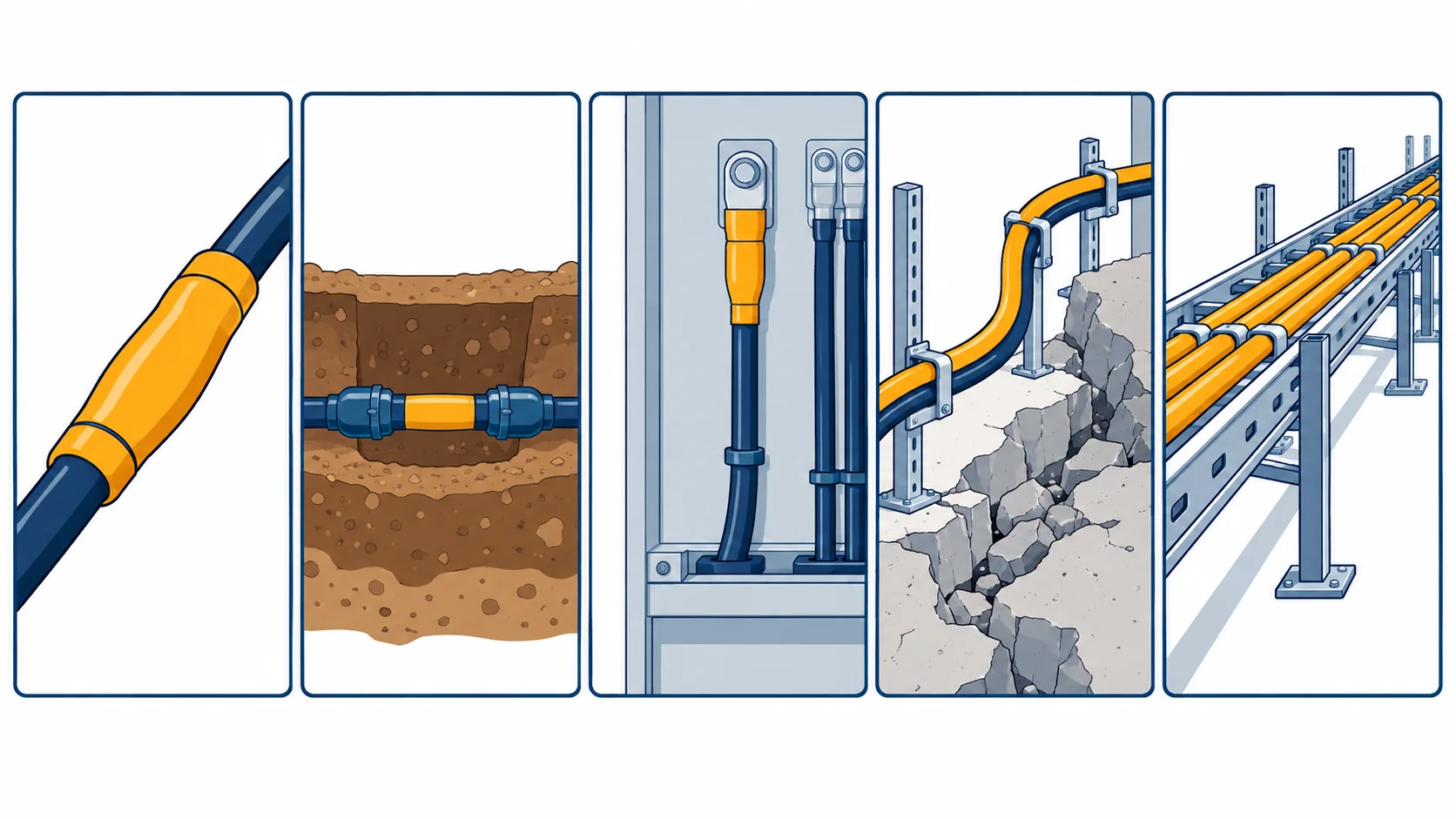
The table sets out the options a site team chooses between: what each one restores, what to specify, the evidence to demand, what drives cost and lead time, and how each one fails when it is chosen to save a day.
| Option | What it restores | What to Specify | Evidence to Demand | Cost and Lead-Time Driver | How It Fails |
|---|---|---|---|---|---|
| Oversheath repair | The water barrier over a nick that has not reached the insulation | The repair system, its thickness and its rating for the route environment | The repair system data matched to the original jacket | Inexpensive and usually a stock item | Applied over damage that already reached the insulation, so the fault returns |
| Section replacement with two joints | The damaged length and a full electrical and water-blocking path | Joint type, cable length, spare allowance and the tooling for both joints | Joint data rated for the voltage, plus the jointing record | Cable plus two joints plus excavation, so the dominant cost | Joints made in a wet trench or by untrained staff, failing within a season |
| Re-termination only | The circuit where the damage is confined to the termination | The termination kit, the crimp tooling and the torque requirement | The termination test result and the jointing record | Modest material cost and a planned outage | The cable is replaced while the same accessory and tooling defect stays in service |
| Re-route around the damage | A working circuit without disturbing the damaged section | The new route, its protection and its derating basis | The revised route drawing with the derating calculation | Labour and tray work rather than cable cost | A longer route that was never re-checked for voltage drop or derating |
| Full route replacement | Everything, including the route problem that caused the damage | The new construction, the protection at each risk point and the route drawings | The new commissioning test record, per core and against armour | The largest cost, and the one worth planning rather than reacting to | Bought in an emergency at a premium, and laid back into the same unprotected route |
The Numbers Behind the Decision
Compare total cost of ownership, not the invoice. A repair that costs a fifth of a replacement but fails in eighteen months has cost more than the replacement if the second outage includes production loss. Put the expected life of each option next to its cost, and the comparison becomes a rate per year rather than a price.
Include the outage, not only the material. The cable and the joint are usually the smaller part of a field repair once access, reinstatement, testing and lost production are counted. That is why the same technical decision lands differently on a plant that can isolate a circuit and one that cannot.
A repair moves the weak point to the joint. Every joint is a new termination to make well, and a repair that creates two joints in a wet duct has moved the risk rather than removed it. Where the joints will sit in water, water blocking and joint quality matter more than the cable.
Test evidence separates a repair from a guess. A repair that restores the insulation resistance to its commissioning value is a defensible decision; one that restores it to something merely acceptable is a bet. The method is set out in our note on insulation resistance testing.
What to Freeze Before the Order Goes Out
Six decisions decide whether the work solves the problem or postpones it. Each is cheap to settle before the cable is ordered and awkward afterwards.
| Decision | What to State | Evidence to Attach | Cost of Leaving It Open |
|---|---|---|---|
| Damage classification | Whether the damage is in the oversheath, the insulation or the conductor, at each fault | The test sheet and the retained sample from the damaged section | A repair applied to damage that already reached the insulation |
| Remaining life of the route | The replacement horizon for the circuit and the condition evidence behind it | The commissioning baseline plus the trend of later readings | Money spent extending a cable that is due for renewal anyway |
| Expected life of the repair | How long the repair is intended to last, and the condition it assumes | The repair system data with its service conditions | A repair compared against replacement at the wrong lifetime |
| Access and outage window | The excavation, the isolation and the time actually available for the work | A method statement with the access arrangement and the reinstatement | A joint made in a hurry in a wet trench and failing a season later |
| Joint and accessory specification | The joint type, the voltage rating, the tooling and the installer competence | Accessory data plus the tooling identification and training record | A correct cable joined with an accessory rated for a lesser duty |
| Acceptance tests and records | The tests to be carried out and the pass criteria for returning the circuit | A test sheet with pass limits and the as-built drawing update | A circuit returned to service on a reading nobody can compare to anything |
Doing the Work
Make the joint where it can stay dry. A joint position chosen for the shortest trench is usually the wrong one, and moving the joint out of the wet zone is worth extra cable. Where that is impossible, the joint has to be of a construction that tolerates the environment rather than a default kit in a wrapped bag.
Use the tooling the accessory maker specifies. Crimp tools are matched to lugs and connectors, and an unapproved tool produces a joint that passes a pull test and heats up in service. The tooling identification belongs on the work record, and the technique is set out in our note on termination testing.
Restore the water path, not just the conductor. A repair that leaves the oversheath open in a wet route will fail again, because the mechanism that destroyed it the first time is still operating. Water blocking at the joint and a restored oversheath are part of the repair, not optional extras.
Record the position and the depth. The next fault on that route will be found by comparing the new reading against the old one, and a route drawing that shows every repair saves a survey. The drawing is part of the work, not documentation for later.
Proving the Result
Test before backfill. Insulation resistance, continuity of the armour and screen, and a phase comparison if the conductors were separated, all taken with the joint accessible. Finding a bad joint under a reinstated surface is how a one-day job becomes three and how a decision to repair becomes a decision to replace.
Compare against commissioning, not against the limit. A repaired cable should return close to its original reading, and a result that meets the minimum while sitting far below the baseline suggests residual moisture. Where an independent view is needed on a high-value circuit, our note on third-party cable inspection covers how that is arranged.
Check the warranty position before you cut. Work carried out by an unapproved party can affect the terms on a cable still inside its warranty period, and the position is worth checking before the repair rather than after. Our note on power cable warranty terms sets out how those conditions are usually written.
Bring the trend up to date. Add the post-repair reading to the same record as the commissioning and interim results, so the next decision starts from a trend rather than a single number. In-service measurement practice is covered in our note on in-service cable testing.
Cost and Lead Time
A repair system or joint kit is the cheapest item on the list and normally available from stock, which is why holding one for each route type costs less than a single day of downtime. A section replacement carries the cost of the cable, two joints and the excavation, and the joints often cost more than the cable length. A full route replacement is the largest single cost, and planned rather than reactive it is usually lower than the same work bought during an outage.
Where replacement cable is required, copper is the largest element of the price, so ask how the copper element is calculated and how long the quotation holds. A replacement ordered during a forced outage tends to pay a premium that a planned purchase does not, which is an argument for keeping the decision framework ready rather than inventing it under pressure. That mechanism is covered in our note on copper price and cable procurement.
When a Field Repair Is Not the Answer
When the damage is in the conductor. A conductor that has been reduced in section or has arced cannot be restored by an oversheath repair, and a joint at that point is a full repair. Repair systems belong to sheath damage, not to electrical damage.
When the cable has lost its margin everywhere. A route with a falling insulation resistance trend, several past repairs and no spare capacity is due for replacement, and another repair delays a decision that is already made by the evidence.
When the access is going to be repeated. A repair in a place that will be excavated again next year should be planned as part of that work, with the cable bought in advance and the joints made properly. Paying for access twice is the most avoidable cost in this decision.
When the load is about to change. A repair that restores a cable to a duty it is about to outgrow is wasted, because the circuit will need a larger section soon. Ask what the load will be in five years before deciding how much to spend on today’s damage.
RFQ Checklist
- The damage classification at each fault: oversheath, insulation or conductor
- The commissioning baseline reading and the trend of later results for the route
- The replacement horizon for the circuit and the condition evidence behind it
- The intended life of the repair and the conditions it assumes
- The joint or repair system, its voltage rating and its rating for the route environment
- The crimp tooling identification and the installer competence record
- Water blocking restored at the joint or in the section replaced
- The access, isolation and reinstatement method, with the outage window
- Acceptance tests and pass criteria, taken before backfill
- As-built route drawings updated with the repair position and depth
- The warranty position on any cable still inside its warranty period
- Copper basis and the validity window of the quoted price
Conclusion
Repair or replace is a four-number comparison: what is restored, how long it lasts, what it costs to do properly, and what a repeat outage costs. Sites that make the decision with those four in view tend to repair the small damage and plan the big replacements, and the money goes where the risk is. Sites that decide on appearance tend to do the opposite, and pay twice for the same lesson.
Kexingyu Cable Group (KXYE) has manufactured cable in Quanzhou since 1996, including armoured, jacketed and ducted constructions for industrial routes, supplied with the construction data, accessory lists and test records that a repair-or-replace decision needs. Send us the route, the damage and the test result you have, and we will come back with the construction, the accessories and the acceptance tests that apply. A request for quotation is the fastest route.