Transshipping Through Kazakhstan to Uzbekistan and Beyond: Transfer and Gauge

Quick Answer: For most cable bound for Uzbekistan, Kyrgyzstan or Tajikistan, Kazakhstan is not the destination, it is the corridor. The drums cross the gateway, change gauge, re-marshal at Almaty, run south under a transit regime and hand over at the Kazakh-Uzbek gateway, with a transfer or two wherever the branch lines leave the trunk. Each transfer is a handling step, each handover a document step, and every one of them is contractable. The chain moves at the speed of its slowest transfer, so the specification belongs on the transfers, not on the trunk.
Introduction
This page follows the drums after the crossing: through the Kazakh transit corridor, across its transfer points and onward to the neighbouring destinations. The gateway itself, with its gauge change and border papers, is the subject of our note on rail freight via the Khorgos and Dostyk crossings; this page picks the chain up on the Kazakh side and follows it to the handover.
The full route picture and the terms around the lane sit in our China-to-Central-Asia shipping overview, and the quotation arithmetic is in our note on cable quotations from China to Central Asia. Regional buying context sits in our Central Asian cable buying hub; this page stays with the corridor between the gateway and the destination.
Use the page as a corridor specification: name the transfers, fund the transit regime, tie the window to the price validity, and close the file with records taken along the way rather than at the end. The two tables near the end compress the routine for the delivery annex.
Why Transit Through Kazakhstan Is a Lane of Its Own
Geography makes Kazakhstan the hallway of Central Asia. Cable for Tashkent, Bishkek or Dushanbe crosses Kazakh territory under a transit regime, and cable for Almaty itself simply stops there. The distinction matters because transit and import are different customs animals: a transit consignment is sealed, documented and moving under a declaration that promises it will leave, and the corridor treats it accordingly.
The corridor has its own physics. Trunk lines carry the volumes, branch lines carry the destinations, and between them sit the yards where wagons are re-marshalled, inspected and handed between operators. Every yard is a handling step and a queue, and the total transit is the sum of the rides plus the waits, which is why the waits deserve specification as much as the speed does.
For a cable buyer, the practical meaning is that the delivery annex should describe the corridor, not just the endpoints. Named transfer points, a named handover gateway, a transit window per leg and a dwell allocation: these are the difference between a chain that runs and a chain that is discovered, once, at the yard where it jammed.
The Transit Chain: From the Border to the Uzbek Gateway
The trunk run is simple in shape. Wagons leave the gateway yard on the broad-gauge trunk, re-marshal at the major hub where through-trains are assembled, and run south to the Kazakh-Uzbek gateway, the handover point where the transit regime closes and the Uzbek side takes over. For Almaty-bound consignments the chain is shorter; for the mountain republics it continues by rail or road beyond the handover.
Through-trains reduce the chain to its minimum: one marshalling, one transit declaration, no intermediate re-secure. When wagon supply or volumes do not support a through-train, the drums re-marshal at the hub, and the re-marshalling is a handling event with the same securing questions as the gauge change, just further along the line.
The buyer’s interest in the shape of the chain is not academic. A quoted transit that assumes a through-train, booked as a re-marshalled consignment, is a different delivery. Ask which shape the quotation priced, and put the answer in the delivery annex next to the transit window.
Gauge Change and Transfer Points
The gauge itself was settled at the gateway; what the corridor adds is transfers. Drums are lifted and re-loaded wherever the train formation changes: at the hub re-marshalling, at branch junctions, and at the terminal where road takes over. Each lift is a chance for a chock to shift, a strap to slacken or a flange to meet a careless fork, and the securing plan should say so.
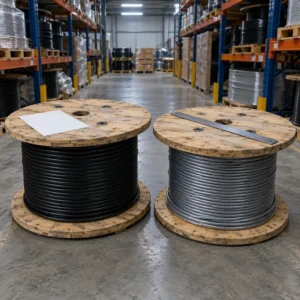
Transfer points are specified, not discovered. A delivery annex that names the re-marshalling hub, the branch junction and the transloading point lets the supplier write one securing spec for the whole chain and gives the inspection routine a list of points to photograph. The drum packaging behind that spec is the subject of our export packaging note; the corridor applies it at every lift, not once at the works.
Condition records ride the chain. A third-party check before departure, the scope in our note on third-party cable inspection, fixes the baseline; photographs at each named transfer close the gaps between them. Damage found at arrival with no record in between is unattributable, and unattributable damage is negotiated, not claimed.
Transit Regimes and Transit Documents
Kazakh transit runs on a declaration that promises the goods will exit. The consignment travels under transit documents with the corridor’s customs authorities, sealed where the regime requires, and the regime closes at the declared exit gateway or destination. The declaration must match the commercial set line by line: the invoice, the packing list and the drums on the wagons describing the same cargo.
The transit regime also asks for its security: a guarantee or deposit against the duty that would apply if the goods never exit, released when the transit closes properly. Who carries that guarantee, and who pays its fee, is a contract question; leaving it to the forwarder’s defaults is how a supplier funds a corridor he does not sell into.
Certificate scope travels the whole chain. The market access certificate for the final destination must cover every construction in every wagon, because the transit inspection checks what the destination will demand, and a scope gap discovered mid-corridor stops wagons in a yard the buyer cannot visit. The certificate routes are in our note on cable import certification by country, and the pack behind them is in our power cable certification checklist.
Handing On: Uzbekistan, Kyrgyzstan and Beyond
At the handover gateway the Kazakh transit closes and the next country’s regime opens, with its own declaration, its own broker and its own inspection queue. Pre-alerting that broker is the same discipline as pre-alerting the first one: documents before drums, so the handover is a signature rather than a discovery.
Beyond the handover the chain branches. Uzbek trunk lines run on to Tashkent and the industrial corridors; Kyrgyz and Tajik destinations leave the rail system early and continue by road through the passes, with the axle limits and transloading those legs carry. Each branch re-asks the arrival question: who unloads, what equipment, and on what schedule.
Where the volumes or the calendar justify it, the corridor’s southern options connect to the Caspian routes, and the ocean alternative is described in our note on cable sea freight. The corridor and the sea-rail lane are competitors for the same drums; the delivery annex should say which one it priced.
Dwell, Storage and Who Pays
Dwell is the corridor’s silent invoice. Yards bill storage, transit regimes penalise expired declarations, and every day of dwell pushes the arrival window the site is planning around. The causes repeat: paper mismatches, missed re-marshalling connections, a branch line with a queue, or a consignee who was not ready.
Allocate the dwell before it happens. The delivery annex should say who bears storage at each named transfer, whose guarantee covers the transit, and what happens to the calendar when a dwell event exceeds a stated allowance. Defaults are not neutral; they usually read towards whoever has less paper.
Transit time and price validity are the same argument wearing two clauses. A corridor run that extends past its quoted window moves the copper market against a fixed price, and the basis clause is the defence; its mechanics are in our note on copper price lock contracts. Contract the window and the validity together, or they will disagree productively.
Arrival and the Handover File
Arrival at the destination terminal is where the file closes. The quantity check runs against the packing list, drum condition against the transfer photographs, and the quality dossier, passports, certificates and protocols per drum, against what the acceptance regime demands. A file aligned since departure turns arrival into a formality.
Where damage is found, the inspection decides the outcome. The arrival inspection routine and the criteria for accepting or rejecting a drum are set out in our note on site cable inspection and replacement criteria, and the baseline they compare against is the pre-departure record, which is why that record was worth commissioning.
The last mile follows the same logic as anywhere in the region: unloading equipment at the terminal, road transport sized to the drums, and a site window that honours the schedule. The arrival duties are set out in our note on site delivery and offloading, and the planning that books them belongs to the same calendar as the wagons, as our note on cable MOQ and lead time describes for the production end.
The Transit Chain Map
The table lines up the stages a transit consignment passes through and what each one decides.
| Stage | What Happens | What Decides It | Cost of a Failure |
|---|---|---|---|
| Gateway exit yard | Transit regime opens, wagons enter the corridor | Transit declaration matched to the cargo | Yard dwell on a mismatched line |
| Hub re-marshalling | Through-train assembled or wagons re-secured | Whether a through-slot was booked | Extra handling and securing risk |
| Corridor run | Trunk transit under sealed transit documents | Transit window written into the annex | Copper moving against a fixed price |
| Handover gateway | Kazakh transit closes, next regime opens | Broker pre-alerted with documents | Queue time at the next border |
| Destination terminal | Quantity, condition and dossier checked | File aligned since departure | Damage negotiated, not claimed |
The Transit Freeze List
These are the corridor decisions to freeze before the drums enter it.
| Item to Freeze | How to Write It | Evidence to Attach | Cost of Leaving It Blank |
|---|---|---|---|
| Chain shape | Through-train or re-marshalled, named in the annex | Booking confirmation | A transit quoted in the wrong shape |
| Named transfers | Hub, junction and transloading points listed | Securing plan keyed to the list | Damage with no attributable step |
| Transit guarantee | Who carries the regime security and its fee | Guarantee draft | Supplier funding a corridor he does not sell into |
| Certificate scope | Destination certificate covering every wagon's constructions | Certificate copy with scope list | Wagons stopped mid-corridor |
| Transit window | Range per leg, with the price validity tied to it | Quoted transit with validity | Window and validity contradicting |
| Dwell allocation | Storage responsibility at each named transfer | Transfer point tariff notes | Dwell billed to whoever has less paper |
| Arrival checks | Quantity, condition and dossier routine at the terminal | Pre-departure inspection record | Arrival claims without a baseline |
When a Through Quote Is Not the Answer
When the quote assumes a through-train that does not exist. Volumes and slot supply decide the chain shape, and a quotation priced on one shape cannot be delivered in another. Ask which shape was priced, and re-quote when the answer changes.
When the transit regime is treated as the destination’s customs. Transit closes at exit or delivery; it does not import. A consignment that needs to enter the Kazakh market, rather than cross it, runs a different declaration, and mixing the two stops wagons at the wrong gate.
When dwell is priced as if it were free. The cheapest corridor quote with no dwell allowance is not the cheapest chain. Yards bill storage and regimes bill expired declarations; allocate them before the first transfer, not after the first invoice.
When the branch line is the real project. A trunk transit that ends in a pass road with axle limits and a queue is a different delivery from the one quoted. Quote the branch honestly, including the transloading it always costs.
When the file is being assembled at arrival. If passports, transfer photographs and the inspection baseline only come together when the drums do, the chain was run on hope. Assemble it before the gateway and arrival becomes arithmetic.
RFQ Checklist
- Corridor shape named: through-train or re-marshalled, per consignment
- Transfer points listed and the securing plan keyed to them
- Transit guarantee and its fee assigned in the delivery annex
- Transit declaration line-matched to invoice and packing list before departure
- Destination certificate scope covering every construction on the wagons
- Next-country broker pre-alerted before the handover gateway
- Transit window per leg written with the price validity tied to it
- Storage responsibility at each named transfer allocated
- Pre-departure inspection commissioned as the condition baseline
- Arrival routine defined: quantity, condition and dossier checks at the terminal
Conclusion
The corridor is where a Central Asian cable delivery is actually made: not at the factory, not at the site, but in the yards and handovers between them. A chain with named transfers, a funded transit regime and a window tied to its validity runs to time; a chain specified only at its endpoints is re-discovered at every yard, at dwell rates.
Kexingyu Cable Group (KXYE) delivers the corridor as a specification: named transfer points, securing plans keyed to every lift, transit papers matched before the gateway and a handover file that closes at the terminal. Send the destination and the consignment volumes. A request for quotation is the fastest start.