Concrete Pump Cable: Specifying Boom, Remote Control and Supply Cable
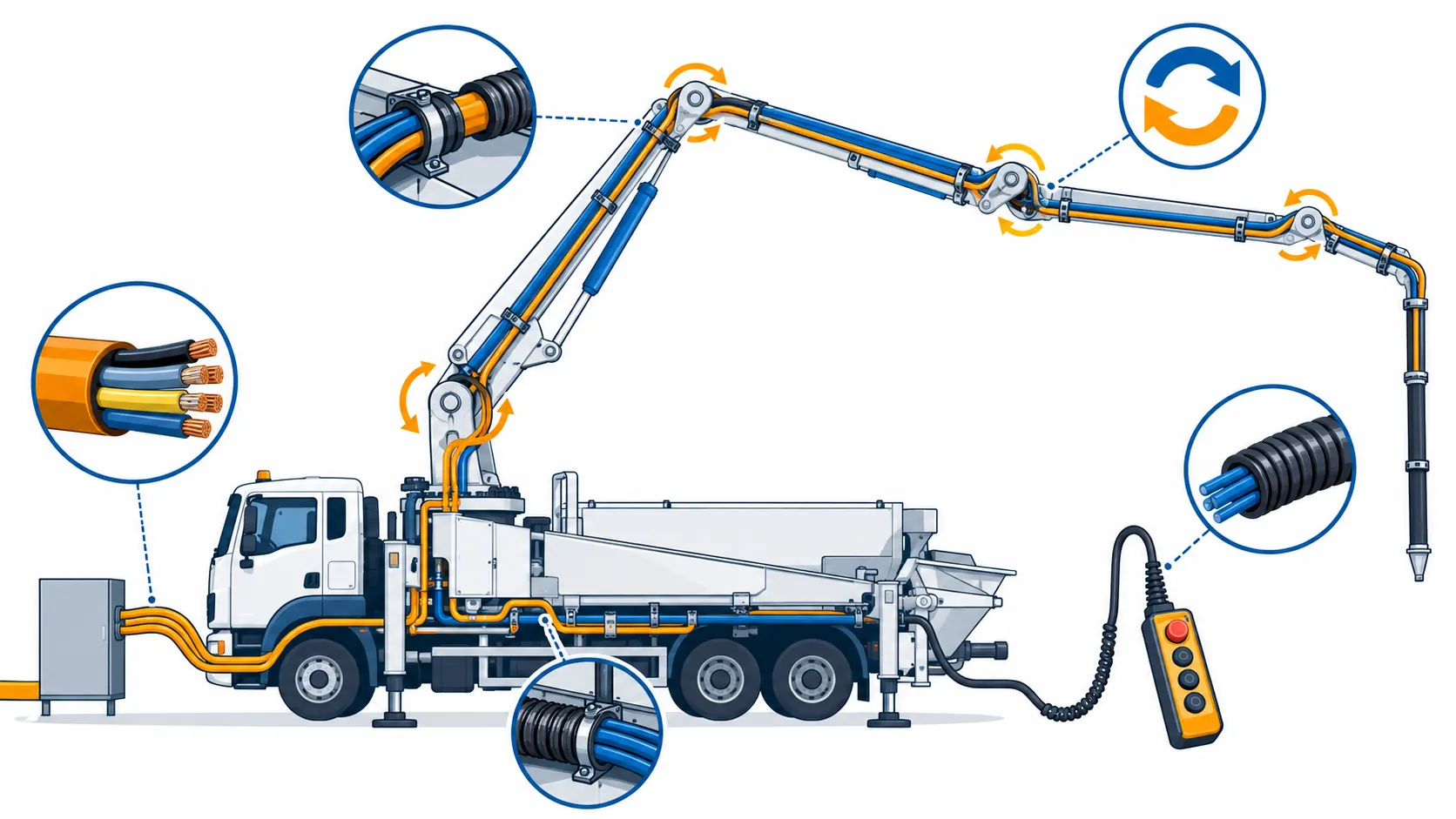
Quick Answer: A concrete pump or placing boom buys three cable populations: the main supply, the remote control feed, and the circuits that live on the boom itself. Each fails differently. The boom cable flexes and twists with every slewing movement, the control feed is handled constantly and blamed for everything, and the supply is ordinary drag duty. Specify the boom circuits for torsion and flex cycles, the control feed with proper screening, and freeze the boom geometry before ordering anything.
Introduction
Concrete pumps and placing booms concentrate three electrical environments into one machine. The chassis and main supply live the ordinary life of site plant. The boom is a moving structure that flexes and twists its cabling at every slew, fold and pour. And the operator’s remote control, the cable everyone handles, becomes the default suspect whenever anything on the machine misbehaves.
That mix makes pump cable a procurement job about matching construction to position on the machine, not about one specification. Get the positions right and the machine runs a season without electrical downtime; get them wrong and the failure repeats, usually at the worst moment of a pour.
What Pump Duty Does to Cable
Slewing and folding. The placing boom twists its cable bundle every time it slews and folds at every reposition. The cable sees combined bending and torsion at low cycle counts but high severity, and a straight flexible construction corkscrews and fatigues over a season.
Vibration. The pump itself is a hammer. Circuits on the chassis and boom live in constant vibration, which works loose terminations and fatigues conductors at clamps long before insulation ages.
Washdown and slurry. Cement slurry is alkaline and gets everywhere; the machine is washed daily. Sheaths and glands take water, cement and steam cleaning, and cement dust tracks moisture into anything not sealed.
Handling. The remote control pendant and its feed are coiled, dropped and stood on every shift. The control feed is the most handled cable on the machine.
The Three Cable Populations
Main supply. Drag duty from the site supply to the machine, or a short drum feed on self-propelled units. A heavy rubber connecting construction sized for the pump’s starting current covers it; the interesting part is the voltage drop on long feeds and the plug the site provides, both covered below.
Boom-mounted circuits. Whatever travels the boom: solenoid and valve feeds, boom lights, sensors, and any communication to the end of the boom. This is torsion-and-flex duty, and it needs a construction rated for combined bending and twisting, not a general shielded flexible cable. Our notes on torsion cable for rotating applications and on cable bending cycle life cover how those ratings are built and tested.
Remote control feed. Where the pendant is cabled rather than radio, the feed is a screened multicore that gets handled like a tool lead but carries the machine’s control signals. Screening quality decides whether the pump’s own drives put noise into its commands; a shielded construction with proper coverage and a drain, terminated to the machine’s scheme, is the difference. Constructions of this type are covered in our note on shielded rubber control cable.
| Population | Duty | What to Specify | Evidence to Demand | Cost and Lead-Time Driver | How It Fails |
|---|---|---|---|---|---|
| Main supply feed | Drag or short reel, high starting current | Heavy rubber sheath, fine-stranded conductor sized for starting, length matched to site reach, plug compatibility | Conductor resistance figures, starting dip calculation for the site feed | Stock constructions; copper content dominates | Voltage dip at pump start, cuts at crossings, crushed sections under vehicles |
| Boom-mounted circuits | Combined bending and torsion at every slew, vibration, washdown | Torsion-rated flexible construction, screen arrangement, sheath resistant to cement slurry, clamp and gland schedule | Torsion and flex cycle test at boom geometry, screen coverage figures, sheath chemical resistance | Torsion-rated construction carries a premium; boom lengths set footage | Corkscrewing, conductor fatigue at boom pivots, chafing at clamps, screen damage |
| Remote control feed | Constant handling, coiling, drops, noise environment | Screened multicore with drain, fine stranding, robust sheath, length that reaches the operator's position | Screen coverage and coupling data, flex test for pendant duty | Small order line; screening grade sets the difference | Intermittent control faults blamed on the pump, broken conductors at the pendant boot |
| Chassis and fixed circuits | Vibration only, no movement | Standard flexible constructions, gland and clamp discipline, vibration-rated terminations | Standard test certificates | Commodity; installation quality decides life | Terminations working loose, chafe at a missing clamp |
Torsion and Flex: The Boom Specification
Boom cable fails at the pivots and the clamps, and the specification that matters is the cycle rating at the boom’s real geometry. State the slew angle, the fold geometry and the number of slewing cycles the machine actually does per shift, then require the flex and torsion test to have been run at that geometry. A general flexible cable claims flexibility; a torsion-rated construction is built so the cores and screen survive the twist, and the difference is visible in month six. Whether a circuit needs torsion rating or ordinary high-flex is a duty question, and our comparison of high-flex versus standard cable gives the dividing lines.
The clamps and glands are half the specification. Boom cable that is correctly built but clamped too hard, or glanded without strain relief, fails at the clamp. Ask the supplier to state clamp widths and gland types with the cable schedule, so the fit is designed rather than improvised on the machine.
Main Supply and Starting
The pump’s main feed looks like the simplest line in the order and is the one most often undersized.
Starting current. Hydraulic pumps start against load, and the draw at breakaway is several times running current. On a long site feed the dip at start trips the machine’s own protection or browns out everything sharing the board. Give the supplier the starting current and the feed length, and ask for the starting dip calculation with the quotation rather than after the first stall. Where the site runs several machines from one board, sequence the starts, or the board sees every machine starting at once.
Route and protection. The feed crosses the same traffic as everything else on site, so specify heavy sheath, and route it where the mixer trucks do not park. Where the feed passes work areas, a barricaded route is cheaper than replacing the cable monthly. The plug and board interface belongs in the schedule too: a machine delivered with a plug the site board cannot accept loses half a shift.
Length discipline. Order the feed to the site’s real reach with modest slack, not a drum length left over from the last job. Excess cable coiled at the machine is a heat and trip hazard, and shortfalls mean a jointed run, which is a maintenance item for the life of the job.
Chassis Discipline: Clamps, Glands and Vibration
The fixed circuits on a pump fail rarely as cable and constantly as installations, because vibration works loose what assembly left slightly wrong. Three clauses in the delivery documentation buy most of that life back.
Clamp schedule. Every bundle on the chassis and boom gets a clamp at the stated spacing, with the width matched to the cable so the sheath is held without crushed spots. Missing clamps turn any vibration duty into a chafe test.
Glands and sealing. Washdown drives water and cement into every unsealed entry. Specify glands rated for the washdown, and torque values for reassembly, so the crew re-fits things the way the supplier intended.
Termination checks. Add a re-torque of chassis terminations to the maintenance schedule for the first month in service. Vibration finds the loose ones early; after that the machine settles into ordinary service, and a clamp check costs minutes against a chafe fault that costs the pour.
The Control Feed: Small Cable, Large Blame
Cabled pendants are unfashionable but common, and their feeds generate disproportionate downtime because every intermittent fault gets blamed on them. Two procurement choices reduce that.
Buy the screening honestly. State the coverage, the drain arrangement and the termination scheme, and buy a construction tested for flex life at pendant duty. A screen that survives coiling is worth more than a higher coverage figure on a cable that cracks at the boot.
Standardise the spare. A spare control feed on the truck turns a day’s diagnosis into a five-minute swap, and it costs a fraction of one hour of pump standby. Specify the spare with the order.
What to Freeze Before the Order
| Decision | What to State | Evidence to Attach | Cost of Leaving It Open |
|---|---|---|---|
| Cable population per circuit | Boom, control feed, main supply or chassis, circuit by circuit | A cable schedule mapped to machine positions | One construction bought for four duties |
| Boom geometry and cycles | Slew angle, fold points, slewing cycles per shift | Boom drawing with the cable path marked | Flex cable specified for a duty that needs torsion |
| Screening scheme | Coverage, drain, termination scheme per control circuit | Screening concept matched to the machine's controls | Noise faults that never get diagnosed |
| Clamps and glands | Clamp widths, gland types and strain relief at each position | Termination schedule from the cable supplier | Failures at the clamps on correct cable |
| Sheath environment | Cement slurry, washdown, summer heat at the boom | Compound declarations with chemical resistance | Sheaths that chalk and crack in one season |
| Spare strategy | Spare control feed and repair kit carried on the machine | Spares list with the reasoning | A standby pump for a pendant fault |
Lead Time and Cost Structure
Main supply and control feed are fast lines: stock or short make-to-order, days to two weeks. Boom cable in torsion-rated construction is made to order against the boom length and core schedule, typically three to six weeks, and it is worth ordering against the machine’s commissioning or the boom’s next major service rather than the failure date.
On cost, the boom population is where the money is, and the premium over general flexible cable buys cycle life at exactly the points where downtime concentrates. Copper dominates the supply feed. Cement chemistry is hard on sheaths, so the compound declaration is worth reading; a sheath that hardens and cracks in slurry service was never a like-for-like comparison.
Incoming Inspection
Boom cable. Check length and marking, run continuity and screen tests end to end, and verify the core schedule against the machine’s drawing before the boom is climbed. A core fault found on the deck is a re-termination; found at the boom head it is a lift and a shift.
Control feed. Test the screen and cores, and coil a sample at pendant duty to confirm it survives handling before the old one is cut off the machine. For the acceptance sequence on moving constructions, our note on moving cable acceptance testing gives the checks in order.
When a Pump Cable Specification Is Not the Answer
When the clamp is the problem. Boom cable failing at one clamp position needs a clamp and strain-relief fix, not a heavier cable. The heavier cable fails there too, on a different schedule.
When the fault is a chafe point. A single worn edge on the boom structure cuts through any sheath eventually. Dress the edge, then re-fit.
When radio replaces the pendant. If the machine is converting to radio control, stop buying cable for it and put the budget into the spare boom cable instead.
When the noise is real. Control faults that move with pump speed are a screening and earthing scheme question. Replacing the feed with a better screen without fixing the termination scheme buys the same fault in a newer jacket.
RFQ Checklist
- Cable population per circuit: boom, control feed, main supply or chassis
- Boom geometry and slewing cycles per shift, with the cable path marked
- Core schedule per circuit, with screen and drain arrangement for control
- Torsion and flex cycle test at the declared boom geometry
- Sheath chemical resistance to cement slurry and washdown
- Clamp widths, gland types and strain relief per position
- Starting current for the main supply, with the site feed length
- Spare control feed and repair kit carried on the machine
- Continuity and screen test records per finished length
- Copper basis with validity window, and delivery against commissioning
Conclusion
Pump cable is bought well circuit by circuit: torsion-rated construction on the boom, honest screening on the control feed, and a stock-standard supply feed sized for starting. Freeze the geometry and the clamp schedule with the order, and the machine’s electrical downtime mostly disappears.
Kexingyu Cable Group (KXYE) has manufactured cable in Quanzhou since 1996, including screened control and torsion-rated flexible constructions for concrete pumps and placing booms, with the test documentation pump builders demand. Send us the cable schedule with the boom geometry, and we will come back with constructions per position, the evidence for each, and a delivery plan. The fastest route is a request for quotation.