Procuring Cable and Busway for Desert Data Centers: Heat, Dust, UV and What to Specify
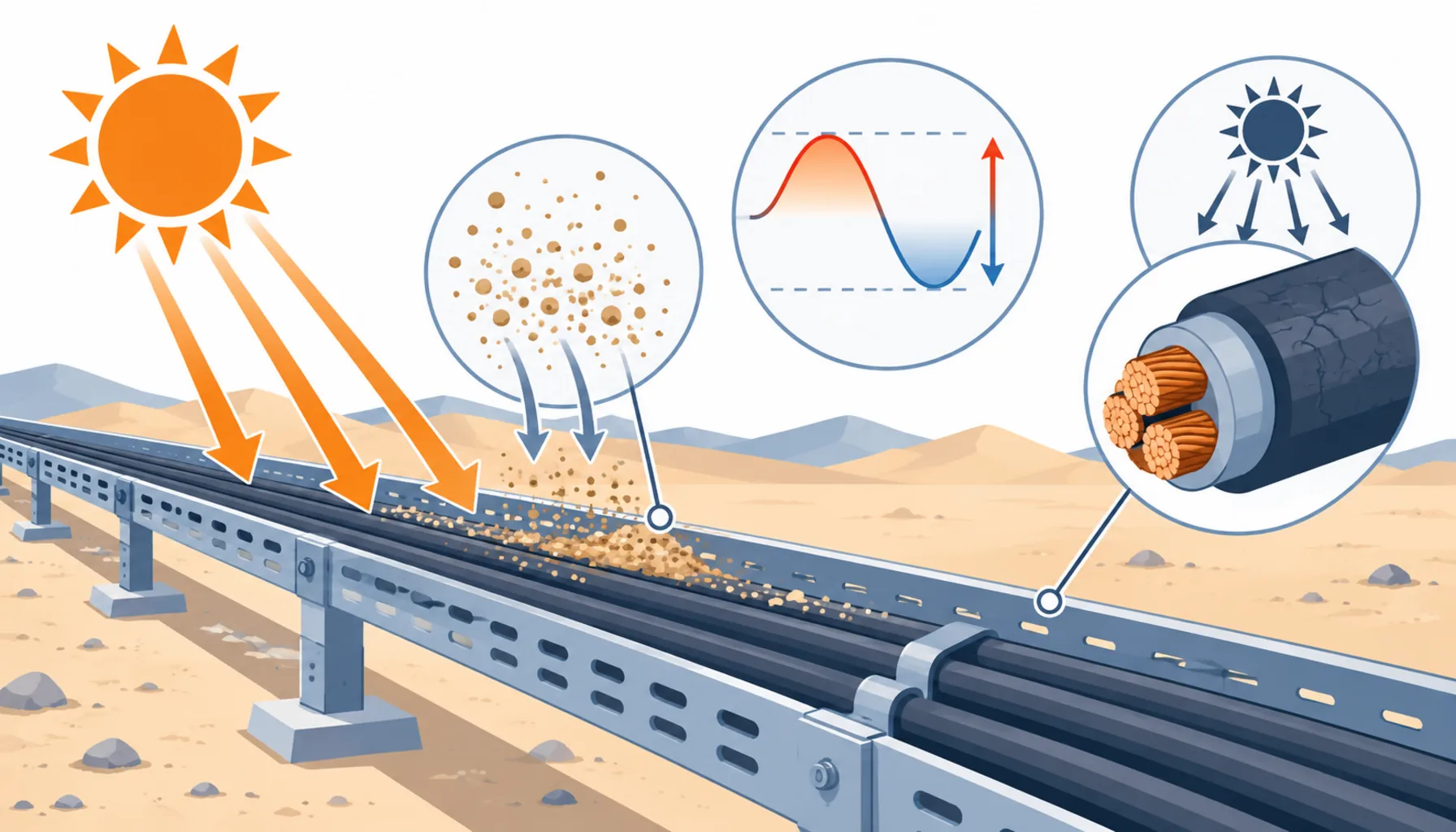
Quick Answer: A desert site does not just run hot. It applies sustained ambient heat, direct solar gain on every outdoor surface, airborne sand that settles in trays and on insulators, and a daily temperature swing that works on joints and gaskets. Each of those is a specification input, and the one that catches buyers most often is solar gain: a tray in full sun runs far hotter than the air temperature that the rating table assumes.
Introduction
Data center projects in the Gulf and North Africa have a straightforward capacity problem dressed as a cable problem. The cooling plant is designed for a design dry bulb that can exceed 45 °C, the outdoor distribution runs sit in that heat all day, and the cables inside them have to be rated for conditions that a European catalogue does not describe.
None of this is exotic. It is standard practice on utility and industrial work in the region, and the equipment exists. What goes wrong on data center projects is that the environmental inputs are treated as a footnote to a specification written for a temperate site. Our notes on the region cover the sourcing picture in Middle East power equipment sourcing and the country detail in Saudi Arabia data center cable; this note covers what the environment does to the selection itself.
What the Desert Environment Does to a Cable Installation
Four effects matter, and they compound rather than add.
Sustained ambient heat. The rating basis is the design ambient temperature, and in this region that is a summer afternoon figure rather than an annual average. Selecting on an annual mean can cost twenty percent of the available capacity, and the mistake is invisible until the hall is loaded.
Solar gain on outdoor surfaces. Direct sun raises the surface temperature of a tray or a busway enclosure well above air temperature, and the cable inside follows. The temperature to use in a rating calculation for a sunlit route is not the air temperature, and the rating table does not mention it.
Airborne sand and dust. Sand settles in tray runs, where it adds weight and insulates the cables from the air that is supposed to cool them. On insulators and bushings it forms a conductive deposit, which reduces the effective creepage distance and is a design input rather than a maintenance nuisance.
Diurnal swing. The difference between midday and night can be thirty degrees or more. Long runs move, joints and gaskets cycle, and any enclosure that is not designed for that movement will find the weakest point on its own.
Ultraviolet radiation belongs on the same list, as a material selection input for sheaths, gaskets and non-metallic enclosures.
The Decision Table: Four Route Options and What Each One Demands
The four options below are the choices a data center buyer actually makes outdoors. The solar gain column is the one that most often changes the answer.
| Route Option | What You Are Buying | What to Specify | Evidence You Should Receive | Heat, Dust and Cost Shape |
|---|---|---|---|---|
| Shaded or ventilated tray | Steel tray with a sun shield or a ventilated cover, on elevated supports with clearance for cleaning | Ambient plus solar gain basis, shield material, UV performance and the sand clearance detail | Rating calculation using the sunlit temperature, plus tray load and support data | Modest cost for a real capacity gain; needs a maintenance route for sand removal |
| Buried duct or direct burial | Cable that never sees the sun, in duct or in a sand-bedded trench | Soil thermal resistivity, burial depth, duct backfill and the derating basis for the soil | Soil thermal resistivity data, burial calculation and depth records | Removes solar gain entirely; the design now depends on soil data that is often assumed |
| Outdoor busway | A sealed busway run with the ingress protection and thermal design for the site | Ingress protection rating, UV and temperature rating, expansion provision and tap-off positions | Type test data at the rated ambient, IP certification and thermal test results | Highest unit cost, lowest site labour; expansion and sealing are where the failures occur |
| Indoor-only distribution | Short outdoor links and all distribution inside the conditioned building | Minimum outdoor exposure, cable selected for the transfer route only | Route drawings showing exposure length and rating basis per segment | Avoids the problem rather than solving it; requires the building to be larger and the layout to suit |
What Each Option Changes in the Order
The environmental inputs convert into four items that should appear in the enquiry.
The rating basis becomes explicit. The order should state the design ambient, whether solar gain has been included, and the installation method assumed. Where a route is partly shaded and partly exposed, the rating should be taken from the worst segment rather than averaged over the run. The general position on how these terms combine is set out in our note on cable derating factors.
Sheath material becomes a specified grade. A compound selected for ultraviolet performance is a different product from a standard grade, and the difference is documented in type tests rather than in a description. Where the run is exposed, the sheath requirement belongs in the specification as a performance property. Ranges built for this position are described in our note on UV resistant cable.
Sand becomes a design load and a clearance detail. Trays should be sized and supported for the weight of settled sand, and the supports should leave a gap that can be cleaned. A tray that fills with sand and is never cleaned is a tray that runs hotter than the calculation assumed, and the calculation is not wrong, the maintenance assumption is.
Busway selection adds an environmental layer. Ingress protection, expansion provision and the rated ambient all move together, and a busway specified for an indoor switchroom is not automatically suitable outdoors. The comparison between the two technologies is set out in our note on busway versus power cable, and the tap-off hardware that has to match the outdoor rating is described in our note on busbar tap-off boxes.
Where Desert Projects Fail
Rating taken from an annual average. The capacity case is built on a temperature that occurs for two months of the year rather than the one that occurs in July, and the equipment then runs at its actual limit for a season every year.
Solar gain left out because the route was assumed to be shaded. Shading changes with time of day and season, and a route shaded at commissioning may not be shaded at noon in midsummer once other structures are complete.
Sand treated as a housekeeping matter. Settled sand is weight, insulation and, on insulators, a reduction in creepage. Where the cleaning regime is not defined and resourced, the installation drifts out of the conditions it was designed for.
Sealing details bought from a temperate catalogue. Gaskets and enclosures rated for a mild climate can harden and shrink through a desert year. The enclosure is where an outdoor installation either works or leaks sand.
What to Freeze Before the Order
| Item | What to State | Evidence to Attach | Cost of Leaving It Open |
|---|---|---|---|
| Design ambient | The summer design temperature, and whether it is dry bulb air or a sunlit surface figure | The design basis with the source of the temperature record | Capacity that exists on the design documents and not in July |
| Solar gain treatment | Which routes are exposed, and whether the rating includes a solar increment | A rating calculation with the exposed segments identified | A derated route inside a shaded assumption, discovered at load commissioning |
| Sheath and jacket grade | UV performance, temperature rating and colour where it affects heat absorption | Type test data for the compound, including UV exposure testing | Sheathing that degrades in a few summers on a route that is expensive to rework |
| Sand loading and cleaning | Settled sand load allowance, tray sizing and the clearance provided for cleaning | Support and load calculations with the allowance shown | Trays sagging under unplanned load, or a cleaning job that was never in a budget |
| Pollution and creepage | The pollution level assumed for external insulation, and the creepage distance required | Insulation drawings with creepage distances stated against the requirement | Surface tracking or flashover on outdoor terminations during a dust event |
| Expansion provision | Expansion joints, movement allowance and the temperature range used | Expansion calculations across the diurnal and seasonal range | Joint damage that appears in the second or third year, in hard-to-reach places |
| Busway environmental rating | Ingress protection, rated ambient, UV performance and sealing detail | Type test reports at the rated ambient, with IP certification | An outdoor busway run that leaks sand and loses its rating in service |
| Outdoor terminations | Termination type, sealing method and the pollution level they are rated for | Termination qualification for the environmental conditions | An outdoor termination failing in the first hot season, with the hall already energised |
When a Standard Product Is Not the Answer
Where the site specification has been copied from a temperate project. The most common failure in this region is not a wrong product but a right product specified for the wrong environment. Ambient, solar gain, pollution and UV all have to be restated as site values before the enquiry goes out.
Where the solution is a shade structure rather than a heavier cable. Upsizing the conductor to recover solar gain capacity is one answer; shading the route is often cheaper and physically effective. The comparison should be made, and it should be made with the same capacity figure on both sides.
Where buried cable is assumed to remove the problem. Burial removes solar gain and replaces it with soil thermal resistivity, which must be measured or conservatively assumed. A burial design built on a resistivity borrowed from another site is a guess with a cable attached.
Where cleaning is the mitigation for sand. Cleaning works when the regime is defined, resourced and inspected. Where it is aspirational, the design should assume partial sand coverage rather than clean trays, because that is the condition the cables will actually see. Our note on data center cable selection covers how the route environment feeds back into the cable choice for the in-building segments.
RFQ Checklist
- Summer design ambient stated, with the source of the record and whether solar gain is included
- Exposed and shaded segments identified per route, with the rating taken from the worst case
- Sheath compound specified for UV performance, with type test evidence requested
- Settled sand load allowance stated for tray sizing and support design
- Cleaning access and clearance defined, with the regime that will maintain it
- Pollution level and required creepage distance stated for outdoor insulation
- Expansion provision calculated across the diurnal and seasonal temperature range
- Outdoor busway rated for the site ambient, with ingress protection and UV performance stated
- Outdoor terminations specified for the pollution level, with qualification evidence
- Buried routes supported by measured soil thermal resistivity rather than an assumed value
- Shading options priced against conductor upsizing before the route is fixed
- Maintenance and cleaning actions carried into the operations plan, not left as a recommendation
Conclusion
The desert environment is unforgiving in a particular way: nothing it does is unexpected, and everything it does is written into the load case already. The projects that go wrong are the ones where the environmental inputs existed in the design basis and never reached the purchase order. Restating ambient, solar gain, sand and UV as specification values costs a paragraph per package and removes the whole class of problem.
Kexingyu Cable Group (KXYE) supplies cable and distribution equipment for hot and dusty sites, including the WDZ-YJY, WDZN-YJY, BTTZ, NG-A (BTLY), KVV and YJV ranges, the weather resistant cable range used on exposed outdoor routes, and the KYN28 medium voltage switchgear used on the incomer and distribution bays, all from one factory group with copper price linkage available on project-scale orders. Send the design ambient, the route conditions and the pollution level, and we will return the ratings, the sheath options and the test records that support them; the fastest route is a request for quotation.