Buying Exoskeleton Cable for Wearable Robots: Weight, Twist and What to Specify
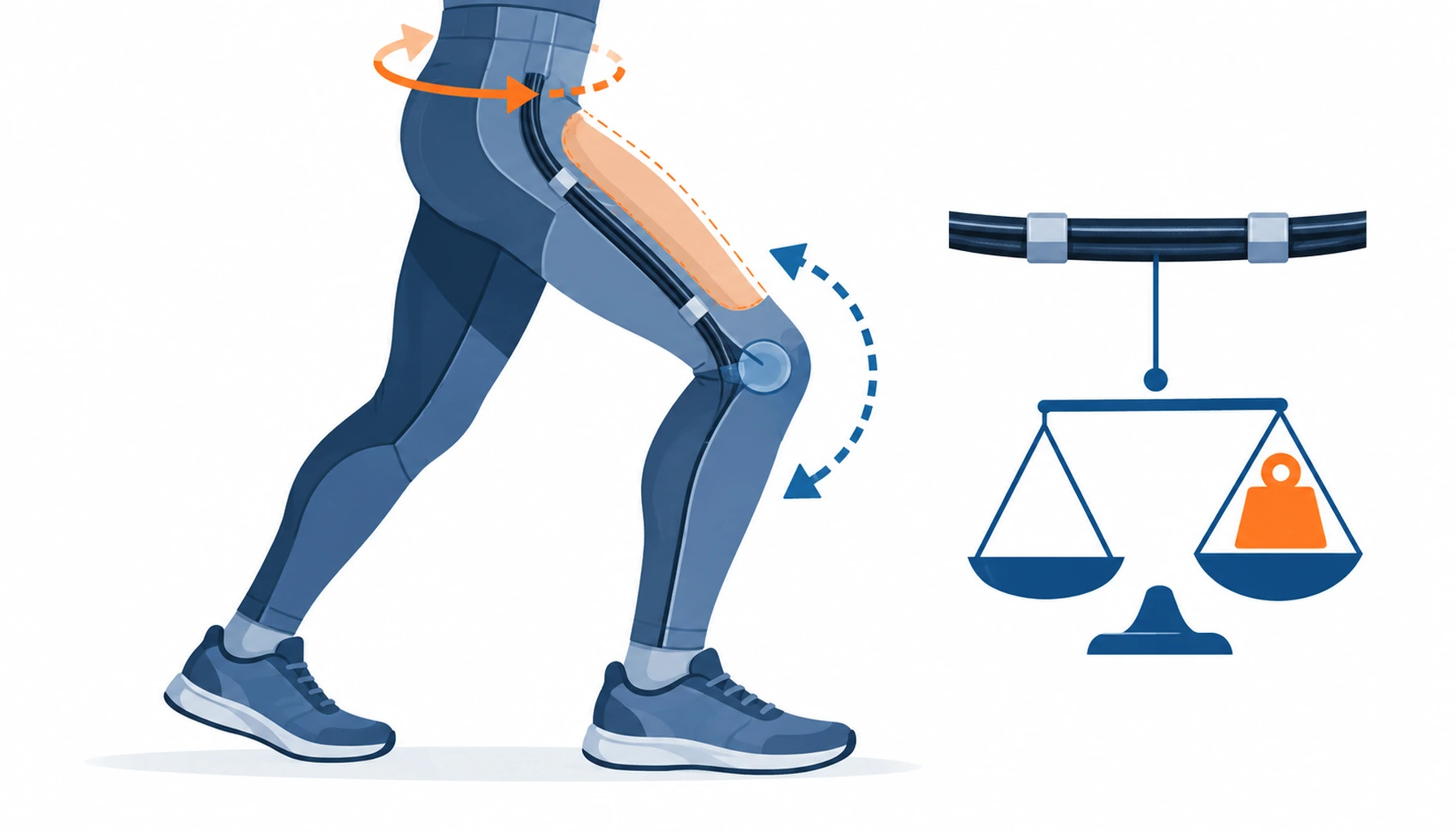
Quick Answer: On an exoskeleton the cable is carried by a person, not by a machine. That makes weight a specification, torsion a real failure mode rather than a special case, and body contact a purchasing question rather than a design footnote. The four numbers to fix before you order are grams per metre, the twist angle at the hip or shoulder, the bend radius around the joint, and the temperature the cable will actually see.
Introduction
Rehabilitation and assistive devices sit between robotics and clothing, and the cable has to satisfy both. It cannot be sized the way an industrial harness is sized, because every metre of it is lifted thousands of times a day, and it cannot be treated as a garment either, because it carries the current that moves the joint.
The industrial moving-cable rules still apply, and the comparison between continuous flex and drag chain duty in our note on flex versus drag chain cable is a useful starting point. What follows is the part that only appears once the machine is worn.
Weight Is the Specification Nobody Writes Down
A harness that weighs two kilograms feels trivial on a design table and becomes the first complaint from a patient after twenty minutes. The standard industrial approach of adding a thicker jacket, a screen and a sleeve to every run has to be traded against what the wearer can tolerate. Lightweight multi-core constructions designed for a moving vehicle, such as the multi-core automotive cable family, are a reasonable reference point for what a thin, tough, multi-conductor cable weighs.
Put grams per metre in the RFQ as a line item with a limit, not as an adjective. That single change forces the conversation onto conductor size, screen necessity and sleeve coverage in the right order. It also exposes the runs where a composite construction would remove a separate data cable and its own jacket, which is often the biggest weight saving available.
Weight also decides where the battery pack goes, and the cable that connects it. A pack worn on the belt has a fixed run with a flexible loop at the transition; a pack mounted on a thigh frame moves with the leg. The two are different cables, and the reasoning is the same as in our note on robot battery cable.
Twist, Not Just Bend, at Every Body Joint
A robot joint bends. A human shoulder and hip do both, and the cable that crosses them twists as the limb rotates. A construction that is excellent in repeated bending can fail early in torsion, which is why the twist requirement has to be stated separately with its own angle and cycle count. What torsion duty does to a conductor lay, and why a standard flexible build is not automatically suitable, is set out in our note on torsion cable construction.
Measure the twist rather than estimating it. The angle a hip run sees in normal walking is small; the angle it sees when a patient turns around, sits down and stands up in one session can be much larger. Ask the clinical team what the device must tolerate, because the range of motion they report is the number the cable will be bought against.
The evidence to ask for is a test at that angle and that cycle count, on the finished assembly. A torsion figure quoted for a bare cable does not describe an assembly with a connector on one end and a moulded transition on the other. The test methods that make the comparison meaningful are in our note on cable flex testing methods.
The Decision Table: Four Routing Strategies and What Each One Costs
| Strategy | What to specify | Evidence to demand | Cost and lead time | Where it fails |
|---|---|---|---|---|
| External run along the frame | Grams per metre, sleeve coverage and the attachment points | A weight per metre figure plus an abrasion figure | Lowest cost, standard lead time | Snagging on door frames and furniture |
| Integrated into the garment or strap | Route through the fabric, flex zone and how it is replaced | A flex figure for the sewn assembly, not the bare cable | Higher assembly cost, longer lead time | A cable that cannot be reached without unpicking the garment |
| Routed through the joint structure | Bore diameter, bend radius and clearance at full range | A layout drawing checked at full range of motion | Higher design effort, same build cost | Chafing at a bore that was never dimensioned |
| Flat or ribbon construction | Thickness, width, flex axis and torsion tolerance | A flex figure in the correct axis, plus a torsion figure | Higher unit cost, tooling lead time | Paying for flat where a round build routed better |
| Composite power, signal and data | Element list, zone separation and tail lengths | Construction data plus a termination first article | Higher unit cost, tooling lead time | Paying for composite where two thin cables were lighter |
Body Contact, Heat and the Safety Question
Two requirements appear on a wearable that never appear on a robot. The first is contact suitability: the sheath, any sleeve and any moulded transition sit against skin or against clothing all day. A material statement from the supplier belongs in the file, along with a note on odour and plasticiser migration, because these are the complaints that reach a clinic rather than a maintenance log.
The second is heat. Actuator current in a walking aid comes in peaks, and a cable carrying those peaks while pressed against a leg cannot shed heat into open air. Ask for a temperature rise record at the peak current with the cable in the worst-case installation, and route it so the warm section is not the one in contact. The mechanics are close to those described in our note on thermal paths inside robot arms, with a human tolerance added at the boundary.
Then there is snagging, which is a safety issue rather than a cable issue. A loose loop on a walking frame is a fall risk, and it is a design failure even if the cable itself never fails. Specify the loop supports and the attachment points with the same seriousness as the conductor size, and keep the external run as short as the mechanism allows.
Connectors You Can Don and Doff Alone
A wearable is put on by the user, often with one hand, sometimes with limited grip. That changes the connector requirement: keyed so it cannot be mated wrongly, large enough to hold, and latched so it does not release during use. The selection logic for that interface, including what to demand as evidence, is set out in our note on robot harnesses and connectors.
Where the device is used in a clinical setting, the same pressure applies in reverse: a therapist needs to remove the cable quickly. A connector that needs two hands and a tool is the wrong choice for a device that is donned and doffed several times a day.
What to Freeze Before the Order
| Item | What to state | Evidence to attach | Cost of leaving it open |
|---|---|---|---|
| Weight budget | Grams per metre, and a total for the harness | A weight figure for the finished assembly | A device that is rejected by users after one session |
| Torsion duty | Twist angle and cycle count per body joint | A torsion test at that angle on the assembly | A conductor lay that opens up in month three |
| Flex duty | Cycles and arc at each moving joint | A flex figure measured in the correct axis | A rating that describes the wrong motion |
| Bend radius | The figure for the assembled run around each joint | A flex figure at the tightest point of motion | Screen and core damage hidden inside the run |
| Contact suitability | Materials against skin or clothing, and how they are covered | A material statement plus a sample for smell and feel | A clinical complaint that has no engineering fix |
| Temperature window | Coldest and warmest use, including outdoor rehab | A low temperature flex figure at the coldest point | A stiff jacket that cracks on a cold morning |
| Peak current and heat | Actuator peak current and the duty ratio | A temperature rise record in the worst installation | A warm run against a leg and a shortened jacket life |
| Snag protection | Loop supports, attachment points and the external run length | A drawing showing every fixing at full range | A trip hazard the clinic will find before your test does |
| Connector handling | One-handed mating, keying and latch retention | A first article fitted by a user, not by an engineer | Mis-mating and a service call for a connector that is fine |
| Replaceability | Which runs can be replaced without unpicking the garment | A swap procedure and the tools it needs | A whole garment written off for one damaged run |
When an Exoskeleton Cable Specification Is Not the Answer
When the device is a research platform. A gait laboratory prototype with ten users does not justify torsion tooling or a custom compound. Buy a proven flexible construction, keep the runs short and accessible, and spend the budget on the experiment. Our note on research and education robot cable covers why laboratory duty misleads buyers about real life.
When the cable is being used to fix a mechanical problem. If the run is being replaced every few months at the same hip joint, and the continuity tests are clean, the joint has a sharp edge or an unsupported loop. No cable compound survives a mechanism that folds it tighter than its radius, so fix the geometry first and the specification second.
When nobody has measured the twist. Buying a torsion build on an estimated angle usually means paying for a construction whose properties nobody can check. Get the range of motion from the clinical team, and if the answer is uncertain, specify a build with margin and test it, rather than buying the most torsion-resistant cable on the list.
When the environment is genuinely clinical and controlled. A device used only in a heated rehabilitation gym does not need a cold-flex compound. That requirement belongs to outdoor and home use, and the family of products built for it is described in our note on low temperature flexible cable. Where the device also has to satisfy a regulated environment, our note on surgical robot cable covers the documentation side.
RFQ Checklist
- Weight per metre and a total harness weight limit, quoted as line items
- Torsion angle and cycle count at each body joint, with a test on the assembly
- Flex cycles and arc at each moving joint, measured in the axis of motion
- Bend radius given as a figure for the assembled run, not for a single core
- Material statement for everything that touches skin or clothing, with a sample
- Lowest and highest use temperature stated, with a cold flex figure at the coldest
- Actuator peak current and duty ratio, with a temperature rise record in situ
- Loop supports and attachment points shown on a drawing at full range of motion
- Connector specified for one-handed mating, keyed and latched
- Replaceable runs identified, with a swap procedure and the tools required
Conclusion
A wearable robot cable is bought on four numbers that rarely appear together on one datasheet: grams per metre, twist angle, joint bend radius and peak current heat. Put those four in the RFQ with a limit attached to each, and the technical arguments resolve themselves. Leave them out and they will be settled by the first user who finds the device uncomfortable.
Kexingyu Cable Group (KXYE) has supplied flexible and special cable since 1996, including torsion rated, lightweight multi-core and cold-flexible constructions for compact moving assemblies. Send us the weight budget, the range of motion and the current profile, and we will return constructions, sleeve options and sample assemblies for a user trial; the fastest route is a request for quotation.