Thailand and Philippines Cable Markets: Standards and Entry Routes
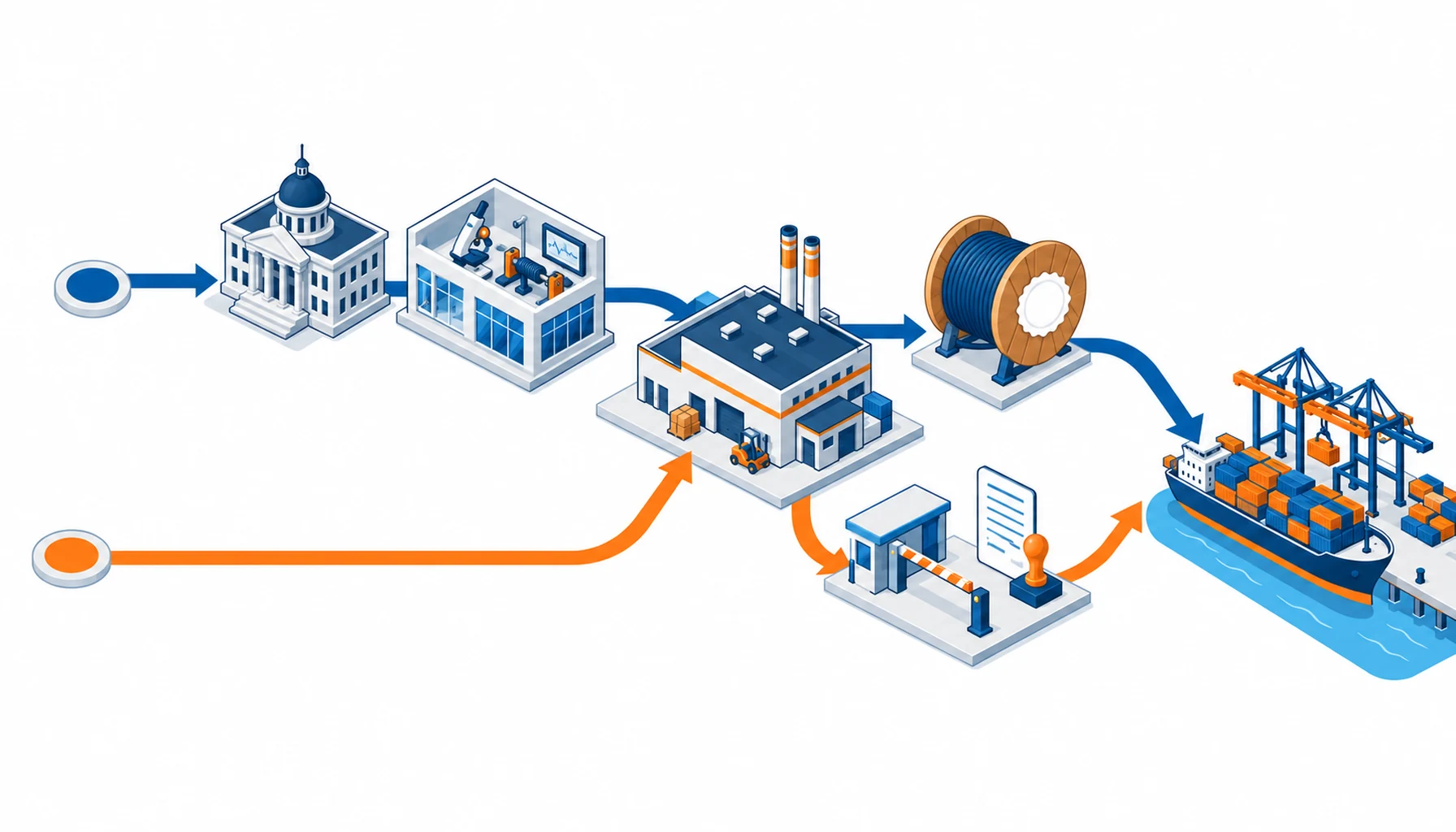
Quick Answer: Thailand guards its market with TISI plant licensing; the Philippines runs a BPS scheme with the PS mark plus per-shipment ICC clearance.
Thailand and the Philippines are two of Southeast Asia’s busiest construction economies — industrial estates, mass transit, grid upgrades and a data center pipeline that keeps expanding — and both regulate imported cable with mandatory conformity schemes. But the two gates are built differently. Thailand’s is a plant-level license with a national mark; the Philippines’ is a license-plus-shipment-certificate structure where the border does the matching. Buyers who treat “Southeast Asia” as one market discover the difference at customs. This guide maps both routes in a single read.
Introduction
The demand side of both markets is well understood: Thailand’s construction and data infrastructure boom, and the Philippine buildout from grid extensions to industrial parks, are among the region’s strongest cable demand stories, part of the regional picture in Southeast Asia data center power and its industrial-park demand engine. The supply side is where the two countries diverge. Thailand regulates through the Thai Industrial Standards Institute, TISI, which administers mandatory industrial standards and issues licenses bearing the TIS mark. The Philippines regulates through the Bureau of Philippine Standards — BPS, under the Department of Trade and Industry — whose mandatory list places common cable families under certification, with the PS mark for licensed manufacturers and the Import Commodity Clearance certificate for shipments. One scheme ends at the factory gate; the other continues through every consignment. Knowing which is which determines your schedule, your documents and your supplier choice.
Thailand: The TISI License and the TIS Mark
TISI’s scheme is the plant-license model this cluster has met repeatedly. A cable family on the mandatory list — building wire and common power cable constructions are covered by TIS standards derived from the IEC family — requires the manufacturer to hold a TISI license for that product before the goods can be imported or sold. The license is earned, not claimed: product samples are tested against the TIS standard at designated laboratories, and assessors audit the manufacturing plant to verify that production can reproduce the tested design consistently. The license names the plant, carries the TIS standard it certifies against, and keeps the factory on a surveillance cycle for its life. Drums carrying the TIS mark tie the physical product back to the license. For a foreign manufacturer, the process is the region’s heavy-gate pattern: months-scale, audit-bound, and issued in the factory’s name. That’s why a current TISI license ranks among the strongest factory-credibility signals available, per the reasoning in supplier vetting. At the border, Thai customs checks consignments of regulated goods against the licensing requirement, so the importer’s clearance depends on the exporter’s license — a dependency worth allocating in the contract, per the incoterms framing in FOB vs CIF for power equipment.
The Philippines: PS Mark and the ICC Route
The Philippines splits the job in two. The license layer: manufacturers of products on the BPS mandatory list may hold a PS Quality and/or Safety Mark license, earned the familiar way — through product testing against Philippine National Standards and a factory audit, with surveillance keeping it current. The shipment layer: imports of regulated products require an Import Commodity Clearance certificate, the ICC, issued by BPS per consignment after evaluation of documents and, where required, inspection and sampling. The ICC is the paperwork that clears the border; the PS mark is the manufacturing credential that supports it. The structure rewards disciplined paperwork: the certificate, the commercial invoice, the packing list and the drum markings must tell one consistent story about what the goods are and who made them — the one-source document discipline cataloged in international power equipment sourcing mistakes. For foreign manufacturers, the PS license is obtainable directly — BPS runs the same audit route for overseas plants as for domestic ones — and a supplier holding it converts the ICC from a recurring obstacle into a routine shipping step.
| Dimension | Thailand | Philippines |
|---|---|---|
| Authority | TISI (Ministry of Industry) | BPS (Department of Trade and Industry) |
| Core credential | TISI license with the TIS mark, issued to the plant | PS mark license for manufacturers; ICC certificate for each import shipment |
| Earning route | Testing against TIS standards plus plant audit, surveillance for license life | Testing against PNS standards plus plant audit; ICC per consignment at the border |
| Border role | Customs checks regulated goods against the licensing requirement | BPS issues the ICC that clears the consignment |
| Buyer emphasis | License holder and scope verified before supplier selection | License verified once, then per-shipment ICC discipline in the schedule |
What the Two Routes Share — and Where They Diverge
Upstream, the schemes rhyme: both rest on IEC-derived national standards, both prove the design by accredited testing, both audit the plant, and both reward the cluster’s four checks — holder, coverage, currency, marking — which are the same checks detailed in the power cable certifications checklist. Downstream they diverge in rhythm. Thailand’s gate is front-loaded: once the TISI license exists and its scope covers your constructions, shipments follow a conventional import path, and the planning problem is concentrated in supplier selection. The Philippines spreads the gate across every consignment: even with a PS license in place, each shipment needs its ICC scheduled — document preparation, evaluation time, and a buffer before the vessel’s cutoff — which turns certification planning into shipping planning, the same calendar discipline that governs cable sourcing delays and EPC timelines. Match the gate to the program. A one-off Thai project order pivots on the license search; a recurring Philippine supply program pivots on the ICC pipeline and an importer of record who runs it well.
| Stage | Action | Classic Trap |
|---|---|---|
| RFQ | Map each construction to TIS standards or the PNS mandatory list | "Southeast Asia" treated as one scheme in the RFQ |
| Selection | Verify TISI license or PS license: holder plant, scope, currency | License copy accepted without register verification |
| Contract | Allocation of clearance duties and ICC costs named explicitly | ICC timeline discovered after the vessel is booked |
| Shipment | One document set; markings consistent with the license scope | Invoice descriptions drifting from the certified construction |
| Arrival | Customs match; license and shipment identities reconciled | Mixed loads pairing regulated and unregulated families loosely |
When Standards Are Not the Whole Answer
Two boundaries keep the schemes in proportion. They are market gates, not engineering verdicts: a TIS mark or PS license proves the national standard’s minimums at an audited plant, while the project’s ampacity, voltage drop and fire strategy remain specification work, verified through type test reports and per-drum batch evidence under the IEC-derived framework mapped in our MV and LV standards guide. And both are scope-specific and evolving: the mandatory lists and the standards beneath them change, and the current status of a specific cable family is a register question at RFQ time. Where a construction sits outside the mandatory scope, absence of the mark isn’t a quality verdict. It’s a customs classification question to resolve before booking, with the engineering question answered by test reports and batch evidence.
RFQ Checklist: Entry-Route Lines for the RFQ
Put both markets’ questions in writing:
- Thailand: TISI license held for each offered construction — holder plant, TIS standard, scope and license number stated
- Thailand: license currency verified through TISI’s channels before supplier selection
- Philippines: PS mark license held, or the ICC route planned with per-shipment lead time budgeted
- Philippines: importer of record named, with BPS clearance duties allocated in the contract
- Test reports against TIS or PNS standards from recognized laboratories
- Drum markings consistent with the license scope on every consignment
- Document set — invoice, packing list, certificates — generated from one source, descriptions agreeing
Conclusion
Thailand and the Philippines ask for the same things — tested product, audited plant, consistent documents — but on different timetables. Thailand’s gate is the plant license you verify once and heavily; the Philippines’ is a license plus a per-shipment clearance you schedule forever. Buyers who map the right gate to the right program keep both markets open; buyers who assume one Southeast Asian scheme meet the difference at the port.
Kexingyu Cable Group (KXYE) supports Thailand- and Philippines-bound orders with accurate license-status disclosure, test reports aligned to TIS and PNS standards, and one-source document sets that keep the ICC pipeline, where it applies, a routine step rather than a surprise.