
Third-Party Cable Inspection: SGS, BV and TUV Pre-Shipment Checks
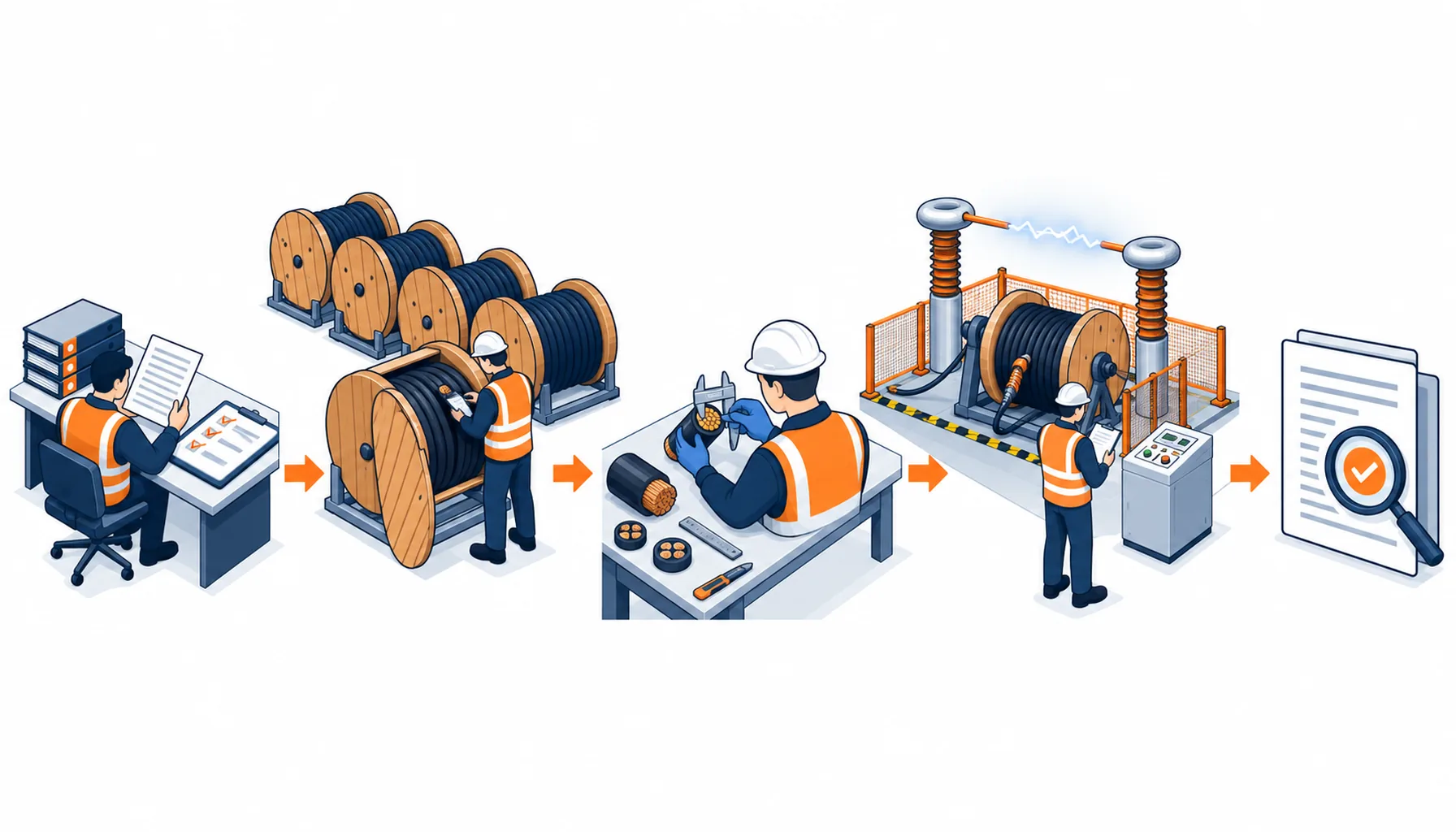
Quick Answer: A third-party pre-shipment inspection verifies quantity, marking, construction and documents before the drums sail — so the verdict comes from a party with no stake in it.
Everything a buyer knows about a cable order until the day it arrives comes from the seller: the quotation, the datasheet, the batch reports, the shipping photographs. A third-party inspection inserts one independent witness into that chain. An inspector from an agency like SGS, Bureau Veritas or TUV walks the factory floor, opens the drums, reads the reports and answers to you, not to the factory. For orders where the stakes justify it, this is the strongest single instrument in the sourcing toolbox. This guide covers what inspection can and cannot do, how to scale its scope, and how to brief it so the findings are worth the fee.
Introduction
Cable is unusually well suited to pre-shipment inspection because its quality signals are physical and checkable: drum counts, meter marks, printed designations, cut samples that show conductor and construction, batch reports keyed to drum IDs. An inspector doesn’t need the factory’s cooperation to measure a sheath or count a drum. The product testifies about itself. That’s why cable inspection delivers more verdict per dollar than inspection of many other products, and why experienced buyers of power equipment treat it as a standard milestone rather than a sign of distrust. The inspection sits at the end of a verification chain the buyer builds across the whole order: the supplier vetting structured in how to vet a Chinese electrical equipment manufacturer, the factory audit, the sample approval. It closes the loop by checking the delivered goods against all of them. It’s also the bridge between factory and site. The division of verification labor between the factory gate and the installation is mapped in our FAT vs SAT guide, and pre-shipment inspection is the factory-gate half of that map.
Why Cable Needs a Third Pair of Eyes
The buyer’s dilemma with cable is asymmetry: the product’s value is invisible inside its sheath, the shipment is large and heavy, and returning a rejected order is nearly impossible once it has crossed an ocean. The factory’s own quality system produces evidence, but the evidence is produced by the party selling the goods. Trustworthy when the factory is trustworthy, decorative when it’s not. The third-party inspector resolves the asymmetry three ways. Independence: the agency is paid by you and reports to you, so its incentives point at accuracy. Presence: an inspector standing at the line sees what no document records, such as housekeeping, handling, and whether the drums that shipped are the drums that were tested. And timing: findings arrive while the goods are still in the factory, when the fix is a re-roll or a reprint rather than a claim fought across a customs border. The economics are one-sided for any order of consequence. The inspection fee is a rounding error against the cost of a rejected or failing shipment, and against the schedule damage cataloged in cable sourcing delays and EPC timelines.
The Scope Ladder: From Visual Check to Witnessed Testing
Inspection scope is a ladder, and the buyer chooses the rung. The basic rung is visual and documentary: drum count and condition, marking completeness, cable ends sealed, packing per the specification, and the shipping document set against the purchase order. The middle rung adds physical sampling: cutting samples from selected drums to measure conductor, insulation and sheath against the datasheet, photographing construction, and checking meter marks against the stated lengths. The top rung adds witnessed testing. The inspector selects drums, watches the factory run the routine tests on those drums, such as conductor resistance and high-voltage withstand, and signs the results as witnessed. Scope should match stakes: a repeat order from an audited supplier justifies the basic rung, while a first order, a customized construction or a project-critical feeder justifies the top. What matters is that the scope is written before booking. An inspector told to “check everything” checks what is easy, and an inspector with a checklist checks what you specified.
| Scope Rung | What the Inspector Does | When to Use |
|---|---|---|
| Visual and documentary | Drum count, condition, marking, packing, documents vs purchase order | Repeat orders from audited suppliers |
| Physical sampling | Cut samples measured against datasheet: conductor, insulation, sheath | New suppliers, new constructions, price-sensitive orders |
| Witnessed testing | Selects drums, watches routine tests run, signs witnessed results | Project-critical orders, MV lengths, customized constructions |
| Full PSI with loading check | All of the above plus container loading supervision and seal numbers | High-value or consignment-sensitive shipments |
What the Inspector Actually Checks on Cable
On the floor, a well-briefed cable inspection runs a fixed sequence. First identity: drum IDs on the drums against the batch reports, meter marks against the stated lengths, printed designation against the purchase order, all character by character, because printing errors are common and cheap to fix now. Second condition: drums undamaged, lagging intact, cable ends sealed, packing matching the export specification. Third construction: samples cut from the agreed number of drums, covering conductor diameter and strand count, insulation and sheath thickness, armor lay where present, measured against the datasheet and photographed. Fourth documents: the batch report values against the standard’s limits, the test report naming the exact construction, certificates matching the order. Fifth, where scope includes it, the witnessed tests on selected drums. Each step produces a pass, a fail or a photographic record, and the sequence ends with a findings list the factory can act on immediately, whether that means reprinting a drum, re-testing a length or resealing an end, before the container doors close.
| Step | Check | What It Catches |
|---|---|---|
| Identity | Drum IDs, meter marks, printed designation vs order | Wrong construction shipped, untraceable drums |
| Condition | Drum damage, lagging, sealed ends, packing | Transit-bound damage, moisture exposure |
| Construction | Cut samples: conductor, insulation, sheath measured | Undersized conductor, thin insulation, wrong compound |
| Documents | Batch reports vs limits, certificates vs order | Generic reports, family certificates, missing values |
| Witnessed tests | Routine tests run on selected drums, results signed | Untested or selectively tested production |
| Loading | Container loading, restraint, seal numbers | Unrestrained drums, mixed loads, lost traceability |
Booking and Briefing: Where Inspection Is Won
Most disappointing inspections are briefing failures, not agency failures. Book against the production and packing schedule. The inspection happens after packing is complete and before container loading, with enough margin that a failed finding can be corrected without missing the vessel. Brief the agency with documents, not intentions: the purchase order, the approved datasheet, the sample approval record, the drum-marking specification, the batch report format, and the inspection checklist with pass criteria. State the sampling plan, meaning how many drums, which tests witnessed, and AQL or 100 percent for markings, and state the reporting format: findings with photographs, same-day preliminary results, and a written report within the agency’s standard turnaround. Name the escalation path: who at the factory receives findings, and what happens on a critical fail. An agency briefed this way produces a report that reads like an engineering verdict. An agency briefed with “inspect our cable order” produces photographs. The briefing documents themselves come from the earlier verification stages, the certification file assembled per the China certification checklist and the evidence regime in the power cable certifications checklist.
Reading the Report and Acting on Findings
The report’s value is in what happens in the seventy-two hours after it. Findings split three ways, and each has a script. Pass: release the shipment, archive the report with the batch documentation, and let it strengthen the supplier’s track record. Minor findings, such as a reprint needed on two drums or lagging to be re-banded: list them, confirm the factory’s correction with photographs, and release. Critical findings, such as construction off-datasheet, batch report values missing or failing, or untraceable drums: hold the shipment, and treat the finding as a conversation with evidence rather than a negotiation. The inspector’s photographs and measurements are the reference, the purchase order and datasheet are the standard, and the remedy, whether re-manufacture, re-test or rejection, follows the contract’s inspection clause. This is where the shipping terms matter, because the cost of a held shipment and a missed vessel lands differently under different incoterms. The handoff logic is covered in FOB vs CIF for power equipment. A critical finding caught at inspection is expensive; the same finding caught at the trench is a catastrophe, which is the entire argument for the fee. And the pattern of findings feeds back into supplier strategy, closing the loop that started with vetting and qualification.
When Third-Party Inspection Is Not the Answer
Inspection has three honest limits. It is a snapshot: the inspector sees the drums presented on the day and cannot see what the factory ships after the seal is applied, which is why the loading check and seal numbers exist for consignment-sensitive orders. It does not create quality. An inspection can reject bad cable but cannot make a weak factory build good cable; that work belongs to the audit and the qualification path in the power cable manufacturer checklist. And it does not replace the factory’s own regime. A buyer who uses inspection as the only quality gate pays inspection prices for every order forever, while a buyer who uses it to verify a strong regime pays once to confirm what the batch reports already show. Inspection is the last gate, not the system. The system is what makes the gate usually quiet.
RFQ Checklist: Specifying the Inspection
Put the inspection into the contract and the schedule, line by line:
- Third-party pre-shipment inspection required before container loading
- Agency and scope rung agreed: visual, sampling, witnessed testing, loading check
- Sampling plan stated: drums sampled, tests witnessed, pass criteria defined
- Briefing pack defined: PO, datasheet, sample approval, marking spec, report format
- Inspector access to production and test records granted in the contract
- Findings protocol: preliminary same-day results, written report, correction window
- Critical findings hold shipment; remedy and cost bearing follow the contract
- Inspection reports archived with batch documentation for the warranty period
Conclusion
Third-party inspection converts the buyer’s position from trust to verification at the exact moment it’s cheapest: before the container closes. Scoped to the stakes, briefed with documents and acted on within days, it produces the one verdict in the supply chain that belongs to neither the buyer nor the seller. That verdict, drum by drum, is what the evidence chain has been building toward.
Kexingyu Cable Group (KXYE) supports customer-appointed third-party inspections as standard practice. We grant full access to production and test records, demonstrate drum-level traceability on the spot, and correct findings before loading, because an independent verdict is the strongest sentence a shipment can carry.
Recent Posts

158 · CCC Certification for Cables: What It Covers and Who Needs It
CCC Certification for Cables: What It Covers and Who Needs It Quick Answer: CCC runs three layers — type testing, factory audit, annual surveillance —

157 · Cable Import Certifications by Country: A Global Overview Map
Cable Import Certifications by Country: A Global Overview Map Quick Answer: Market access is country-specific — CCC in China, CE in the EU, SASO/SABER in

Power Cable Warranty Terms: What to Demand and What to Watch For
Power Cable Warranty Terms: What to Demand and What to Watch For Quick Answer: A usable warranty names its scope, duration, evidence standard, exclusions and