Prefabricated Branch Cable: Buying the Factory-Made Option
Quick Answer: A prefabricated branch cable takes the joints out of a riser and puts them in a factory, where the environment, the tooling and the inspection are controlled. In exchange, the order is dimension-driven: every branch position, every branch length and every penetration height is fixed before the order is released, and a survey error is expensive to correct. It is a strong buy where the building layout is settled and repetitive, and a poor one where the design is still moving.
Introduction
Most riser distribution is still made on site: pull a long cable, cut it, fit a joint, branch off, repeat. The prefabricated alternative moves all of that into a factory, delivering a single assembly with moulded branch joints already in place, cut to the building’s dimensions, ready to lift into the shaft and connect.
That trade is the whole story of the product. What you gain is quality and speed on site. What you give up is flexibility, because a factory-built branch is at the position the drawing says and nowhere else. This guide covers where that trade is worth making, how to run the survey that governs the order, and what to verify before the reel leaves the factory.
What a Prefabricated Branch Cable Actually Is
The construction. A main conductor run, usually a single-core or multicore insulated cable, with branch cables of smaller size joined to it at factory positions. The branch joint is the critical component: it is moulded, cast or resin-encapsulated around the connection so that the joint is mechanically sealed and electrically continuous, and the whole assembly is then insulated and sheathed as a unit.
What arrives on site. A continuous main run, cut for the riser, with branches at the marked heights and the correct tails to reach each floor distribution board. Depending on the product, it may arrive on a reel, in a coil or on a purpose-made support frame, and the branches are usually protected with a temporary sleeve until they are dressed out.
What is fixed at order. Branch positions, branch lengths and sizes, the main run length, the direction the branches exit, the tail arrangements at each end, and the sheath and fire classification. Every one of those is a manufacturing input, so every one of them has to be decided earlier than it would be on a site-jointed riser.
The comparison that matters is not prefabricated against cable; it is prefabricated against the alternatives that deliver the same floor-by-floor distribution, and the options are set out in the table below.
Comparison of Riser Distribution Options
| Option | Best Duty | What to Specify | Evidence to Demand | Cost and Lead-Time Driver | How It Fails |
|---|---|---|---|---|---|
| Prefabricated branch cable | Settled, repetitive layouts with many identical floor branches | Branch heights, lengths and sizes, exit direction, main run length, tail arrangements, sheath class | Joint test and inspection records, continuity and resistance results per branch, dimensional inspection report | Made-to-measure, so lead time follows the survey and the shop schedule rather than stock | A survey error discovered on site, where a branch is at the wrong height and cannot be moved |
| Site-jointed riser cable | Layouts that are still moving, or shafts with difficult access for a large assembly | Drum lengths, joint positions agreed in advance, jointing system, cleat spacing | Joint system type approval, jointing operative certification, test records after jointing | Cheap material, expensive and variable labour; joint quality depends on the crew | Joints made in a damp shaft, repeat failures at one location, moisture into a poorly sealed joint |
| Busbar trunking riser | Heavy loads, frequent reconfiguration, tap-offs needed at will | Rating, tap-off positions now and future, enclosure ingress protection, support spacing | Type tests for short-circuit withstand and temperature rise, joint torque values | Higher material cost, faster and more predictable installation | Condensation inside the enclosure, loose joint bolts, tap-off boxes that do not match |
| Pre-cut and pre-terminated sets | Short, repetitive final distribution where only the ends are factory work | Cut lengths, termination type at each end, labelling scheme, packing for transport | Termination inspection records, continuity results, packing list matched to the schedule | Modest premium over raw cable; the gain is in site labour and reduced waste | Mis-labelled sets at the floor, or lengths that assumed a duct that was not built |
The Dimension Survey Is the Whole Order
With a site-jointed riser, the drawing is a guide and the site adapts. With a prefabricated assembly, the drawing becomes a manufacturing instruction, and the distance between the drawing and the building is the risk being bought.
Survey the slab-to-slab heights. Measure the actual storey heights and the penetration positions, rather than taking them from the architectural drawings. Concrete soffits vary, service openings move, and a branch that arrives half a metre out cannot be re-made on site.
Fix the branch exit direction. The direction a branch leaves the main run decides how it will be dressed into each floor board, and it has to suit the board position and the tray route on every floor, not just the typical one.
Confirm the tails. Tail length at each branch and at the main ends depends on how the connection is made and how much slack the electrician needs. Short tails are one of the most common complaints on this product, and the fix is a survey that records the board positions rather than an assumption.
Agree the tolerance. No survey is exact, so agree in writing what dimensional tolerance the manufacturer builds to and how a discrepancy is resolved. A tolerance clause is what turns a survey error from an argument into a documented change. Where the building is being surveyed rather than read off a model, our notes on vertical riser and shaft cable and on the sample approval process cover the checks that go with a made-to-measure order.
What to Freeze Before the Order
| Decision | What to State | Evidence to Attach | Cost of Leaving It Open |
|---|---|---|---|
| Survey basis | Measured heights and penetration positions, with dates | A signed survey sheet per riser, taken from the built structure | Branches at the wrong height on an assembly that cannot be altered |
| Branch schedule | Branch heights, lengths, sizes and exit direction | A branch schedule matched to the electrical drawings | Rework on site or a remake at the factory, both on the critical path |
| Joint evidence | Joint type and the tests or inspections carried out on each | Per-branch test results with the manufacturing records | A joint nobody can document, in a shaft nobody wants to reopen |
| Dimensional tolerance | The tolerance the assembly is built to and how a discrepancy is handled | The tolerance clause and the remedy in the purchase order | A dispute instead of a documented variation |
| Packing and handling | Reel, coil or frame, lifting points, maximum bend in transit | A packing and handling instruction with lifting detail | Damage in transit on a made-to-measure item with a long remake lead time |
| Factory test witness | Which checks are witnessed and what records ship with the reel | A written witness plan with acceptance criteria and dates | A reel accepted on paperwork nobody watched being produced |
Quality Control at the Factory
The reason to buy prefabricated is the factory, so the evidence should come from there rather than from the site.
Joint integrity. The branch joint is the product’s reason for existing. Records should show the joint type, the process used, the inspection carried out and the electrical result for each branch, not a sample of them. Our note on cable factory testing covers the tests that should be witnessed, and on this product the branch continuity and resistance checks are the ones to ask for individually.
Continuity and resistance per branch. A branch with a high-resistance joint will heat in service, and it will not show up on a whole-reel insulation test. Per-branch measurement is the check that finds it, and a supplier who cannot provide it is assembling rather than testing.
Dimensional inspection. Every branch height and length measured against the schedule before the assembly is packed. This is cheap at the factory and impossible to correct afterwards.
Sheath and marking. The main run sheath, the marking along its length, and the branch identification should all match the schedule. Mis-marked branches cause more site errors than wrong dimensions do, because the electrician trusts the label.
Packaging, Shipping and Site Handling
A prefabricated assembly is more fragile in transit than a drum of cable, and it is harder to replace.
Reel, coil or frame. Long riser assemblies need a support method that matches how the site will lift and position them, and the manufacturer should state the lift points and the minimum bend the assembly tolerates during handling. Once the reel is on site, a bend applied where the branches exit can damage a joint.
Branch protection. Branches should arrive sleeved and anchored so they cannot be crushed or fatigued in transit. Our note on cable drum packaging for export covers what a shipping specification should include, and it applies with more force to a made-to-measure assembly than to stock cable.
Site storage. A long assembly needs somewhere flat, dry and out of the traffic until it is lifted into the shaft. Where that space does not exist, the delivery date has to be planned around the lift rather than the other way round. The same planning logic applies to order phasing on any large cable package, which our note on cable MOQ and lead time sets out.
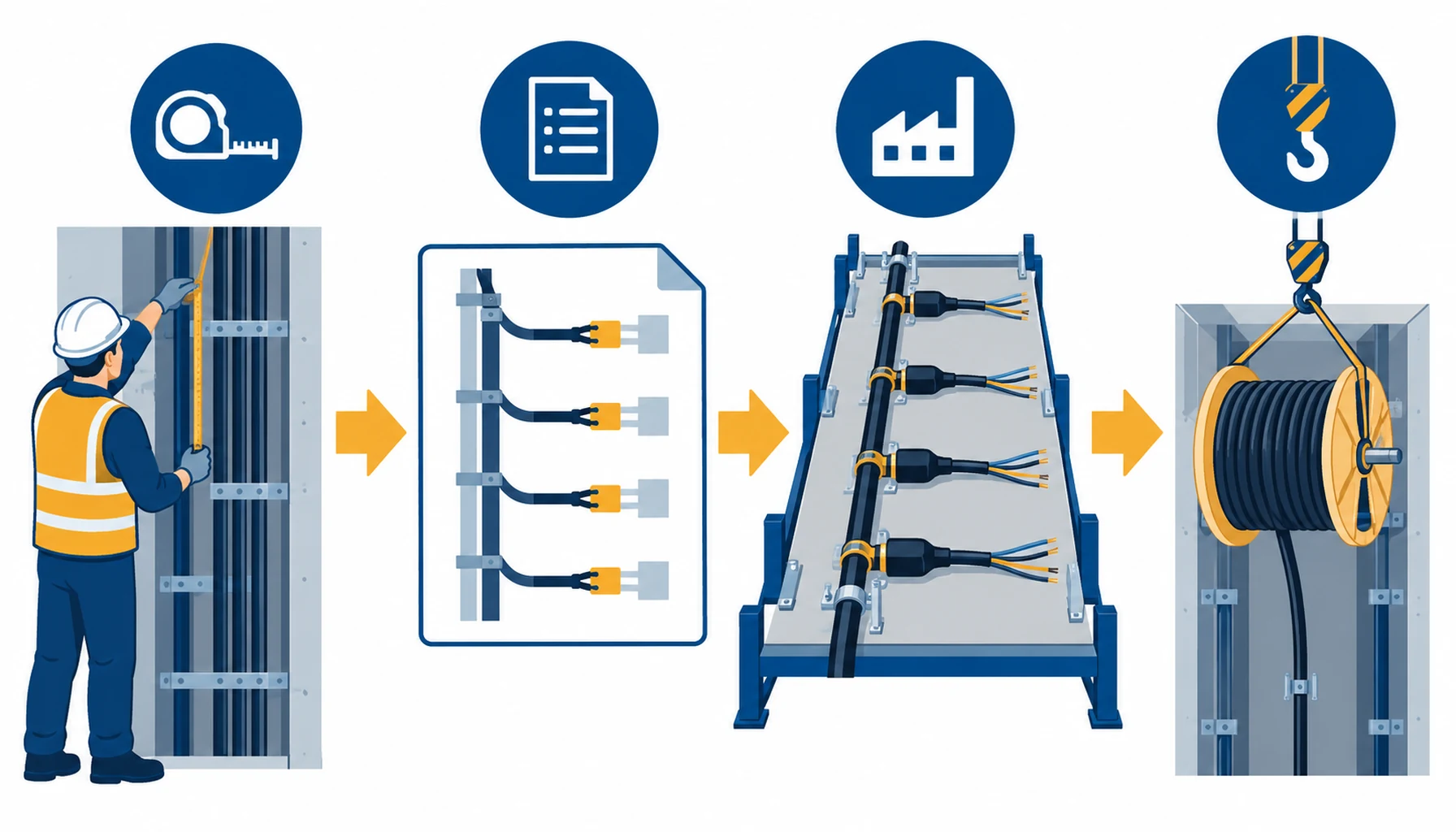
The Procurement Sequence, Step by Step
This product rewards a sequence, because each step closes an input the factory needs.
Step one, freeze the layout. The branch positions come from the electrical design, and the design has to be firm before anything is surveyed. A riser that is still being re-planned is not ready for this purchase.
Step two, survey the structure. Measure the built heights and penetrations, record the board position on every floor, and photograph each riser. This is a task for somebody who will stand in the shaft, not a desk exercise.
Step three, issue the branch schedule for approval. Height, tail length, conductor size, exit direction and marking for every branch, per riser. That document is the order, and nothing should be cut until it is signed.
Step four, agree the test and witness plan. Say which checks are witnessed, at which point in production, and what records ship with the assembly, the way our note on prefabricated modular cabling sets out for wider packaged installations.
Step five, agree packing and delivery against the lift plan. The delivery date is set by when the shaft can take the assembly, not by when the factory can finish it. Booking the lift, the storage area and the access before the reel leaves is what keeps a made-to-measure item usable.
Run in that order, the purchase is routine. Run out of order, the usual outcome is a survey taken after the order was placed, which is how projects pay for a remake they could have avoided with a tape measure.
When Prefabricated Branch Cable Is Not the Answer
When the design is still moving. A prefabricated assembly locks the layout at order. If floors are still being re-planned, buy a site-jointed riser or busbar and keep the flexibility.
When the branch pattern is irregular. The economics come from repetition. A riser with a handful of branches at odd heights does not gain much from the factory, and the survey cost may exceed the benefit.
When the shaft cannot accept the assembly. A rigid prefabricated run needs a clear route and the space to position it. Existing shafts with offsets, obstructions or very tight bends are often unsuitable.
When the site cannot store or handle it. Without a flat, protected area and a planned lift, a long assembly is a liability, and a damaged joint at handling is the most expensive kind of failure because it is invisible until the circuit is energised.
RFQ Checklist
- Survey sheet per riser with measured heights and penetration positions
- Branch schedule: height, tail length, conductor size and exit direction
- Main run length, cut allowance and end tail arrangements
- Sheath class and the reaction-to-fire requirement for the riser route
- Joint type, per-branch test results and inspection records
- Dimensional tolerance and the remedy clause for a discrepancy
- Packing method, lift points and the minimum handling bend
- Branch sleeving and anchoring for transit
- Factory tests to be witnessed and the records shipped with the reel
- Marking and labelling scheme matched to the branch schedule
- Delivery phasing against the shaft access and the lift plan
Conclusion
A prefabricated branch cable is a good buy when the building is settled, the branch pattern repeats and the survey is done properly. It is a bad buy when the layout is still moving, the shaft is awkward or nobody has measured the structure. Do the survey from the built building rather than the drawings, agree the tolerance in writing, ask for per-branch test results rather than a reel certificate, and plan the lift before the reel arrives.
Kexingyu Cable Group (KXYE) has manufactured cable in Quanzhou since 1996, supplying riser distribution assemblies and the fire-rated and sheathed constructions they are built on, with the test records and packing specification that a made-to-measure order needs. Send us the branch schedule with the surveyed heights, the tail requirements and the riser conditions, and we will come back with the construction, the joint detail and the factory test plan. The fastest route is a request for quotation.