Cable Lead Time and Capacity: Scheduling Orders Against Site Milestones
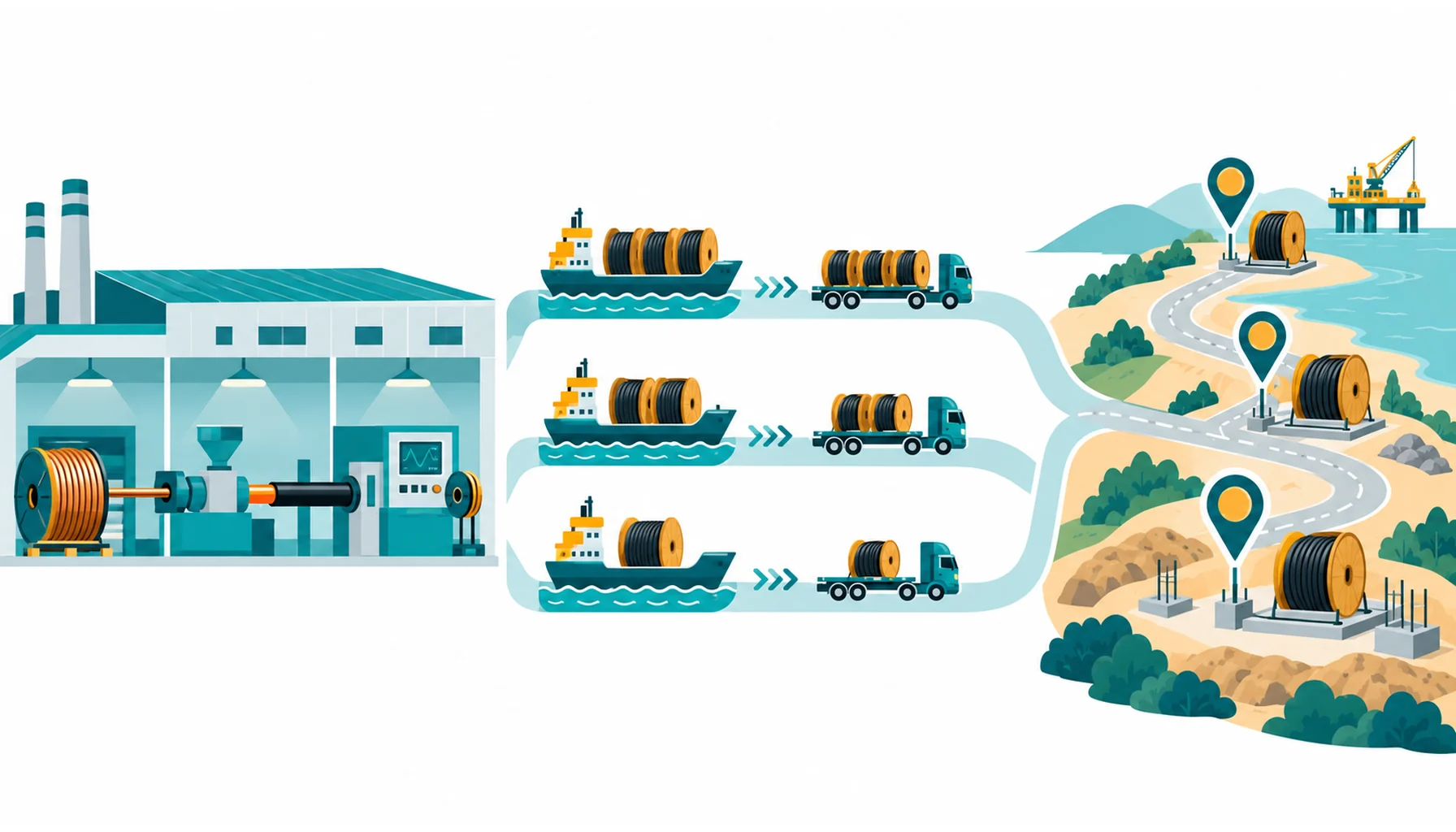
Quick Answer: Cable lead time is almost never a single number. It is the sum of conductor purchase, compound availability, line scheduling, drum supply, testing, documentation, freight and site access, and the longest of those is not always the one the supplier quotes. A delivery plan built on one figure borrowed from a previous order is a plan waiting to slip.
Introduction
Cable is rarely the longest lead item on an industrial project. It is usually the one that arrives late anyway, because it was ordered against a total quantity and a delivery month rather than against a sequence of site activities that need specific drums on specific dates.
This page is for project buyers and planners responsible for getting cable to site in the right order. It sets out what actually consumes the time, where schedules break, the scheduling routes available and what each one fixes, how to read a lead-time answer properly, and the six decisions to freeze before the order is placed. Our note on MOQ and lead time covers the factory economics behind the quote, and the wider programme effect is described in our note on cable sourcing delays and EPC timelines.
What Actually Takes the Time
Conductor purchase is the first real constraint. A factory buys copper against its order book, and on a large run the conductor may need to be drawn and stranded before it can be laid up. That step happens before the extruder sees the cable, and it is invisible in a lead time quoted as a single figure.
Compound availability decides more orders than capacity does. Standard PVC is rarely the problem. Special LSZH grades, specific rubber compounds, fire-resistant constructions and anything requiring a compounded batch outside the usual range can carry a material lead time that exceeds the production time. This is the single most common reason a promised date moves.
Then the line, the drums, the tests, the paperwork and the freight. Extrusion scheduling depends on what else is on the plant. Drums have their own supply, particularly large steel drums and non-standard flange sizes. Routine testing and any witnessed inspection take bay time. Certificates and packing lists take office time. Freight takes booking time, and sea freight takes space that may not exist in peak season. Our note on cable sea freight covers the shipping side.
Where the Schedule Breaks
A specification change after the order is placed. Every revision restarts part of the chain. A sheath compound swap or a length change confirmed late can push the whole run back by a full production cycle, and the drums already scheduled are displaced.
A witness or inspection date that was never agreed. Where a third-party inspection is required, the date has to exist in the factory calendar. An inspector who arrives without notice, or a buyer who demands attendance two days before dispatch, converts a straightforward order into a rescheduled one.
A site that is not ready when the drums arrive. Cable delivered to a site with no secure storage, no crane and no reel stand is cable that will be damaged or returned. The delivery date is half the plan, and the receiving arrangements are the other half.
An approval that arrives after the material was ordered. Where the buyer approves the sample or the drawing late, the factory has either started and risked the approval, or waited and lost the early slot it had booked. Both outcomes cost somebody time, and the cost lands wherever the contract is silent.
Scheduling Routes Compared
The table sets out the routes available for getting cable to a site against milestones: what each one fixes, what to specify, the evidence to demand, what drives cost and time, and how each fails.
| Route | What it fixes | What to Specify | Evidence to Demand | Cost and Lead-Time Driver | How It Fails |
|---|---|---|---|---|---|
| Single full delivery | One shipment against one date, with the simplest administration | The date, the receiving capacity and the storage arrangements on site | A dispatch schedule with drum numbers and lengths | Lowest freight cost per tonne, and the longest wait for the first metre | One missed vessel holds up every activity on the project at once |
| Phased deliveries by milestone | The sequence the site actually needs, with cable arriving to be installed | The milestone list, the required lengths against each, and the release triggers | A phased dispatch plan agreed before the order is placed | More shipments and more administration per tonne | A phase released late because an earlier milestone moved without notice |
| Stock reservation at the factory | Production capacity and material held for your call-off window | The quantity reserved, the release window and the holding arrangements | A written reservation with dates and quantities | Holding cost, and a commitment on volume either way | A reservation that expires unused, with the volume obligation still standing |
| Split-mode delivery | The critical lengths arrive first by a faster route, the balance follows by sea | The lengths that must arrive early, and the cost ceiling for the fast leg | Two dispatch schedules with the mode stated for each | Air or road freight on heavy cable is expensive per tonne | The critical lengths are not actually critical, and the premium was wasted |
| Framework call-off | A recurring supply against agreed pricing, released order by order | The call-off volumes, the notice period and the pricing basis | A framework agreement with a release procedure | Lower unit administration, with capacity shared across call-offs | A call-off inside the agreed notice period that the plant cannot absorb |
Reading a Lead Time Answer Properly
Ask where the clock starts and stops. Production lead time usually means the period from a technically complete order and a released material position to the point where the cable is tested and ready at the factory. It does not include approval, freight, customs or inland delivery to site. Two suppliers can both say eight weeks and mean dates that differ by a month.
Ask what the figure assumes. A lead time is normally quoted for a standard construction, at a minimum quantity, with materials in stock and no witness testing. Change any of those and the answer changes. A credible reply names the assumptions rather than just the number.
Ask for confidence, not just dates. The useful question is what proportion of orders of this type shipped inside the stated window, and what the usual cause of a slip is. A supplier who knows this can tell you where the risk sits on your particular order. The commercial side of the same conversation is covered in our note on cable payment terms.
Building the Delivery Plan Against Milestones
Work backwards from the first cable activity, not forwards from the order. Identify the date the first drum has to be on site, subtract the receiving and inspection time, subtract the transit time, subtract the testing and dispatch time, and what remains is your latest order release date. If that date has already passed, the plan needs a different route rather than a faster promise.
Identify the longest-lead item and let it set the pace. On most cable packages that is whichever construction carries the unusual compound or the approval test. The standard lengths are rarely the problem, so ordering the whole package on the longest-lead date wastes money and ordering it on the shortest wastes the programme.
Sequence the deliveries with the jointing programme. Delivering all the long lengths first and the short tails last usually leaves the jointers idle. Matching dispatch order to installation order costs nothing and shortens the site programme more than any expediting fee. Where a phased plan is agreed, our note on custom cable orders covers what a factory needs in order to hold and release against it.
Keep a named person on both sides. A delivery plan without a named contact at the factory and a named receiver at the site will be tested by the first change. Where a second source is needed for programme insurance, the route is described in our note on second-source qualification.
What to Freeze Before the Order Goes Out
Six decisions decide whether the delivery plan survives contact with the site. Each belongs in the purchase order, not in the weeks that follow it.
| Decision | What to State | Evidence to Attach | Cost of Leaving It Open |
|---|---|---|---|
| Frozen specification date | The date after which no construction change is accepted without a re-quote | A signed data sheet or drawing as the reference revision | A revision that restarts the production chain and displaces booked slots |
| Milestone and phase list | The dates cable is needed on site, and the lengths required at each | A phased dispatch plan agreed before the order | A single large shipment that arrives when the site can install none of it |
| Inspection and witness dates | The tests to be witnessed and the dates reserved for them | A test plan with the factory calendar slot confirmed | Dispatch held for an inspection that was never scheduled |
| Drum and packing requirements | Drum sizes, weights, marking and any export packing standard | A drum schedule with measured lengths and weights | Drums that cannot be offloaded or handled on site |
| Freight route and delivery basis | The Incoterm, the port pair, the mode for each phase and who books | The booking reference and the sailing or collection dates | Freight booked at spot rates and a delivery date nobody owns |
| Buffer and recovery plan | The permitted float on each phase and what happens when it is consumed | A recovery route with the cost ceiling stated | An expediting decision taken under pressure at the worst possible price |
Cost and Lead Time
Compressing a schedule costs money in one of three ways. Money buys a place in the production line, a faster freight mode, or a stock position held for your call-off. All three are real, and a supplier who offers a shorter lead time without one of them is either redefining the clock or hoping the schedule will not be tested.
Split delivery usually costs less than most buyers assume. Two shipments on the same vessel booking often cost little more than one, and the second can be adjusted without penalty. What costs money is delivering everything at once and then storing it on site, where drums are damaged, drums are moved twice and the cable is exposed. Storage at the factory is generally the cheaper option, provided the release dates are committed.
Late changes are the expensive ones. A change requested before the conductor is ordered may be free. The same change after extrusion started is a scrapped length. The cost curve is steep and short, which is the argument for freezing the specification early rather than optimising it late. Where the programme depends on figures from other suppliers, our note on switchgear lead times covers the same logic on the equipment side.
When Fast Delivery Is Not the Answer
When the specification is not yet right. Buying the wrong cable quickly produces the same outcome as buying it slowly, plus a return and a second order. Freeze the construction first, then compress the schedule.
When the fast route breaks a test. Skipping or reordering routine tests to gain a week removes the only evidence the drums were sound. Move the milestone instead, and record why.
When the site cannot receive it. Cable that arrives before storage, crane access or the installation gang are ready will be handled by whoever is available. Where the site is not ready, holding at the factory is usually cheaper than holding on site, and far cheaper than replacing a damaged drum. Planned replacements follow the same logic in our note on planned cable replacement.
When the item is standard and in stock. For a small quantity of a common construction, a distributor with stock can beat a factory schedule outright, and there is no programme argument for waiting.
RFQ Checklist
- The date the specification is frozen, and the revision that applies
- The milestone list with the lengths required against each date
- The longest-lead construction on the package, identified by name
- Production lead time defined at both ends, with the assumptions stated
- Compound, drum and accessory availability checked for the specific construction
- Any witness or third-party inspection date, reserved in advance
- The drum schedule with sizes, weights and marking requirements
- The mode and route for each phase, with the booking party named
- The Incoterm and the point at which risk and cost transfer
- The delivery basis, including unloading responsibility at the destination
- The permitted float on each phase and the agreed recovery route
- The named contacts at factory and site, with escalation to a single owner
Conclusion
Cable lead time is a chain rather than a number, and the chain is only as strong as the material nobody mentioned. The orders that run to schedule are the ones where the specification was frozen early, the phases were tied to site milestones, and the assumptions behind the delivery date were written down and accepted by both sides.
Kexingyu Cable Group (KXYE) has manufactured cable in Quanzhou since 1996, and works to phased release plans against buyer milestones rather than to a single dispatch date. Send us the programme and the construction list, and we will come back with the longest-lead items, a release plan and the dates each one can be met. A request for quotation is the fastest route.