Cable Packaging, Drum Weight and Site Delivery: Avoiding Damage
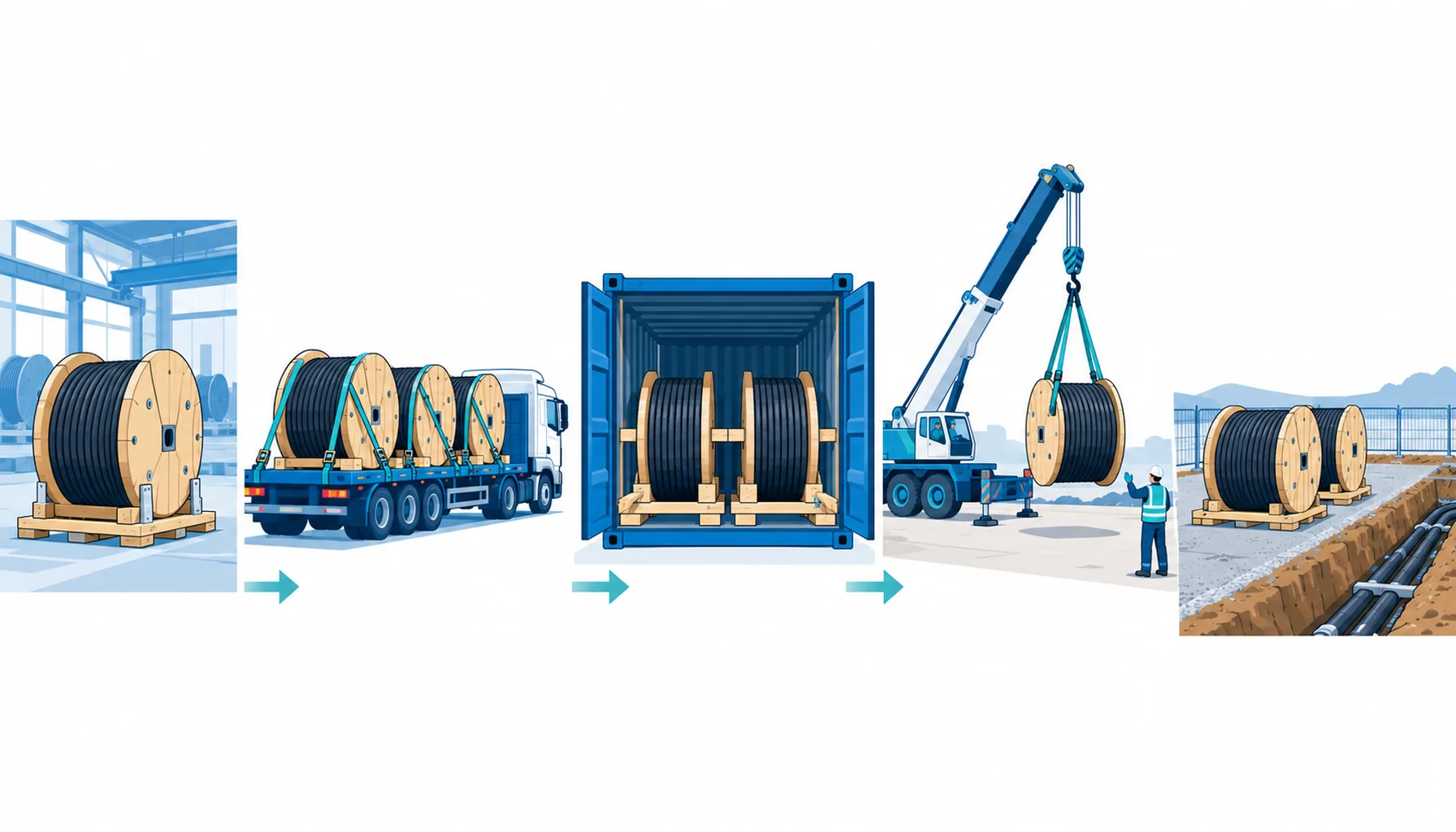
Quick Answer: Most cable is damaged between the factory gate and the first pull, not in service. The four causes are a drum too heavy for the crane, packing that could not survive the crossing, a drum dropped because nobody agreed who offloads it, and storage on site that puts drums in standing water or in the path of plant. All four are decided at the enquiry stage.
Introduction
A cable order reaches site having already been lifted, stacked, lashed, driven and shipped. Every one of those stages is an opportunity to damage a drum, and the damage is often hidden until the cable is paid out weeks later when the evidence has gone cold.
This page is for site buyers and planners who have to get cable onto a site in one piece. It covers where the damage actually happens, how drum size and weight set the practical limits, the packing routes available and what each protects, offloading and storage practice, inspection on receipt, and the six decisions to freeze before the order is placed. The factory packing arrangements are described in our note on cable drum packaging, and the handling sequence assumed here starts from the drum schedule agreed before dispatch.
Where Cable Gets Damaged
The outer layer of a drum takes the punishment. When a drum rolls, the outermost turns of cable are the ones pressed against the flange, the ground and whatever it hits. A flange that is dented inward has already reduced the clearance around the cable, and a short section of sheath damage is the visible part of it.
Handling is where most incidents start. Dragging a drum on its flange, rolling it down a slope, lifting it with a chain through the centre without a spreader, or dropping it the last few centimetres off a loader all distort the drum and load the cable. A drum has to be lifted with a proper spindle or sling arrangement, and it has to be put down with control.
Storage on site causes damage that looks like a manufacturing fault. Drums left upright in standing water take moisture into the outer layers. Drums left where vehicles turn get hit. Drums stored in direct sun for months age the sheath and the lagging. The claim that follows usually arrives as a complaint about the cable, which is why the receiving evidence matters so much.
Drum Size, Weight and Handling Limits
The weight limit comes from the lifting equipment, not from the factory. The practical maximum is set by the crane or telehandler available, the reach at which it will operate, the ground conditions, and the axle and height limits on the delivery vehicle. Those constraints point to a maximum drum weight and often to a maximum flange diameter as well.
A lighter drum means more drums, and more drums cost money. More drums mean more freight volume, more handling operations and more joints on site. Fewer, heavier drums mean a bigger crane. The right answer is the one your site can actually handle, and it should be stated in the enquiry rather than discovered on the delivery note.
Reel stands and payout practice need the drum to be compatible. A drum with the wrong bore or flange diameter will not sit in the stand you have, and forcing it produces cable that is pulled off against a flange. Where cable will be paid out mechanically, the drum geometry and the pulling arrangement belong in the same conversation. How the pull loads the cable is covered in our note on pulling tension and sidewall pressure, and the geometry limits are set out in our note on minimum bend radius.
Packing Routes Compared
The table sets out the packing and delivery routes available for an industrial cable order: what each protects against, what to specify, the evidence to demand, what drives cost and time, and how each one fails.
| Route | What it protects | What to Specify | Evidence to Demand | Cost and Lead-Time Driver | How It Fails |
|---|---|---|---|---|---|
| Standard drum with lagging | The outer turns, against abrasion and light impact in normal road transport | The drum size, the flange thickness and the lagging material | A drum schedule with weights, plus photographs of the packed drum | The lowest packing cost, and adequate for short inland moves | A drum received with a bent flange and damaged outer turns after a long road leg |
| Fully enclosed drum | Weather, salt spray and impact across a sea voyage and multiple handling points | Timber cladding, steel strapping, bolt tension and edge protection | Photographs of the finished packing and the strapping pattern | Material and labour, plus freight volume and weight | Enclosure that protects the cable but traps water against the sheath |
| Container with dunnage and bracing | Drum movement inside the container, which is the main cause of transit damage | The bracing method, the chocking pattern and the loading plan | A loading photograph showing the bracing before the doors close | Slightly lower volume efficiency and more loading time | Drums chocked fore and aft but free to move sideways |
| Reel stand shipped with the drum | Cable being paid out against a flange on a stand that does not fit | The stand type, the drum bore and flange, and the payout direction | A drawing showing the stand, the drum geometry and the pull path | The stand itself, plus extra volume on the delivery | A stand that arrives without the spindle or the correct adaptor |
| Loose coils or boxed lengths | Handling of short tails and accessories that do not warrant a drum | The coil weight, the winding direction and the label on each item | Photographs of the coils with their labels applied | Low material cost and high handling cost on site | A coil wound the wrong way, so it twists as it is paid out |
Offloading and Storage on Site
Agree who offloads before the vehicle arrives. Whether the delivery is on a basis that includes unloading changes both the cost and the plan, and a driver who is not allowed to touch the load will wait while the site finds a crane. The Incoterm and the unloading responsibility belong on the same line of the order. Our note on delivery terms covers how the risk and cost transfer.
Prepare the ground before the first drum lands. Drums need a firm, level, drained surface. A drum laid on its side must be chocked so it cannot roll, and a drum left upright must be on a clean base rather than on soil. Access for the crane has to exist on the day, not the week after.
Store with the payout direction in mind. The way a drum is positioned now determines how it has to be moved later. A drum that will be paid out into a trench should be faced so the cable leaves the top of the drum, and drums should be grouped by the order they will be pulled rather than by size.
Keep the drum ends protected and the labels legible. The drum label carries the length, the drum number and the construction reference. If it is buried under dirt or lost, the receiving evidence and the installation sequence both suffer. What the label has to contain is set out in our note on cable labelling and documentation.
Inspection on Receipt and Evidence to Keep
Inspect before the vehicle leaves. A damaged drum is easiest to argue about while the carrier is still on site and the load has not been mixed into the store. Check the flange condition, the lagging, the strapping, the seal where one exists, and the drum label against the delivery note.
Photograph the drum ends and the damage. Images with the drum number visible, taken before anything is moved, are what a claim is built on. A note on the delivery document countersigned by the driver records that the damage was noted on receipt, which is a different position from reporting it a fortnight later.
Measure a length where a length claim is likely. If the delivered quantity is close to the tolerance limit, or the order was placed on the basis of meeting a site requirement, measure one or two drums rather than relying on the label. The method of measurement is described in our note on cable length tolerance.
Keep the records with the cable. The drum list, the delivery note, the receipt inspection record and the photographs form the file that a later damage or shortfall claim will be decided on. Where a package is assembled with other equipment, our note on packaged equipment supply describes how the documentation is normally consolidated.
What to Freeze Before the Order Goes Out
Six decisions decide whether the cable arrives intact and usable. Each belongs in the purchase order.
| Decision | What to State | Evidence to Attach | Cost of Leaving It Open |
|---|---|---|---|
| Drum weight and size limits | The maximum drum weight, flange diameter and bore the site can handle | A drum schedule confirming weights and dimensions | A drum that cannot be lifted, or a crane mobilised at short notice |
| Packing standard and mode | The packing required for the actual route, not a generic export standard | Photographs of the finished packing before loading | Damage in transit that is discovered only when the cable is paid out |
| Loading plan and bracing | How drums are arranged and braced in the transport unit | A photograph of the braced load with the doors still open | Drums moving against each other across a sea passage |
| Delivery basis and unloading | The Incoterm, the delivery point and who provides the lifting equipment | The delivery clause, with the unloading party named | A vehicle waiting for hours while the site finds crane capacity |
| Site receiving arrangements | The storage surface, access route, drainage, layout and security | A site layout sketch showing where drums will stand | Drums stored in water or in a traffic route, and damage that looks like a defect |
| Receipt inspection and claims window | What is inspected on delivery, who signs, and how long a claim stays open | A receipt record template with damage and shortfall fields | A claim made after the evidence has gone cold and the carrier has gone |
Cost and Lead Time
Packing is the cheapest insurance on the order. The difference between adequate and inadequate protection is a small percentage of the cable value, and the cost of one damaged drum in programme terms is a joint, a re-order and a delay. Where the route includes a sea leg and two or three handling points, the packing standard should match the route rather than a generic default.
Weight costs money twice. Heavier drums carry more cable per drum and lower the freight cost per tonne, but they need bigger lifting equipment at every handling point, including the port and the site. On a site with limited crane capacity, several lighter drums almost always beat one heavy one once the whole chain is counted.
Bad storage can undo good packing. Drums kept for months in the open, on wet ground, in a traffic area, will suffer regardless of how well they were packed. Where the site cannot store properly, holding the drums at the factory or at a warehouse and calling them off in phases is usually the cheaper route. Our note on sea freight arrangements covers how a phased release interacts with shipping.
When Elaborate Packing Is Not the Answer
When the route is short and internal. A drum moving a few hours by road does not need a full export enclosure. Money spent on cladding is better spent on a better drum and correct handling.
When the cable is going straight to the pull. If the drums will be installed in the week they arrive, transit packing is what matters and long-term storage protection is not. Spending on both is paying twice.
When the problem is the drum, not the packing. A drum with a thin flange or poor strapping will fail regardless of what is wrapped around it. Ask about the drum specification and not only the enclosure, and where a reeling application is involved, consider a drum designed for repeated payout such as our reeling cable range.
When the real fault is the delivery date. Cable arriving early to a site with nowhere to put it will be damaged, and no packing standard fixes that. Move the delivery or hold at the factory.
RFQ Checklist
- The maximum drum weight and dimensions the site crane and access can handle
- The drum specification, including flange thickness and lagging material
- The packing standard matched to the actual transport route
- The loading plan and bracing method, with a photograph before the doors close
- The bore and flange dimensions, and the payout direction required
- Whether a reel stand, spindle or adaptor is to be supplied with the cable
- Sheath marking and drum labelling, with the length and drum number visible
- The Incoterm, the delivery point and the party responsible for unloading
- The planned storage location, surface, drainage and access at the destination
- The receipt inspection scope, and the form used to record findings
- The claims window for damage and shortfall, and the evidence required
- The named contacts for the delivery day, at the carrier and on site
Conclusion
Cable arrives at site having already been handled more times than most buyers picture. The orders that arrive intact are the ones where the drum was sized to the crane, the packing was matched to the route, the unloading responsibility was written down, and the storage area was prepared before the first vehicle turned up. None of those are expensive decisions. They are just early ones.
Kexingyu Cable Group (KXYE) has manufactured cable in Quanzhou since 1996 and packs to the transport route rather than to a default, with drum weights and dimensions confirmed against site handling limits before dispatch. Send us the site access, the crane capacity and the storage arrangements, and we will come back with the drum sizes and packing that fit them. A request for quotation is the fastest route.