Buying Medium-Voltage Cable for Kazakhstan: 6 to 10 kV Projects, GOST or IEC

Quick Answer: Medium-voltage cable for Kazakhstan is bought against a voltage class, a construction standard and a screen size. Write 6/10 kV (Um 12 kV) or 8.7/15 kV as a fraction with the earthing arrangement behind it, say whether the tender cites GOST 31996 or IEC 60502-2, and state the metallic screen cross-section the fault current needs. Then ask for the routine test regime, the termination diameters and the drum lengths. A quotation that answers those four points can be checked at receipt. One that answers only the voltage cannot.
Introduction
The 6 kV and 10 kV networks that carry most of Kazakhstan’s distribution load are old enough that both voltage classes are still live in the same procurement programme. A refurbishment on a 6 kV feeder and a new 10 kV ring main may sit in one BOQ, described in one line as “10kV cable”. That line is where medium-voltage orders go wrong, because the class fixes the insulation thickness, the test voltages, the terminations that fit and the price.
This guide is for EPC buyers, utility procurement staff and distributors buying MV cable for Kazakhstan. It covers the voltage class, the GOST and IEC constructions available, the conductor, screen and armour decisions that follow from the network, the tests a 10 kV delivery should carry, and the accessory and drum questions that decide whether the cable can actually be installed. Our note on buying XLPE power cable for Kazakhstan covers the low-voltage side of the same specification, and supplier screening is set out in the Kazakhstan supplier checklist.
Start With the Voltage Class, Not the Voltage Word
The fraction is the specification. 6/10 kV means 6 kV phase to earth, 10 kV phase to phase, with the highest system voltage Um at 12 kV. 8.7/15 kV describes a different insulation thickness and a different test regime. Both sell into networks described as “10 kV” in conversation, and a factory that receives “10kV” quotes whichever class it runs most, usually the cheaper one.
The earthing arrangement decides the fraction. Where a 10 kV network is earthed through a resistor or left isolated with limited earth-fault current, the phase-to-earth stress is different from a solidly earthed arrangement, and the class in the specification follows that. That is an engineering decision for the project’s electrical design, not the supplier. Write the class and the earthing basis together, or the supplier is guessing.
Convert once and record it. Where the project documents give a system voltage, a nominal voltage and a cable rating on three different sheets, reconcile them once, on paper, before the enquiry leaves. That sheet is also what you defend when a delivered drum is questioned.
GOST and IEC Constructions Side by Side
Both systems are in use, and they are not interchangeable by name. GOST 31996 covers power cables with plastic insulation from 0.66 kV to 35 kV, and the older GOST 18410 covers paper-insulated cable still present in refurbishment work. IEC 60502-2 covers extruded insulation from 1 kV to 30 kV. A 10 kV cable can satisfy either, but the dimensions, the designation and the test schedule are not the same document.
Translate the designation before you price it. Russian-style designations encode conductor material, insulation, armour and sheath in the letters. АВБбШв is read as an aluminium conductor, PVC insulation, steel tape armour and a PVC sheath, a low-voltage construction. АПвБП reads as aluminium conductor, XLPE insulation, steel tape armour and a PE sheath, which is the common 10 kV field cable. Reading the letters wrong by one position changes the price by a wide margin, and the decoding is set out in detail in our note on medium-voltage cable standards across IEC, GB and BS.
Conductor, Screen and Armour on a 6 to 10 kV Cable
Aluminium is the default in this market, and it should be a stated choice. Aluminium conductors dominate regional distribution practice on cost and weight, and copper appears where the design or the client requires it. Say which metal per line rather than leaving the factory to assume, and ask for the conductor class too, because a compacted stranded aluminium conductor terminates differently from a shaped one. The trade-off is set out in our comparison of aluminium and copper cable.
The screen is a fault-current device, not a wrapping. Metallic screens on 6 to 10 kV cable carry earth-fault current for the clearing time the protection allows, and their cross-section follows from that current and time. A copper tape screen sized at 16 mm² and one at 35 mm² look identical from outside and behave very differently in a fault. State the fault current, the clearing time and the resulting screen section, then ask the supplier to confirm the section in the offer.
Armour follows the route and the core count. Steel tape armour suits buried three-core distribution cable and gives the mechanical protection a trenched route needs. Single-core circuits are the case where a ferrous armour chosen by habit creates circulating currents and heat, and aluminium wire armour or a non-magnetic arrangement is the answer. The selection logic is set out in our note on steel wire armour selection.
Medium-Voltage Options for a Kazakhstan Distribution Project
The table sets out the constructions that come up most often on 6 to 10 kV work in Kazakhstan, with what each one commits the project to. Use it to narrow the enquiry before the drawings are final, not after.
| Option | What to Declare | Evidence to Ask For | Cost and Lead Time | Risk If Left Open |
|---|---|---|---|---|
| GOST 31996 three-core, 6/10 kV, steel tape armour | Designation in letters plus the class fraction; aluminium conductor class; screen section | Acceptance test records per drum; designation on the certificate matching the offer | Widest supply base regionally; shortest slots on standard sections | Designation read one letter wrong; screen section never stated |
| IEC 60502-2 three-core, 6/10 kV | Standard and edition; nominal insulation thickness; armour type and bedding | Routine test sheet with partial discharge values; type report for the construction | Comparable on price; fewer regional stockists | Quoted to 8.7/15 dimensions and priced as 6/10 |
| IEC 60502-2, 8.7/15 kV for a 10 kV network | Why the higher class is specified; earthing basis; screen section for the fault level | Type test at the class; routine tests at the class voltage | Higher insulation cost, longer set-up, larger accessories | Paid for a class the network does not need, or missed where it does |
| Single-core 12/20 kV for long or high-current runs | Core count; armour material for single-core duty; screen section; laying formation | Screen and armour confirmation in the offer; drum schedule per phase | More drums and more jointing; accessories cost more | Steel tape armour on single-core, circulating current and heat |
| 6/6 kV replacement on a legacy 6 kV feeder | The legacy class in full; whether the retention is a like-for-like swap | Records of the cable being replaced; confirmation of the class offered | Smaller quantities, less competition, longer slots | Quoted as 6/10 because that is the standard line |
Tests and Documents a 10 kV Delivery Should Carry
Routine tests on every drum, with the values written down. The regime a 6/10 kV construction carries includes conductor resistance, a partial discharge measurement and a voltage withstand at a multiple of the phase-to-earth rating for a defined time. Ask for the sheet per drum, with the measured values rather than a pass stamp, and check the values against the class you ordered rather than against the class the factory usually ships.
Type reports belong to a construction, not to a factory. A type test proves one build: that conductor, that insulation thickness, that armour. A report for a neighbouring section is a useful signal about capability and not evidence about your cable. Where the project requires it, name the construction in the request and check the report’s description against the offer line by line.
Test at the cable, not only at the factory. After installation, a 10 kV circuit is usually proved by an insulation resistance check and a withstand or very low frequency test before energisation, and the termination work is where most early failures originate. The arrangements are covered in our note on MV cable termination testing, and the factory side in cable factory testing.
Terminations, Joints and the Diameter Question
Accessories are sized to the cable, so the cable has to be sized to the accessories. A termination for a 6/10 kV three-core cable is selected on insulation diameter, core insulation diameter and screen section, all of which come from the construction. A GOST-dimensioned cable does not always match an IEC-dimensioned kit from another source, so where accessories are already on site, quote the cable against them.
Ask for the accessory list with the cable offer. The number of terminations indoors and outdoors, the joint count derived from drum lengths, and the lug sizes for aluminium conductors are all order-stage information. Discovering at installation that the lugs on site are copper-only, or that the joint kits suit a different screen section, is a delay measured in weeks on a feeder outage window.
Jointing skill decides more than the joint kit. A 10 kV joint is a craft product. Where the project has no qualified jointers, the drum plan should minimise joints rather than optimise freight, and that trade-off belongs in the enquiry. The selection logic is set out in our note on joints and terminations.
Drum Lengths, Weight and the Last Kilometre
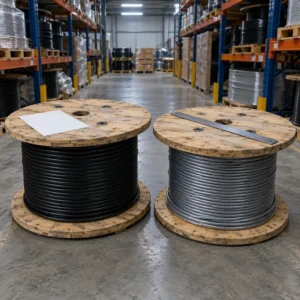
Available lengths drive the joint count. A 3×240 aluminium 6/10 kV cable is a heavy drum, and the length a factory can put on one drum is bounded by weight and by the transport that will carry it. Ask for available lengths per line and set the splits against the route, rather than ordering metres and hoping the drums match the pulls.
The receiving point is part of the specification. Crane capacity at the substation yard, the width of the access track and the height of the gate all bound the drum. A drum plan that ignores them produces cable standing in a laydown area three kilometres from the trench. Give the supplier the real receiving conditions, and the drum schedule comes back usable.
Tolerance on ordered length is a one-line confirmation. The allowance a factory applies to a stated length varies, and on a feeder it shows up as an extra joint or as metres nobody planned. Confirm the tolerance in the offer and reconcile lengths against the drum labels at receipt.
Medium-Voltage Order Freeze List
These are the items to have settled and written into the order before the purchase order is issued. Each one is cheap at enquiry stage and expensive afterwards.
| Item to Freeze | How to Write It Into the Order | Evidence to Attach | Cost of Leaving It Blank |
|---|---|---|---|
| Voltage class and earthing basis | Fraction in full, Um value, earthing arrangement named | Project electrical design sheet showing the conversion | Wrong insulation class delivered, refused or accepted and derated |
| Construction standard | GOST 31996 or IEC 60502-2, with the edition | Standard clause list referenced by the supplier | Two offers compared across different documents |
| Conductor material and class | Aluminium or copper, class named, per line | Conductor schedule in the offer | Metal substitution found at receipt, no remedy in the contract |
| Metallic screen section | Cross-section in mm squared, from fault current and clearing time | Calculation sheet plus the supplier's confirmation | Screen undersized for the fault level, replacement at your cost |
| Armour and sheath | Armour type and material; sheath compound; route condition if any | Construction drawing for the offered cable | Ferrous armour on single-core, or a sheath that fails in soil |
| Drum lengths and tolerance | Available lengths confirmed; tolerance stated; splits agreed | Drum schedule per line and per phase | Extra joints, extra outage time, unusable short ends |
| Test documents | Routine sheet per drum; type report named by construction | Sample test sheet approved at order stage | Documents chased after delivery, or never produced |
When a Standard 6/10 kV Construction Is Not the Answer
When the network’s earth-fault level is high. A standard screen section is sized for a typical fault current and clearing time. Where the protection settings allow a larger current for longer, the standard section is the wrong answer and the calculation has to be rerun. Buying the catalogue construction and discovering this at commissioning is the expensive version of the same conversation.
When the route is wet, saline or under a road. Soil condition changes the sheath and sometimes the armour. A sheath chosen for a dry trench performs differently in a saline water table, and the difference appears as corrosion rather than as a failure, which is worse because it arrives late.
When the only comparison is price per metre. Two 10 kV offers at different screen sections, different conductor classes and different drum lengths are not comparable numbers. If the evaluation cannot normalise those three fields, it is choosing a supplier, not a cable.
RFQ Checklist
- Voltage class written as a fraction with the Um value, plus the earthing basis
- Construction standard named with its edition, GOST or IEC, per line
- Conductor material and class stated per line, with the metal as a decision not a default
- Metallic screen cross-section derived from fault current and clearing time
- Armour type and material confirmed, with single-core circuits called out separately
- Sheath compound with any route condition attached to the line it affects
- Routine test sheet per drum and the type report named by construction
- Available drum lengths and the length tolerance confirmed before the splits
- Termination and joint quantities, kit type and lug material quoted alongside the cable
- Receiving conditions given: crane capacity, access width, laydown space
- Copper or aluminium basis, validity window and included documents stated in the offer
Conclusion
Medium-voltage cable buying in Kazakhstan is decided by four fields: the voltage class in full, the standard the project enforces, the screen section the fault level needs, and the accessory dimensions that follow from both. None of them are visible in a price per metre, and all of them are cheap to settle before the enquiry goes out. The offers that follow are comparable, and the delivery can be checked against the same four fields.
Kexingyu Cable Group (KXYE) manufactures XLPE power cable in Quanzhou, including 6/10 kV and 8.7/15 kV armoured constructions, and quotes Kazakhstan enquiries line by line against the class, standard and screen section as written, with test documents and a drum schedule attached. Send your specification, quantities and destination, or upload your BOQ. A request for quotation is the fastest route to start, and the enquiry format is set out in our guide to requesting a cable quotation for Central Asian projects.