Selling to State Utilities in Central Asia: KEGOC-Type Frameworks and Utility Buying
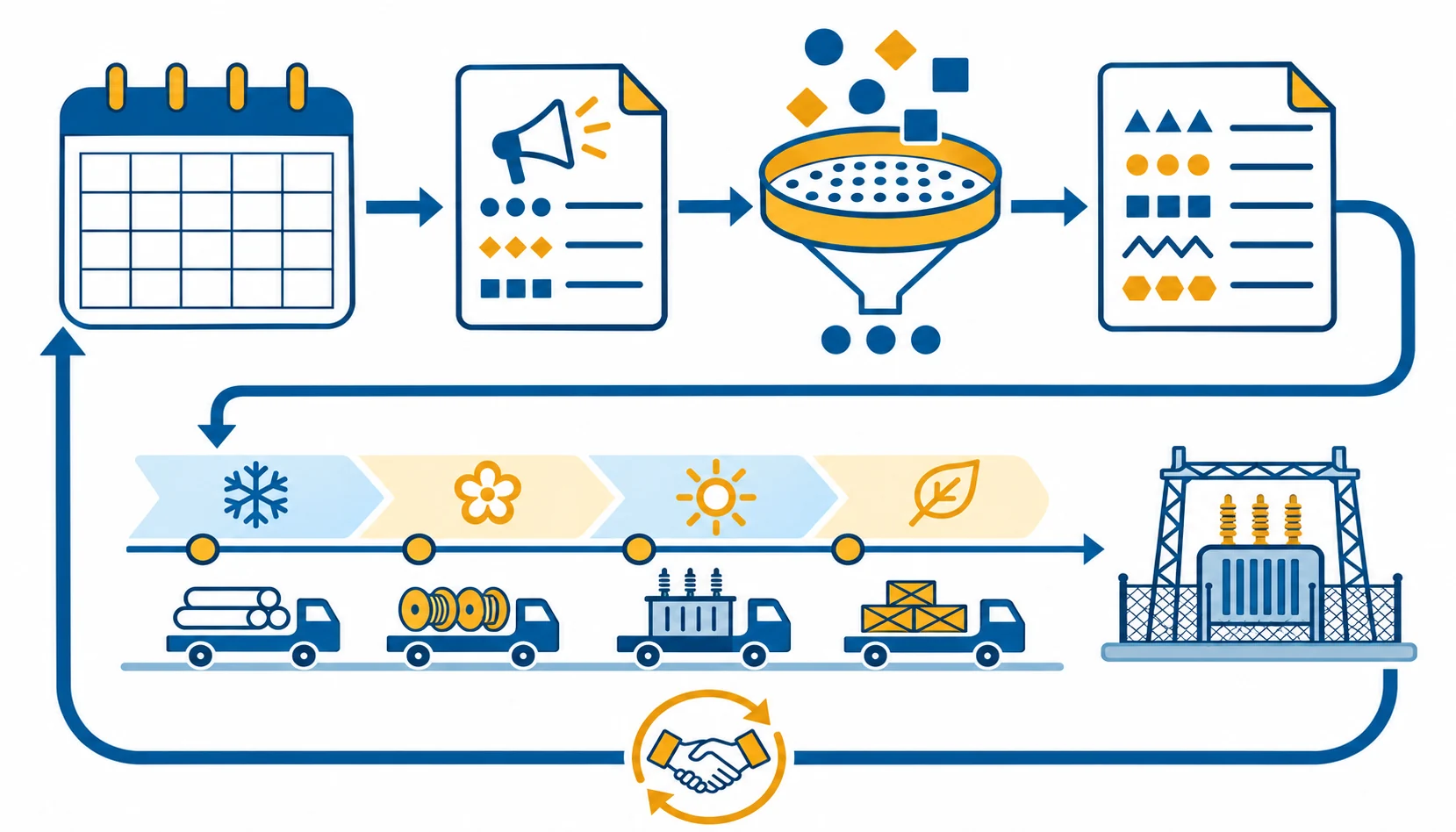
Quick Answer: A state-owned grid or generation utility buys cable differently from an EPC contractor: the volume comes from annual investment and maintenance programmes, the specification is written to GOST by the utility’s own design function, qualification screens run before prices are ever compared, and delivery windows are tied to construction seasons. Suppliers who treat the utility as one big tender miss the pattern. The buyers who last are the ones qualified once, referenced often, and priced inside a framework the utility renews.
Introduction
The largest cable buyers in Kazakhstan, Uzbekistan and the wider region are state-owned: the transmission system operator, the regional distribution companies, and the generation holdings behind new plant programmes. Their purchases are formal, seasonal and reputation-driven, and they repeat. A supplier who wins one season on price and disappears loses the next one to a competitor who stayed visible, delivered clean and answered the phone.
This page describes the buying pattern these utilities share, without pretending any two run identical processes: where the volume originates, how qualification works, what the specifications fix, and how delivery and service expectations shape the relationship. The full tender path sits in our Central Asian cable tender guide; this page stays with the utility as a buyer. Country-level supplier context is in our Central Asian cable buying hub.
How a State Utility Buys Cable
The volume starts in a plan, not in an enquiry. Investment programmes for new lines and substations are approved annually, and maintenance programmes generate a steadier stream of smaller quantities. Procurement publishes tenders against those plans on national portals, and the cable arrives as lot packages: by project for investment work, by region or by construction family for maintenance.
Timing follows the construction season. Winter complicates cable laying, spring and summer carry the installation load, and procurement therefore closes months earlier, so production, certification and transport all land before the ground is workable. Suppliers who treat a utility award as the start of the conversation misjudge the calendar; the delivery conversation has usually been running since the tender was drafted. The reverse is also true: a supplier whose lead time is known and respected enters the season with a calmer price.
The purchasing style rewards continuity. Some utilities run framework agreements with qualified suppliers for recurring families, drawing call-offs as programmes execute. Even where every purchase is a fresh tender, the same qualification file and the same reference projects get reused, so preparation compounds for suppliers who keep theirs current.
The Purchaser's Document Set
A utility tender carries the same skeleton as any regional public tender, with utility-specific layers: the programme reference that justifies the purchase, a technical assignment written by the utility’s design function, and schedules that group cable by voltage class and construction. Drawings matter less than in an EPC package; quantities are often grouped by family because the exact routing is decided during construction.
The specification leans on GOST families and on the utility’s historical habits: drum lengths that suit its drum trailers, sheath colours its crews recognise, and designation strings its stores system already carries. Where a foreign construction is offered, the equivalence has to be argued against those habits, not only against the standard. The vocabulary problem is the same one our note on medium voltage cable standards addresses for cross-system buyers.
Acceptance is documented more heavily than in commercial sales. Utilities record deliveries into stores, and the stores receipt is what release of payment follows, so the document set per consignment is not a formality; it is the trigger for the money. The per-drum papers that keep that chain unbroken follow the same field discipline our documentation notes describe.
Qualification: What Utilities Screen First
Before any price is read, the utility checks who may compete: legal standing, tax compliance, financial capacity, experience on comparable projects, and the conformity documents for the constructions in the schedule. The screen is deliberately mechanical, and it is where new entrants are removed without ever learning why their offer was strong. A reference list with utility names, quantities and dates counts for more than a factory brochure.
Local presence appears here as a practical matter rather than a legal one. A service address inside the country, a stock of emergency lengths, or a local partner who can attend a fault at short notice moves a bidder from paper to practical. The rules may not require any of it; the evaluation frequently rewards it, and the wording of the tender tells you which way that utility leans.
Conformity screening ties to market access: the certificates the utility accepts, the schemes it recognises and the validity windows it checks. Importers should reconcile their certification file against the tender’s list before pricing, because a certificate the utility will not accept is a cost discovered twice. The country-by-country routes are in our note on cable import certification.
Standards and Verification in Utility Specifications
Utility specifications are conservative by design. The network has to operate for decades, crews have to terminate what arrives, and stores have to carry spares that match. That conservatism shows up as fixed designations, fixed drum lengths and narrow equivalence clauses. Fight the conservatism and the bid reads as risk; work inside it and the bid reads as competence. The habit has a history: crews, stores systems and spare shelves all assume the same strings, and none of them retools for one order.
Verification follows the specification. Utilities commonly ask for factory test reports per batch, sometimes witness testing on larger contracts, and occasionally third-party inspection for imported supply. The evidence pack that satisfies a utility is the same one that satisfies an IFI reviewer, named construction, standard and laboratory per report, and the power cable certification checklist sets out the layers.
One verification habit deserves respect: utilities talk to each other. A batch that failed acceptance at one network is known at the neighbouring one before the next tender closes. The regional market prices delivery discipline faster than any audit, which is why a single botched consignment costs more than its margin.
Delivery, Storage and Site Discipline
Utility deliveries land in a different world from port-to-site freight: regional stores yards, unpaved access, drums handled with the utility’s own plant. Packaging and drum quality are checked on arrival, because a drum that cannot be rolled or lifted at a rural substation becomes the supplier’s problem immediately. Export packaging practice is in our note on cable drum packaging for export.
Delivery windows are programme commitments. A substation energisation date sits behind each cable lot, and a missed window moves a whole construction season. Suppliers quote lead times into their offers for a reason; our note on cable MOQ and lead time covers how production reality should shape the delivery schedule you commit to, and why padding it carelessly is its own risk.
Phased handovers are the norm on investment programmes: sections delivered as construction advances, documents per consignment, and acceptance notes signed per batch. Suppliers who plan one big shipment against one big acceptance misread the rhythm, and the mismatch shows up first in cash flow, then in the relationship.
The Relationship Layer: Stock, Service and References
What keeps a supplier inside a utility’s next programme is rarely the last price. It is the pattern a purchaser can point to: deliveries that matched the windows, documents that matched the stores system, faults attended without a negotiation. Utilities buy predictability because their own performance is measured against it, and predictability is easier to buy than to build mid-programme.
Stock and service are part of the offer. A supplier who can hold regional stock of common families, or commit to response times on technical queries, answers risks the specification cannot name. Where the utility buys through frameworks, those service commitments are written into the framework terms and scored at renewal, which makes them part of the price conversation even though they never appear on the schedule.
References work in both directions. The utility asks for projects; suppliers should ask which projects the utility will allow them to name. A reference earned on a clean energisation is the cheapest marketing a cable supplier ever buys, and it is the asset the next qualification screen reads first.
The Utility Purchase at a Glance
The table lines up the layers a utility purchase runs through and where each one decides an outcome for the supplier.
| Layer | What It Fixes | What It Decides | Where Suppliers Slip |
|---|---|---|---|
| Annual programme | Volume origin and seasonal timing | When the tenders actually close | Pricing against a calendar that already moved |
| Qualification screen | Who may compete at all | Market entry before any price comparison | Reference lists without quantities, dates or utility names |
| Technical assignment | GOST families, drum habits, designation strings | Technical responsiveness and equivalence logic | Offering an IEC-flavoured answer to a GOST habit |
| Delivery schedule | Windows tied to construction season and energisation dates | Liquidated damages and the relationship itself | One big shipment promised against phased handovers |
| Acceptance and stores | Per-consignment documents feeding payment release | Cash flow, dispute exposure, reference quality | Treating documentation as an afterthought |
Positioning for Utility Frameworks
These are the positions to build before the next programme tender appears, in the order the arguments usually arrive.
| Position to Build | How to Evidence It | What It Answers | Cost of Skipping |
|---|---|---|---|
| Qualification file | Registration, tax, financials and conformity documents current and translated once | The mechanical screen before prices are read | Removed from a tender before competing |
| Reference register | Utility names, constructions, quantities and dates, with consent to name them | Experience screening and shortlisting | Experience the evaluator cannot verify |
| Specification alignment | Product range mapped to the utility's designation strings and drum lengths | Technical responsiveness without a fight | An equivalence argument nobody asked for |
| Seasonal logistics plan | Production, certification and transport timed to close before the laying season | Delivery windows and liquidated damages | A won tender that cannot be delivered in season |
| Regional stock offer | Named stock points and families held inside the country | Emergency lengths and service response | Scored as paper-only presence |
| Documentation discipline | Per-consignment document set matched to the stores system | Payment release and acceptance records | Cash stuck behind paperwork |
| Price stability mechanism | Copper basis and adjustment clause offered inside the framework terms | Framework renewal pricing conversations | A fixed price that copper erodes before call-offs land |
When a Utility Tender Is Not the Answer
When the volume is private or EPC-led. Industrial developers and EPC contractors buy on negotiation, references and credit terms, not on portal deadlines. The qualification discipline of utility work transfers, but the buying criteria do not, and the offer should be rebuilt around delivery speed and payment structure instead of programme windows.
When the quantity is small and urgent. A fault or a network extension needing a few drums will not wait for a tender cycle. Regional stock and distributor channels answer that demand, and a supplier visible in both worlds, programme supply and emergency supply, reads as a partner rather than a bidder.
When the specification cannot be met as written. A designation the factory does not build, or a drum length outside its winding range, is a clarification question while the window is open, not a bid with a quiet deviation. Utilities remember deviations they discovered; they respect ones declared.
When the payment structure is unbankable. Where a utility tender’s payment terms and guarantee package would tie up more capacity than the margin supports, the disciplined answer is to decline. Winning an unbankable contract is a slower way of losing it, and the guarantee mechanics behind that calculation are in our note on locking the copper price in a cable contract.
When the relationship already carries the volume. Framework call-offs and repeat programmes mean the next tender is often won before it is published. Chasing every advertised lot distracts from the service that renews the framework, and the effort belongs with the relationship.
RFQ Checklist
- Programme season mapped: when each utility’s tenders actually close
- Qualification file current, translated once, reusable across tenders
- Reference register with utility names, quantities and dates
- Product range mapped to the utility’s designation strings and drum lengths
- Certification file reconciled against the tender’s accepted schemes
- Delivery schedule built from production and transport reality, not from the sales plan
- Per-consignment document set matched to the stores system
- Regional stock or service commitments written into the offer
- Copper basis and price adjustment offered inside framework terms
- Guarantee package checked against bank capacity before bidding
Conclusion
State utilities in the region are not one market; they are a handful of programmes that repeat, each with its own calendar, habits and qualification habits in common. Suppliers who build the file once, keep references current and deliver to the construction season stop bidding from scratch every year, and the compounding shows in both margins and bank capacity. The first season is the most expensive; every one after it is cheaper.
Kexingyu Cable Group (KXYE) supplies grid and generation programmes with GOST-family constructions, per-batch test documentation and export packaging built for regional store yards. Send the programme reference and the destination country. A request for quotation is the fastest start, and the offer fields behind it are in our industrial cable RFQ checklist. Product-level entry points are in our notes on buying XLPE power cable for Kazakhstan and buying power cable for Uzbekistan.