Shipping Cable from China to Central Asia: Routes, Terms and Timelines
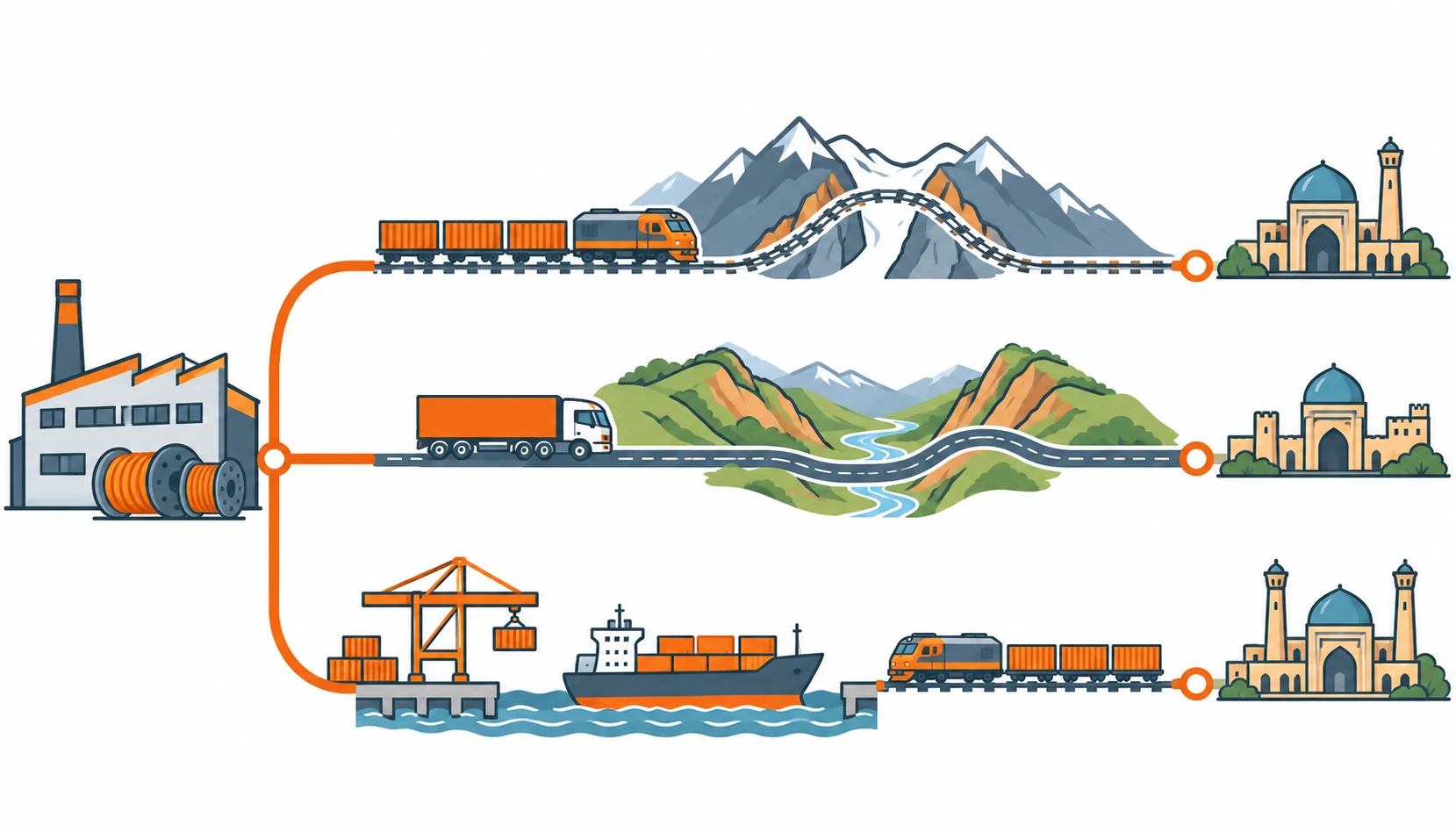
Quick Answer: Cable to Central Asia moves overland, and the route is a contract decision, not a booking. Rail through Khorgos or Alashankou carries the bulk at the best balance of time and cost; road through the mountain passes reaches sites the railheads do not; sea-rail through Lianyungang and the Trans-Caspian corridor sits in between. What decides the outcome is rarely the carrier. It is the drum packing for three thousand kilometres, the Incoterm matched to the buyer’s import capability, certificates whose scope covers the packed constructions, and a delivery calendar written against the construction season.
Introduction
Central Asia is landlocked, cable is heavy, and the shipping layer of a regional order behaves differently from any other lane a cable buyer works with. Drums are oversized freight, borders are document gates, and the last hundred kilometres often matter more than the first three thousand. This page is the route and terms overview for that lane.
The tender and contract path around the shipment is the subject of our Central Asian cable tender guide, and the quotation arithmetic that prices this lane is in our note on cable quotations from China to Central Asia. Wider regional buying context sits in our Central Asian cable buying hub; this page stays with the drums in transit.
Why Cable to the Region Is a Distinct Shipping Problem
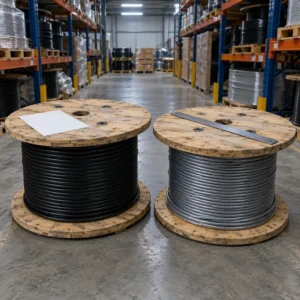
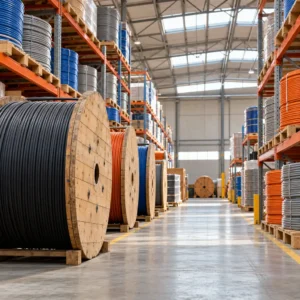
Cable drums are awkward freight. The flange diameter of a project-length drum usually exceeds the internal height of a standard container, so drums travel on flatracks, open wagons or flatbeds, exposed to weather and to every handling step between works and site. The packing decision is therefore a routing decision, made per lane, not a factory default.
The region is landlocked, which means no port delivery and at least two border crossings on every lane, sometimes three. Each crossing is a document gate before it is a physical one: invoices matched to packing lists, transit regimes, and a market access certificate whose scope must cover the constructions actually packed in the consignment.
Then there is the calendar. Regional construction seasons compress site works into warm months, remote sites need last-mile capability the railheads cannot provide, and drums that arrive without unloading equipment become inventory at the roadside. Arrival capability is a shipping input, and our note on site delivery and offloading covers what to confirm before the drums move.
Route One: Rail Through Khorgos and Alashankou
Rail is the backbone lane. Block trains leave Chinese yards for the border at Khorgos or Alashankou, cross the gauge change into broad gauge, and run on to Almaty and onward to Tashkent. Typical transit runs twelve to eighteen days to Almaty and sixteen to twenty-five onward to Tashkent, wide enough that the booking calendar deserves the same scrutiny as the price.
Cable suits rail well when it is booked properly. Drums ride on flatcars and in open wagons lashed to a securing plan, and full wagon lots protect the drums from the transloading that mixed consignments attract. The gauge change at the border is a handling event, so the drum securing spec is written for it, not discovered there.
The constraint is capacity, not distance. Wagon supply tightens in the peak season, block-train slots go to committed volumes, and border congestion adds days that no quotation promises to absorb. A shipping plan that books wagons as part of the contract calendar, backward from the season, behaves differently from one that books after production ends.
Route Two: Road Through the Mountain Passes
Trucking is the flexible lane. The Khorgos highway reaches Almaty in eight to fourteen days door to door; the Torugart and Irkeshtam passes carry Kyrgyzstan and the Fergana Valley in twelve to twenty. Road is how cable reaches sites the railheads never touch, and how smaller lots move without waiting for a wagon block.
Road has its own physics. Axle limits cap the drum weight per vehicle, so heavy drums travel two or three to a truck; passes close or slow in winter; and border transloading from Chinese trucks to local ones is a handling step the packing must survive. TIR transit documents keep the seals intact where the regime applies.
Cost per kilometre is higher than rail, but road prices a different product: door-to-site delivery with arrival dates the site can plan around. For mixed consignments, phasing deliveries by truck against the site programme often beats holding the whole order for a wagon block that may not be available when the season opens.
Route Three: Sea-Rail and the Trans-Caspian Corridor
The sea-rail lane runs from a Chinese port, usually Lianyungang, across to Aktau on the Caspian, then by rail into Kazakhstan or across to Baku and onward to Tashkent. Typical transit runs thirty-five to fifty-five days depending on the port rotation and the leg schedules. The general mechanics of the ocean leg are in our note on cable sea freight.
The lane wins in two situations: volumes that exceed the wagon supply on the northern rail lines, and programmes on the Caspian side of the region where the ocean leg shortens the land distance. Ocean rates sometimes undercut rail sharply, and a buyer with a flexible calendar can use that spread deliberately.
The cost is handling. Two transhipments mean the drums are lifted, stored and re-secured more times than on any other lane, and port storage in summer heat tests drum wrapping and end seals. Schedule reliability on the middle corridor has improved but still varies, so the lane is planned with wider buffers, not narrower ones.
The Route Map at a Glance
The table lines up the nine lanes that carry most regional cable volume, with typical transits, the situations each fits and the risk that decides it.
| Lane | Typical Transit | Best For | Main Risk |
|---|---|---|---|
| Rail block train, Khorgos to Almaty | 12 to 18 days | Full wagon lots into Kazakhstan | Wagon availability in the peak season |
| Rail block train, Khorgos to Tashkent | 16 to 25 days | Uzbek project volumes | Transloading at the gauge change |
| Rail via Alashankou to Almaty | 13 to 20 days | An alternative when Khorgos queues | Border congestion days |
| Road, Khorgos highway to Almaty | 8 to 14 days | Door-to-site delivery, mixed lots | Winter pass and axle limits |
| Road via Torugart to Bishkek and Tashkent | 12 to 18 days | Kyrgyz and south Uzbek sites | Transloading at the pass |
| Road via Irkeshtam to Osh and Tashkent | 14 to 20 days | Fergana Valley projects | Mountain transit handling |
| Sea-rail via Lianyungang to Aktau, rail onward | 35 to 45 days | Volumes beyond rail wagon supply | Double transhipment of drums |
| Sea-rail via Lianyungang and Baku to Tashkent | 40 to 55 days | Middle corridor programmes | Port storage and schedule drift |
| Mixed: rail mainline, road last mile | Rail transit plus 3 to 6 days | Remote sites off the railheads | Unloading capability at the site |
Packing Cable Drums for Long Land Transit
Packing starts with the drum itself: steel or timber according to the construction and the drum length, ends sealed against moisture, wraps specified for ultraviolet exposure because the drums will stand in yards, not warehouses. A packing spec written per lane survives the route; a generic one is re-invented at every transhipment by whoever is holding the crane.
Securing is the second half. Lashing plans for flatcars and open wagons, chocking for road, and drum weights distributed to respect axle limits on the last leg. The gauge change and the border transloads are the hardest steps on any lane, and the packing is designed for the worst leg, because that is where drums fail.
Documentation rides on the drums. Drum passports and protocol summaries travel attached, and a third-party check at the works before departure, the scope in our note on third-party cable inspection, records what was packed and how, the evidence that settles a transit damage argument later.
Incoterms for Central Asian Deliveries
The Incoterm allocates the transit risk, and in a landlocked region that means clearance risk at two or more borders. Free carrier terms end the seller’s duty at the Chinese yard; carriage-paid terms carry the goods to a named city or border; delivered-duty-paid terms put the supplier inside a customs regime he does not operate in. The term is chosen, not inherited.
Match the term to the buyer’s import capability. A buyer with a competent broker and a history of clearing similar consignments can take a delivered term seriously; a first-time importer cannot, and pretending otherwise produces drums that dwell at the border while the paperwork is improvised. Landed-cost comparisons between offers are set out in our note on comparing cable quotations for Central Asia.
Whatever the term, write the delivery plan as a document: named lanes per phase, who holds which document at which border, where storage responsibility sits if the site is not ready. The plan is what turns an Incoterm from a three-letter allocation into an operating routine both sides can run without meeting.
Border Documents and the Consignment Paper Flow
Every crossing asks for the same core: commercial invoice, packing list, transit documents, certificate of origin, and the market access certificate for the destination. The failure mode is always the same one: scope. A certificate that covers some of the constructions packed stops the whole consignment, which is why the certificate strategy is settled before packing starts. The country routes are in our note on cable import certification by country, and the full pack is in our power cable certification checklist.
The flow works when the lines match. Invoice lines keyed to packing list lines, packing list lines keyed to the drums actually sealed, certificate scope keyed to those constructions. Pre-alerts go to the broker before the drums reach the border, not after, because dwell time at a congested crossing is measured in days and paid in storage and patience.
Each consignment also carries its own quality dossier: technical passports per drum, batch certificates, test protocols naming the constructions shipped. The routine test layer behind those protocols is described in our note on cable factory testing, and keeping the dossier aligned with the invoice is what lets the acceptance gate move at the same speed as the drums.
Timelines: Production, Transit and the Construction Season
A regional cable delivery is a chain of three clocks: production, transit and clearance, and the buyer feels only the sum. Production lead time for project volumes is the first and longest block, set out in our note on cable MOQ and lead time, and it is planned backward from the season the site can actually work in.
Transit adds its own seasonality. Winter slows the passes and the wagon slots, the peak season tightens both, and copper moves throughout the whole cycle, which is why the price basis and the delivery calendar are negotiated as one question, the mechanics in our note on copper price lock contracts. A validity that expires mid-transit is a problem the contract created on purpose.
Quote realistic windows and say what is inside them. A timeline that absorbs one border congestion event and one winter week is a plan; a timeline that promises the brochure transit is a liability with a signature on it. Losing a season costs more than every day saved on paper combined.
Insurance and Risk in Transit
Transit insurance is arranged per lane and per term, and the loss driver is handling, not distance. Transhipments at the gauge change, at border transloading and in port storage are where drums are dropped, wrapped and re-secured by strangers. Cargo coverage on the land legs deserves the same care the ocean leg gets, because the land legs handle the drums more.
Write the claim mechanics into the terms: who insures, who is the beneficiary, what the survey duty at destination is, and which documents the claim needs. The survey evidence, packing records and the pre-shipment inspection report travel together, which is why they are arranged as one file rather than assembled after a loss.
Risk reduction is mostly upstream of the insurer: packing specified per lane, handling points designed for, drums secured to a plan rather than to habit. Insurance pays for losses; the packing and inspection routine keep them rare enough to stay a formality.
What a Central Asian Shipment Costs
The freight line is only the visible half. A consignment also carries terminal handling at both ends, border and transit fees, certificate and brokerage costs, insurance, and storage whenever dwell appears. On this lane the fixed costs are predictable and the variable ones are handling driven, which is why the packing and the paper flow decide the cost almost as much as the carrier does.
Cost behaves by unit. Full wagon and truck loads price per vehicle and reward phasing that fills them; smaller lots price per drum and pay a convenience premium at every step. Backhaul opportunities and seasonal rates move the number between quotations more than fuel does, which is why freight is quoted as a range with a stated validity.
Who pays what follows the term. Freight inside a delivered term looks expensive and transfers the risk; freight on carriage-paid terms sits as a separate line the buyer can audit; ex-works quotes hide the whole layer in the buyer’s own budget. The honest comparison is landed cost at the site, and it is the only number that survives a procurement review intact.
The Shipping Freeze List
These are the shipping decisions to freeze before the drums leave the works, in the order the risk arrives.
| Item to Freeze | How to Write It | Evidence to Attach | Cost of Leaving It Blank |
|---|---|---|---|
| Route and lane | Named lane per consignment phase in the delivery plan | Transit quotes per lane | Booking after production, at peak rates |
| Incoterm | Term matched to the buyer's import capability | Delivery plan naming document holders | Clearance risk owned by nobody |
| Drum packing spec | Drum type, sealing, wrapping and lashing per lane | Packing drawing and securing plan | Damage found at the far border |
| Certificate scope | Market access certificate covering packed constructions | Certificate copy with scope list | Drums held at the border |
| Insurance | Coverage per leg, survey duty, claim holder | Insurance draft and terms | Uninsured handling at transhipment |
| Consignment phasing | Phases against the construction season, drums per phase | Phasing table keyed to the programme | A season lost to one shipment |
| Arrival duties | Unloading capability, storage and offloading at site | Site offloading note | Demurrage and drums stranded roadside |
When Faster Is Not the Answer
When speed outruns the paperwork. A fast lane that arrives before the market access certificate does stores drums at the border at the buyer’s patience. Sequence the papers with the drums, not after them, and the fastest file is the one that crosses without stopping.
When the last mile is the project. A railhead is not a site. Drums that cannot be offloaded or hauled the last fifty kilometres are inventory by the road, not delivery. Confirm site capability before choosing the lane, not when the truck calls.
When the cheapest lane is slow twice. The cheapest quotation that dwells at a congested border twice is not the cheapest lane. Compare transit ranges and handling steps, not the headline number, because every unscheduled day is paid in storage and season.
When packing is where the money was saved. A drum that survives the pass but fails the transhipment was packed for one handling too few. Pack for the worst leg on the lane, and the rest of the journey takes care of itself.
When the season has already turned. If the calendar says winter transit and spring site works, a spring departure can beat an autumn hero run. Shipping into a closed season stores risk, not cable.
RFQ Checklist
- Route decided as a contract decision: named lane per consignment phase
- Transit windows quoted as realistic ranges against the construction season
- Drum packing specified per lane: type, sealing, wrapping, lashing
- Drum weights checked against road axle limits on the last mile
- Incoterm matched to the buyer’s import capability and broker
- Document holders named per border in the delivery plan
- Market access certificate scope covering every packed construction
- Invoice, packing list and transit documents line-matched
- Insurance per leg with survey duty and claim holder named
- Pre-shipment inspection scoped before the drums leave the works
- Per-drum dossier: passports, certificates, protocols per consignment
- Booking calendar backward-planned from production and the season
Conclusion
Shipping cable to Central Asia is one file wearing five labels: route, term, packing, papers and calendar. The lanes are known and none of them is difficult; what fails is the seam between them, where a certificate misses a scope, a drum meets one transhipment too many, or a delivery date meets a season it ignored.
Kexingyu Cable Group (KXYE) ships the region as a plan, not as a booking: lanes named per phase, drums packed for the worst leg, papers line-matched before the border, and a calendar backward-planned from the site season. Send the destination and the consignment volumes. A request for quotation is the fastest start.