Lessons from Regional Supply Contracts: What Cable Exporters Should Negotiate
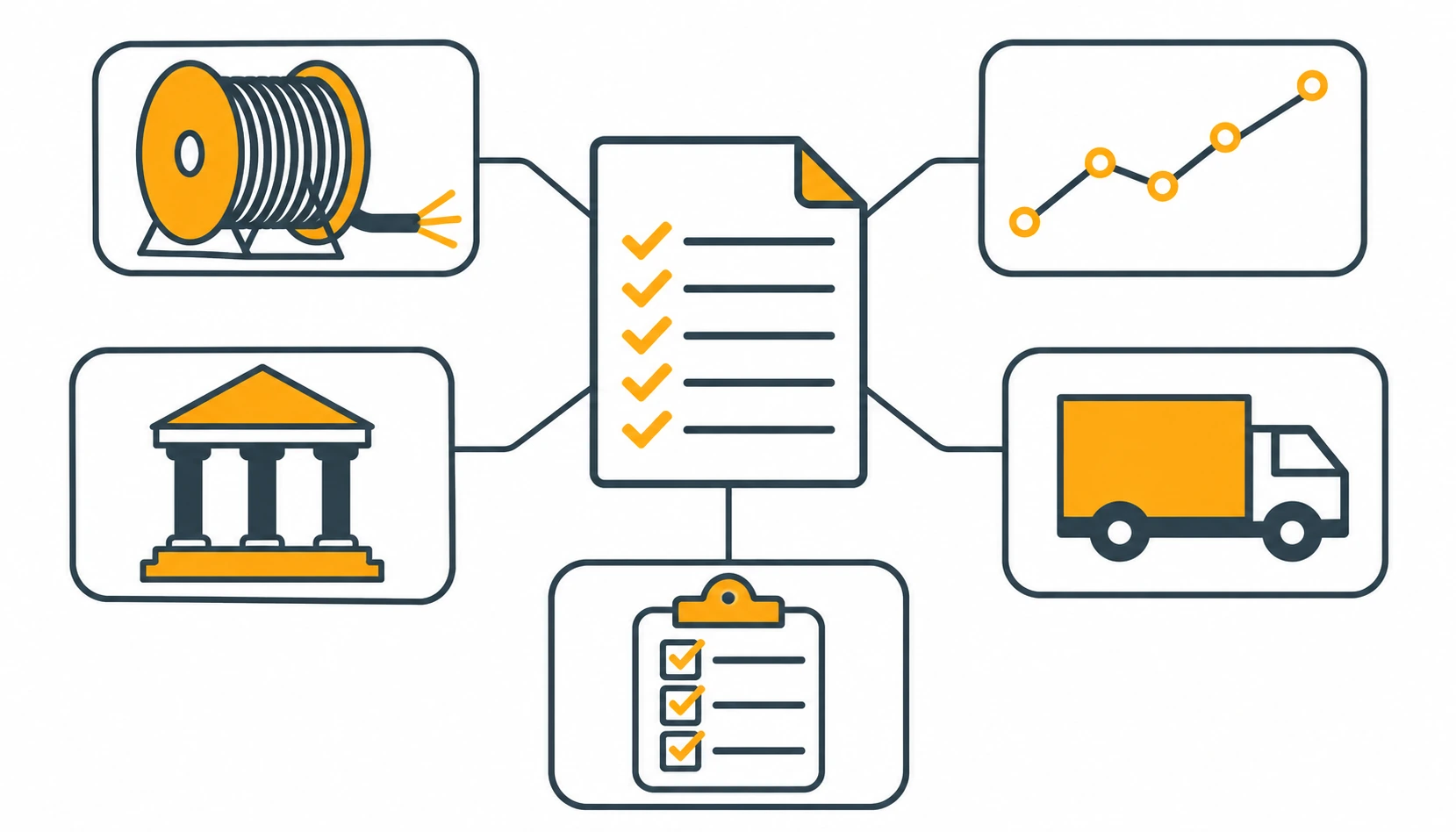
Quick Answer: The tender wins the order, and the supply contract decides whether the order pays. Across regional cable contracts, the clauses that move money are the same five: the scope annex with its drum schedule, the price basis and its copper adjustment, the payment and security structure, the delivery terms with their damages, and the acceptance and document duties. Templates allocate all of it by default. Exporters who correct those pages before signature, with evidence in hand, finish cleanly; exporters who sign as issued donate the difference.
Introduction
This page reviews the clause patterns that repeat in Central Asian cable supply contracts, drawn from regional supply work with project names anonymised. It treats the contract as a whole: what each clause family costs when accepted unedited, what to negotiate in its place, and what evidence turns a correction from a request into a reasonable one.
The claims machinery that starts after a drum fails in service sits in our note on warranty, claims and liability; this page stays with the contract as signed. The tender that produced the award is the subject of our Central Asian cable tender guide, and wider regional buying context sits in our Central Asian cable buying hub.
Use the page as a pre-signature routine: read the five clause families in the order they arrive, cost each default, and bring a written correction for the ones that price your side. The clause map and freeze list near the end compress the routine into two tables that travel well into a negotiation meeting.
Why the Template Reads Against the Supplier
Most regional supply contracts arrive as the purchaser’s document, drafted by a legal department or a design institute around local practice. The paper is not hostile; it is one-sided in the quiet way boilerplate usually is. Every clause that looks standard prices a risk, and the default allocation of that risk runs towards whoever signed last.
Reading the template is therefore a costing exercise. A retention clause is a financing cost. A delivery date written against site readiness is a schedule risk the factory does not control. A warranty that starts at loading rather than acceptance is a period the supplier pays for twice. Price what you are reading before you answer any of it.
Timing decides leverage. Corrections raised between award and signature are negotiations; the same corrections raised after signature are favours. The strongest positions arrive with evidence attached: a draft clause, a reference from a comparable contract, a cost figure for what the template asks. Corrections without evidence read as preference, and preference loses.
The Scope Annex: Constructions, Quantities and Drum Schedules
The scope annex fixes what is actually bought: constructions, voltage strings, governing standards, drum lengths, total quantities and the marking language. Every other clause leans on it, which is why it deserves the first hour. Tie each line to a datasheet and a standard edition, so the factory builds to a document and the inspector inspects against the same one.
Quantities need the closest read. A recurring regional pattern is volume that swells after the award at the contracted price, and a schedule written without bands invites it. Negotiate quantity bands per construction, or a stated price validity per volume tier, so growth becomes a new negotiation instead of a gift.
Drum lengths are a contract clause, not a factory preference. Lengths interact with route profiles, joint positions and pulling lengths on site, and a drum schedule agreed at signature avoids the mid-project argument about who pays for the offcuts. State the spares percentage here as well, priced, so it does not return later as an unpaid favour.
Price Basis and the Copper Adjustment Clause
A fixed price across a long validity is a position in copper that nobody priced. Regional contracts run months between signature and final delivery, and the metal moves more than the margin does. The correction is a price basis clause: the copper content visible, a named quotation source, a stated frequency, and a formula both sides can apply without meeting.
Templates omit the boring parts, and the boring parts are where disputes live. Say whether the adjustment uses the average or the close on the adjustment date, which publication, which rounding, and what happens when delivery slips for reasons on either side. The reference structure is in our note on copper price lock contracts.
Build the price so its parts are visible: metal, process, freight, duty where the term carries it, and the cost of the security instruments inside it. A layered price survives renegotiation, because each element can move without moving the others. The anatomy is set out in our note on the cable price breakdown.
Payment Terms and Security Instruments
The regional template usually reads: an advance of ten to thirty percent against an advance payment guarantee, progress payments per consignment, and a retention slice released at acceptance. The structure is workable; what needs negotiating is the timing of each trigger and the cost of the instruments, which belong in the price, not in the margin.
The currency clause deserves a lawyer’s hour even on repeat business. A contract that pays in one currency while the copper was bought in another builds a spread position nobody priced, and a trigger written as payment on delivery into a landlocked destination can mean payment on clearance, which is a different quarter. Term patterns are compared in our note on cable payment terms.
Force majeure and sanctions language sit beside payment because both decide when money stops. Write the notice period, the documents that prove the event, and what happens to the delivery calendar when the event ends. Templates that simply suspend obligations, with no rescheduling duty and no exit, leave the supplier holding inventory with no payout path.
Delivery Terms, Incoterms and Border Papers
The Incoterm decides who owns clearance risk, and clearance risk in the region is document risk. Delivering duty paid into a customs union means owning clearance in a jurisdiction you do not operate in; ex-works leaves the purchaser holding paperwork he may not be equipped to handle. Match the term to the buyer’s import history and say so in the delivery plan.
Border papers travel with the goods and fail before the goods do. The market access certificate’s scope must cover the constructions actually packed, and the transit documents must match the invoice line by line. The freight mathematics behind the term are in our note on cable quotations from China to Central Asia, the certificate layer is in our note on cable import certification by country, and the full document pack is in our power cable certification checklist.
Write the delivery calendar against the construction season, not against the signature date. Winter transit, storage at the border and site readiness all move the same weeks. State who bears storage and re-handling when the purchaser’s site is not ready, because the default answer in the template is usually the supplier, silently.
Liquidated Damages and Milestone Dates
Late delivery damages are usually written per week with a cap, and the number matters less than the dates it runs from. Anchor the milestones the factory controls: production complete, ex-works, loaded. A damages clause that runs from site readiness prices a delay the supplier cannot influence, and it will be triggered by somebody else’s winter.
Excusable delay needs its own mechanics: what counts, who proves it, how much notice, and how the calendar resets afterwards. Border closures and transit force majeure are regional realities, not hypotheticals, and a clause that treats them as ordinary breach converts a shared risk into a supplier-only one.
Check cap symmetry before signing. If late delivery damages are capped at five percent and general liability at one hundred, the paper is not neutral, it is directional. Negotiate the delivery damages cap and the warranty cap as one question, and keep the remedy language consistent between them.
Acceptance, Testing and Document Duties
The acceptance clause decides when the money finishes moving. Define what acceptance means: routine tests per drum, the witness points, the documents per consignment, and who signs at the gate. Templates that leave acceptance undefined turn retention into a negotiation, and negotiations after delivery are held without leverage.
Name the document duties per consignment: technical passports per drum, batch certificates, test protocols naming the constructions shipped. The test layer is set out in our note on cable factory testing, and a third-party check at the works before shipment, the scope in our note on third-party cable inspection, is the cheapest way to keep that gate moving.
Rejection and cure need a path: what triggers a re-test, who pays freight on a replaced drum, and how long the cure window runs. Without a mechanism, one disputed drum stops the retention and the schedule together. The machinery that starts once a drum has failed in service belongs to the claims note; the contract’s job here is only to price the cure in advance.
The Clause Decision Map
Reviewed clause by clause, the negotiation reduces to five families, and the same five appear whether the buyer is a state utility, a municipal programme or a private EPC. The wording differs; the risk allocation underneath it does not.
The table lines up the five clause families, what the template defaults to, the correction to ask for, and what accepting the default costs.
| Clause Family | Template Default | What to Negotiate | Cost of the Default |
|---|---|---|---|
| Scope annex | Constructions and quantities as ordered, no bands | Quantity bands, drum schedule, spares priced in | Volume swell at the signed price |
| Price and copper | Fixed price for the full validity | Basis, named source, formula, frequency, rounding | The copper move absorbed in the margin |
| Payment and security | Advance against guarantee, retention at acceptance | Trigger timing, instrument costs priced, currency of account | Financing cost and an unpriced spread |
| Delivery and damages | Dates from signature, damages without mechanics | Milestones the factory controls, excusable delay, cap symmetry | Damages running on somebody else's winter |
| Acceptance and documents | Acceptance undefined, retention until handover | Defined tests, witness points, document list per consignment | Retention held without a release path |
The Negotiation Freeze List
These are the decisions to freeze before signature, in the order the risk arrives.
| Item to Freeze | How to Write It | Evidence to Bring | Cost of Leaving It Blank |
|---|---|---|---|
| Scope and quantities | Bands per construction with a drum schedule | Datasheet per family and site route notes | Unpriced volume growth after the award |
| Price basis | Copper source, formula, frequency and rounding | Draft clause text with a worked example | A copper position nobody priced |
| Payment triggers | Advance, per-consignment progress and retention dates | Guarantee draft and bank fee quote | Cash tied in instruments and waiting |
| Currency | Contract currency aligned with the copper currency | Bank fee schedule for the spread | An open position inside the margin |
| Delivery milestones | Dates from ex-works and loading, not site readiness | Production calendar against the season | Damages on dates you do not control |
| Excusable delay | Named events, notice period, calendar reset | Transit route risk notes | A shared risk read as breach |
| Acceptance package | Tests, witness points, documents and retention release date | Protocol samples per consignment | Retention held by argument, not by fact |
When Conceding the Template Is Not the Answer
When the annex contradicts the award. A scope annex that drifts from the tender schedule shifts the bargain after the prize has been given. Correct it at signature, or the discrepancy becomes your discount later, discovered by someone who did not write it.
When retention has no release mechanism. A retention clause without a defined acceptance event is a deposit the buyer keeps by not meeting. Define the event, the documents and the date, or the slice never comes home on its own.
When the currency clause is a trade. Paying in one currency against copper bought in another is an open position on your margin. Align the two or price the hedge, and say which you did inside the offer.
When consignment stock is requested without security. Holding stock in the region unpaid is a warehouse with your name on it. Stock is priced; consignment is financed; neither is a courtesy extended between professionals.
When every correction is refused. Some buyers will not move a clause. Then the paper is a cost like freight: price what you are signing, and walk away from the ones who price nothing at all.
RFQ Checklist
- Scope annex tied to datasheets, standard editions and a drum schedule
- Quantity bands per construction, or price validity per volume tier
- Spares percentage stated and priced inside the schedule
- Copper basis with named source, formula, frequency and rounding
- Payment triggers dated against milestones, instrument costs inside the price
- Contract currency aligned with the copper purchase currency
- Incoterm matched to the buyer’s import capability, document flow stated
- Delivery milestones anchored to ex-works and loading, not site readiness
- Excusable delay, notice and calendar reset written as mechanics
- Acceptance defined: tests, witness points, documents, retention release date
Conclusion
A regional supply contract is five clause families wearing one signature. The scope annex, the copper basis, the payment structure, the delivery milestones and the acceptance package decide the margin long before the price page does, and every one of them is negotiable inside the window between award and signature.
Kexingyu Cable Group (KXYE) contracts the way it builds: scope tied to datasheets, a copper basis both sides can apply without a meeting, and an acceptance package defined per consignment. Send the draft contract and the destination country. A request for quotation is the fastest start, and the machinery that lives after delivery is described in our note on warranty, claims and liability.