Warranty, Claims and Liability: Cable Terms That Survive Site Reality
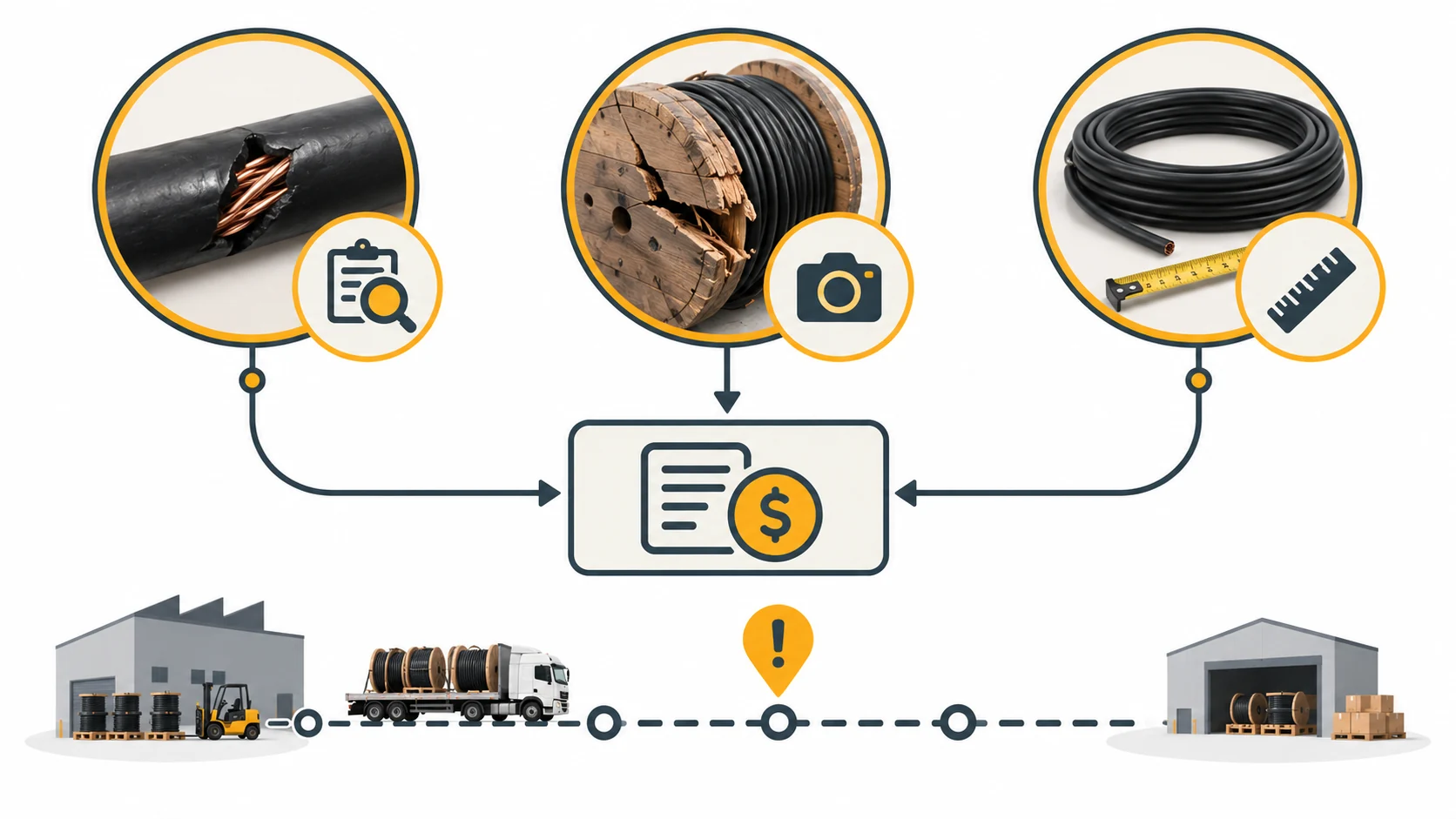
Quick Answer: A cable warranty covers defects that were present when the cable was delivered. It does not cover damage caused after delivery, however soon that damage appears. The disputes that go badly for the buyer are almost never about the terms themselves. They are about a site that kept no record of how the cable was stored, pulled, bent or terminated.
Introduction
Cable is one of the few bought items that can be damaged by the buyer’s own installation and then presented as a supplier defect. A sheath with a clean diagonal cut, a conductor that has been stretched, a drum that has taken water, a termination that has been made badly. In each case the cable arrives sound and fails later, and the warranty discussion turns on evidence rather than on goodwill.
This page is for site buyers, QA engineers and commercial managers who have to settle a cable claim. It covers what a warranty actually covers, how to separate a manufacturing defect from site damage, the three claims that reach a site, the claim routes and what each recovers, the evidence file that decides the outcome, where liability sits under each delivery term, and the six decisions to freeze before the order is placed. The general terms are described in our note on cable warranty terms.
What a Cable Warranty Actually Covers
A defect present at delivery, not a failure in service. The warranty exists to make good a cable that was not made or tested as specified. Conductor below the required class, an insulation wall under the minimum, a sheath compound different from the order, a missing layer, incorrect marking, or a length outside tolerance. Those are the findings a warranty is built for.
It runs from a defined trigger, for a defined period. The trigger is usually delivery, sometimes commissioning, and the period is commonly twelve to twenty-four months, whichever falls earlier. The trigger matters more than the length, because a delay between delivery and installation can consume the whole period before the cable is ever energised.
Exclusions are where most claims die. Damage from pulling beyond the rated tension, bending below the minimum radius, storage in standing water or direct sun, rodent attack, overcurrent, and work by third parties are normally excluded. Our notes on pulling tension and sidewall pressure and on minimum bend radius cover the two installation limits that generate the most excluded claims.
Separating a Manufacturing Defect from Site Damage
Look at the failure before the paperwork. A manufacturing defect usually repeats along the drum or appears at a consistent position in the construction. Site damage is local, directional and different from drum to drum. A single flattened section on one drum points at handling; a thin insulation wall on every drum points at the line.
Check the direction and the shape. A cut with a clean edge and a consistent angle is a pulling or edge damage signature. A radial split around a bend is a radius problem. Water in the outer layers with the inner construction intact suggests storage rather than manufacture. The patterns themselves are catalogued in our note on cable damage and wear patterns.
Ask what the records say. Pulling logs, tension readings, bend radius at the entry, the storage location and the date of installation convert an opinion into a finding. Where those records do not exist, the conversation between the two sides is a matter of assertion, and the supplier is under no obligation to concede. The wider set of causes is set out in our note on common causes of cable failure.
The Three Claims That Reach a Site
A defect claim. The cable did not meet the specification. This is the cleanest position and the one the warranty is designed for, provided the specification was written clearly and the release documents trace to the drums. Even here, the claim needs a test result or a measurement, not a description.
A transit or handling claim. The cable was damaged between the factory gate and the hardstanding. This is decided by the receipts inspection record, the photographs taken before the drums moved, and the named risk transfer point. Once the drums are mixed into the store or paid out, the position weakens quickly.
A quantity or shortfall claim. Fewer metres than ordered, on a drum that was specified for an unjointed run. Where the shortfall forces a joint or a re-order, the claim carries programme cost as well as cable cost, and the measurement method has to be agreed in advance or the argument becomes circular.
Claim Routes Compared
The table compares the routes available once a cable claim is identified, what each one can recover, what to specify, the evidence it needs, what drives cost and time, and how each one fails.
| Route | What it recovers | What to Specify | Evidence to Demand | Cost and Lead-Time Driver | How It Fails |
|---|---|---|---|---|---|
| Warranty repair or replacement | The defective cable, replaced from the supplier's cost | The defect scope, the replacement schedule and who pays freight | A test result or measurement showing the specification was missed | A production slot, so the delay is longer than the repair | A defect that cannot be separated from site damage done later |
| Cargo insurance claim | Damage between the risk transfer point and the site | The insured value, the cover and the notification period | The receipt record, the photographs and the carrier's paperwork | Survey and administration, with weeks to settle | A claim notified after the policy window has closed |
| Commercial settlement | A discount, credit or free replacement without admission | The basis of the settlement and what it closes off | A schedule of the affected drums and the cost claimed | The fastest route to a workable outcome on site | A settlement accepted without checking the real programme cost |
| Retention and payment leverage | Cost recovered from money still owed on the order | The retention percentage and the release conditions | Certificates, tests and the outstanding items list | Nothing up front, but it delays the supplier's cash | A claim on a fully paid order, where no leverage remains |
| Formal recovery or legal route | Full cost including programme damage, if the case holds | The notice requirements, the governing law and the forum | The complete file, with independent expert findings | Cost and time on both sides, usually the last resort | A strong commercial case with a file too thin to argue |
Building the Evidence File
Start the file before the cable arrives. The purchase order, the specification, the terms, the drum schedule and the delivery basis all sit in the file from day one. Adding them after a failure begins makes the whole chain look reconstructed.
Record the delivery, the storage and the installation. A receipt inspection with photographs, a note of where the drums stood and for how long, the pulling log with the tension and the entry radius, and a dated installation record. None of this takes more than a few minutes a day, and all of it decides claims.
Keep a retained sample of the failed piece. The failed length, cut cleanly, labelled, sealed and photographed, is what an independent examination works from. Cable that has been cut up and disposed of cannot be examined, and the claim usually goes with it.
Liability and Where Risk Sits
The delivery term sets the risk transfer point. Under an FOB or CIF arrangement the risk passes to the buyer at shipment, which means transit damage is a matter for the buyer’s insurance rather than the supplier. Under a delivered term the supplier carries the risk to the named destination. The difference decides which claim route is available before any technical question is asked, and our note on delivery terms sets out where the line falls.
Insurance is not a substitute for packing. Cover recovers value; it does not recover the weeks lost while a survey is completed and a replacement is scheduled. Packing matched to the route is still the first line of defence, and how it is specified is set out in our note on cable drum packaging for export.
Payment structure is the quiet lever. Retention, staged payments against dispatch and release certificates, and a final payment against satisfactory receipt all give the buyer something to work with when a claim is live. That is commercial, not technical, but it is decided at the same table as the warranty period, and our note on cable payment terms explains how the two interact.
What to Freeze Before the Order Goes Out
Six decisions decide whether a warranty will still be worth something when it is needed. Each belongs in the purchase order.
| Decision | What to State | Evidence to Attach | Cost of Leaving It Open |
|---|---|---|---|
| Warranty period and trigger | The length, whether it runs from delivery or commissioning | The clause with the trigger event named | A period consumed in storage before the cable is even installed |
| Scope and exclusions | What is covered, and the installation limits that are not | A list of exclusions with the associated limits | A claim refused on an exclusion nobody read at award stage |
| Claim notification period | How long after discovery a claim can be raised | The clause with the number of days stated | A valid defect claim lost on timing alone |
| Delivery term and risk point | Where risk transfers and whose insurance applies | The Incoterm with the named point | A transit claim with no insurer and no supplier obligation |
| Required site records | The storage, pulling and installation records to be kept | A record template issued with the delivery | An unwinnable argument about how the cable was handled |
| Payment and retention | The retention percentage and the release conditions | An agreed release certificate before final payment | A claim on a fully paid order with no leverage left |
Cost and Lead Time
The replacement is the cheap part. A replacement drum costs cable and freight. The programme cost of waiting for it, with plant and labour standing, is usually several times larger, which is why the claim should be framed with the programme consequence in it and not only the material.
Decide the provisional repair early. Where a section can be repaired or a joint accepted, agreeing that on the day keeps the programme moving while the commercial argument continues in parallel. Waiting for a settlement before acting on site is the most expensive way to handle a defect.
Replacement drums need a production slot. A replacement to the same construction is a small production order that still needs conductor, extrusion and test time, and it displaces other work. The realistic date comes from the factory schedule, and expectations should be set against the structure in our note on cable MOQ and lead time.
When a Claim Is Not the Answer
When the damage was caused by installation. Pulling over a sharp edge, bending under the minimum radius or dropping a drum causes damage the warranty does not cover, and pursuing a supplier on those facts costs credibility that a genuine claim will need. Record it, fix it, and use the failure to improve the method.
When the specification was never written. If the order left the construction or the class open, there is no baseline for a defect claim. The right response is to correct the specification and re-order, not to argue about a cable that was never defined.
When the failed cable has already been removed and disposed of. Without a retained sample and photographs taken in place, an examination cannot be carried out and the claim has nothing to stand on. This is entirely avoidable and it is the single most common way a strong case is lost.
When the numbers do not justify the effort. A claim for a few metres of cable costs more in staff time than it recovers. Accept the loss, note the cause, and put the effort into the order that matters. Where a supplier is worth keeping, a credit note and a short conversation often beat a formal process, and the relationship is preserved for the next project. Our note on after-sales support covers how that is normally handled.
RFQ Checklist
- The warranty period, the trigger event and which falls earlier
- The scope of cover and the list of exclusions, in full
- The installation limits that make an exclusion apply
- The claim notification period, in days from discovery
- The delivery term and the exact point where risk transfers
- Who insures the shipment, and to what value
- The records the site is required to keep, and for how long
- The retained sample requirement, and who holds it
- The remedy sequence: repair, replacement, credit, or a combination
- Who carries the cost of freight on a replacement drum
- The retention percentage and the conditions for its release
- The named contacts for a claim on both sides, with authority to settle
Conclusion
A cable warranty is a document, but a cable claim is an evidence exercise. The terms decide what is recoverable; the site records decide whether it is recoverable at all. Buyers who write the exclusions down, set the risk transfer point at the order stage and keep a receipt record and a pulling log get settlements. Buyers who do not, argue.
Kexingyu Cable Group (KXYE) has manufactured cable in Quanzhou since 1996 and works warranty claims from the drum record, the release documents and the retained sample, so a genuine defect is settled on the facts rather than negotiated on goodwill. Send us the specification and the delivery basis and we will set out the records and terms that come with the order. A request for quotation is the fastest route.