Cable for Cement and Building-Materials Plants in the Region
Quick Answer: A cement plant asks one question of its cable in four ways: what is the cable standing next to. Heat at the kiln and cooler, dust everywhere, impact at the crushers and vibration on the conveyors each select different constructions from the same catalogue. Map the plant into zones, specify the cable per zone with the evidence attached, and buy to the outage calendar, because in a plant that runs continuously the only time cable work is cheap is when the kiln is down.
Introduction
This page covers the cable side of cement and building-materials plants in the region: how the circuits divide from quarry to packing, what each zone of the plant does to a sheath, where heat and dust change the specification, and what to freeze in an RFQ so the package fits the maintenance calendar. It is written for the plant’s electrical department, the EPC and the upgrade contractor buying the cable.
The regional buying context sits in our Central Asian cable buying hub. Our note on asphalt plant and paver cable covers the other hot, dusty building-materials process; this page stays with the cement plant itself.
Why a Cement Plant Is a Cable Specification Problem
Continuity is the first fact. A cement plant earns nothing when it is down, restarts are expensive, and the cable routes run through the middle of the process it feeds. Specification errors surface as unplanned stops, and the same errors cost ten times more to fix during production than during a planned outage, which is why the specification work in this sector is really scheduling work.
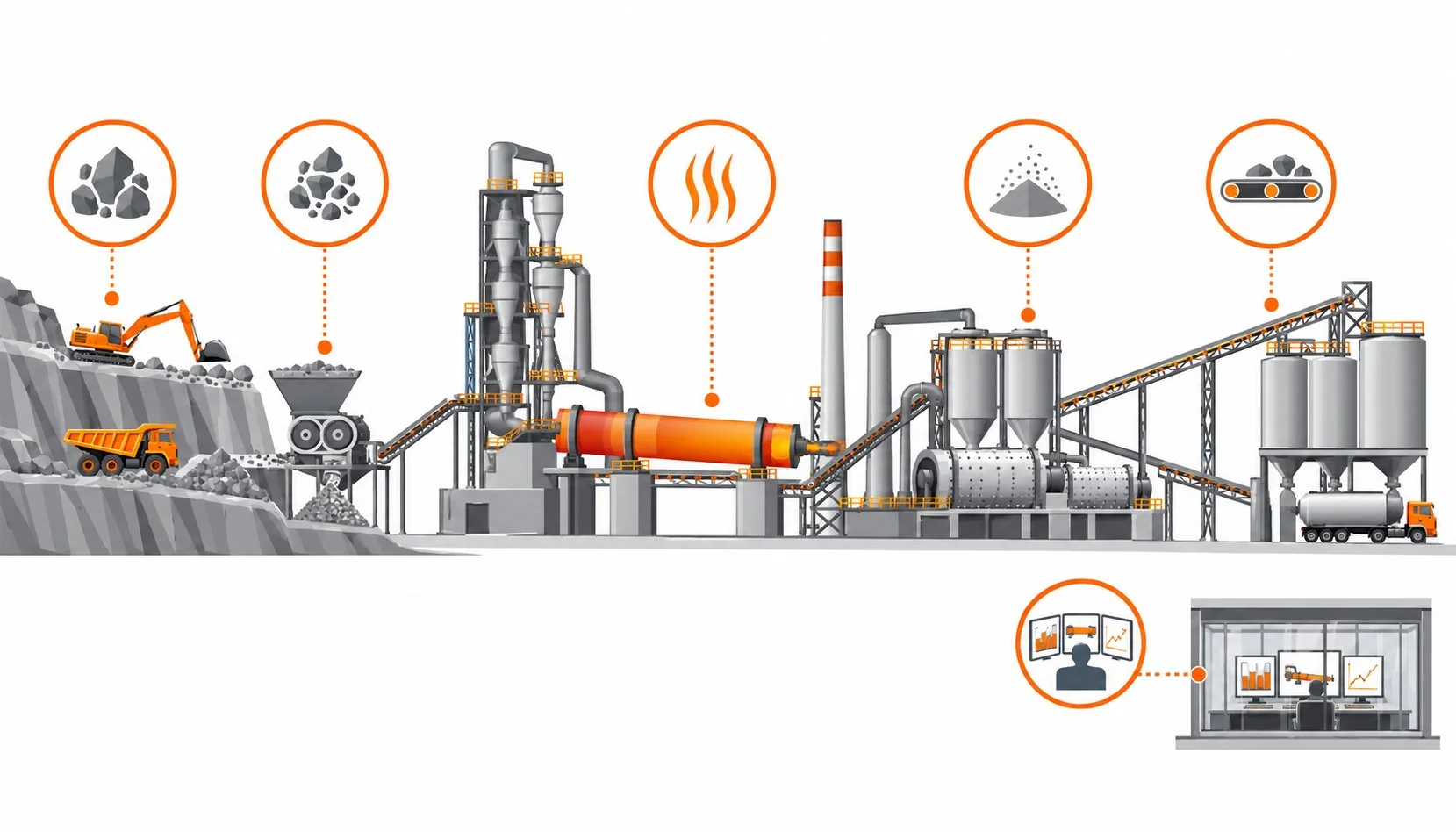
The environment is the second fact, and it varies by zone more than any buyer expects. One plant holds an ambient dust storm, a radiating kiln, a wet grinding circuit, an abrasive conveyor gallery and a quiet control room, and a single plant-wide cable standard is simultaneously overbuilt for the offices and underbuilt for the kiln nose. Zoning is the specification method that fits.
The installed base is the third. Many plants in the region run mixed vintages, with cable added across decades to different standards, and the upgrade project inherits every shortcut. A package that specifies by zone, with evidence per line, gives the plant a defensible baseline; a package priced as one number gives it another layer of the same history.
Mapping the Circuits: Quarry to Packing
The electrical system follows the process, and the process defines the zones: quarry and crusher lines, raw meal grinding, the kiln and cooler, cement grinding, and packing with dispatch. Each zone pairs its process loads, mostly large motors with high starting duties, with the control and instrumentation that watches them, and each pairs a different environment with the same voltage class.
The power side concentrates on motor feeders. Crushers, mills, fans and the kiln drive itself are fed over feeders sized for starting behaviour, and the starting method is an electrical decision with a cable consequence, as any plant that inherited a direct-online crusher knows. Feeder routes also concentrate where the environment is worst, which is why feeder construction is a zone decision before it is a cost decision.
The control side follows the same zones with different rules. Process instrumentation, weighfeeders and the drive network carry signals that dust and heat degrade slowly and predictably; the control cable families for plant duties are described in our note on KVV control cable. Table 1 lines the zones up against construction and evidence.
Heat Zones: Kiln, Cooler and Hot Material
Heat selects cable twice: by rating and by ageing. Ambient temperature around the kiln hood, the cooler and the clinker handling lines sits above the values behind standard ratings, so ampacity is corrected before cross-sections are chosen; the correction method is the one in our note on cable derating factors. The correction is small on paper and decisive in service, because a feeder run at its limit ages on a curve, not a line.
Ageing is the zone’s real bill. Insulation and sheath compounds each carry a temperature class, and a cable run permanently above its class loses life by chemistry long before anything trips; the classes and their selection logic are set out in our note on cable temperature classes. Around hot material, distance and shielding do the work the compound cannot, and routing away from radiation is worth more than any upgrade.
Where the route cannot move, the specification steps up to the high temperature constructions for fixed industrial duty compared in our note on high temperature cable for industrial plant, with the zone, the ambient and the evidence named on the order line.
Dust, Abrasion and the Jacket Question
Dust in a cement plant is not dirt; it is abrasive raw material in suspension. It packs enclosures, loads horizontal surfaces, holds moisture against sheaths and grinds at anything the conveying air touches. The jacket question is therefore an abrasion question first, and the compounds built for wear and cut resistance are compared in our note on mining jacket compounds, which face the same test every shift.
Cement dust adds a chemistry that mining dust does not: it is alkaline and hygroscopic, and on a sheath that holds a dust layer through a humid night, the combination works slowly into the surface. Sheath materials differ in how much of that they shrug off, and the comparison is set out in our note on cable sheath materials compared. Cleaning and inspection rhythms do the rest, and they cost a shift, not a specification.
Enclosures and glands inherit the same dust. IP ratings are chosen for the packing and grinding halls, glands are matched to the sheath and checked at every outage, and the horizontal runs above equipment that collects dust are inspected where they sag. None of this is exotic; all of it is skipped where the RFQ never mentioned the dust it would live in.
Crushing, Conveying and Mechanical Protection
The mechanical zones select for impact and abrasion together. Crusher areas see thrown material and mobile plant; conveyor galleries see vibration, loaded belt failures and the occasional tramp iron event. Cable in these zones runs in tray and conduit with protection sized to the hazard, and the selection logic for impact and crush exposure is set out in our note on crush and impact cable protection.
Routing again beats armour. The cheapest mechanical protection is the metre of distance between the cable and the hazard: runs above the spill line, not beside the chute; crossings over conveyors in protected spans; drops to motors on the far side from the flow. Every plant has a gallery where this was ignored, and the gallery explains the maintenance budget.
Conveyor feeders deserve one extra line: they are long, repetitive and interruptible, so drum lengths matched to the gallery keep joints out of positions that only open during outages. Every joint placed in the wrong position is a future outage of its own.
Control and Instrumentation in Dust
The process runs on measurements, and the measurements run on cable that dust ages quietly. Weighfeeder and analyser signals, thermocouple runs at the kiln, and the drive communication network all degrade in predictable ways: screens loaded, connections resistive, rooms hot. The control and instrumentation split follows the plant’s instrument list, with process signals and drive communication kept on their own screened constructions.
Segregation and screening are the specification core, as in any plant that mixes power and signals. The cement plant version adds one habit: screens and glands are checked at every outage, because dust turns a marginal connection into an open one over exactly the interval between outages.
Spare cores and spare instruments cable belong in the original package, because the plant upgrades its instrumentation continuously and the routes are expensive to open. The core schedule per route, labelled at both ends, converts the next upgrade from a survey into an order, and it costs a rounding at installation time. The schedule is written once and read at every upgrade since, which is why it belongs in the package rather than in a drawer.
Buying for the Plant: Tests, Phases and Outages
The plant buys cable against an outage calendar. Major work lands in the annual shutdown, smaller packages in weekend windows, and the delivery plan is staged to those dates with drums and termination kits arriving per zone, not per order. Lead time for the lane is committed in the order, per position, not assumed.
Upgrades are the recurring purchase. A plant modernising by zones needs the same comparison envelope a new plant needs: construction, tests, lengths and delivery per phase, with evidence per line. The buying discipline is the one in our note on the industrial cable RFQ checklist, with supplier credibility checked before the volume lands.
Table 2 is the freeze list that makes the envelope common before offers land, and the document that survives the personnel changes between outages.
The Plant Zone Map
Table 1 lines up the plant zones against the governing stress, the construction answer and the evidence that decides the order.
| Plant Zone | Governing Stress | Construction Answer | Evidence to Demand |
|---|---|---|---|
| Kiln and cooler | Ambient heat and radiation | Temperature class above zone ambient | Class declaration, derating sheet |
| Grinding and packing | Abrasive alkaline dust | Abrasion and chemical resistant jacket | Compound specification and tests |
| Crushers | Impact and mobile plant | Protected routing, rated protection | Protection detail per route |
| Conveyor galleries | Vibration and long runs | Drum lengths matched to gallery | Joint placement plan |
| Control rooms and DCS | Signal integrity | Screened instrumentation, segregation | Segregation and test records |
The Cement Plant RFQ Freeze List
Table 2 is what to settle before the enquiry goes out, because these lines decide whether the package survives its first outage.
| Item to Freeze | How to Write It | Evidence to Attach | Cost of Leaving It Blank |
|---|---|---|---|
| Zone map | Zones drawn with stresses named | Layout with zone overlay | One standard for five climates |
| Temperature classes | Class per zone, ambient stated | Derating calculation per route | Feeders ageing on a hidden curve |
| Jacket standard | Abrasion and chemistry per zone | Compound data and tests | Dust doing the specifying |
| Protection detail | Tray, conduit and crossing spans | Routing sheets per area | The gallery that owns the budget |
| Joint plan | Drum lengths matched to galleries | Joint placement schedule | Outages spent on old joints |
| Core schedule | Spare cores per route, labelled | Core schedule per area | Upgrades that start with a survey |
| Outage staging | Drums and kits staged per window | Shutdown schedule | Kits on site after the window closes |
When One Plant-Wide Cable Standard Is Not the Answer
When the kiln area is specified from the office block. A single standard is overbuilt in the quiet zones and underbuilt at the kiln nose, and the failure lands where the repair is most expensive. Zones with their own classes, jackets and evidence are the only version of this that holds up.
When derating is treated as optional. Ambient heat around the burning line cuts ampacity below the datasheet number, and a feeder run at its limit ages invisibly until it stops the plant. The derating calculation belongs in the RFQ as a named document with its inputs.
When protection is bought instead of routed. Armour and hard jackets do not excuse a route beside the chute. The metre of distance between cable and hazard is the cheapest protection on the project, and the routing sheet is where it is bought.
When control cable is specified by price alone. Screens, segregation and labelled spare cores are small money on the order and the whole difference in the DCS’s behaviour over ten years. The instrumentation layer is specified by its vendor’s requirements, not by the lowest line on the quote.
When delivery ignores the outage calendar. Cable that misses its shutdown window waits for the next one, and the plant pays for the delay twice: once in the project and once in the risk it carries in the meantime. Staging per window is a procurement line, not a favour.
RFQ Checklist
- Zone map drawn with the governing stress named per zone
- Temperature class and derating calculation per heat zone route
- Jacket standard per zone: abrasion, chemistry, dust load
- Protection detail per route: tray, conduit, crossing spans
- Drum lengths and joint placement matched to galleries
- Control and instrumentation schedule with segregation rules
- Spare cores per route, labelled at both ends
- Evidence list per line: routine tests, compound data, class declarations
- Delivery staged to the outage calendar with kits per window
- Supplier audit or third party inspection agreed for major packages
Conclusion
A cement plant is bought zone by zone. Heat zones take their class, dusty zones take their jacket, mechanical zones take their routing, and the control layer takes its segregation, all written into one RFQ with evidence per line and delivery staged to the shutdown calendar. Packages written that way survive outages and management changes alike; packages written as one number inherit the plant’s history instead of replacing it.
Kexingyu Cable Group (KXYE) supplies cement and building-materials plants with zone-by-zone packages: heat-rated feeders, abrasion-resistant jackets, screened instrumentation and termination kits staged to your outage windows. Send the zone map and the shutdown schedule. A request for quotation is the fastest start.