Specifying Mining Cable Jacket Compounds: Wear, Tear and Cut Resistance
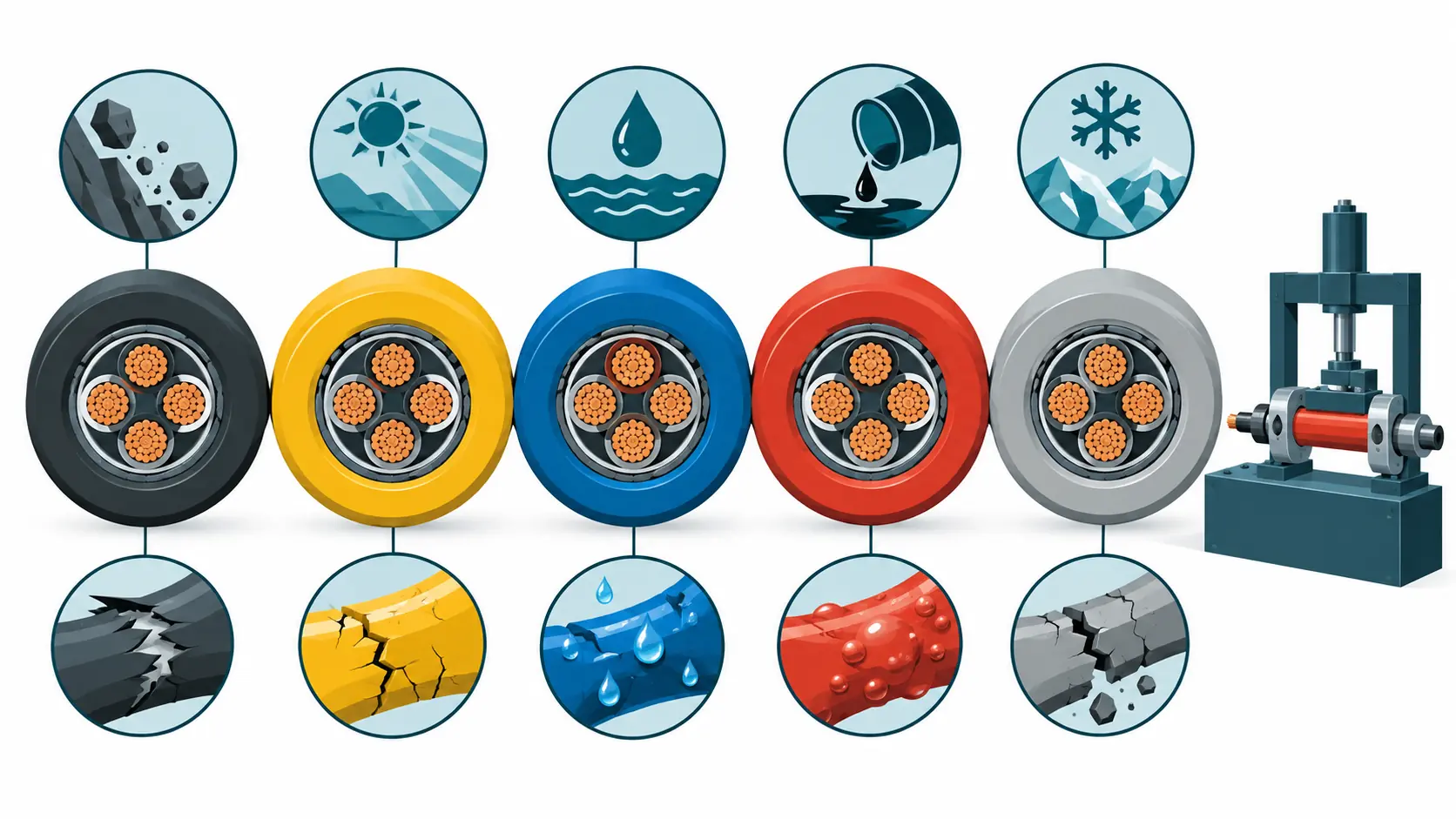
Quick Answer: The mining cable jacket carries most of the cable’s price and absorbs most of the damage, yet it is usually the last thing fixed in a specification. Mine duty breaks jackets four ways: drag abrasion, cut-through from rock and track plates, tear at a clamp or machine entry, and attack by oil, acid water and heat. Correct compound selection starts from the failure you are actually seeing, not from a general preference for rubber.
Introduction
Ask a mine why it changed jacket compound and the answer is usually a maintenance number: cable replacements per quarter on a particular run, or hours lost to a sheath fault that turned into an earth fault. That is the right way to choose. A compound is not better or worse in the abstract. It is better or worse against a specific damage mechanism, and the mechanisms differ between a face conveyor and a flooded roadway feeder.
The commercial side matters as much as the technical one. The jacket is the single largest material cost in a heavy mining cable, and it also sets the outside diameter, which sets the drum length and the freight. Where the jacket is specified by habit rather than by mechanism, mines pay twice: once for a compound that will not survive, and again when the drum length on the haul is wrong.
What Actually Damages a Mine Jacket
Drag abrasion. A trailing cable pulled across gravel, broken rock and coal loses material from one side. Abrasion is a slow, localised process, and it rarely looks dramatic until the screen is exposed and water gets in.
Cut-through and impact. Track plates, bucket teeth and falling rock cut rather than rub. A haul truck crossing a cable may not sever it, but a flattened core and a scored jacket become a fault months later at a termination.
Tear at the constraints. Most jacket failures on trailing cable begin at a clamp, a guide or the machine entry, where a small cut propagates under tension. Tear resistance is a different property from abrasion resistance, and a compound that scores well on one is not automatically good on the other.
Chemical and thermal attack. Acidic seepage, hydraulic oil, diesel and reagent spillage all soften or swell a sheath. Heat from a continuous load and from a hot return airway accelerates the same ageing. A jacket that resists abrasion but swells in oil is the wrong jacket for a workshop or a coal preparation plant.
The Compound Families Used on Mine Cable
Chlorinated polyethylene (CPE). The workhorse for heavy rubber-sheathed mining cable. Good abrasion and weather resistance, decent oil resistance, and it can be made flame retardant. It is not the best at any single property, and it is the right answer more often than any other compound on a mine site because it is balanced.
Polychloroprene (CR). Tough, flame resistant, and tolerant of oil and ageing, which is why it appears on trailing and reeling duties where mechanical abuse dominates. Tear resistance is good. Cold flexibility is the limit, and it stiffens more than the alternatives below zero.
Polyurethane (PUR). Exceptional cut, tear and abrasion resistance with excellent flexibility, and the compound of choice where a cable is dragged over rough ground or run through a festoon under constant working. It pays for itself on the worst run on the site and is hard to justify on a fixed feeder. Our comparison of PUR, PVC and TPE jackets sets out where each one stops making sense.
EPR and EPDM. Usually an insulation material, and sometimes the sheath on lighter service cable. Very good flexibility and temperature range, modest abrasion resistance, so it belongs on cable that is handled rather than dragged over rock.
Silicone and speciality compounds. Bought for temperature rather than mechanical duty, for example at a fan motor or a brake resistor. Where a mine needs both heat and tear resistance on the same run, that is a sign the run needs heat shielding rather than an exotic compound. The tear-resistant silicone rubber range covers the niche.
The Five Families and the Duty They Suit
The table below is written to be read against a specific failure, not as a ranking.
| Compound | Best Fit on a Mine | What to Specify | Evidence to Demand | Cost and Lead Time | How It Fails |
|---|---|---|---|---|---|
| CPE | General heavy rubber-sheathed cable, feeders and service runs | Grade, flame-retardant version and hardness range | Abrasion, tear and flame test results on the compound | Balanced price, widely available, shortest lead time | Slow drag wear and eventual screen exposure |
| Polychloroprene | Trailing and reeling duty with heavy mechanical abuse | Oil and flame resistant grade, cold flexibility limit | Tear strength, oil immersion and low temperature results | Higher than CPE; long run quantities add cost | Stiffening below zero, then cracking at the machine entry |
| PUR | Worst run on site: dragged over rock, festoon working, frequent reeling | Grade, hardness and the abrasion mechanism it is bought for | Cut, tear and abrasion data at the declared duty | Highest jacket cost; justified only where it replaces repeat replacements | Rare mechanical failure; hydrolysis where the cable sits in warm water |
| EPR / EPDM | Handled service cable, lighting and control runs | Temperature range and ozone resistance | Ageing and low temperature results | Moderate cost, quick to make | Mechanical damage under drag; poor where rock rubs |
| Silicone and speciality | Heat at fan motors, brakes and hot equipment | Temperature class and the mechanical duty it must still take | Heat ageing and tear results at temperature | High cost and a longer lead time | Bought for heat and then cut through where nobody shielded the run |
Reading the Compound Evidence
Compound claims are only as good as the test behind them, and the test has to match the mechanism. Four pieces of evidence carry weight on a mining order.
Abrasion. Ask which abrasion method was used and at what load, because different methods rank compounds differently. Our note on the cable abrasion test standard explains how the published figures should be read.
Tear. Tear strength matters at the clamp and the machine entry, and it should be quoted with the test temperature. A figure taken at room temperature tells you little about a cable that is handled at minus twenty.
Oil and chemical exposure. Where the run passes hydraulic equipment or a reagent plant, ask for immersion results at the actual fluid and temperature rather than a generic oil resistance statement. Our note on the cable oil resistance test covers what those results do and do not prove, and the oil resistant cable range lists the constructions built for it.
Mechanical properties after ageing. The IEC 60811 mechanical test series is where tensile strength and elongation after ageing are measured. A compound that starts tough and loses half its elongation in a hot airway is not a compound that will survive the mine’s life.
One general point on evidence: the compound and the finished cable are different subjects. A supplier can quote a compound data sheet and still deliver a cable whose sheath is thin at the worst point. Ask for the sheath thickness and the finished cable test results, not only the compound properties. The sheath materials comparison is a useful starting reference for matching a family to a duty.
When a Tougher Compound Is Not the Answer
When the run is being damaged at one point. Repeated jacket failure at the same clamp or guide is a routing problem. A harder compound moves the failure a few weeks later; fixing the guide stops it. Our note on cable damage wear patterns is written to separate the two before money is spent on a heavier drum.
When reinforcement is the cheaper route. Where cut-through rather than abrasion is the mechanism, a reinforced or armoured construction may be more economical than a premium compound, because the compound cannot resist a bucket tooth and the reinforcement can. The trade off is weight and bend radius, which is set out in our note on abrasion resistant cable jackets.
When the damage is inside a joint. A jacket that fails at a repair sleeve is telling you about the sleeve, not the cable. Mines that keep losing repair sleeves are usually reusing a joint kit designed for a different cable diameter.
When the site asks for the toughest compound on every line. A PUR jacket on a fixed roadway feeder buys nothing but cost and a narrower temperature window. Match the compound to the mechanism, run by run, and put the premium where the damage actually happens.
When the driver is not wear at all. Where a run is being replaced because it absorbed water rather than because the jacket wore out, a different compound does not help. That is a construction problem in the insulation and the water blocking, and the jacket is only the symptom.
What to Freeze Before the RFQ Goes Out
| Decision | What to State | Evidence to Attach | Cost of Leaving It Open |
|---|---|---|---|
| Damage mechanism | Drag, cut, tear or chemical, named per run | Photographs and replacement history for the run | A premium compound bought against the wrong failure |
| Compound and grade | Family, flame-retardant version, hardness range | Compound test results at the relevant temperature | Two suppliers quoting different products under one name |
| Sheath thickness | Nominal and minimum wall, with the tolerance stated | Finished cable measurement on a cut sample | A cable that meets the compound spec and not the jacket duty |
| Oil and chemical exposure | The actual fluid, temperature and duration | Immersion results at those conditions | Swelling and softening inside the first year |
| Temperature range | Site low and high, plus the handling temperature | Cold bend and heat ageing results | Cracking at the machine entry on a freezing shift |
Lead Time and Cost Structure
The jacket decides the price more than any other single item on a heavy mining cable, and it also decides how long the cable takes to make. A speciality compound has to be ordered in a batch, mixed and then extruded, and the run length has to be large enough to be worth setting up. That is where a short special run becomes disproportionately expensive.
The practical procurement rule is to concentrate the premium compound on the runs that are actually destroying cable, and to buy the balance on a standard grade. A mine that has three problematic trailing runs and forty sound feeders does not need PUR on all forty three. Splitting the specification this way usually saves more than the negotiation on a single blended price.
Where a project fixes prices early, remember that the copper basis and the compound grade are separate variables. A quotation that holds copper for a window but leaves the compound grade open is not a fixed price, so ask for both to be pinned and compare the cost structure rather than the total.
Incoming Inspection of the Jacket
Measure on a cut sample. Sheath thickness at several points around the circumference, plus overall diameter. This settles more arguments than any data sheet, and it is cheap to do with both parties present.
Check hardness and appearance. A jacket that has gone hard, chalky or uneven in colour before it has seen service has a compounding problem. Compare a sample against the approved sample if one was kept.
Confirm the compound identity on paper. Match the grade quoted on the delivery documents to the approved sample and the test reports, and keep those three together in the drum records. Where a mine later changes supplier, that file is what makes a like for like comparison possible.
When a Compound Change Is Worth Making
When replacement history justifies it. Three failures on one run in a year is a case. One failure in five years is not, and the money is better spent on the guide that caused it.
When the failure mode has changed. A run that used to wear and now cracks in the cold needs a different cold flexibility limit, not more abrasion resistance. Read the failed samples before specifying the replacement.
When the site is standardising. Standardising on one compound across a fleet is a real benefit for stores, and it is worth some over-specification on the easy runs. Standardise on a balanced grade rather than on the premium one, so the standard does not price the mine out of its own spares programme.
When the cable is being bought on unit price alone. A jacket comparison that never reaches the maintenance record is not a comparison. Ask for the replacement history against each quotation and price the compound against the failures it prevents.
RFQ Checklist
- Damage mechanism named per run, with photographs where available
- Jacket compound family and grade, including the flame-retardant version
- Hardness range and the expected handling temperature
- Sheath thickness nominal and minimum, with tolerance
- Abrasion, tear and cold bend results at the site conditions
- Oil, acid and reagent exposure with the actual fluids and temperatures
- Ageing results, with tensile and elongation retention quoted
- Reinforcement or armour considered against the cut-through mechanism
- Outside diameter, because it sets drum length and freight
- Copper basis and compound grade both pinned in the price
- Approved sample kept and referenced on the order
- Delivery documents traceable to the compound test reports
Conclusion
Choose the mine jacket from the failure you are seeing, per run, and put the money where the damage is. A balanced compound on forty sound feeders and a premium one on the three bad runs usually beats a single premium grade across the fleet.
Kexingyu Cable Group (KXYE) has supplied electrical cable from Quanzhou since 1996, including the rubber-sheathed, oil resistant and speciality constructions used on mine duty, along with the compound test evidence that goes with them. Send the replacement history and the run conditions, and we will come back with the compound that matches the mechanism, the sheath dimensions, the test results that apply, and a delivery plan around your shutdown window. The fastest route is a request for quotation.