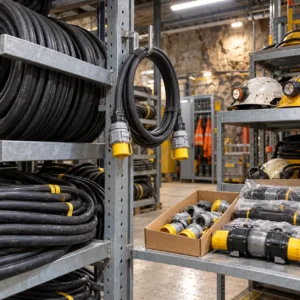
Procuring Mining Cable: A Buyer's Guide to Duty, Approval and Lead Time
Quick Answer: A mining cable order is decided by three things the catalogue page does not show: the duty the machine imposes, the approval the destination mine will accept, and the lead time the site can live with. State all three in writing before the RFQ goes out and most of the arguments that arrive three weeks into the project never happen. This guide covers what to specify on each cable family, what evidence to demand, where each one fails, and what to freeze before the order is placed.
Introduction
Mining is the one industrial market where cable is expected to move. In a plant it goes into a tray and stays for twenty years. On a mine the same copper is dragged behind a loader, wound onto a shovel reel, or laid in a roadway that floods twice a year, and it still has to carry a motor load two kilometres away.
That turns procurement into three problems: describing the duty well enough for a manufacturer to build against, matching the approval the destination mine accepts, and fitting lead time to a production calendar that will not move. Getting the first two right and the third wrong still ends with a stopped machine. The switchgear and skid-mounted distribution alongside the cable belong to our note on the mining power equipment package.
Mine Duty: What the Same Copper Has to Survive
Mechanical duty. Trailing cable is dragged over gravel, run over at a switchback, and forced into a bend radius it was never designed for at the machine entry. Reeling cable is wound and unwound under tension several times a day.
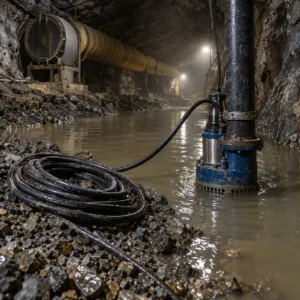
Environment. Roadway seepage, washdown and dewatering sumps keep water in the picture, and pump cable lives in it.
Electrical duty. Mine feeders are long and loads are heavy and intermittent, so voltage drop at the face is a design constraint and motor starting makes it worse. Where variable speed drives run, the harmonic environment decides whether control and monitoring circuits behave at all.
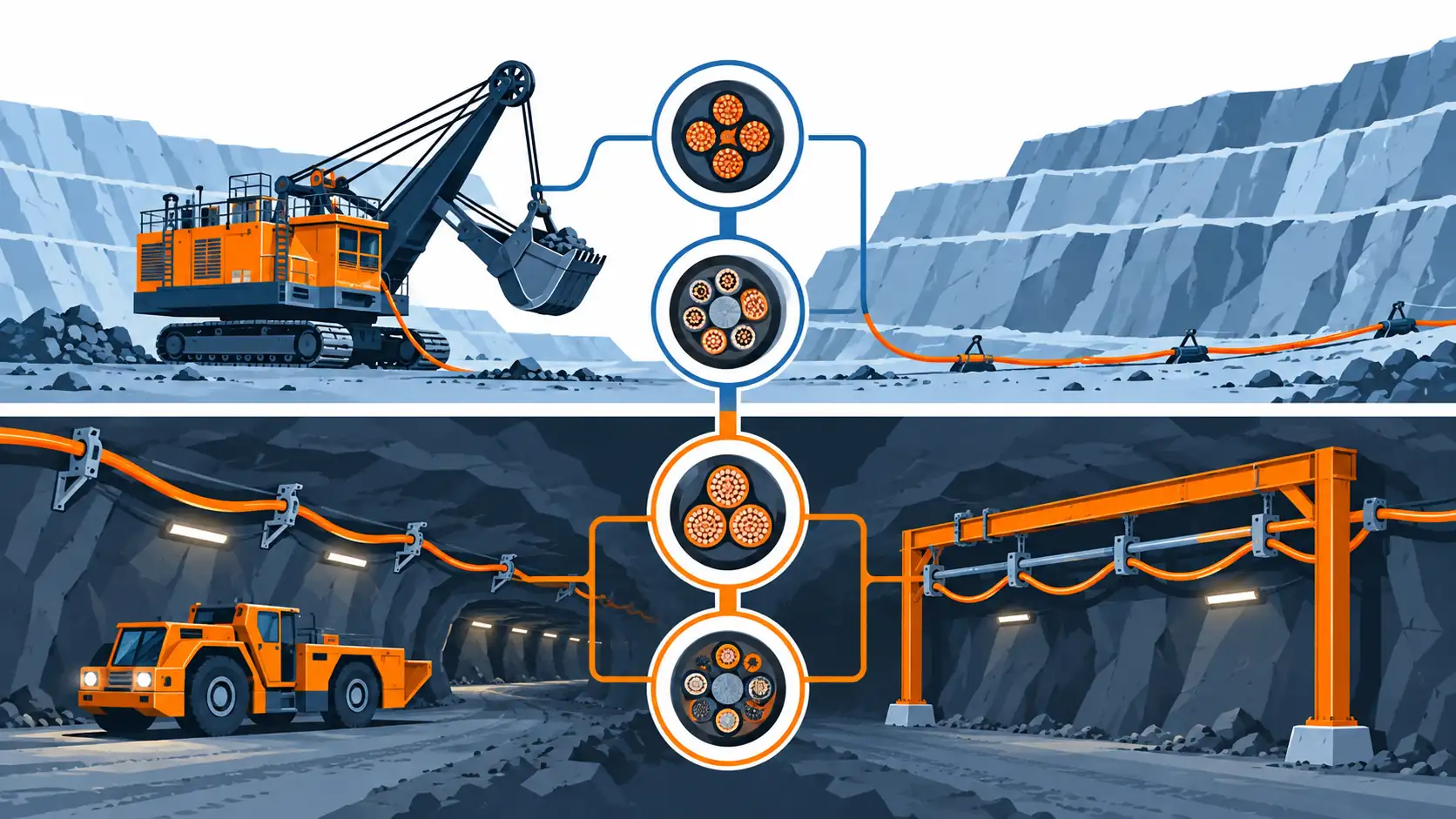
Open-Pit and Underground: Two Procurement Lines
Most mines buy two cable populations, and the mistake to avoid is specifying one and applying it to both.
Open-pit operations run mobile machines on trailing cable: loaders, drill rigs, shovels, draglines and face conveyors. The duty is drag and crush, the failure that hurts is a torn sheath letting water into a screen, and lengths change as the pit advances, so cable is ordered in working lengths with factory-fitted ends.
Underground operations run fixed feeders along roadways, semi-mobile cable on gantries and continuous miners, and services for pumps, fans and lighting. Space shapes the order: bend radius in a low roadway, termination space in a junction box. Where the workings are gassy, flame retardance and antistatic performance decide whether the mine accepts the delivery at all.
A site running both needs two specifications, two approval conversations and probably two suppliers. One cable for both lines ends up over-specified for the fixed runs and under-specified for the trailing duty.
Approvals: What the Certificate Actually Proves
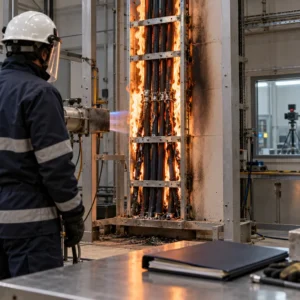
Underground coal is a safety approval market. Cable for gassy workings is accepted on flammability and antistatic test evidence, tested to the national mining standard for that cable type, with a safety mark issued against a named construction. When a supplier says flame retardant, that is a material description rather than a test result. Ask for the standard, the method, the measured values, and the mark covering the exact construction quoted.
Approvals also attach to constructions, not brands. A certificate names a conductor class, an insulation, a sheath compound and a screen or armour arrangement, so substituting a compound or moving production to a second line breaks it on paper even when the cable looks identical. On export orders, confirm the mark the receiving country’s authority recognises, not the one held for home.
The table below is the scope of a mining cable purchase, family by family: what to specify, what evidence to demand, what drives the price, and how each one fails when specified loosely.
| Cable family | Duty on site | What to Specify | Evidence to Demand | Cost and Lead-Time Driver | How It Fails |
|---|---|---|---|---|---|
| Trailing cable for loaders, drills and shovels | Dragged, run over, reeled under tension, coupled daily | Flexible conductor class, EPR insulation, reinforced sheath, screen arrangement, voltage class, bend radius | Drag and flex data at the declared radius, sheath tear results, screen continuity on the finished length | Sheath compound and reinforcement set the price band; bespoke lengths and vulcanised ends add weeks | Sheath cut through to the screen, undetected screen damage, phase-to-earth fault after water ingress |
| Underground fixed feeder | Fixed in roadway or on a gantry, damp, congested, hard to pull | Flame retardant and antistatic performance, armour or screen arrangement, bend radius, termination space, drum lengths to suit pulling sections | Flammability and antistatic report to the named standard, safety mark for the construction | Certified compound and approval administration both sit in the lead time | Damage at tight bends, water tracking into a joint, armour corrosion in acidic water |
| Services cable: pumps, fans, lighting | Continuous immersion for dewatering pumps, permanent dust for fans | Water-blocked or submersible construction where immersed, flat or round profile for the sump, earthing core arrangement | Immersion test evidence, insulation resistance figures, gland and mechanical protection details | Submersible construction carries a premium; profile choice affects handling | Water treeing in insulation, earth core corrosion, failure at the pump gland |
| Control and monitoring cable | Long runs beside drives and motor feeders, shared trenches | Screen coverage per pair, drain or overall screen, separation from power runs, flame and antistatic performance underground | Screen coverage figure, shielding concept drawing, coupling or attenuation data where the circuit is fast | Screening and certified compounds drive unit cost; a second drum doubles logistics | Noise on analogue signals, earth loops through screens, faults that appear when a drive starts |
| Reeling and drum cable | Wound and unwound under tension along a rail or bench | Reel duty and torsion rating for the actual winding pattern, drum and guide dimensions, tension range, length per drum | Reeling cycle test at the declared tension and winding geometry, torsion test for spiral drums | Torsion-rated construction costs more; over-length drums change handling and transport | Corkscrewing after torsion beyond rating, core breakage at the drum entry, sheath flattening at the guide |
| Couplers, joints and repair sleeves | Assembled in the field, wet and dirty, under time pressure | Rated voltage and current, ingress protection, compatibility with the cable construction, tooling required | Type test evidence, sealing verification for the assembled state, assembly instructions and torque values | Kits are cheap against the labour of a joint; incompatible kits are the expensive version | Joints that pass a megger and fail under load, moisture into the screen, repeat failures at one location |
Construction Choices That Move Price and Life
Conductor class. Flexible mining cable uses a finely stranded conductor, and the finer the stranding the longer it survives being dragged. Class 5 and class 6 conductors cost more than standard stranding, and on a trailing application they are not optional.
Insulation and sheath. Ethylene propylene rubber stays flexible at low temperature and tolerates the working that comes with a moving cable; cross-linked polyethylene suits fixed feeders and is the wrong choice where the cable bends repeatedly at the machine entry. The sheath takes most of the budget, so compound and wall thickness are the numbers worth arguing about. Our notes on abrasion-resistant cable jackets and on armoured versus unarmoured construction cover the alternative of adding an armour layer instead.
Screening and earthing. Mobile machine cable carries a screen or pilot core for earth continuity monitoring, and its continuity is a safety function rather than a signal function. Whether the screen is metallic or composite, and how it behaves when the sheath is damaged, matters more than the coverage figure. The families available for each duty are set out in our special cable range.
Trailing and Reeling Duty in Practice
The first number to fix is the bend radius at the two worst points: where the cable enters the machine or its coupler, and where it leaves the reel or guide. A cable bending tighter than its rating at the machine entry fails there regardless of the rest of the run. Our note on cable minimum bend radius explains where suppliers quote that figure optimistically.
The second is tension. Reeling cable is not only bent but pulled along its axis, and the wind-on geometry decides whether it rolls or flattens. Where the drum is spiral wound, the cable is twisted every revolution and a straight reeling construction corkscrews within a few thousand cycles. Our notes on reel crane cable and on reeling cable constructions go through the options.
The third is the coupler. On a machine uncoupled and moved daily, the coupler and the first metre behind it take more abuse than the rest of the run, so buy the coupler and the factory-fitted end from the same source as the cable.
Sizing for Voltage Drop and Motor Starting
Mine feeders are long, and the electrical design decides the copper content of the order. Three inputs belong in the RFQ.
Run length and route. State the route length including the trailing loop and vertical drops, not the distance on the plan.
Load and starting duty. Give continuous and starting current, and how often the machine starts. A conveyor starting loaded several times a shift puts a duty on the cable that a fan running continuously does not, and a conductor that satisfies steady-state current may still fail the starting voltage requirement at the motor terminals.
Ambient and installation. Grouped cables in a roadway, cable in sun on a bench and cable in a hot tunnel derate differently, so ask for the derated current. Earth fault protection is set against the circuit’s earth loop impedance, which makes the calculation a pre-order task; our note on grounding and bonding verification covers the checks at the source end. Where a run has outgrown what the cable can carry economically, the answer is often a closer source of supply, which is where prefabricated substations for mining earn their place.
What to Freeze Before the Order Goes Out
These eight items are cheap at specification stage and expensive once drums are on a truck.
| Decision | What to State | Evidence to Attach | Cost of Leaving It Open |
|---|---|---|---|
| Duty per run | Trailing, reeling, fixed or immersed, run by run | A cable schedule mapping runs to duty and machine | One construction bought for two duties |
| Approval basis | The standard and mark the destination mine accepts | Test report and certificate for the exact construction quoted | A delivery that cannot be inspected in |
| Voltage class and fault level | System voltage, insulation level and prospective fault current per feeder | Single line diagram with the associated settings | A cable that defeats the earth fault protection |
| Construction detail | Conductor class, insulation, sheath compound, screen and armour arrangement | Construction drawing with dimensions and material declarations | Substitutions that invalidate an approval |
| Ends and couplers | Factory-fitted ends versus field joints, coupler type and supplier | Coupler compatibility list and termination instructions | Weekly maintenance and split responsibility |
| Lengths and drums | Working lengths, drum size and mass limits, drum marking | Packing list checked against the cable schedule | Joints where a continuous length was expected |
| Test and witnessing plan | Which tests are witnessed, when, and what records ship per drum | A written plan with acceptance criteria and dates | Volume accepted on a sample nobody kept |
| Spares and quantity | Working lengths plus a stated spare allowance and coupler stock | A spares list with the reasoning behind the allowance | A stopped machine waiting for a drum |
Lead Time and Cost Structure
Lead time is driven by everything around the copper, and knowing which part of the order sits on the critical path is what lets a buyer trade scope against a shutdown date.
Stock product ships in days, limited to the constructions, lengths and ends the supplier happens to hold. Made to order against a specification is the normal case, and it runs on the sheath compound, the screening or armour arrangement and the drum lengths. Certified underground construction is the longest line, because the compound has to be the certified one, the testing follows the standard’s regime and the paperwork is part of the product. Buyers who discover the approval requirement after award routinely lose four to eight weeks.
On price, copper is the largest single component and the only one that moves between quotation and order. Mining programmes run long, so a quotation issued at tender stage can be months from the purchase order, and the copper content of a heavy feeder is large enough that the movement outweighs the margin. Ask at quotation stage how the copper element is calculated and how long the price holds; a supplier who locks a copper basis for a stated window is easier to budget against than one who resets at order.
Incoming Inspection: What to Witness
Against the drum, before anything is cut. Count drums against the packing list, verify marked lengths and photograph the drum markings. Traceability starts here, and a drum arriving without records cannot be linked back to them later.
Electrical and dimensional checks. Conductor resistance and continuity, insulation resistance, and screen or pilot core continuity end to end; then overall diameter, sheath thickness and conductor cross-section on a sample. Measuring the actual copper area on a cut sample settles arguments about what the conductor is, and it is better done with both parties present than discovered on site.
Documents and accessories. Match the flammability and antistatic reports to the drum references, and confirm that couplers, joints and consumables arrived with the cable.
When a Mining Cable Specification Is Not the Answer
When the failure is routing, not cable. Repeated sheath damage at the same point on a face conveyor is usually a guide, a clamp or a bend radius problem. Our note on cable damage wear patterns is written to sort one from the other before money is spent.
When one specification is asked to cover both lines. A construction that satisfies a gassy underground roadway and a drag duty in a pit does not exist at a sensible price. Two specifications cost less over the life of the mine than one compromise.
When the site’s approved list already settles it. If the mine’s engineering standard names a construction and a supplier, the competition is on delivery, service and spares rather than design.
When the protection settings are the real problem. A feeder tripping on earth fault well above its setting is telling you about the earth loop, not the cable. Replacing the cable without doing the calculation repeats the fault with a newer drum.
When the run has outgrown the cable economically, or price is the only variable asked about. Past a certain distance the copper needed to hold voltage drop costs more than moving the source closer. A cable bought on unit price alone is judged in service rather than in the quotation.
RFQ Checklist
- Duty stated per run: trailing, reeling, fixed, immersed or mixed
- Run length including trailing loop and vertical drops
- System voltage, insulation level and prospective fault current per feeder
- Continuous and starting current, plus starting frequency per shift
- Ambient and installation conditions, with the derated current required
- Approval basis named: standard, test method and mark the mine accepts
- Conductor class, insulation and sheath compound specified per duty
- Screen or pilot core arrangement, plus the monitoring system it must support
- Minimum bend radius at the machine entry and at the reel or guide
- Factory-fitted ends versus field joints, with coupler type and supplier
- Working lengths, drum sizes, mass limits and drum marking
- Tests to be witnessed, records per drum, and the copper basis with its validity window
Conclusion
Mining cable is bought well when duty, approval and lead time are treated as three clauses of the same order. State the duty in numbers a manufacturer can build against, name the approval the destination mine will inspect to, and work back from the shutdown date rather than forward from the quotation.
Kexingyu Cable Group (KXYE) has supplied electrical cable from Quanzhou since 1996, including the rubber-sheathed, screened and control constructions that mobile and underground mining duty calls for, along with the joints, couplers and accessories that go with them. Send us the cable schedule with the duty, the run lengths, the approval standard and the site conditions, and we will come back with the constructions, the test evidence that applies to each, and a delivery plan against your shutdown window. The fastest route is a request for quotation.