Piling Rig Cable: Specifying Supply Cable for Rigs and Rotary Drills
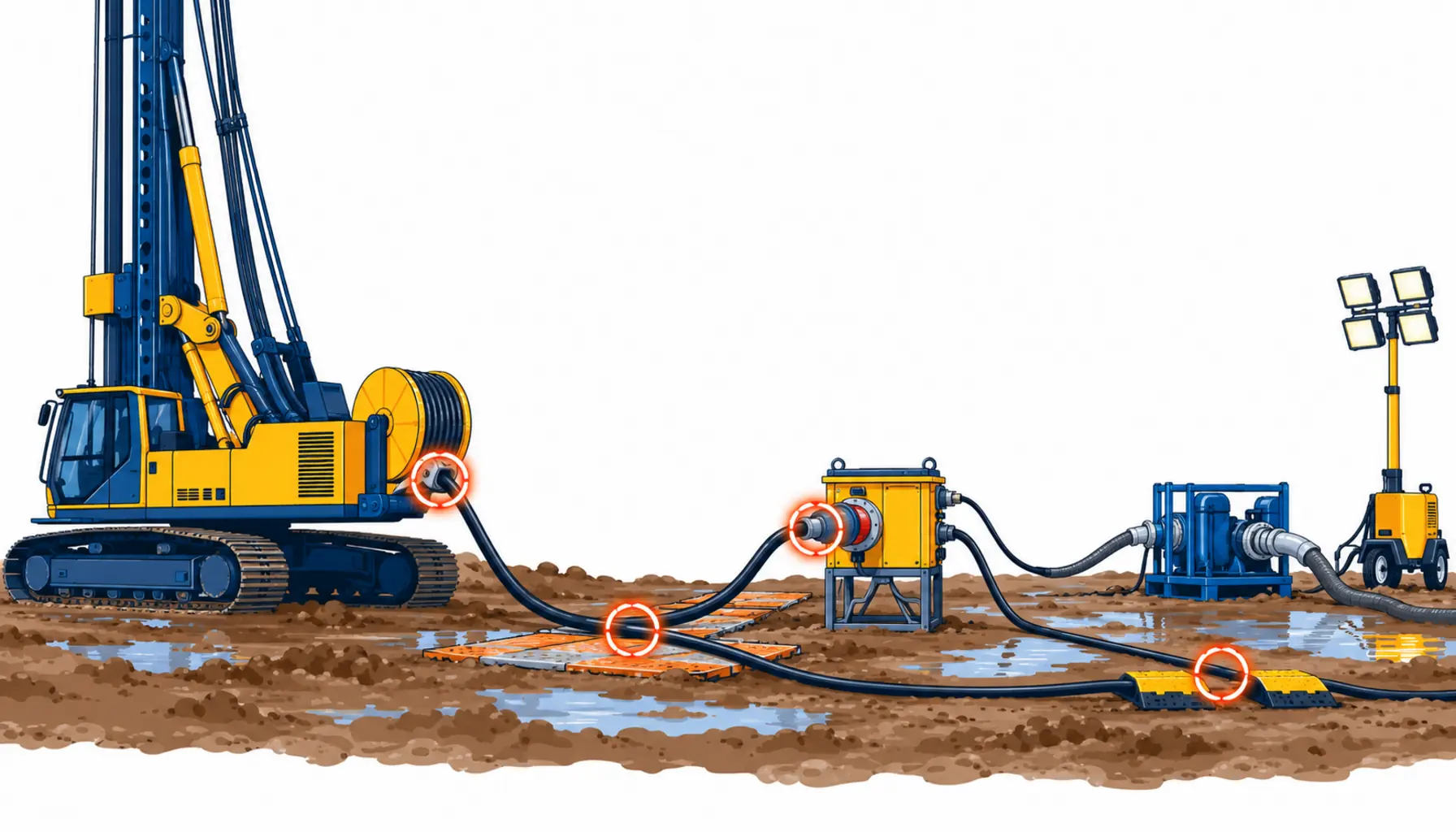
Quick Answer: A piling rig or rotary drill buys one main supply cable, usually on a machine drum, plus auxiliary and control circuits. The duty is the worst combination in construction: reeling cycles under tension, mud and standing water, impact from casings and reinforcement cages, and a new position on site every few days. Specify for reeling duty with an abrasion-resistant sheath, insist on wear monitoring, and freeze the drum geometry before selecting anything.
Introduction
Piling rigs and rotary drills are the heaviest mobile plant on most sites, and their supply cable takes abuse no fixed installation ever sees. The cable reels in and out all day, drags through bentonite and mud, gets run over by the crane that offloads cages, and moves position whenever the rig does.
It is also a cable whose failure is expensive in a specific way. A rig that loses supply mid-bore has a hole in the ground that can collapse or set, and recovery costs far exceed the cable. Procurement’s job is to specify against that failure mode, not against the catalogue.
What Piling Duty Does to Cable
Reeling under load. The main cable winds onto the machine drum as the rig travels and slews, under tension that spikes when the drum takes up slack over broken ground. Cycle counts run into the thousands per season.
Abrasion and impact. The cable crosses rebar, casing edges, rock and site traffic. Sheath cuts are the normal wear mode, not an anomaly, and every cut is a water path in an environment that is always wet.
Mud, slurry and water. Bentonite slurry, flush water and rain keep the cable wet for the life of the project. Sheath compound and screen design decide whether water stays outside the conductors.
Frequent repositioning. Rigs move along the pile line daily. Cable handling is constant, and the coupler and first metres take the worst of it.
Reeling Cable Versus Trailing Cable on Rigs
Most modern rigs carry the main supply on a motorised drum; older setups and some auxiliary loads run trailing cable to a site board. The two duties differ, and so does the specification.
Drum-fed main supply. This is reeling duty: select a construction rated for reeling cycles at the drum’s entry radius and the working tension, with a screen or pilot core tied into the rig’s earth-continuity monitoring. Where the drum winds in a spiral, torsion behaviour matters too. The constructions and their ratings are covered in our note on reeling cable for mobile machinery.
Trailing auxiliary supply. Trailing runs to pumps, lights and companion plant take plain drag duty: flexible conductor, heavy rubber sheath, and enough mechanical headroom to survive being dragged by the cable instead of the plug. A splash-resistant rubber cable for wet outdoor service is the baseline for these runs.
The drum itself. Drum diameter, entry geometry and winding pattern decide how much of the cable’s rating survives in practice. Measure them and put them in the RFQ; the same construction on two different drums has two different service lives. Our guide to reel-fed crane and plant cable covers the system view.
| Line | Duty | What to Specify | Evidence to Demand | Cost and Lead-Time Driver | How It Fails |
|---|---|---|---|---|---|
| Main supply on the machine drum | Reeled under tension all day, dragged, wet | Reeling duty rating, drum entry radius, working tension, abrasion-resistant sheath, screen or pilot core, length with tolerance | Reeling cycle test at declared tension, sheath abrasion results, screen continuity per length | Reeling-rated construction and sheath compound set the price; long continuous lengths set the clock | Sheath cut through to the screen, water in at the cut, conductor fatigue at the drum entry |
| Trailing auxiliary supply | Dragged across site to pumps and lighting | Fine-stranded conductor, heavy rubber sheath, plug-compatible sizes, lengths that reach without joints | Flex and abrasion data, water resistance results | Stock constructions ship fast; price tracks copper | Cuts at crossings, crushed sections under plant, pulled plugs |
| Control and monitoring circuits | Carried on the machine, vibration and flex | Screened flexible control cable, core schedule, compatibility with the rig's safety circuits | Screen coverage figures, continuity records, flex data | Small order line, large downtime consequence | Intermittent faults that stop the rig and resist diagnosis |
| Couplers and repair materials | Field assembly in mud, under time pressure | Couplers rated to the circuit, ingress protection, vulcanising repair kits matched to the sheath | Type test evidence and assembly instructions for the assembled state | Kits are cheap against rig downtime | Repairs that pass a megger and fail under load, water tracking at a field joint |
Sheath and Construction Choices
Sheath compound. On a piling rig the sheath is the product. Rubber compounds with high tear and abrasion resistance outlast standard jackets by a wide margin in this duty, and the difference shows up in repairs per month. Our comparison of cable sheath materials and our note on abrasion-resistant jackets cover the trade-offs.
Conductor and screen. Fine stranding is mandatory for any reeled cable. The screen or pilot core is a safety function when the rig monitors earth continuity; specify it by construction, and require screen continuity test records for the finished length.
Length strategy. A single continuous length from drum to site supply beats a jointed run every time, but site geometry sometimes forces a mid-run coupler. If a joint is unavoidable, specify its position in the schedule so it lands where it can be inspected, not behind the mast.
The Coupler and the First Metre
On a rig that repositions daily, the coupler and the first metre behind it take more abuse than the rest of the run combined. They are dragged by hand, stood on, and re-made in the mud. Specify the coupler with the cable from the same supplier, with the ingress protection and contact rating stated for the assembled pair, and insist on factory-fitted ends so the first termination is not a site job. Agree where a mid-run coupler sits if one is unavoidable, keep it out of standing water, and mark it on the cable schedule. Most repeat failures at one position on a rig are coupler problems that a better cable was asked to absorb, and the coupler is the cheaper thing to fix.
Wear Monitoring and the Repair Decision
Rig cable wears visibly, which makes inspection policy a procurement item. Write into the delivery what the crew should check daily: sheath cuts over the screen, flattening at the drum entry, and damage at the coupler. Our note on cable damage and wear patterns helps the crew tell cosmetic damage from the kind that becomes a fault.
When damage happens, the decision is repair or replace. Vulcanised repairs on a good core are legitimate; repeated repairs on the same metre are a replacement order with a routing change attached. Agree the acceptance criteria with the supplier in advance, and our note on acceptance testing for moving cables gives the test sequence for a repaired length going back into service.
Sizing the Supply: Voltage Drop and Starting
The rig’s main supply is a long feed to a load that starts hard, and both facts push conductor size up.
Route length. State the full route from the site supply to the drum, including the slack the rig needs to travel the pile line. The reel adds metres to the electrical length that never appear on a plan, and they count in the voltage drop budget.
Starting duty. A rotary drill’s main drive draws several times running current at breakaway, often under full crowd force. The dip at the rig on a thin conductor trips drives and stalls the bore; size against starting, not just running load, and put the starting current in the RFQ.
Ambient and grouping. Cable coiled on a drum carries the whole circuit current in the worst thermal position it will ever see, so ask for the derated current at the drum rather than the open-air figure. A supplier who sizes honestly here saves a re-order later, and the calculation belongs in the quotation, not after it.
Handling Between Sites
Rig cable lives longer than its cycle count suggests when it is handled well between jobs, and the storage routine is worth writing into the delivery.
Drum storage. Keep drums off the ground, capped, and out of prolonged sun; a sheath that weathers on a stored drum starts its service life already aged. In winter, allow the cable to warm before re-reeving, because bending a cold heavy sheath at the drum radius does damage that only shows up weeks later; cold-flexible constructions are covered in our note on low temperature flexible cable.
Re-reeving. When the rig moves, unreel or crane the drum rather than flaking the cable on the ground, and inspect the first and last metres each time, because that is where drum damage concentrates.
What to Freeze Before the Order
Rig cable is manufactured to order in continuous lengths, and a wrong dimension means a new drum rather than a repair.
| Decision | What to State | Evidence to Attach | Cost of Leaving It Open |
|---|---|---|---|
| Drum geometry | Diameter, entry radius, winding pattern, tension | Drum measurements or the rig manufacturer's data | A construction that under-performs on the actual drum |
| Duty per line | Drum-fed, trailing or control, run by run | Cable schedule mapping runs to duty | One construction bought for three duties |
| Sheath specification | Abrasion and tear class, water and slurry resistance | Compound declarations with test values | Monthly repair cycles on a standard jacket |
| Screen and monitoring | Screen or pilot construction, matching the rig's monitoring | Screen continuity records per finished length | A safety circuit that trips on ghosts |
| Ends and couplers | Factory-fitted ends, coupler type and supplier | Termination schedule with torque and assembly data | Field joints in the mud at the worst locations |
| Length and spare strategy | Continuous lengths, tolerance, and a stated spare allowance | Packing list against the cable schedule | A rig idle waiting for a drum |
Lead Time and Cost Structure
Main supply cable for a rig is made to order: reeling-rated construction in one continuous length, typically four to eight weeks with fitted ends. Auxiliary trailing cable and couplers are stock items. Order the main drum against the rig mobilisation date and hold the spares against the wear rate from the first weeks on site.
On cost, copper and the heavy sheath compound dominate, in that order. The reeling-rated premium over standard flexible cable is real, and it is repaid in repairs avoided and bores not abandoned. Copper movement between quotation and order is worth fixing: agree a copper basis and a validity window at quotation stage, because a rig package quoted at tender can be ordered months later.
Incoming Inspection
Against the order. Verify length, drum markings and packing documents, and photograph the markings before the drum leaves the gate.
Electrical and construction. Run continuity, insulation resistance and screen continuity on the finished length. Check overall diameter and sheath thickness against the specification on a sample, and match the compound declaration to the delivered construction before the drum is fitted.
When a Rig Cable Specification Is Not the Answer
When the drum guide is the killer. Cable cut at the same point entering the drum is a guide or radius problem. Re-shimming the guide is cheaper than any sheath upgrade.
When the route is the problem. Cable run over the same rebar edge or casing stock every cycle wears out on schedule. Move the route or protect it, then buy cable.
When repeated repairs mask a bad choice. Monthly vulcanised repairs on the same run mean the construction is wrong for the duty. Re-specify, do not patch.
When the fault is upstream. Rigs tripping on earth-continuity ghosts are often seeing a monitoring or coupling problem, not cable damage. Test the loop before ordering a new drum.
RFQ Checklist
- Drum diameter, entry radius, winding pattern and working tension
- Line duty per run: drum-fed, trailing or control
- Continuous length with tolerance, and whether any mid-run joint is unavoidable
- Reeling cycle test at the declared tension and entry radius
- Sheath abrasion and tear values, with water and slurry resistance
- Screen or pilot core construction, with continuity records per length
- Core schedule for power, control and monitoring
- Factory-fitted ends, coupler type, and repair kit compatibility
- Spares allowance with the reasoning stated
- Delivery date against rig mobilisation, and the copper basis with its window
Conclusion
Rig cable is bought well when the drum geometry, the sheath duty and the monitoring circuit are specified as one package. Buy reeling-rated construction with an abrasion sheath, insist on continuity records, and agree the repair-versus-replace rules before the first cut happens.
Kexingyu Cable Group (KXYE) has manufactured cable in Quanzhou since 1996, including reeling and heavy rubber constructions for piling rigs and rotary drills, with factory-fitted ends and the test documentation rig work demands. Send us the drum geometry and cable schedule, and we will come back with constructions per line, the evidence for each, and a delivery plan against mobilisation. The fastest route is a request for quotation.