Buying ROV Cable for Underwater Robotics: Pressure, Water Ingress and Flex
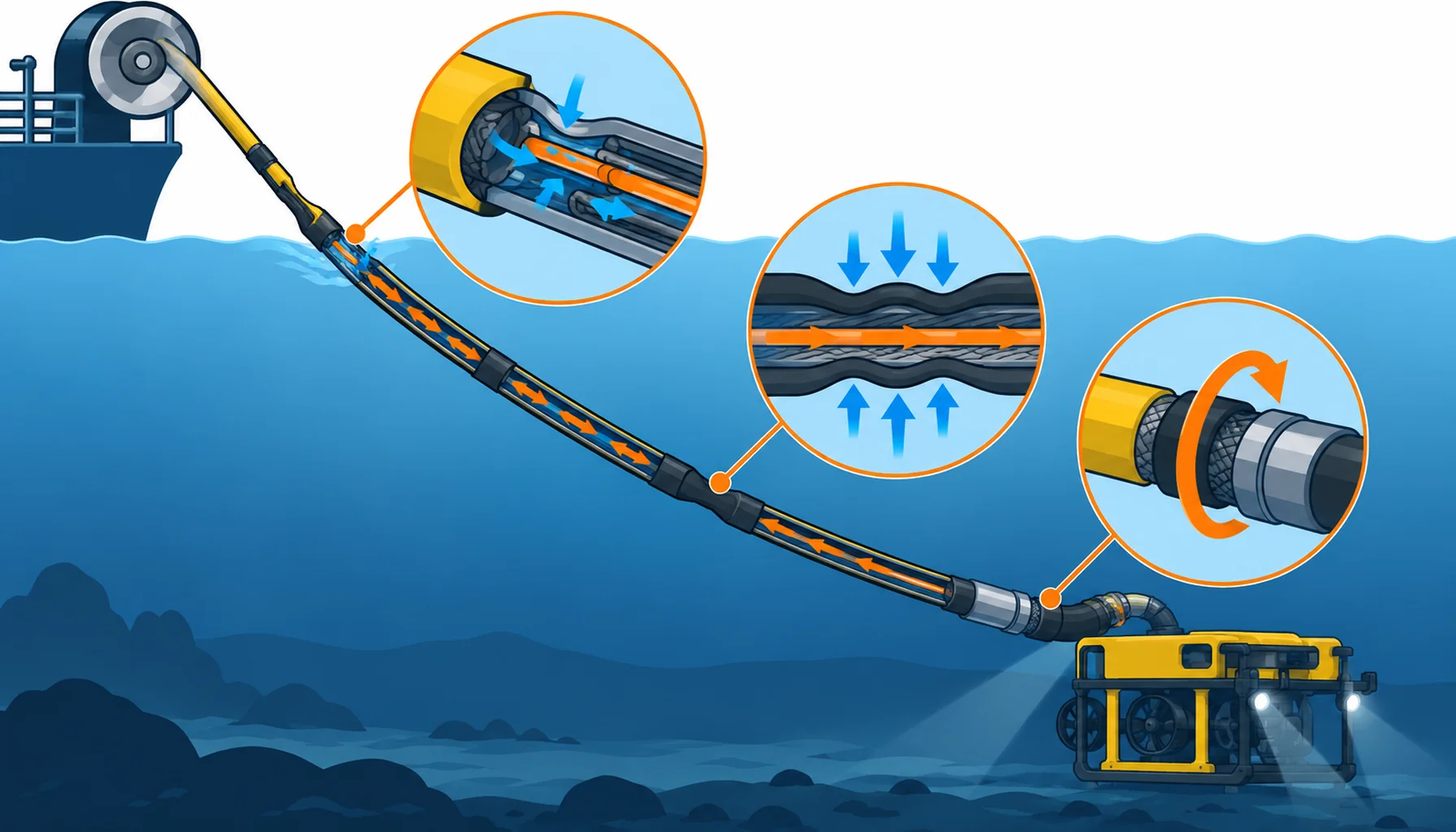
Quick Answer: Underwater is the one environment where the cable is asked to keep working while it is being attacked from both ends. Pressure squeezes it, salt water tries to travel along it, and the motion at the vehicle and the winch keeps flexing it. Four figures decide the purchase: the depth rating, the water blocking construction, the mating cycles of the connector, and the torsion the tether sees when the vehicle turns.
Introduction
Subsea robotics is an unusual procurement case, because the cable is not an accessory to the machine. On a small observation vehicle it is the tether that keeps the vehicle attached; on a work-class vehicle it may also carry the load, and on a seabed crawler it may be the only thing connecting the machine to its power.
The outdoor rules for land machines do not carry over, and our note on construction robot cable covers a harsher surface but a much friendlier fluid. What follows is the part that is specific to water: pressure, ingress along the length, and salt.
Water Gets In Along the Length, Not Just at the Connector
The instinct is to focus on the connector, and it is the wrong place to start. The dominant failure in a submerged cable is water travelling along the core from a damaged point to a connector that is otherwise sound. Once water reaches a termination it is trapped, and it corrodes the contact and the screen from the inside while the outside still looks perfect.
Blocked constructions exist for exactly that path. Products such as the water blocking cable range use fillers and tapes so that a cut or a chafed point does not turn into a flooded harness. The question to ask a supplier is not whether the cable is waterproof, but what limits the water path once the sheath is breached, and over what length.
The second path is the termination itself. A moulded or potted transition removes the gap that water exploits, and it is standard practice on submersible pump cable, which faces the same problem in a borehole. The construction behind that family is described under submersible pump cable, and the same logic applies to a small underwater robot with far less room.
Pressure Is a Construction Question
Depth rating is written on datasheets as a single number, and it is really two separate properties. The first is whether the jacket and any void in the cable collapse under external pressure; a construction with air spaces will deform at depth, and the deformation is permanent. The second is whether the pressure can push water past the seals at a joint. Both are testable, and both should be tested on the finished assembly rather than on a sample of cable.
Calculate the pressure rather than buying a round number. Ten metres of seawater adds roughly one bar, so a 300 metre rating and a 3000 metre rating are very different products at very different prices. Buy the depth the vehicle will actually work at, plus a stated margin for the vehicle being lowered past its working depth.
Pressure also interacts with buoyancy. A tether that is neutral at the surface can become heavy or light as it compresses with depth and takes on water in its outer layers, which changes how the vehicle handles. If the vehicle’s control system assumes a particular tether drag, that assumption belongs in the cable specification rather than in a sea trial. Products built for controlled buoyancy, such as the zero buoyancy floating cable range, are bought for that property rather than for conductivity.
Torsion, Flex and Where the Tether Dies
A tether experiences flex at two places and torsion at one. It bends over the sheave at the surface and it bends at the vehicle, and both are sharp radius events repeated thousands of times. It twists when the vehicle turns, and a turning vehicle that keeps turning the same way will wind the tether up until something gives. That is a torsion problem, not a flex problem, and the construction for it is set out in our note on torsion cable construction.
The termination at the vehicle end is where most failures start. A moulded assembly spreads the load over a length of cable instead of concentrating it at one point, and it also removes the water path into the termination. What an overmould does, what it costs in tooling and why it changes the repair model is covered in our note on overmolded cable assemblies.
Connector mating is the other decision. A wet-mate connector lets the vehicle be recovered and relaunched without drying anything, at a considerable cost per mating, while a dry-mate connector is cheaper but needs a dry interface. Decide how many mating cycles the machine will actually see before choosing, because on a vehicle that dives ten times a day the difference pays for itself quickly. What an ingress rating does and does not cover is set out in our note on IP ratings for robot connectors.
The Deck End Is Half the Problem
Most of the money in a subsea tether is spent on the water, and most of the failures happen at the surface. The cable crosses a sheave, passes over a deck edge and is wound onto a winch, and each of those events loads it in a way the underwater section never sees. Vessel motion adds snap loads on top, so a tether that is slack one second and taut the next is being pulled through its length range again and again.
Ask what the sheave diameter is, what the load at the deck edge will be, and whether the winch pays out under tension. A tether specified entirely around its depth rating, but bought without those three answers, will be replaced for reasons that had nothing to do with the sea.
The Decision Table: Four Subsea Cable Strategies
| Strategy | What to specify | Evidence to demand | Cost and lead time | Where it fails |
|---|---|---|---|---|
| Dry-mate connector, flexible tether | Depth rating, water blocking and the tether length | A pressure test on the finished assembly | Lowest connector cost, standard lead time | Water travelling along the core to a sound connector |
| Wet-mate connector at the vehicle | Mating cycles, contact arrangement and pressure rating | A mating cycle record plus a pressure test mated | Highest connector cost, long lead time | Paying for wet-mate where the vehicle is deck launched |
| Neutral buoyancy tether | Buoyancy per metre, crush depth and drag | A buoyancy figure at the working depth | Higher unit cost, specialist lead time | A tether that goes heavy with depth and changes handling |
| Armoured seabed umbilical | Armour type, torsion balance and crush rating | A torsion figure in turns over the working length | Highest material cost, longest lead time | Armour that resists flex and transfers load into the terminations |
| Reeling tether with a slip ring | Reel capacity, retraction force and slip ring rating | A reeling life figure at the real extraction length | Highest hardware cost, longest lead time | Paying for reeling hardware where a fixed tether was enough |
What to Freeze Before the Order
| Item | What to state | Evidence to attach | Cost of leaving it open |
|---|---|---|---|
| Working depth | Normal depth plus the margin for lowering and recovery | A pressure test on the assembly at the stated depth | A jacket that deforms permanently on the first deep dive |
| Water path | What limits water travel once the sheath is breached | A description of the blocking construction and its length | A flooded harness behind a connector that tests clean |
| Termination seal | Moulded, potted or mechanical, and the pressure rating | A pressure test on the terminated end, not on the cable | Water entering at the one place nobody sealed |
| Connector type | Wet-mate or dry-mate, and the mating cycles expected | A mating cycle record at the rated pressure | Wet-mate cost on a deck-launched vehicle |
| Buoyancy | Buoyancy per metre at the working depth | A buoyancy figure measured under pressure | Vehicle handling that changes the deeper it goes |
| Torsion | Turns per metre the tether must take, and the cycling | A torsion figure quoted in turns over a stated length | A tether that winds up and fails at the vehicle end |
| Flex at the sheave | Sheave diameter, load and cycles | A flex figure at the real sheave diameter under load | A tether failing where it crosses the deck edge |
| Seabed abrasion | Where the tether can touch rock, wreck or structure | An abrasion figure plus a protected section if needed | A breach that becomes a flooded harness |
| Temperature and salt | Working water temperature and the salt exposure | A compound statement covering both | A stiff tether in cold water and corroded metalwork |
| Repair model | Whether the tether is repaired or replaced, and by whom | A repair procedure and a spare assembly level | A vessel waiting onshore for a part mid-survey |
When a Fully Specified ROV Cable Is Not the Answer
When the vehicle works in shallow, sheltered water. A tank or harbour inspection vehicle that never exceeds a few metres does not need a deep-rated, blocked construction with wet-mate connectors. Buy a proven submersible construction, keep the run short and replace it on a schedule, and put the budget into a spare tether rather than into a depth rating the machine will never reach.
When the failure is at the termination, not in the cable. If water is appearing inside a connector on a harness that passes its electrical tests, the cable is doing its job and the termination is not. Adding blocking to the cable will not seal a moulded end that was made badly. The signatures of that failure are described in our note on robot cable failure.
When nobody has counted the mating cycles. A wet-mate connector is bought for a number of matings, and if nobody knows the number, the cheapest option usually wins by default. Count the dives per day and the days in the season first, because that figure alone decides which connector family is rational.
When the sample has not been tested under pressure. A length of cable approved on a bench tells you nothing about the finished assembly at depth. Ask for the pressure test on the terminated assembly, with the rate of pressure change stated, because a slow ramp and a fast one are different events. What a meaningful sample programme looks like is set out in our note on robot cable sample testing, and a washdown machine raises a much milder version of the same question in our note on cleaning robot cable.
RFQ Checklist
- Working depth stated, with a margin for lowering and recovery, and a pressure test on the assembly
- Water path described, including what limits travel once the sheath is breached
- Termination method named, with a pressure test on the terminated end rather than the cable
- Connector type chosen against a counted mating cycle figure, tested at the rated pressure
- Buoyancy per metre stated at the working depth, not at the surface
- Torsion figure quoted in turns over a stated length, with the cycling regime
- Sheave diameter, deck edge load and flex cycles declared for the surface end
- Abrasion protection specified for seabed contact, as a replaceable section
- Water temperature and salt exposure declared, with a compound statement for both
- Repair or replacement model agreed, with spare assemblies held where the vessel operates
Conclusion
An ROV cable is bought on four numbers: depth, water path, mating cycles and turns. Get those four agreed before the order and the rest of the specification is ordinary cable engineering with a tighter tolerance. Leave them out and the sea will find the weakest one, usually at the end of a tether that was never tested under pressure.
Kexingyu Cable Group (KXYE) has supplied water-blocking, submersible and floating cable constructions since 1996, alongside moulded terminations for sealed assemblies. Send us the working depth, the mating cycle count and the vehicle’s turns, and we will return constructions, termination options and sample assemblies for a tank trial; the fastest route is a request for quotation.