Humanoid Cable Supply: Sourcing From Prototype Batches to 100,000 Units
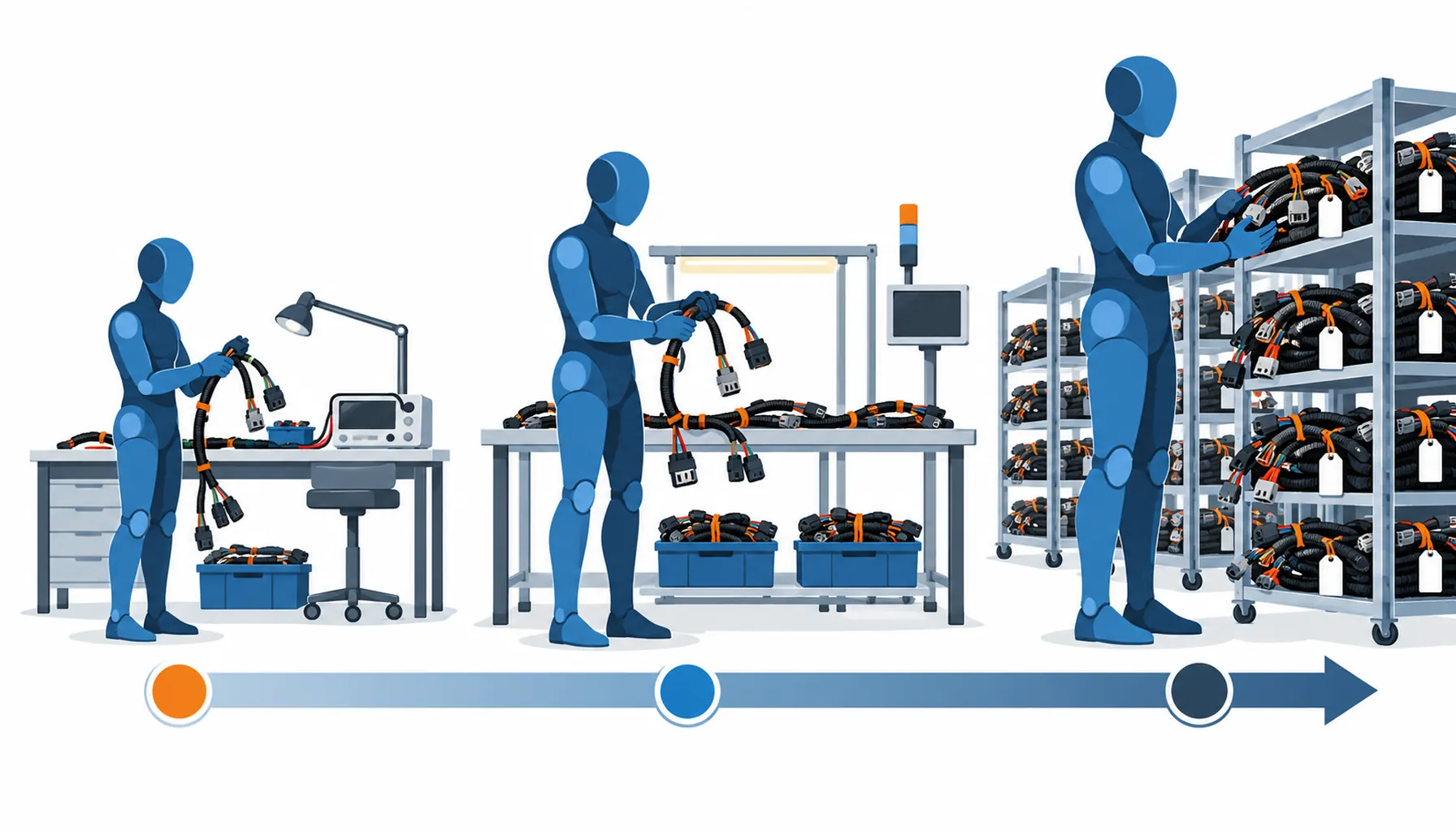
Quick Answer: Humanoid shipments are climbing from thousands of units toward six figures, and cable sourcing has to make that journey in step. This guide walks the three sourcing stages, prototype, pilot line and ramp, names the supplier capabilities each stage needs, and closes with the qualification checklist to freeze before committing.
Introduction
This pillar has walked the humanoid’s cabling piece by piece: the actuator joints, the dexterous hands, the power architecture, the torso, the production tolerances, the tendon elements and the missing test standards. It closes with the question a supply chain lead actually asks: how do I source all of that, from a prototype bench today to a six-figure annual run tomorrow, without re-learning the cable problem at every stage? The machine-level backdrop lives in our note on the humanoid robot cable category.
The honest headline is that cable is a small line item with an outsized ability to embarrass a ramp. A humanoid’s harnesses are a few percent of the bill of materials, and they touch every assembly station, every field unit and every warranty claim. Sourcing them well is less about finding a cheaper metre of cable and more about matching supplier capability to the stage the program is actually in. That matching is what this guide is for.
The Demand Picture, in Numbers
The forecasts are no longer speculative in scale. TrendForce expects global humanoid shipments to reach about 51,000 units in 2026, up roughly seven hundred percent from under 10,000 the year before. GGII, the Chinese robotics research house, is more aggressive on the home market, projecting China’s own shipments at around 62,500 in 2026 from 18,000 in 2025. Morgan Stanley’s work lands between them for the near term, counting about 19,000 units shipped globally in the first half of 2026 against roughly 5,000 a year earlier, and projecting China at about 50,000 units in 2026 growing toward 446,000 by 2030. Counterpoint Research, counting units rather than forecasting them, logged more than 22,000 shipped globally in the first half of 2026, close to triple year on year.
Two features of those numbers matter more than their precision. First, the growth is concentrated: a handful of Chinese and American programs account for most volume, which means cable demand arrives in program-sized chunks rather than as a smooth market. A supplier who can hold consistency for one ramp can be overwhelmed by three at once. Second, government programs are pulling demand forward; China’s real-scenario training initiative for humanoid robots and embodied intelligence, run by MIIT with SASAC, pushes machines into factories and utilities where duty is real and replacement cycles start counting.
On the supply side, published market estimates put the robot wire harness and connector business at roughly thirteen billion US dollars for 2026, with integrated power-and-signal harnesses the fastest-growing slice, and manufacturers in mainland China now supplying a substantial and rising share of that demand. For a buyer, the practical reading is: capacity exists, it is modernising fast, and the differentiator between suppliers is not whether they can make cable but whether they can hold consistency through your ramp. What consistency costs in practice is the subject of our note on humanoid assembly yield.
Stage One: Prototype Sourcing, Where Speed Buys Learning
A prototype program needs tens of units of harnesses, and its scarcest resource is calendar time, not unit cost. The right purchase at this stage is standard, qualified constructions cut and terminated to drawing, bought from stock or short custom runs, with the engineering effort spent on documenting duty rather than on tooling. Every custom mold, private conductor schedule or special jacket bought at this stage is a bet against your own design changes, and design changes are what prototypes are for.
What the stage does need from a supplier is responsiveness and honesty about data. Turnaround on a modified sample in days rather than weeks, flex figures with methods attached, and a willingness to say “that construction doesn’t fit your radius” instead of quoting whatever was asked for. The sample mechanics, from first build to signed reference, are the same ones described in our note on the cable sample approval process, and they cost little to start at prototype scale and much to retrofit later.
The deliverable to carry out of stage one is a duty dossier. Per joint, per run: cycles, amplitudes, radii, temperatures, the motions logged from real operation. It is the raw material for every later decision, and programs that skip it arrive at the pilot line with opinions where numbers should be. Suppliers respect a dossier; it tells them the buyer intends to qualify, not just to buy.
Stage Two: The Pilot Line, Where Consistency Enters the Vocabulary
Hundreds of units change the problem. At pilot scale the machine is no longer hand-assembled by its designers, so the harness has to fit fixtures, dress the same way every time, and survive operators who did not write the design. This is the stage where length tolerances, exit geometry and lot records stop being nice-to-haves and start being the difference between a line that flows and one that persuades.
Buying changes accordingly. The pilot order should carry the tolerances, the first-article reference and the change-control triggers from our earlier discussion, along with a real incoming inspection plan. Tooling decisions arrive here too, and the rule of thumb is to commit molds only for geometries that have stopped moving; a pilot line is the last cheap place to discover that an exit angle was wrong, which is exactly why it should be discovered there. Termination quality assurance, crimp records and pull tests, belongs in the order now rather than at scale, per the practice in our note on terminating robot harnesses.
It is also the stage to run the custom tests that no standard covers, because the pilot fleet generates the duty logs that make those tests honest. Bench rigs built now, at the real radii and temperatures, produce the qualification evidence that stage three will lean on. Our note on robot cable sample testing covers the bench route in detail.
Stage Three: The Ramp, Where Capacity Is the Product
From ten thousand units toward six figures, the sourcing question inverts. At prototype scale the supplier’s product was the point; at ramp scale the supplier’s process is the point. Capacity, batch consistency, documentation discipline and the ability to absorb your design revisions without quietly changing the product are what you are actually buying, and unit price, while never irrelevant, stops being the deciding column.
The ramp order should specify capacity in writing: lead time at your quarterly quantity, surge arrangements for the peaks a launch quarter brings, and the supplier’s own answer to how your growth changes their process. Second sourcing deserves a start date tied to evidence rather than to anxiety: begin qualifying the alternate when the primary’s capacity answer stops being comfortable, and use the ramp’s calm quarters for it, because a qualification begun during a shortage is a qualification done badly.
Cost structure deserves one honest paragraph. At volume, harness cost is dominated by termination labour, yield loss and logistics far more than by copper, which is why the cheap-cable conversation misses the point. A supplier who holds geometry tolerance and lot consistency removes rework hours that dwarf any per-metre saving, and the reverse arithmetic holds just as firmly. The downtime economics that make this clear in the field are worked through in our note on the real cost of robot downtime.
The Decision Table: What to Buy at Each Stage
| Stage | What to buy | Evidence to demand | Cost and lead time | Where it goes wrong |
|---|---|---|---|---|
| Prototype, tens of units | Standard constructions to drawing, fast samples | Flex figures with methods; duty dossier started | Highest unit cost, days of lead time | Custom tooling bought against an unfrozen design |
| Pilot line, hundreds to thousands | Toleranced builds, first article, fixture-fit harnesses | Tolerance records, crimp and pull tests, bench duty tests | Tooling cost where geometry has frozen | Skip the tolerances; discover them at final assembly |
| Ramp, ten thousands | Capacity-backed supply, lot documentation, second source | Written capacity statement, lot records, audit access | Volume pricing, lead time now strategic | Single source stretched past its honest answer |
| At scale, six figures | Multi-site supply, lifecycle spares, revision control | Consistency data across sites and years | Cost dominated by labour, yield and logistics | Cost engineering that quietly degrades the product |
What the Cable Set Actually Contains
The table’s quiet lesson is that each stage’s purchase makes sense only in its own row. Buying prototype flexibility at ramp scale wastes the discipline the line needs; buying ramp rigidity at prototype scale wastes money on a design that will change. Programs that mismatch stages pay twice, once in cash and once in schedule, and the mismatch is visible in the order language long before it reaches the floor.
Choosing a Supplier for the Whole Ride
It helps procurement to see the whole package on one page. A humanoid’s cable set runs roughly as follows: actuator joint bundles for every rotary joint, the highest-duty mechanical runs on the machine; hand harnesses carrying dozens of channels at micro radii; a torso and spine section crossing compound twist; power distribution from battery through limbs, where weight is the currency; charging and service connections at the dock and panels; and, in some architectures, tendon elements that are motion components rather than wiring at all. Each element has its own guide in this pillar, and each rewards a supplier who treats them as different products rather than one catalogue item.
Per-unit value concentrates where the duty is worst. The joint bundles and hand harnesses are the smallest lengths and the largest engineering content, which is why integrated power-and-signal constructions and molded assemblies are the fastest-growing slice of the harness market. A sourcing plan that prices all runs at the same per-metre rate will overpay for the easy runs and underbuy the hard ones; the plan that matches construction to duty, element by element, buys the right thing in both places. The element-by-element requirements are set out across this pillar, starting with actuator cabling.
What to Freeze Before the Order
The capabilities that matter at prototype stage are responsiveness and honest data. The ones that matter at ramp are process control, capacity and documentation. Few suppliers lead in both, and the trick is not to find a unicorn but to know which stage you are entering and to weight the audit accordingly. A factory tour tells you more in an hour than a questionnaire in a month: look at how cutting lengths are set, whether first articles are kept and labelled, and how a lot number can be traced from a returned harness back to its production run.
Geography is part of the answer without being the answer. Supply chains close to the assembly line respond faster to design change, and for a machine still iterating, that speed has real value. Regional capability in China has matured quickly on robot-specific constructions, and our note on the humanoid robot supply chain in China maps that landscape, while our note on humanoid factory deployment shows what the machines do once they arrive. The decision is program-specific: a fast-iterating design wants proximity, a frozen design at volume wants the best qualified process wherever it sits.
One supplier, one harness family, one revision trail beats three suppliers and three stories. Consolidation has limits, of course, and a second source is eventual necessity at scale, but the consolidation question comes after capability, and capability is what the checklist below freezes.
When Waiting Is Not the Answer
| Item | What to state | Evidence to attach | Cost of leaving it open |
|---|---|---|---|
| Stage match | Which stage the program is in, and what that buys | A sourcing plan naming the row | Tooling bought too early, flexibility bought too late |
| Product range | All harness families covered, or named gaps | A capability sheet per family | Three suppliers and three stories |
| Duty evidence | Flex, twist and micro-bend records with methods | Bench reports at your radii | Datasheet numbers that fit nothing |
| Tolerance discipline | Length and geometry bands the supplier will hold | First-article measurements per lot | Fit-by-persuasion on the line |
| Traceability | Lot number to production run, both directions | A demonstrated trace on a sample return | Field faults that cannot be bounded |
| Capacity | Lead time at quarterly quantity, surge plan | A written capacity response | Improvised lots during the launch quarter |
| Second source | When alternate qualification starts, and on what trigger | A dated qualification plan | Qualification attempted during a shortage |
| Change control | What forces re-verification, and who signs | A signed procedure | Silent drift between lots |
| Support duty | Sample speed, engineering contact, spares terms | Response times in the agreement | A stalled line waiting on one answer |
| Commercial terms | Price structure by stage, warranty and claims route | Signed terms with the lot records referenced | Arguments instead of replacements |
RFQ Checklist
When the market forecasts are used as a specification. Forecasts justify capacity planning, not cable selection. A construction chosen because “the market is growing seven hundred percent” rather than because it survives your duty profile is a press release in cable form, and the duty dossier, not the forecast, belongs in the technical envelope. Prices for standard robot cable families are published and comparable, as our note on robot cable pricing sets out, and the forecast affects schedule, not geometry.
When one supplier is offered the whole journey by default. A supplier excellent at fifty hand-built samples is not automatically excellent at fifty thousand consistent ones, and the reverse holds. Match the stage, audit for the stage, and let the supplier list grow or shrink honestly as the program moves between rows of the table above.
When the second source waits for the first shortage. Qualification is a calm-quarter activity by nature: samples, benches, first articles and watched lots. Run during a shortage it becomes a rubber stamp, which is worse than no second source because it carries the paperwork without the confidence. Start it on the trigger, not on the crisis.
When the RFQ asks only for price. A cable RFQ that requests a number and nothing else invites the cheapest possible interpretation of every unspecified requirement. The structured route, duty figures, protocols and stage expectations stated up front, is what our note on the robot cable RFQ exists to make easy, and at humanoid scale the difference in responses is dramatic.
Conclusion
- Sourcing stage named, with the purchase scope that matches it
- Duty dossier attached: cycles, amplitudes, radii and temperatures per run
- All harness families listed, with constructions and quantities per stage
- Test protocols stated for flex, twist-plus-flex and micro-bend, with methods required in reports
- Tolerance bands for length and geometry, referencing the fixture drawings
- First-article and change-control procedure attached, with named approvers
- Written capacity response requested at the expected quarterly quantity, with surge terms
- Traceability requirement stated: lot to production run, both directions
- Second-source qualification plan dated, with its trigger defined
- Commercial terms by stage, including warranty and the claims route, signed before release