Tower Crane Cable: Specifying Reeling and Festoon Cable for Cranes and Hoists
Quick Answer: A tower crane buys two moving cable systems: the power reeling cable on the drum, and the festoon loops that travel with the hoist and trolley. Both are selected from geometry before ampacity. Fix the drum dimensions and winding pattern, the trolley spacing and the working tension, then choose cable rated for that duty, and demand cycle-test evidence rather than a flexibility claim. Everything else on the crane is ordinary fixed wiring.
Introduction
Most of the cable on a tower crane never moves: the feed to the mast base, the control wiring in the cab, the fixed runs along the jib. None of it gives procurement any trouble. The two systems that do are the ones the crane bends and winds a hundred times a day, and they fail in a season when bought on price alone.
The mistake to avoid is treating crane cable as a heavy flexible cable. It is not. Reeling cable is engineered for winding under tension, festoon cable for hanging and travelling in loops, and each has constructions, tests and failure modes the general product does not carry. This guide walks through what to specify on each, what evidence to ask for, and where each one fails on site.
Why Crane Duty Is Different
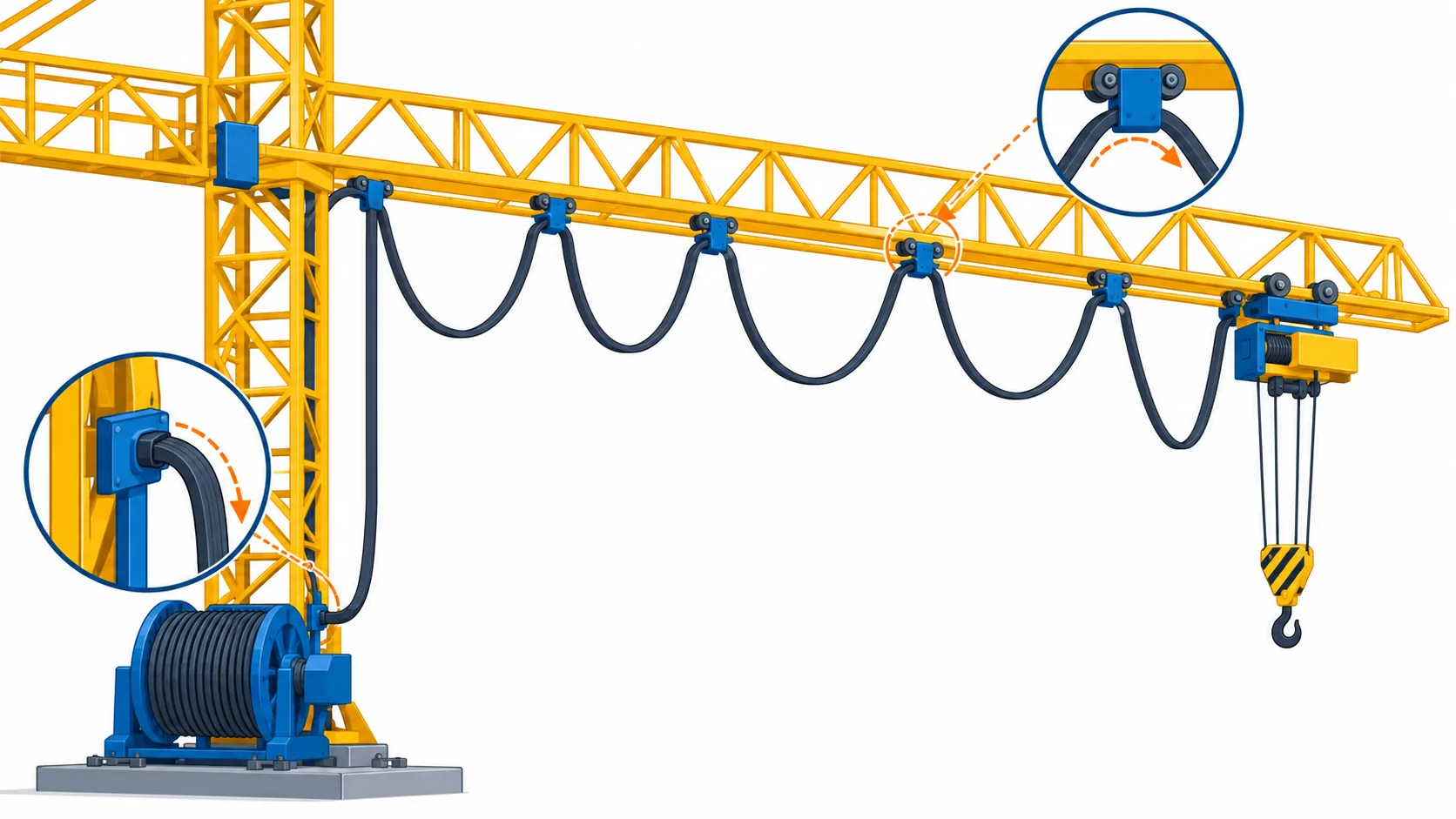
The drum. A tower crane power drum winds and unwinds the main supply cable under tension at every slewing or travel movement. Where the drum winds in a spiral, the cable is twisted one way wound up and back again paid out, thousands of times over a project. Cable that is not built for torsion corkscrews: the loops refuse to lie flat, the sheath wrinkles, and the conductors inside work loose.
The festoon. Hoist and trolley travelling cables hang in loops between trolleys on a track, folding and unfolding at every lift. The duty is bending at a fixed radius, at high cycle counts, with the cable’s own weight adding tension at the top clamp.
The environment. Both systems sit outdoors at height: full sun, rain, wind-driven dust, and winter cold that stiffens the wrong compounds. UV and cold flexibility belong in the specification alongside the mechanical numbers.
Reeling Cable: What the Drum Decides
The drum geometry decides the cable, not the other way round. Three numbers fix the order before any product is chosen.
Drum diameter and core diameter. The minimum bend radius the cable can live with is set by where it enters the drum, and it is tighter than most datasheet optimism. Measure the actual entry geometry and state it in the RFQ.
Winding pattern. A monospiral drum twists the cable every revolution; a parallel-wound drum with a traversing guide mostly does not. The two need different constructions, and the single most common cause of premature crane cable failure is straight reeling cable on a spiral drum. Our note on torsion cable construction explains how torsion-rated designs handle the twist.
Working tension and travel. State the pull the cable sees at full extension and the travel length. Tension sets the strain relief and the core anchoring; travel and drum width set the length and the tolerance on it.
The constructions built for this duty are covered in our note on reeling cable for cranes and drums, and the wider crane application in our guide to reel crane cable systems.
Festoon Cable: What the Trolleys Decide
Festoon systems are bought around the trolleys: their spacing sets the loop length, their saddles set the flat or round profile, and their curve radius sets the bend duty.
Flat or round. Flat cable hangs flat, stacks in the loop without twisting, and seats squarely in the trolley saddles; most festoon tracks on hoists and cranes take flat. Round cable suits light festoon runs and anywhere the saddles are cylindrical. Matching the profile to the saddle is worth more than any sheath upgrade.
Loop length and sag. Loop length comes from trolley spacing and the travel stroke, with sag kept enough that the cable never pulls taut at full extension. Undersized loops pull at the clamps; oversized ones foul the structure.
Core count and pilot cores. State the power cores, the control cores and any pilot or earth-continuity cores in one line of the RFQ. A festoon re-specified mid-order for a missing pilot core is a two-week slip.
Flat festoon constructions, including composite designs that carry power and data in one flat section, are covered in our note on flat festoon composite cable.
| System | Duty | What to Specify | Evidence to Demand | Cost and Lead-Time Driver | How It Fails |
|---|---|---|---|---|---|
| Crane power reeling cable | Wound and unwound under tension, thousands of cycles, possible torsion | Reeling duty rating, torsion rating if spiral wound, drum entry radius, working tension, length with tolerance | Reeling cycle test at declared tension, torsion test for spiral drums, sheath elongation data | Reeling and torsion-rated constructions carry a premium; long continuous lengths set the clock | Corkscrewing, conductor breakage at the drum entry, sheath flattening at the guide |
| Festoon travelling cable | Hangs in loops, folds at every lift, bend radius fixed by the trolley | Flat or round profile to the saddle, trolley spacing and loop length, bend radius, core and pilot count, weather rating | Flex cycle test at the trolley radius, flat profile dimensions, UV and cold flexibility data | Profile-matched flat cable is made to order; footage multiplies with trolley count | Conductor fatigue at the clamps, loops collapsing or fouling, UV cracking on the outer face |
| Hoist and passenger hoist trailing cable | Travels with the cage, guided, moderate flex duty | Flexible conductor class, guide-compatible profile, tension relief at both ends, length with travel margin | Flex test data, guide wear reference, strain relief specification | Stock flexible constructions often suffice; guide matching is the work | Damage at the guide entry, pulled terminations, jacket wear on the track |
| Control, pilot and earth-continuity cores | Carried inside the moving systems, safety-related | Core count and sizes, screen or pilot arrangement, continuity monitoring compatibility | Core identification schedule, continuity test records per finished length | Small cost inside the cable, large cost when missing | Continuity loss that trips the safety circuit intermittently, misidentified cores at re-termination |
The Two Numbers That Decide Everything
Bend radius. Every failure mechanism in this article starts with a bend tighter than the cable’s rating: at the drum entry, at the trolley saddle, at the guide. The rated minimum bend radius applies to the moving state, not just the installed one, and suppliers quote it optimistically for some constructions. Measure the real geometry, state it, and make the supplier confirm the rating against it. Our note on cable minimum bend radius lists where optimistic numbers come from.
Cycle count. A crane working two shifts bends its moving cable tens of thousands of times a year. Cable sold as “highly flexible” without cycle-test data is a description, not a rating. Ask for the flex test at the declared radius and the cycle count it survived; our note on high-flex versus standard cable covers what the testing should look like.
Hoists and Travelling Cables
Passenger and material hoists add a third system: the trailing cable that travels with the cage. The duty is gentler than a festoon but not gentle, because the cable rides a guide at every floor and takes its own weight at the top. Specify a flexible conductor class, a profile that suits the guide, strain relief at both ends and a length with travel margin. Standard flexible constructions often suffice here; what fails in practice is the guide entry and the terminations, so buy the terminations matched to the cable and inspect the guide with the same regularity as the cable. Constructions used on hoist and lift control circuits are covered in our note on lift and hoist control cable.
What to Freeze Before the Order
Crane cable is made to order in long continuous lengths; getting a dimension wrong after manufacture means a new drum, not a repair.
| Decision | What to State | Evidence to Attach | Cost of Leaving It Open |
|---|---|---|---|
| Drum geometry and winding | Diameter, entry radius, monospiral or traversing, travel length | Drum drawing or measurements with the winding pattern named | Straight cable on a spiral drum, and corkscrewing within months |
| Festoon geometry | Trolley spacing, saddle profile, loop length, curve radius | System drawing with the trolley stations marked | Loops that pull taut or foul, clamps that eat jackets |
| Core schedule | Power, control and pilot cores, with sizes, per system | Core schedule matched to the crane electrical drawing | Re-termination, or a safety circuit that cannot be connected |
| Weather exposure | Sun, rain, minimum winter temperature at height | Compound declarations with UV and cold-flex data | Outer-face cracking in the first summer or winter |
| Ends and strain relief | Factory-fitted ends, gland types, anchoring at drum and clamps | Termination schedule and strain-relief specification | Field terminations that pull out under tension |
| Test and delivery plan | Cycle-test evidence, continuity per length, delivery against erection date | Written plan with records per drum | A crane standing erected, waiting for a drum |
Lead Time and Cost Structure
Reeling and festoon cable is manufactured to order in continuous lengths matched to the drum or travel, which puts the machinery line at four to eight weeks including fitted ends, longer if the drum is unusual. Order against the erection date, not the crane order date, and confirm the delivery sequence with the erector: the drum cable is needed before the jib goes up, the festoon before the hoist commissioning.
On cost, copper is the largest component, followed by the mechanical construction: torsion-rated cores, reinforced sheaths and profile tooling all sit above standard flexible cable. That premium is bought back by cycle life, and it is worth asking how each bidder’s construction earns its number. Copper movement between quotation and order matters on a long drum, so fix a copper basis and a validity window at quotation stage.
Incoming Inspection
Before it goes up. Check the delivered length against the order and the drum or travel dimensions, photograph the markings, and run continuity and insulation resistance on every core, end to end. A core fault found on the ground is a re-termination; found at the top of the mast it is a crane outage.
Construction checks. Verify the profile against the trolley or drum specification, and the sheath compound against the declaration. For festoon cable, lay a sample loop on the ground at the trolley radius and check it hangs and recovers without kinking before the system is loaded.
When a Crane Cable Specification Is Not the Answer
When the drum is the problem. A reeling cable replaced into a worn drum entry or a failing slip ring assembly dies like the last one. Overhaul the drum and guides with the cable order, or the new cable inherits the old failure.
When the loops foul because the trolleys are worn. Worn festoon saddles and flat trolleys destroy correct cable. Replacing trolleys is cheap against repeatedly replacing loops.
When the fault is in the fixed wiring. Intermittent crane faults are usually hunted on the moving cable first because it is visible, but the fixed runs and slip ring wiring fail too. Test the whole circuit before re-ordering anything.
When the duty has changed. A crane re-purposed to faster cycles or heavier lifts has outgrown its original cable rating. Re-derive the duty and re-specify, rather than like-for-like replacing.
RFQ Checklist
- System per order: reeling drum, festoon, hoist trailing or fixed
- Drum diameter, entry radius and winding pattern, or festoon trolley spacing and saddle profile
- Travel length and working tension, with length tolerance stated
- Core schedule: power, control, pilot and earth-continuity cores with sizes
- Minimum bend radius at every moving point, stated by the buyer, confirmed by the supplier
- Flex or reeling cycle test at the declared radius, with the cycle count
- Torsion test evidence where the drum winds in a spiral
- UV and cold-flex data for outdoor service at height
- Factory-fitted ends and strain relief at drum, clamps and terminations
- Continuity and insulation test records per finished length
- Copper basis with validity window, and the delivery date against erection
Conclusion
Crane and hoist cable is bought well when the geometry leads: measure the drum and the trolleys, state the bend radius and tension, and buy constructions rated for the winding and flexing the crane will actually do. Demand cycle-test evidence, factory-fitted ends, and a delivery date tied to erection.
Kexingyu Cable Group (KXYE) has manufactured cable in Quanzhou since 1996, including reeling, festoon and hoist constructions for construction machinery, with factory-fitted ends and cycle-test documentation. Send us the drum and festoon geometry with the core schedule, and we will come back with the constructions, the test evidence and a delivery plan against your erection date. The fastest route is a request for quotation.