Cable Jacket Selection: Matching the Sheath to the Site Environment
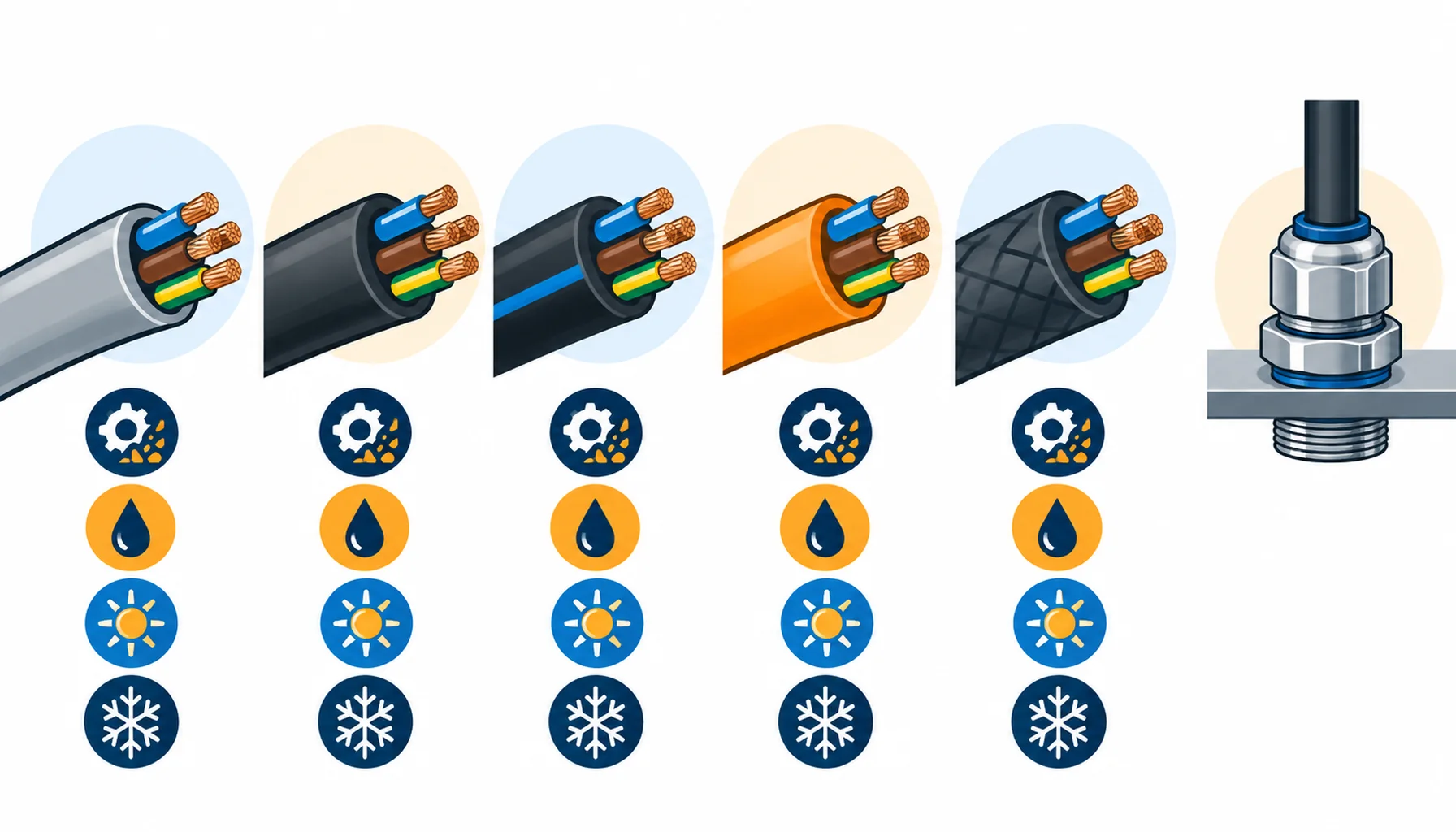
Quick Answer: Cable jacket selection is decided by four conditions on site: abrasion, oil and chemicals, sunlight, and cold. PVC covers dry indoor work, PE covers outdoor and buried work, PUR covers abrasion and oil, and rubber-based sheaths cover cold and heavy mechanical duty. The conductor and the insulation set what a cable can carry. The jacket decides how long it survives, and it is the part of the specification most often left to the supplier.
Introduction
On most industrial projects the sheath is the layer nobody argues about, and it is the layer that decides whether the cable is still there in five years. Two cables with the same copper and the same insulation can differ by a factor of three in service life on the same route, purely on the compound over the top.
This guide is written for the person raising the requisition. It covers what the jacket is asked to do, the four conditions that decide the choice, the evidence worth demanding, and the decisions to freeze before the order goes out. The wider material comparison behind it is in our note on cable sheath materials compared.
What the Jacket Is Asked to Do
Take the mechanical damage. Cable is dragged over concrete, run over at a crossing, pulled through a duct and cleated to a tray. The jacket is the only layer that stands between that and the insulation, and it works by being either hard or tough, depending on the compound.
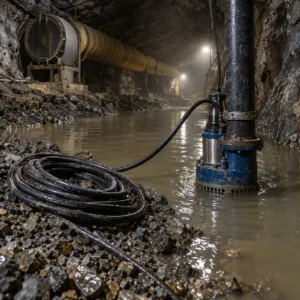
Resist what is on site. Oil, hydraulic fluid, diesel, acid, washdown chemicals, salt and ozone all attack different compounds at different rates. A jacket that swells in hydraulic fluid is a jacket that will fail at a gland.
Survive the weather. Ultraviolet light and ozone crack elastomers and embrittle thermoplastics, and on an outdoor route the jacket is the whole defence. A black jacket is not automatically a UV-resistant one. Our note on abrasion-resistant cable jackets covers how abrasion resistance is specified and measured.
Stay flexible when it is cold. A compound that is flexible at 20 C can shatter at minus 25 C. Where a cable is installed or moved in winter, the low-temperature limit belongs in the specification as a number.
The Jacket Families a Site Buyer Chooses Between
PVC is cheap, tough enough for indoor work and available in any colour. It is the default for panel wiring and indoor fixed runs, and it hardens in cold, softens when hot and releases acidic smoke in a fire.
PE, and particularly high-density PE, is the outdoor and buried compound: excellent water resistance, good UV performance in a black formulation, and better chemical resistance than PVC. It is stiff, which is fine for a fixed buried run and wrong for a cable that has to move. Our note on PUR, PVC and TPE cable compares the flexible families on the same duty.
PUR is the industrial workhorse for abrasion and oil: it resists cutting and tearing, holds up against hydraulic fluid and stays flexible in cold, at a price above PVC. Rubber-based sheaths, including CSP, EPR and silicone-based compounds, are chosen where cold flexibility or heat resistance outranks cost, and they are the usual answer on trailing cable, welding cable and equipment that moves.
The table below compares the families on the conditions a site imposes, with the evidence worth demanding and how each choice fails when it is made on price alone.
| Jacket | Best site duty | What to Specify | Evidence to Demand | Cost and Lead-Time Driver | How It Fails |
|---|---|---|---|---|---|
| PVC | Dry indoor fixed runs, panel wiring, light-duty control cable | Compound type, flame retardance required or not, temperature range, colour and core identification | Compound declaration, temperature and flame test data where claimed | Cheapest family and usually ex stock; lead time is on lengths, not compound | Hardening and cracking in cold outdoor service, swelling in contact with oils |
| PE and HDPE | Buried ducts, outdoor fixed routes, wet ground | Density and grade, UV stabilisation, water-blocking where the route is wet, impact performance at installation temperature | Water absorption and UV ageing data, dimensional records, impact test results | Compounding is simple; the lead time sits in drum lengths and any water-blocking | Stress cracking in a duct, brittle damage during a cold pull, termite or rodent damage |
| PUR | Industrial machinery, trailing and drag duty, oily and abraded areas | Abrasion and cut resistance required, oil and hydraulic fluid resistance, cold flexibility limit, flex duty | Abrasion test results, oil exposure data, flex and cold bend results for the compound | Higher compound cost and slower extrusion than PVC; specialist colours add time | Hydrolysis in hot wet service, chalking under UV, sheath damage where the duty exceeded the grade |
| TPE and halogen-free thermoplastic compounds | Tunnels, confined spaces and areas where smoke and halogen content are regulated | Smoke density, halogen content, flame propagation class, temperature range | Third-party test reports to the named standard, identifying the construction supplied | Certified compound and certification paperwork both sit in the lead time | Approval rejected on delivery because the report names a different construction |
| Rubber-based heavy-duty sheaths | Trailing cable, welding cable, equipment that moves in cold or heat | Flex and torsion duty, low-temperature limit, heat resistance, tear strength, sheath thickness | Flex and torsion results at the declared radius, cold bend data, ageing results | Rubber compounds cost more and cure slower than thermoplastics | Tearing at a guide or drum entry, softening at high ambient, damage from a cheap gland |
Where Each Jacket Fails in Service
Abrasion is a rate, not a yes or no. A jacket is abraded where it touches a guide, a cleat or a rough surface, and the damage is progressive. On a trailing duty the abrasion test result at the relevant load and stroke is the number that matters, not a general claim of toughness. Our note on cable abrasion test standards covers how the test is run and what the figures mean.
Oil and chemical attack usually reaches a gland first. Where a jacket swells, the diameter grows and the gland seal is lost, so the failure appears as water ingress rather than as chemical damage. Exposure data for the specific fluid is worth asking for, and our note on cable oil resistance testing sets out how it is demonstrated.
Cold failures are installation failures. Most low-temperature jacket damage happens on the day the cable is installed or moved, not in service. Where winter installation is planned, specify the lowest temperature at which the cable may be handled and bent. Our note on low-temperature flexible cable covers how that limit is declared.
UV damage needs the right formulation, not just the right colour. Black compounds are usually the best stabilised, but the additive package is what does the work. On an outdoor route that will last decades, that belongs in the material declaration.
What to Freeze Before the Order Goes Out
These six items are cheap at specification stage and expensive once drums are on a truck.
| Decision | What to State | Evidence to Attach | Cost of Leaving It Open |
|---|---|---|---|
| Exposure per run | Oil, chemicals, salt, ozone and UV each route will meet | A route schedule with the exposures marked run by run | A jacket that swells or cracks within a year of commissioning |
| Abrasion duty | Where the cable touches a guide, cleat or rough surface, and the load and stroke | Abrasion test results at the declared duty | Progressive sheath wear at one point on the run |
| Temperature range including installation | The lowest handling temperature and the highest continuous service temperature | Cold bend and ageing data for the compound supplied | Sheath shattered during a winter pull that could have been scheduled |
| UV and weathering | Whether the route is exposed to direct sun, and for how long the cable must last | UV ageing data and the material declaration for the compound | Surface cracking on an exposed run inside two summers |
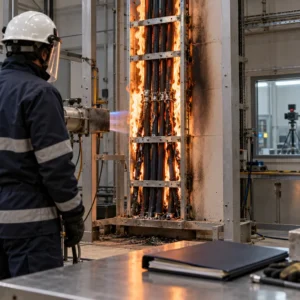
| Fire and smoke performance | Whether flame retardance, low smoke or halogen-free performance is required, to which standard | Third-party test reports naming the class and the construction | A delivery that cannot be inspected in on a regulated site |
| Marking and identification | Sheath marking required: type, size, standard, drum and metre marking | A marking schedule agreed with the goods | Drum identification that cannot be traced back to the records |
Cost and Lead Time
Stock cable is almost always PVC or PE, because those are the compounds that sell in volume and extrude fastest. Made-to-order PUR and rubber sheaths are the normal case on industrial work and run on the compound, the core count and the drum lengths. Certified halogen-free and fire-rated constructions are the longest line, because the certified compound and the test evidence are part of the product rather than paperwork added afterwards.
Copper is the largest single component and the one that moves between quotation and order, but the compound is where a jacket specification quietly changes the budget. Ask for the material declaration with the quotation, and ask how the copper element is calculated and how long the price holds. A supplier who locks a copper basis for a stated window is easier to budget against than one who resets at order.
Incoming Inspection
Against the drum. Count drums against the packing list, verify marked lengths and photograph the drum markings before anything is cut, so the delivery can be linked to the compound declaration.
Dimensional and physical checks. Measure overall diameter and sheath thickness on a sample and compare with the construction sheet. A sheath that is thinner than declared changes both the abrasion life and the gland fit, and it is the cheapest thing for a factory to shave.
Material evidence. Match the compound declaration and the exposure, ageing and fire test reports to the construction delivered. Where a cable is going onto a regulated site, confirm the report names the drum construction rather than a product family, and check the sheath marking against the schedule.
Buying the Sheath as Part of a Construction
A jacket is rarely bought on its own. It arrives on a cable whose insulation, bedding, screen and core count were fixed at the same time, and the four layers have to be chosen against the same duty. A halogen-free jacket over a PVC-insulated core is not a halogen-free cable, and a flexible jacket over a stiff insulation still cracks at the bend.
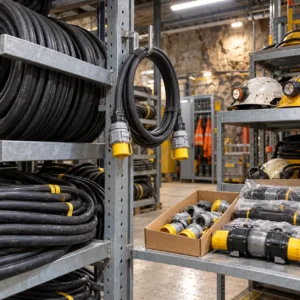
Where a project needs the whole assembly matched to one exposure, it is easier to buy it as a construction than to assemble it from clauses. Our welding cable and the cold-resistant PE jacketed cable are supplied with the sheath compound, the temperature range and the flex rating already fixed for the duty, which removes most of the risk of a mixed specification reaching site.
When a Tougher Jacket Is Not the Answer
When the failure is routing. Sheath worn through at one point on a run is usually a guide, a clamp or a rough surface. A harder jacket in the same route wears through a few months later. Fix the route before buying a grade.
When a cable that should be in a duct is laid in the open. Neither UV stability nor abrasion resistance substitutes for containment on a route that was designed to have it.
When a soft, high-temperature jacket is chosen for an abrasive duty. Silicone-based sheaths tolerate heat and stay flexible, and they are the wrong answer where the cable is dragged. Heat resistance and abrasion resistance pull in opposite directions.
When the client’s specification already names the compound. Where the standard names a sheath type and a marking convention, the competition moves to delivery, evidence and price rather than material selection.
RFQ Checklist
- Route condition and exposure per run: indoor, outdoor, buried, oily, chemical or coastal
- Abrasion duty, with the contact points and the load and stroke where known
- Jacket compound specified per duty, with the material declaration required
- Continuous service temperature and the lowest permitted handling temperature
- UV and ozone exposure, with the expected service life on exposed routes
- Fire and smoke performance required, with the standard and the class named
- Flex or torsion duty where the cable moves, with the radius and cycle count
- Sheath thickness and overall diameter limits for the glands and containment
- Marking schedule: type, size, standard, drum and metre marking
- Test reports required, with records per drum, and the copper basis with its validity window
Conclusion
Jacket selection follows the environment, and the environment is a set of numbers rather than a general description. Name the fluids, the abrasion duty, the temperature range and the sun exposure, put each against the family that handles it, and buy the glands that match the sheath you chose. The jacket is the cheapest place on a cable to save money and the most expensive place to get wrong.
Kexingyu Cable Group (KXYE) has manufactured cable in Quanzhou since 1996, supplying PVC, PE, PUR and rubber-sheathed constructions with material declarations and test records that travel with the drums. Send us the route schedule with the exposures, the temperatures and the duty, and we will come back with the constructions, the evidence that applies to each and a delivery plan against your programme. A request for quotation is the fastest route.