Lead Time Planning for Central Asian Projects: From Order to Site Milestones
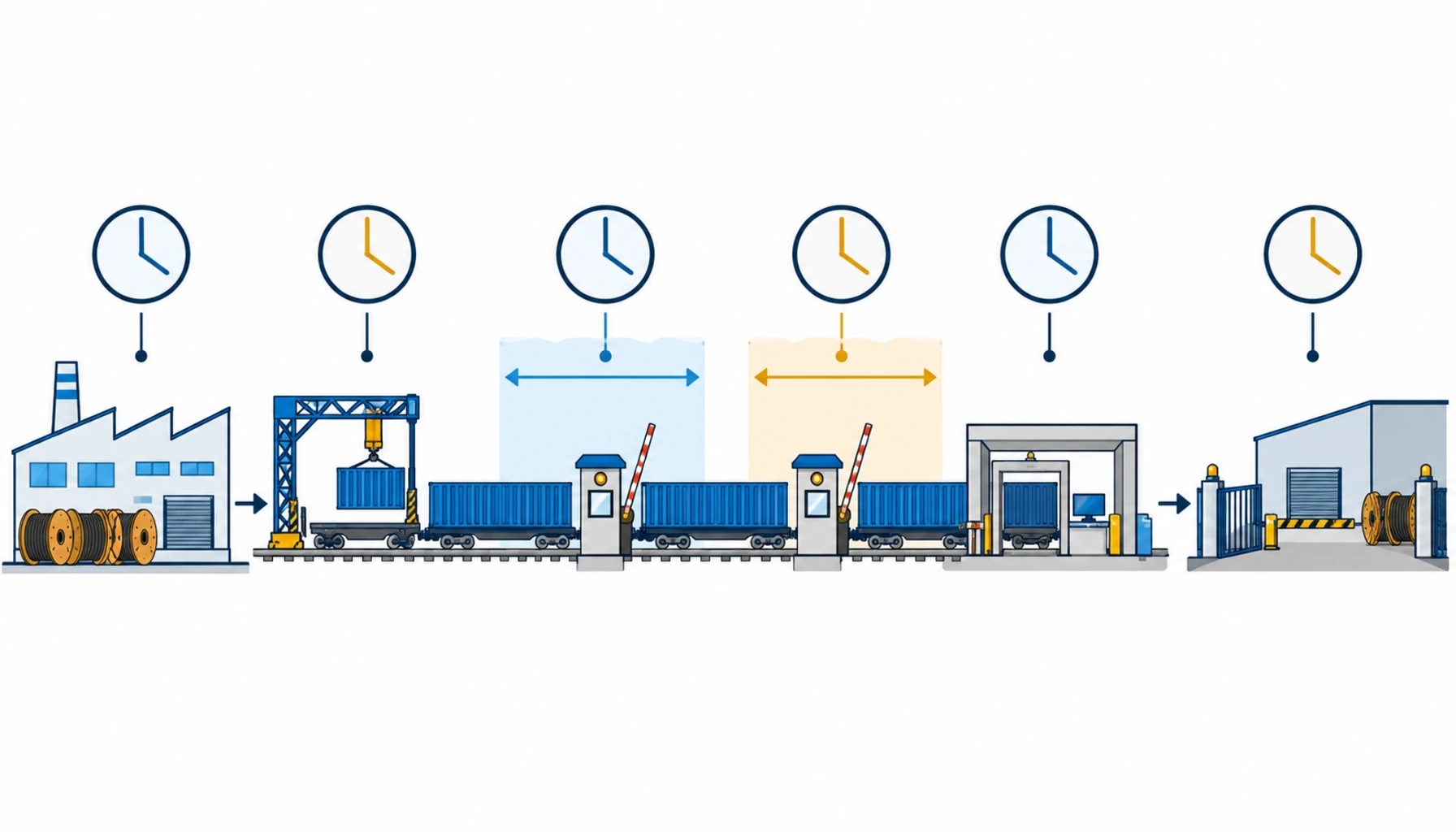
Quick Answer: Cable lead time on this lane is a chain of four legs, production, loading, transit and clearance with handover, and each leg has its own clock and its own failure mode. The schedule that survives is built backwards from the site milestone the cable actually serves, with the factory date derived from it and buffers placed at the legs that wobble, the transit queue and the border, not at the end. A quotation that quotes the shortest production time has usually not quoted the corridor at all.
Introduction
This page treats lead time as a planning exercise rather than a quotation line: what the four legs of a cable order actually take on the Central Asian lanes, how to plan backwards from a site milestone, where phases and partial deliveries help, and how much buffer is honest. The scheduling inside the factory is covered separately; here the factory is one leg of four.
The regional buying context sits in our Central Asian cable buying hub. What follows assumes the construction season matters, because on these projects it always does.
Why Lead Time on This Lane Is a Chain, Not a Number
A cable order for the region moves through four legs with different owners. The factory produces and tests. A forwarder loads and carries the consignment across one or two borders. Customs clears it, and the site receives it against a window it may or may not hold. Each leg can absorb delay or create it, and none of them can compensate for another. The chain image is not decoration: a week saved at the factory is worthless if the crossing it feeds has no slot, and a fast border is worthless if the site cannot receive.
The reason schedules fail here is that the legs are planned by different people at different times. The factory date is quoted at order, the transit time is assumed by the buyer, the clearance window is nobody’s until the drums are rolling, and the site milestone was fixed months earlier by a programme nobody has re-read. The chain is only as honest as its least-quoted leg.
Costly schedule slips are rarely production slips. They are sequencing failures: a consignment released before a certificate was in scope, a transit booking made after the factory finished, or a site window that passed while the drums waited at a crossing. The pattern repeats across regions and is catalogued in our note on cable sourcing delays in EPC timelines.
The Production Leg: From Order Release to Loading
Production starts after three things, none of which are extrusion: technical clarification closed, samples or first-article approval where the contract asks for them, and materials bought against a copper basis. On a quoted schedule those three sit invisibly before day one, and an order that arrives with open questions starts its clock late no matter what the offer said.
The factory leg for a regional order typically runs in weeks set by the construction mix: standard low voltage lines move faster than medium voltage with screens and tests, and a mixed consignment takes the pace of its slowest construction. Where a schedule is tight, the lever is splitting the order so the slow construction starts first, not pressing the whole line to move at once. Where the contract asks for sample approval, that approval sits on the critical path too, and its discipline is set out in our note on the cable sample approval process.
Two documents anchor the leg. The order release, which fixes the technical baseline, and the inspection or test plan, which fixes what must pass before loading. The scheduling discipline behind the factory leg is set out in our note on production scheduling for cable orders, and the quantity effects are in cable MOQ and lead time.
The Transit Leg: Rail, Road and the Season
Transit on the land lanes is measured in weeks and moves with the season. The rail crossings carry most volume and queue accordingly, road through the passes is faster in summer and unreliable in winter, and the sea-rail alternative trades days for weather tolerance. A transit estimate written for July does not describe January.
The transit leg also has a booking character the factory leg lacks. Wagon slots and truck capacity are reserved, and in the autumn push they are scarce. An order that finishes production with no booking has converted a production lead time into a storage bill, and the queue it joins is not the one the schedule assumed. The booking trigger belongs in the master schedule as an event with an owner and a date, exactly like a test.
The planning rule is to fix the transit mode per phase, not per project, and to book when production is confirmed rather than when it starts. Where a phase mixes constructions, the transit plan follows the drums that are actually ready. The route options behind this leg are the subject of our China-to-Central-Asia shipping overview, and the sea leg’s logic is in our note on cable sea freight.
The Clearance and Handover Leg
Clearance is a document leg that behaves like a schedule leg. Where the declaration file was prepared during production, release takes days; where it was assembled after loading, the consignment teaches everyone the schedule the hard way. The clearance calendar belongs in the master plan with an owner and a date, not in the forwarder’s inbox.
Handover adds the site’s own clock. Unloading capability, storage space and a receiving window have to exist when the trucks arrive, and on remote sites the window is weather-bound. A consignment that arrives to a site that cannot receive it parks the whole chain at the least controllable point of the journey. An unreceivable yard is not a detail of logistics; it is the last leg, and it votes.
The receiving side, offloading method and the window discipline, is set out in our note on site delivery and offloading. What planning adds is a confirmation step: the site confirms its window in writing at the same moment the loading date is fixed, and both move together.
Backward Planning From Site Milestones
The reliable way to build the schedule is backwards. Start from the milestone the cable serves, the trench that closes, the substation that energises, the phase that commissions, and ask what must be at the site a working week before it. That arrival date, not the order date, is the fixed point of the plan.
From arrival, walk the chain in reverse: clearance days, transit weeks by season, loading and inspection, and the production weeks of the slowest construction in the phase. The date that falls out of the walk is the order release date, and if it is already in the past, the schedule needs a phase split rather than optimism. The walk also shows which legs can overlap: the clearance file can be built while production runs, and booking can start at confirmation, which is where phasing quietly recovers weeks.
Backward planning also exposes what is actually driving the project. On most regional jobs the driving milestone is seasonal, which makes the winter window the real deadline, and the quotation validity and the copper basis have to be built around it. The quotation mechanics are in our note on cable quotations from China to Central Asia.
Phase Splits and Partial Deliveries
Phasing is the strongest schedule tool on this lane, and the cheapest. A project that takes its low voltage drums first and its medium voltage drums a month later matches factory pace to site readiness, spreads the transit booking across slots that exist, and reduces the storage a site must absorb on any single arrival.
The cost of phasing is administrative, and it is paid in documents: each phase carries its own packing list, certificate check and declaration lines. That is manageable when the phase plan is fixed at order and unmanageable when it is invented at loading. Phase numbering has to run through every document from the first packing list to the last acceptance note.
Where phases serve different standards or destinations, the split doubles as a compliance tool, because each phase can carry exactly the evidence it needs. The discipline of agreeing all of it before production is the same one described in our note on the industrial cable RFQ checklist.
Buffers, Slips and Honest Dates
Buffers belong where the variance is, not at the end of the schedule. On this lane the two high-variance legs are transit booking and clearance, and a plan that pads production while quoting a transit number to the day has placed its margin exactly where it is least needed. Name the buffer in the schedule as a margin on a named leg, so the next reader knows it was a decision. Padding the corridor is what makes a schedule survive contact.
When a leg slips, the response is re-planning rather than pressing. A production delay of a week can be absorbed by moving a transit booking; a missed crossing slot cannot be absorbed by anything except the next one, and pretending otherwise converts a one-week slip into a three-week one. The honest move is to re-walk the chain and reset the site expectation early.
Acceptance testing sits at the junction of legs, and its slot needs protecting in the plan: a factory acceptance test that slips delays loading, and a site acceptance that slips delays the milestone the cable serves. The hold-point logic is set out in our note on FAT versus SAT.
The Lead Time Map
Table 1 sets out the four legs with their typical variance and the lever that actually moves each one.
| Leg | Owner | Variance | Lever That Moves It |
|---|---|---|---|
| Production | Factory | Low once released | Order release quality and phase split |
| Inspection and loading | Factory and forwarder | Low | Test plan agreed before production |
| Transit | Forwarder | High, seasonal | Early booking and mode choice |
| Clearance | Declarant and broker | High, document-driven | File prepared during production |
| Handover | Site | Medium, weather-bound | Receiving window confirmed in writing |
The Lead Time Freeze List
Table 2 is what to freeze at order, because a schedule agreed once in writing is worth three that are re-negotiated in motion.
| Item to Freeze | How to Write It | Evidence to Attach | Cost of Leaving It Blank |
|---|---|---|---|
| Site milestone | The dated milestone each phase serves | Programme extract per phase | A schedule with no fixed point |
| Order release date | Derived from the backward walk, not from the offer | Release checklist closed | Production starting on open questions |
| Transit mode per phase | Crossing and fallback named for the month | Booking plan with the season note | A July plan meeting January |
| Booking trigger | Book at production confirmation, not at start | Confirmation letter per phase | Storage bill instead of a slot |
| Clearance calendar | Owner and dates for the declaration file | File checklist against production | Drums teaching the schedule |
| Receiving window | Site confirms in writing at loading date | Window confirmation per phase | Chain parked at the site gate |
| Buffer placement | Margin on transit and clearance, not on production | Schedule with variance notes | Margin spent where variance is not |
When a Shorter Quote Is Not the Answer
When the short production number hides an open technical baseline. A factory that promises weeks before clarifying the specification is quoting the start of a negotiation. Release quality, not extrusion speed, decides the production leg.
When the transit estimate is a summer number on a winter project. The crossing that runs to schedule in July queues in January. A plan that borrows a season’s transit figure for another season is a plan that slips once, in the wrong month.
When the buffer sits at the end of the schedule. Margin placed after handover protects nothing, because the milestone it guards has already moved. Buffers go on transit and clearance, where the variance actually lives.
When the phase plan is invented at loading. Phasing agreed after production started produces documents that do not reconcile, and the reconciliation is done at the border. Fix the phase split at order, with numbering that survives every paper.
When the site window is assumed rather than confirmed. An arrival date without a written receiving window is a delivery to a yard nobody is watching. The confirmation costs one letter and saves the whole chain.
RFQ Checklist
- Schedule built backwards from the dated site milestone each phase serves
- Order release date derived from the backward walk, with clarifications closed
- Sample and test approval slots planned before production starts
- Transit mode and fallback named per phase, against the delivery month
- Booking triggered at production confirmation, in writing
- Clearance calendar owned and dated, file built during production
- Receiving window confirmed by the site at loading date
- Buffers placed on transit and clearance, not on production or at the end
- Phase numbering consistent across every document
- Validity and copper basis sized to the corridor the schedule implies
Conclusion
Lead time on this lane is a chain of four legs with different owners, and the schedule that holds is the one built backwards from the site, with the corridor padded and the factory told the truth early. Phases, written windows and buffers on the volatile legs are the whole craft; the rest is asking each leg to confirm its own date in writing.
Kexingyu Cable Group (KXYE) quotes lead time as a plan, not a number: release dates derived from site milestones, phase splits that match factory pace, and transit booked the moment production is confirmed. Send the milestone and the volume. A request for quotation is the fastest start.