Imported or Chinese Industrial Cable: A Like-for-Like Comparison
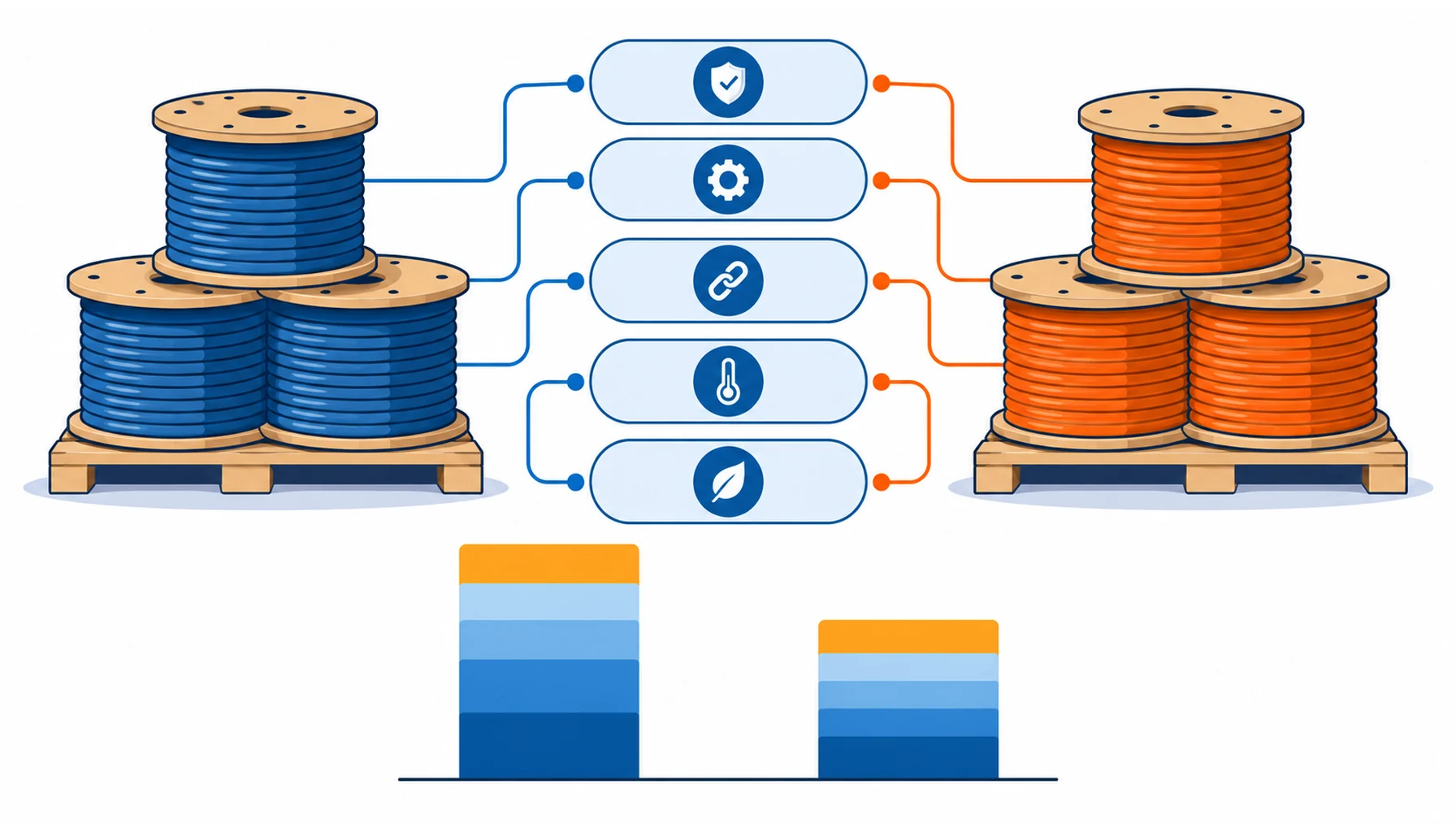
Quick Answer: The comparison is only worth making when both cables are specified the same way. Same conductor class, same insulation and sheath, same voltage rating, same flame and smoke requirement, same test standard, same drum lengths, same certification accepted where the cable is being installed. Until those are fixed, a price difference is measuring two different products, not two sources.
Introduction
Site buyers in Africa, the Middle East, Southeast Asia and South America are asked the same question almost every project: is the imported cable worth the premium over Chinese cable. The honest answer is that the question is badly posed. There is no single imported cable and no single Chinese cable, and the spread within each group is wider than the gap between them.
This page is for procurement engineers comparing sources for an industrial installation. It covers what the two labels actually mean, where a like-for-like comparison breaks down, standards and certification side by side, the specification clauses that make two quotes comparable, the evidence worth demanding, the full cost picture rather than the unit price, and the six decisions to freeze before the order is placed. The buying process itself is described in our note on buying cable from China.
What Imported and Chinese Actually Mean
Imported is not one origin. A European cable, a Korean cable, a Turkish cable and an Indian cable sit at different price points, carry different certifications and behave differently on lead time. A comparison that treats them as one group is comparing a range against a range with no control.
Chinese is not one quality either. The phrase covers everything from a small workshop running a single extrusion line to a factory with its own drawing, stranding, test bay and export certification. Two Chinese suppliers quoting the same product can be thousands of dollars apart, and that spread is a specification signal as much as a price signal.
The useful unit of comparison is the construction, not the country. Fix the conductor class, the insulation compound, the sheath, the voltage rating, the flame and smoke performance, the test standard and the certification, and then compare. At that point the origin is one variable among several, and the differences that remain are real ones.
Where a Like-for-Like Comparison Breaks Down
Copper content is the first place the numbers diverge. Two cables of the same nominal cross-section can carry different actual conductor areas and different stranding, and copper is the largest single element of cost. A cheaper cable is usually a lighter cable, and the reason to check the purity and the build is set out in our note on conductor copper purity and construction.
Test regime is the second. A routine test on every drum is not the same as a type test once, and neither is the same as sample testing on a batch. A quote that names a lower test regime will be cheaper, and on a fixed-price job the saving shows up later as thinner evidence at receipt.
Certification scope is the third, and the most misread. A certificate may cover a product type, a factory’s management system, or a specific listed construction. The certificate that matters is the one the authority having jurisdiction accepts for the cable actually being delivered, and the market-by-market picture is set out in our note on cable import certification by country.
Drum lengths and tolerances are the fourth. A reel that is nominally 1,000 metres is not the same as one measured to a defined positive tolerance. On a long pull the difference decides whether there is a joint in the run, and the measuring convention is described in our note on cable length tolerance.
Standards and Certification Side by Side
Both sides usually work from the same core standards. IEC 60228 defines the conductor classes, IEC 60502 and IEC 60811 cover construction and test methods, and IEC 60332 covers flame propagation. A Chinese factory exporting to a project that specifies IEC will generally build to IEC, so the technical conversation is on common ground.
The domestic Chinese framework is separate. Cable sold into the Chinese market carries CCC certification against GB standards, and that is not interchangeable with an export certification. Ask which certificate applies to the goods on your order, and ask to see it, rather than accepting a general statement about capability. Our note on CCC certification for cable explains what it does and does not cover.
Market access is decided by the destination. The European market looks for CE marking under the Construction Products Regulation for many cable types, North America for UL or CSA listings, and the Gulf and ASEAN markets increasingly for their own registration schemes. A supplier that can produce the right certificate for your market is worth more than one that only holds the domestic certificate, and our note on the product certification set lists what a project normally needs.
Comparison Routes Compared
The table compares the ways a buyer can make an imported-versus-domestic decision, what each one establishes, what to specify, the evidence to demand, what drives cost and time, and how each one fails.
| Route | What it establishes | What to Specify | Evidence to Demand | Cost and Lead-Time Driver | How It Fails |
|---|---|---|---|---|---|
| Unit price comparison | Which number is lower, and nothing else | Nothing, which is the problem with this route | A written quotation against a written specification | Fastest route and the most misleading | A cheaper cable that is a lighter cable with less copper |
| Specification-based tender | That both suppliers are pricing the same product | Conductor class, compounds, ratings, test standard, drum lengths | Compliant quotations with a clause-by-clause response | More buyer time up front, far fewer disputes later | A specification so generic that each supplier prices a different build |
| Sample and type-test review | That the construction and the test results match the claim | The construction to be sampled and the tests to be run | A sample with an independent test report and a retained piece | Testing cost and weeks of programme | A sample made for the test rather than taken from production |
| Landed cost comparison | The real delivered cost rather than the ex-works number | The Incoterm, the delivery point and the duty basis | A cost sheet covering freight, duty, insurance and finance | Analyst time, but it is the only number that decides the award | An ex-works price that looks cheaper until freight and duty are added |
| Qualification and trial order | That the factory can deliver this build at this schedule | The order quantity, the test protocol and the witness point | A production sample, the release package and a delivered trial drum | The largest of the routes, and the strongest | A trial run that is not repeated on the production order |
The Specification Clauses That Make Quotes Comparable
Write the construction, not the product name. “XLPE insulated, copper tape screened, PVC sheathed, 0.6/1 kV, four core, class 2 conductor” leaves nothing to interpret. A trade name or a national designation invites each supplier to price their own version of it.
Name the standard and the test regime. State the IEC or national standard for each property, and say whether routine, sample or type testing is required and who witnesses it. This is the clause that separates two quotes that otherwise look identical, and it is the one most often left out.
Fix the commercial frame as well as the technical one. The Incoterm, the delivery point, the drum lengths with tolerance, the marking and labelling, the documentation language, the packing standard and the warranty period all belong in the enquiry. Two quotes compared across different delivery terms are not comparable at all, and the way to line them up is set out in our note on comparing cable quotes.
Evidence, Testing and Independent Inspection
Ask for the release package on a real past order. Seeing a certificate that matches a drum number, a test result that matches a construction and a drawing revision that matches both is more convincing than any claim. A supplier who cannot produce that on request will not produce it on your order either.
Use independent inspection where the value justifies it. Third-party inspection at the factory, before dispatch, shifts the argument from the site to a point where the cable is still in the supplier’s control. On a first order from a new source, this is usually the cheapest insurance in the file, and how it is arranged is covered in our note on third-party cable inspection.
Keep a retained sample. A sealed sample of each construction, kept by both sides, ends most disputes about what was ordered. It also gives the maintenance team a baseline years later when a replacement length has to match the original.
What to Freeze Before the Order Goes Out
Six decisions decide whether the comparison means anything and whether the award survives delivery. Each belongs in the enquiry.
| Decision | What to State | Evidence to Attach | Cost of Leaving It Open |
|---|---|---|---|
| Construction definition | Conductor class, compounds, screen, sheath, cores and voltage rating | The approved drawing and the full datasheet | Two quotes for two different cables compared as though they matched |
| Standard and test regime | The standard per property, and whether testing is routine, sample or type | A test schedule naming the witness point | A cheaper quote that quietly reduces the evidence at release |
| Certification for the destination | The certificate the authority accepts for these goods | A current certificate scoped to the construction | Cable held at customs or refused at inspection |
| Commercial frame | The Incoterm, delivery point, drum lengths and warranty period | A term-by-term quotation response | Quotes that cannot be compared and a warranty nobody can enforce |
| Landed cost basis | Freight, duty, insurance, finance and storage included | A cost sheet for each source on the same basis | An award made on ex-works price that loses money on delivery |
| Qualification path | The sample, trial order and inspection steps required before release | A qualification plan with dates and owners | A first order that becomes the qualification, at project risk |
Cost, Lead Time and the Real Comparison
Compare landed cost, not unit price. Freight, duty, insurance, customs clearance and the working capital tied up in a longer transit all belong in the number. On a sea shipment the finance and storage cost of a longer pipeline is real, and it frequently narrows a headline gap that looked decisive.
Lead time is a cost too. A domestic supplier that delivers in three weeks can be worth a price premium over an imported cable that needs twelve, particularly where the programme is fixed and a delay triggers standing charges. The structure behind those dates is covered in our note on cable MOQ and lead time.
Price is driven by the metal before anything else. Copper is the dominant element of cable cost on both sides of the comparison, and a fixed price offered across a long window carries a risk premium. Our note on the structure of a cable price shows where the money sits and why two quotes move for different reasons.
When Imported Cable Is Not the Answer
When the certification does not transfer. A European certificate does not satisfy a North American inspector and a Chinese domestic certificate does not satisfy a European one. Where the destination authority has its own scheme, the origin that matters is the one holding the right certificate.
When the programme is the constraint. Imported cable on a long sea route adds weeks that a fixed programme cannot absorb. If the pull date is firm, a shorter supply chain with the right construction beats a smaller unit price.
When the project needs one supplier for the whole scope. Ordering cable from one source and accessories, terminations and control cable from three others multiplies the interface risk. Where the scope has to be coordinated, a single qualified supplier is often worth more than three optimised prices, and that trade-off is set out in our note on coordinating a single equipment supplier.
When nobody has looked at the factory. A price from a source nobody has assessed is a price with unknown risk in it. Before a first order of any size, the visit or the trial order pays for itself, and the buyer-side checks are set out in our note on vetting an electrical equipment manufacturer.
RFQ Checklist
- The full construction: conductor class, compounds, screen, sheath and cores
- The voltage rating, the cores and the nominal cross-sections required
- The standard applied to each property, and the test regime
- The certification the destination authority accepts, named specifically
- The drum lengths required, with the tolerance convention stated
- The sheath marking, labelling and documentation language
- The packing standard matched to the actual transport route
- The Incoterm, delivery point and unloading responsibility
- A landed cost basis covering freight, duty, insurance and finance
- The warranty period, and what it covers and excludes
- Whether third-party inspection is required before dispatch
- The qualification steps: sample, trial order, witness and retained sample
Conclusion
Imported or Chinese is the wrong way to frame the decision. What decides quality and cost is the construction, the test regime, the certification for the destination and the delivery terms. Fix those, and the comparison becomes a straightforward one between suppliers who are genuinely quoting the same product.
Kexingyu Cable Group (KXYE) has manufactured cable in Quanzhou since 1996 and builds to IEC and national standards for export markets, holding the test records and drum traceability that an independent inspection asks for. Tell us the destination, the authority and the construction, and we will confirm the certification and documentation package that applies. A request for quotation is the fastest route.