Cable for Irrigation and Water Pumping Projects in Central Asia
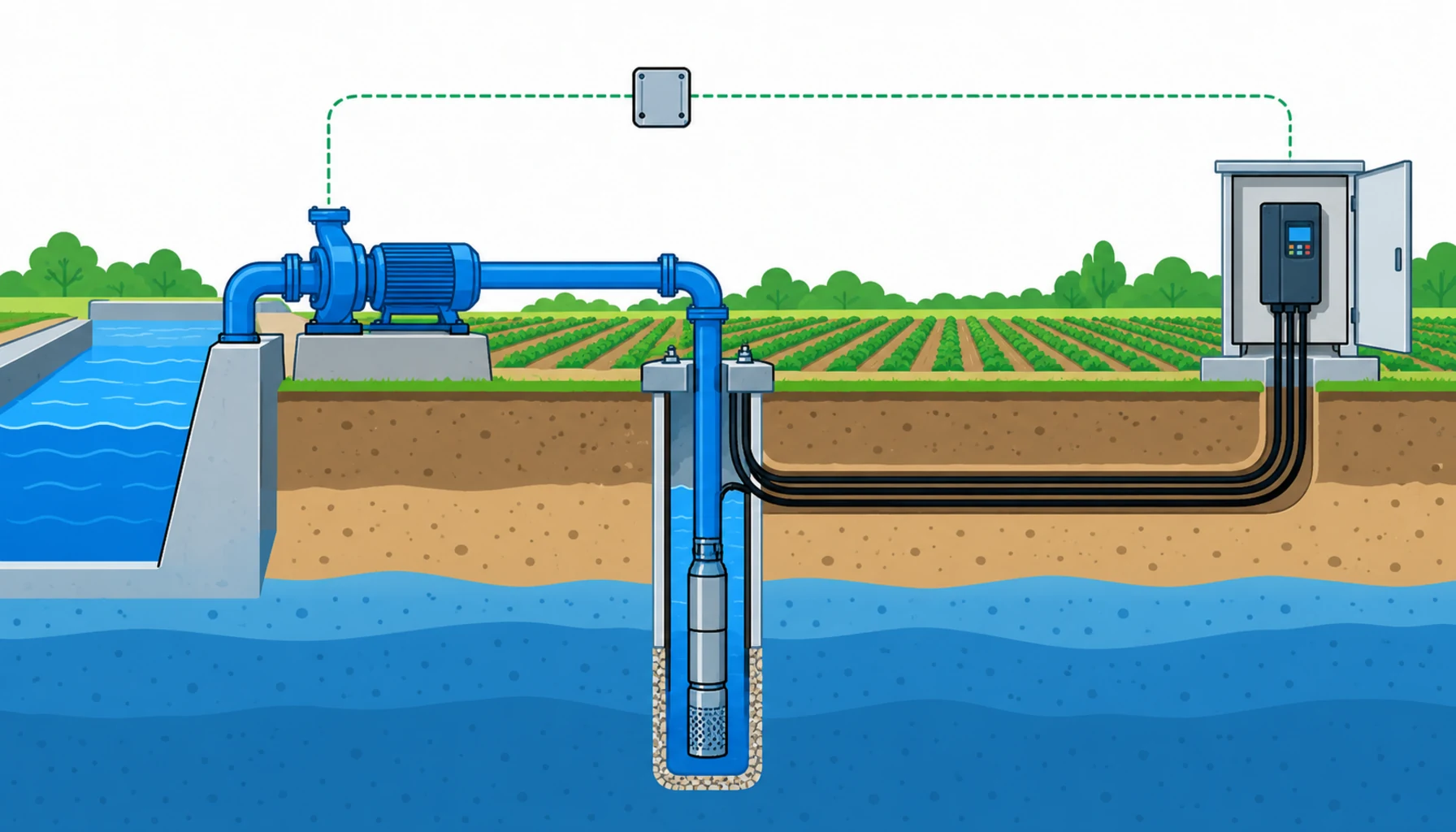
Quick Answer: Irrigation pumping fails on cable before it fails on pumps. The loads sit far from supply, run through a compressed season, and combine three circuits: a feeder to the pump station, a submersible drop down the well, and control lines back to whoever runs the water. Specify the three separately, size the buried runs for soil and frost, and treat the VFD feed as its own problem, not a fat feeder.
Introduction
This page covers the cable side of irrigation and water pumping projects in the region: how the circuits divide, what submersible drops and buried runs need, where VFD duty changes the specification, and what to freeze in an RFQ so a season does not wait on a missing drum.
The regional buying context sits in our Central Asian cable buying hub. Two neighbours share ground with it: cable for mine dewatering feeders is a heavier, deeper discipline, covered in our note on mine pump and ventilation feeders, and cable that rides on field machinery is covered in agricultural robot cable.
Why Irrigation Duty Is Its Own Specification Problem
Distance comes first. A pump station draws supply through a feeder that may run for kilometres, and a well head may sit hundreds of metres from the panel that starts it. Voltage drop, not ampacity, sets the cross-section on most of these runs, and a feeder sized from the nameplate alone stalls the pump in July.
Season is the second fact. The system stands idle for months and then runs around the clock, and the faults that surface in week two are the unscheduled ones: a joint that took moisture over the winter, a sheath cracked by soil movement, an enclosure breathing dust and irrigation spray. Cable here is specified for the standing months too.
Ground is the third. Buried routes cross soil that swells and shrinks between irrigation and drought, frost that reaches well below the trench in the north, and backfill that was never the bedding the drawing asked for. The failure patterns that follow are predictable.
Mapping the Circuits: Feeder, Drop and Control
A pump scheme divides into three cable duties, and mixing them on one specification line is the most common early mistake. The feeder carries station power from the point of supply, usually medium voltage over distance. The drop carries power down the well to the submersible motor, wet for its whole life. The control layer carries signals, readings and telemetry back to the operator.
Each duty has a different owner too. The feeder follows the electrical design and the utility connection rules; the drop follows the pump manufacturer’s requirements and the well report; the control layer follows whoever integrates the automation. A package that keeps the three apart gets quotable lines from each supplier instead of one bundled price nobody can defend.
The mapping also decides evidence. The feeder needs routine test reports and, on medium voltage, type tests against the network standard. The drop needs wet-rated construction with a declaration for continuous immersion. The control layer needs shielding and segregation rules that keep a level signal honest next to a drive. Table 1 lines the duties up against their checks.
Submersible Drops and the Well Head
The drop works immersed, often warm from the motor, sometimes in mineral-laden water. Construction is a specialised submersible range with compounds rated for continuous immersion, and the family we supply is on our submersible pump cable page. The order is cut to the well, not to the pump depth quoted from memory.
The well head is where drops die. The cable exits the well, crosses the pit and meets the starter, and every transition invites mechanical damage and water travel. The joint to the motor lead is a wet joint that belongs to a kit and a trained fitter, not to a taped field splice, and it is the most common warranty argument on the duty.
Freeze three lines: the drop is continuous and unjointed below the well head; the cable is anchored so its weight hangs on the anchors, not on the joint; and the spare coil sits above flood level, not on the ground beside the casing. A well rewound for a joint that planning would have avoided is a season lost.
Buried Runs: Depth, Bedding and Frost
The buried feeder and control route fail from the ground they sit in. Depth protects against farm machinery, and the machinery that will actually cross the route sets it; a route under a farm track and one under ploughed land do not share it. The drawing must carry depth, bedding and marking tape together, so the excavation quote and the cable quote describe the same trench.
Bedding is the insurance buyers delete first. Selected backfill under and over the cable, on a compacted base, keeps a stone in the fill from loading the sheath year after year. The moisture behaviour of buried and semi-buried routes, and the inspections that catch it early, are set out in our note on wet sites and cable condensation.
Frost belongs in the north and in any route crossing a culvert, where water collects and freezes in a lens. Sheath compounds for cold duty are compared in our note on buying cold-resistant cable for Kazakhstan; the short point is that the compound is chosen for the standing months, because installation happens once and winter happens every year.
VFD Feeds and Voltage Drop on Long Runs
Most new pumping capacity arrives with variable frequency drives, for energy and for soft control. A VFD feed is not a feeder with a bigger number: the drive chops the waveform, the cable sees steep voltage edges for its whole length, and the reflected wave at the motor end stresses insulation the ordinary feeder never meets.
Sizing follows the run. On long feeders the cross-section is set by voltage drop at starting and running current, with derating for soil resistivity and grouping applied from the start; the method is the one in our note on cable derating factors. Screening and the drive maker’s maximum motor cable length close the loop, and a run beyond the limit is answered before the order.
Starting method is a procurement decision with a cable consequence. Across-the-line starting buys the biggest starting drop; a soft starter or a drive buys it back. The trade-offs are set out in our note on VFD versus soft starter, and the practical point is that cross-section, drive limits and starting method are one calculation that one party must own.
Control, Telemetry and the Remote Station
Irrigation schemes are run from panels and increasingly from phones, and the control layer carries that: start and stop, level and pressure, flow totals and alarms. The duty is small in copper and large in consequence, because a control fault at a remote station costs a crew a drive and a day before anyone notices.
Specification is mostly discipline. Shielded control constructions, segregated from power runs, earthed per the design, and routed away from the drive output the way the manual insists. Control families and core counts for plant duties follow the same segregation logic as any plant mixing signals with power.
The remote station deserves a line of its own: spare cores, labelled, for the signal added next year. Expansion at an irrigation station is routine; trenching back to it is not, and the marginal cost of cores on the original drum is a rounding error against mobilising a trenching crew twice.
Buying for the Season: Lengths, Spares and Delivery
The season is a deadline the whole scheme can see. Cable arriving after the watering window converts a good specification into a dry field, so the order plan starts from the installation sequence: drop lengths and well heads first, feeder drums to match the trenching crew, control last with the panel work. Lead time per position is committed in the order, not assumed.
Spares for this duty are short and specific: a drum of the common drop size, joint kits for the well heads, a length of feeder for the repair machinery will eventually cause, and the glands and anchors that turn a repair into an hour. Programmes that stock drum ends of everything stock copper instead of availability; the buying discipline is in our note on the industrial cable RFQ checklist.
Sourcing country by country is covered in our note on buying power cable for Uzbekistan, with quotations compared on one envelope of length, construction, tests and delivery. Table 2 is the freeze list that makes the comparison honest before the first offer lands.
The Circuit Duty Map
Table 1 lines up the three circuit duties of a pump scheme against construction, the governing input and the check that decides the order.
| Circuit Duty | Typical Construction | Governing Input | Evidence to Demand |
|---|---|---|---|
| Station feeder | MV over distance, LV inside the fence | Voltage drop at starting and running current | Routine tests; type tests on MV |
| Submersible drop | Wet-rated submersible range, cut to well depth | Continuous immersion and well report | Wet rating declaration, unjointed length |
| Buried route | Sheath for soil and frost, bedding specified | Soil, traffic above, frost line | Depth, bedding and marking on the drawing |
| VFD motor feed | Screened construction within drive limits | Drive maximum cable length, dV/dt | Screening spec and drive compatibility note |
| Control and telemetry | Shielded control cores, segregated routing | Signal integrity next to power | Segregation and earthing design sheet |
The Irrigation RFQ Freeze List
Table 2 is what to settle before the enquiry goes out, because these lines are the difference between a quote that fits the scheme and a price that fits nothing.
| Item to Freeze | How to Write It | Evidence to Attach | Cost of Leaving It Blank |
|---|---|---|---|
| Circuit split | Feeder, drop and control as separate lines | Single line diagram with route lengths | A bundled price nobody can defend |
| Drop lengths | Per well, from the well report, not memory | Well constructor's report per site | Joints in the wet that need not exist |
| Trench standard | Depth, bedding and marking tape on one drawing | Excavation detail with cross-section | A trench quote and a cable quote that disagree |
| VFD limits | Drive maximum motor cable length, per drive | Drive datasheets and layout | A motor feed that fails at commissioning |
| Sizing basis | Voltage drop method with derating factors named | Calculation sheet per route | A feeder that stalls the pump in July |
| Spares list | Drop drum, joint kits, feeder length, glands | Spares schedule with storage points | A season lost to a one-hour repair |
| Delivery sequence | Drums staged to the installation order | Delivery plan against the watering window | Cable on site after the season it serves |
When Buying on the Pump Vendor's Paper Is Not the Answer
When the drop is quoted from pump depth. The pump hangs at one depth and the well tells the truth about the rest. A drop cut from the pump schedule leaves either a splice in the wet or a coil of paid-for cable at the well head, and the well report is the document that ends the argument.
When the feeder is sized from nameplate current. Nameplate current sizes the motor, not the kilometre in front of it. Without the voltage drop calculation and the soil derating, the quote is a number, not a design, and the shortfall surfaces at the first hot start of the season.
When the trench is someone else’s problem. A cable specification that ignores depth, bedding and marking hands the failure back through the ground itself. The cable quote and the excavation quote have to describe the same trench, in the same documents, before either is signed.
When the control layer is drawn last. Cores, screening and segregation decide whether the station runs from the panel or from a phone call to whoever is nearest. A control layer improvised at commissioning is a permanent cost charged to every season after it.
When spares are bought by the metre. A shelf of random drum ends is copper, not availability. The spares that restart a pump station are kits, glands and one drum of the right size, staged where the failure happens.
RFQ Checklist
- Circuit split stated: feeder, submersible drop, buried route, VFD feed, control
- Drop lengths per well, taken from the well constructor’s report
- Unjointed drop requirement and wet-rating declaration per supplier
- Trench standard drawn once: depth, bedding, marking tape, shared by both quotes
- Voltage drop calculation per route with soil and grouping derating named
- Drive maximum motor cable length and screening noted per drive
- Control core schedule with spare cores and segregation routing
- Cold-duty sheath compound confirmed for routes standing through frost
- Spares schedule: drop drum, joint kits, feeder length, glands, anchors
- Delivery plan staged to the installation sequence and the watering window
Conclusion
Irrigation cable is bought against three circuits and one deadline. The feeder is a voltage drop calculation, the drop is a wet-rated length cut to the well report, the control layer is segregation discipline, and the season is the date every drum is measured against. A package that keeps those lines apart is quotable, checkable and repairable; one that bundles them is a price waiting to disappoint a field.
Kexingyu Cable Group (KXYE) supplies irrigation and pumping programmes with the submersible, buried and control ranges in one schedule, sized to the well reports and route lengths you hold. Send the single line diagram and the watering window. A request for quotation is the fastest start.