Telecom Towers and Network POPs in Central Asia: Power Cable Procurement
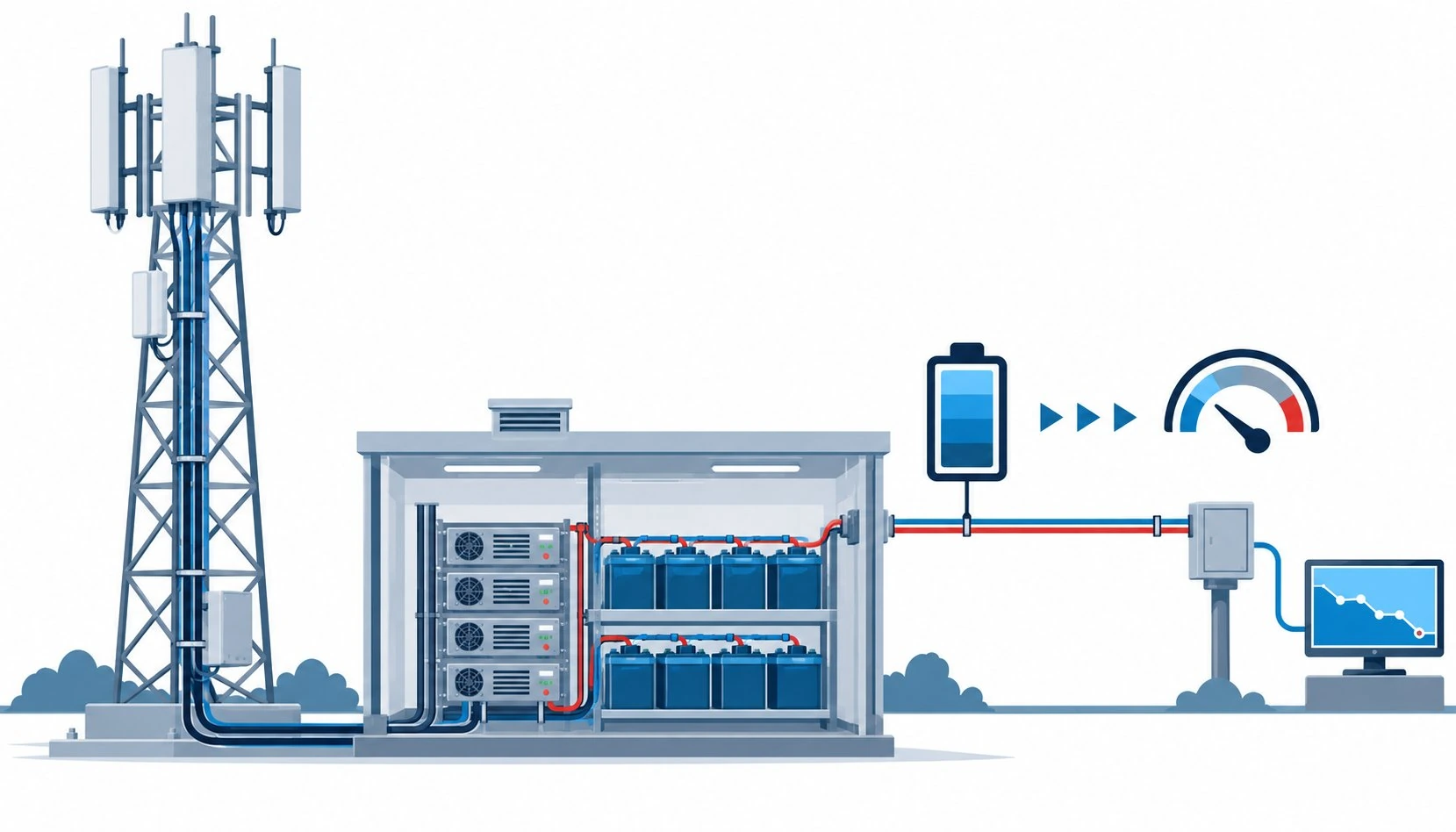
Quick Answer: A telecom network is a cable programme multiplied by site count. Each tower and POP repeats the same small power system, grid feed or hybrid supply, DC plant, battery strings and an equipment room, and the cable is bought once as a design and a hundred times as a kit. Specify the standard site so its cable lines are identical everywhere, protect the tower runs and the battery room properly, and stage deliveries so a repeat order is a release, not a new project.
Introduction
This page covers the power cable side of telecom towers and network POPs in the region: how a standard site divides into circuits, what off-grid and hybrid sites add, what tower exposure and battery rooms demand, and how repeat buying works when the programme scales past the first ten sites. It is written for the operator, the tower company and the rollout contractor buying the cable.
The regional buying context sits in our Central Asian cable buying hub. Data halls are a different discipline with bigger loads and different codes; the small end of that world, and where it meets this one, is described in our note on edge data center cable. This page stays with the network outside the data hall, where the loads are small and the distances are the problem.
Why Site Power Is a Procurement Topic of Its Own
Volume is the first fact. A rollout does not buy cable for a site; it buys cable for a hundred sites, and the decisions are multiplied by every one of them. A sheath chosen wrong costs a drum in a warehouse; chosen wrong in the standard design, it costs a truck roll per site per year.
Distance is the second. Sites sit where coverage needs them, not where the grid is convenient, so the feeder can be long, the terrain is everything from steppe to city duct, and the crew is often the most expensive resource on the programme. Cable bought as a kit that fits the site saves crews; cable bought by the drum creates them.
Remoteness is the third. A fault at a base station is a drive, and in the region the drive can be a day. The cable decisions that matter are the ones that prevent truck rolls: terminations that survive the seasons, runs that shrug off the weather, and battery cabling that does not fail first when the grid blinks.
Mapping the Standard Site
The standard site divides into five cable duties. The AC feed runs from the grid connection or the generator to the rectifier plant. The DC plant runs rectified power to the equipment at 48 volts or similar, in cable sized for current that surprises buyers used to AC. The battery strings connect to the DC plant with short, heavy runs. Tower equipment, radios and lights, feeds up the structure. Monitoring and control ties the site back to the network operations centre.
The DC runs are the specification centre of the small site, because low voltage DC carries high current at low tolerance. Voltage drop that a mains circuit would shrug off steals runtime and trips radios, so cross-sections are set by the drop budget from battery to load, not by a table habit. The sizing logic is the same one set out in our note on UPS and battery cable sizing, and the tolerance is tight on both.
Mapping also fixes the kit. Each duty has its own terminations, its own protection and its own test, and the standard site is standard precisely when those are written down per duty and procured as lines. Table 1 lines the five duties up against construction and evidence, and Table 2 turns them into the freeze list for the programme RFQ.
Off-Grid and Hybrid Sites
A share of sites in the region run partly or wholly off the grid, on generator sets, solar arrays or both, and the hybrid site multiplies the cable map. Generator feeders, solar array cabling, charge controllers and the AC switching between sources all add circuits, and each adds the same question: what does this circuit see on its worst day, and is the construction rated for it.
The generator feed is the most abused line on hybrid sites. It carries starting surges, runs through weather, moves slightly every service visit, and terminates in a cabinet that breathes dust. The temporary power analogue on construction sites, where the same abuse pattern is studied, is described in our note on site generator cable, and the discipline transfers directly to permanent hybrid sites.
Solar array cabling follows its own standard and its own supplier checks; the tower company buying PV cable for sites is buying a product class with a mature buying literature. The hybrid switchboard that ties sources together is switchgear with a telecom budget, and its cable lines answer to the same evidence discipline as any switchboard.
Towers: Vertical Runs and Exposure
The tower run is a cable environment of its own: vertical, exposed, ultraviolet at the top, icing in the northern winters. Power and fibre share the climb, and the routing plan that keeps them separated, supported and out of the antenna crew’s way is a design document, not a site improvisation.
Construction follows exposure. Outdoor rated jackets, UV performance at height, fixings that do not chew the sheath in wind, and drip loops at every entry are the basics; the ground-level analogue for buried and exposed comms runs is set out in our note on underground lighting and comms cable. What the tower adds is height, and every termination at the top pays for the climb.
Lightning belongs in the same conversation. The tower is the structure that gets hit, the down-conductors and bonding do the defending, and the cable routes either respect the bonding plan or become part of the fault path. The bonding verification habit is one the tower crew should carry up the climb with them.
POPs and Equipment Rooms: Batteries and Heat
The POP is the small cousin of the data hall: a room or cabinet with rectifiers, batteries, distribution and the transmission gear that actually earns the revenue. Its cable specification is dominated by the battery room, where short heavy runs, torque-checked terminations and protection against a dropped tool are the difference between a maintenance item and an outage.
Battery cabling discipline is written down and rarely read. Runs short and equal per string, terminations torqued and marked, protection sized for the fault a string can deliver, and routes that keep a shorted span from becoming a fire; the sizing logic is the one already cited on the DC runs. The UPS world that matured this discipline is described in our note on choosing an industrial UPS manufacturer.
Heat is the room’s other constant, because a POP that cools badly ages everything in it, cables included. Temperature classes for the room’s ambient, derating where cabinets cluster, and sheaths that tolerate the dust a ventilated room admits; the rectifiers set the climate, and the cable lives in it.
Monitoring, Control and the Remote Site Problem
Every site reports to a network operations centre, and the monitoring layer carries that report: power alarms, battery state, door and temperature, and the control lines that let a technician act before the drive. The duty is small in copper and decisive in cost, because the monitoring cable that fails silently is the one that hides every other fault until the site is dark.
Inside the site, control and signal cable follows the same segregation and shielding discipline as any plant that mixes power with signals; control families for the duty are described in our note on KVV control cable. Legacy voice runs inside buildings and older POPs still use HYV, a different duty with its own buying guide in our note on HYV telephone cable for building networks.
The remote site problem is solved with spare cores and standard kits, not with heroics. A monitoring cable specified with spare pairs, terminated to a written standard, and repaired from the kit in the shelter, turns a day’s drive into an hour’s work by whoever is nearest. The kit list is a procurement line, and it belongs in the programme RFQ beside the drums.
Buying at Scale: Repeat Sites, Kits and Delivery
Programme buying starts from the standard site design. When the five duties, their constructions, lengths and terminations are frozen in one document, every site order becomes a release against a framework rather than a project. The operator’s savings come from repetition done deliberately.
Kits are the repeat site’s real product. A site kit holds the AC feed length, the DC runs, the battery set, the tower drop and the monitoring pairs, plus glands and labels, packed per site and delivered against the rollout schedule. The RFQ discipline that keeps a kit-based package comparable is the one in our note on the industrial cable RFQ checklist, adapted from drums to kits.
Country sourcing is covered in our notes on buying power cable for Uzbekistan and the neighbouring guides, and the programme version of the comparison rule is stricter: one envelope of construction, tests, kit contents and delivery per wave, against which every offer is read. Table 2 is the freeze list that builds that envelope.
The Site Duty Map
Table 1 lines up the five cable duties of a standard site against construction, the governing input and the evidence that decides the order.
| Circuit Duty | Typical Construction | Governing Input | Evidence to Demand |
|---|---|---|---|
| AC feed | LV cable, outdoor rated to the cabinet | Source distance and weather | Routine tests, UV rating |
| DC plant runs | Heavy LV copper, drop-budget sized | Voltage drop from battery to load | Sizing calculation per run |
| Battery strings | Short equal runs, protected routes | Fault risk and equal sharing | Torque and test records |
| Tower runs | UV rated jackets, supported climb | Exposure and bonding plan | Routing sheet, bonding check |
| Monitoring | Shielded pairs with spares | Signal integrity and repair speed | Core schedule, kit list |
The Telecom Programme RFQ Freeze List
Table 2 is what to settle before the programme enquiry goes out, because these lines decide whether site one hundred is cheaper than site one.
| Item to Freeze | How to Write It | Evidence to Attach | Cost of Leaving It Blank |
|---|---|---|---|
| Standard site design | Five duties with lengths per site type | Standard site drawing set | A hundred bespoke sites |
| DC drop budget | Millivolts from battery to load, per run | Sizing calculation sheet | Runtime lost to a table habit |
| Battery discipline | Equal runs, torque and protection stated | Termination and test records | A maintenance item that becomes an outage |
| Tower routing | Support, separation and drip loops drawn | Routing sheet per tower type | Terminations made twice by the climb |
| Kit contents | Per site type, glands and labels included | Kit list per site | Truck rolls to fetch a gland |
| Hybrid lines | Generator and PV cables as separate duties | Source ratings and schedule | One abused feeder per site |
| Wave delivery | Kits staged to the rollout schedule | Rollout plan with site dates | A warehouse instead of a network |
When Treating Sites as Projects Is Not the Answer
When every site is engineered fresh. A network is a repeated design, and re-engineering it per site multiplies every mistake and every negotiation. The standard site, frozen once and varied only where the site forces it, is the whole economic argument of a rollout programme.
When DC runs are sized by habit. Low voltage DC at radio loads tolerates millivolts, not table habits. A run sized without the drop budget steals battery runtime and trips radios at the edge of the site’s worst day, and the correction costs copper that was cheaper at the order.
When the battery room is treated as finished furniture. Battery strings deliver fault currents that the cabling and protection must carry by design, not by luck. Torqued, marked and protected terminations, checked on a schedule, are the difference between a maintenance line and a site fire.
When tower cable is terminated without a plan. Every termination at height is made twice as expensive by the climb, and every routing shortcut is revisited by the next antenna crew. The routing sheet and the bonding plan are design documents, and the crew should carry both.
When kits are assembled from drums. A site built from drum ends consumes crews, not cable. The kit, packed per site with glands and labels, is what makes site one hundred cheaper than site one, and the kit list is a procurement document.
RFQ Checklist
- Standard site design frozen: five duties with lengths per site type
- DC drop budget stated in millivolts, battery to load, per run
- Battery discipline written: equal runs, torque, protection, records
- Tower routing sheet per tower type, with bonding interface named
- Hybrid site duties separate: generator feed, PV array, switching
- Monitoring pairs with spare cores and a written termination standard
- Kit contents per site type, glands and labels included
- Evidence list per duty: routine tests, UV ratings, sizing sheets
- Framework terms for repeat releases against the standard design
- Wave delivery staged to the rollout schedule, kit per site
Conclusion
Telecom power cable is bought as a programme, not a site. The standard design fixes the five duties, the DC drop budget fixes the copper, the battery room and the tower fix the discipline, and the kit fixes the cost curve. Rollouts that write this down scale cheaply; rollouts that improvise it buy the same lessons a hundred times, one truck roll at a time.
Kexingyu Cable Group (KXYE) supplies telecom programmes with standard-site kits, DC and battery lines, tower runs and monitoring pairs in one framework, staged to your rollout waves. Send the standard site design and the site count. A request for quotation is the fastest start.