
Gas Chemical Complexes in Turkmenistan: Cable for Harsh Process Environments
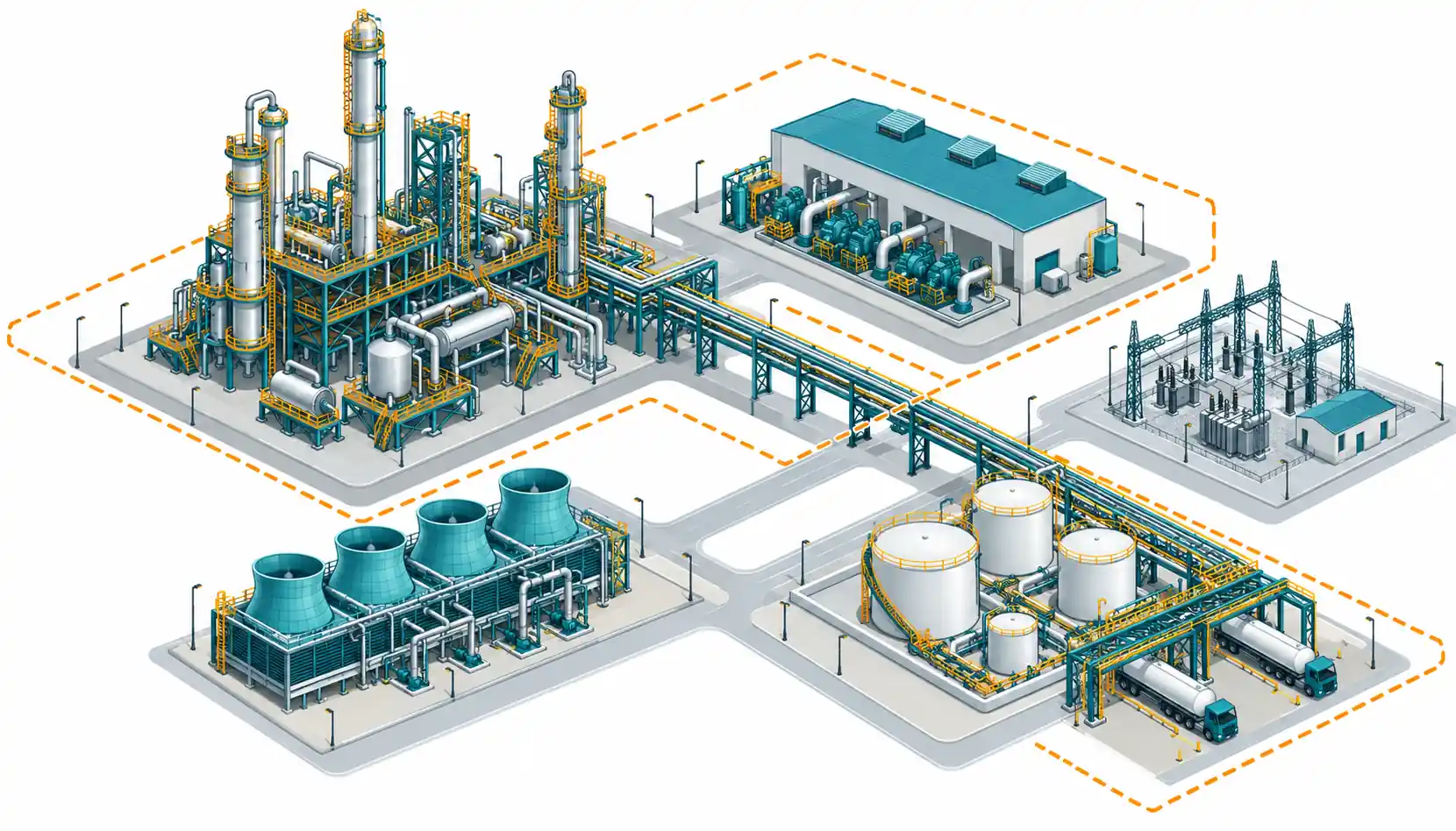
Quick Answer: In a gas chemical complex the cable question starts with the hazardous area drawing, not with the load list. Which zone a run passes through decides the gland, the sealing at the boundary and sometimes the sheath; the process chemistry decides whether a standard compound survives; the compressor house decides how the cable is supported; and the outdoor heat decides the section. Get the zoning, the chemistry and the ambient into the enquiry, and the rest follows. Order on the load list alone and you will buy a plant cable that is correct in the substation and wrong everywhere it matters.
Introduction
Turkmenistan’s gas is converted into methanol, ammonia and urea in complexes that were built in stages, often with a foreign process licensor and a local construction contractor. The cable schedule in those projects is usually written by the licensor’s electrical department for a European yard, then reissued at site with substitutions that nobody documented.
This guide is for buyers, plant engineers and distributors supplying cable into gas chemical projects in Turkmenistan. It covers the zoning logic, the five areas that decide the product, what hydrocarbons and ammonia do to a bedding, compressor vibration, outdoor heat, and the fields to freeze before the order. The instrumentation side of the same plant is covered in our note on instrumentation and control cable for Turkmenistan.
The Hazardous Area Drawing Comes Before the Cable List
A zone is a property of the route, not of the circuit. The same feeder can leave a safe substation, cross a zone 2 area for thirty metres and terminate in a zone 1 pump house, and each of those three sections has a different requirement at the gland.
The boundary is where the money is. Sealing at the transition from a hazardous to a safe area is a documented item, with a certified gland or a barrier, and it is the item most often left out of a reissued schedule. Ask for the drawing that shows where the boundary is.
Zone documentation travels with the cable order. Certificates for glands, a statement of the cable construction, and a drawing showing which circuit passes through which zone belong in the same package. If the offer does not reference the zoning drawing, it cannot be checked.
Most cable in the plant is not in a hazardous area. Utilities, cooling water, the workshop and the substation are ordinary industrial work, and treating them as process areas doubles the cost for no benefit. Read the drawing both ways.
Five Areas That Decide the Cable
Process unit and pipe rack. Hydrocarbon in the air, hot piping, and trays that run above equipment which is opened during maintenance. This is where the sheath, the armour and the gland standard are set.
Compressor house. Continuous vibration, oil mist, and a noise level that makes inspection unpleasant. Flexible connections at the machine, and a sheath that resists oil, matter more than the section.
Cooling tower and water treatment. Wet, warm, and chemically dosed. Cable in this area sees the same problems as a municipal plant, with the addition of a process that cannot be shut down for a cable replacement.
Tank farm and loading gantry. Outdoor, zone-classified at the vent and the loading arm, and exposed to sun, dust and the occasional hydrocarbon spill. UV resistance and a sheath that tolerates product contact belong in the specification.
Substation and central control room. Standard medium voltage and building services, plus the fire-rated circuits that have to survive long enough to shut the plant down. That last group is described in our note on fire alarm and emergency lighting cable.
Cable by Process Area
The table sets out the areas that appear in most gas chemical enquiries, with the decision each one forces.
| Area | What to Declare | Evidence to Ask For | Cost and Lead Time | Risk If Left Open |
|---|---|---|---|---|
| Process unit and pipe rack | Zone classification along the route, hydrocarbon contact, ambient near hot piping | Certified gland data plus sheath resistance to the product | Premium sheath and glands, longer slot | Uncertified gland at the boundary, noted at the safety audit |
| Compressor house | Vibration, oil mist, machine connection type | Flexible conductor class and oil resistance data | Moderate, fewer sources for the flexible grades | Strand breaks at the machine terminal |
| Cooling tower and water treatment | Humidity, chemical dosing, washdown, corrosion at the supports | Corrosion and water blocking data | Standard sections, corroded supports are the cost | Earth faults after a few seasons in the plume |
| Tank farm and loading gantry | Zone at the vent and the arm, UV, spill exposure, outdoor ambient | UV and hydrocarbon resistance, plus gland certification | Outdoor construction, longer slot | Sheath cracking on the sunny side within a few years |
| Substation and control room | Voltage class, fire-rated circuits, cable penetration sealing | Type test report and fire test where required | Standard, with the fire-rated lines the expensive part | Shutdown circuits lost in the event they exist for |
Hydrocarbons, Ammonia and What Reaches the Bedding
The product, not the word “chemical”, decides the compound. A condensate spill, an ammonia release and a methanol leak attack different materials, and a sheath that resists one may soften in another. The list, with concentration and temperature, is what allows a compound to be offered with data behind it; the method is in our note on chemical exposure and cable selection.
Ammonia is the one buyers underestimate. It is a small molecule, it finds its way into a bedding, and it attacks some copper alloys at terminations. In the urea and ammonia areas the sheath and the termination materials are a pair, and both belong in the specification.
Hydrocarbon resistance is a family decision. Cables that may see oil or condensate are usually specified from one family across the plant so that a substitution at site cannot introduce a compound that swells. The range is on our oil resistant cable page.
The scrubber and sewer side is a separate chemistry. Sulphur, spent caustic and acidic condensate give a different answer from the process itself, and the corrosion-resistant constructions for that duty are on our corrosion resistant cable page.
Compressors, Vibration and the Moving Connection
A compressor house is a vibration problem with a cable in it. Machines are mounted on frames that move a little, and the cable between the frame and the fixed tray has to absorb that movement without loading the strands. A flexible conductor class and a loop at the entry do most of the work.
Oil mist coats everything. Sheaths swell or harden depending on the compound, and glands that rely on a soft seal degrade faster than the cable. In a house where the mist is continuous, the gland is often the first failure.
Support the run, do not hang it. Long vertical drops inside a compressor house are common, and a cable supported only at the top carries its own weight on the armour in the same way as a shaft run. The selection logic is in our note on steel wire armour selection.
Heat, Weather and the Outdoor Runs
Outdoor ambient in Turkmenistan is not a European design case. A tray in full sun runs well above air temperature, and a run above hot piping adds radiation on top. Ask for the ambient at tray height in summer, and derate against it; the method is in our note on cable derating factors.
Sun destroys the wrong sheath quickly. UV stabilised compounds exist for exactly this, and a cable bought for an indoor plant and installed on a pipe rack will crack on the exposed side first. It is a visible failure and an avoidable one.
Dust and sand are abrasive. Wind-blown sand works at glands and cleats, and it abrades a sheath at every support over years. Spacing supports to reduce movement helps more than a harder compound does.
Spares, Shutdown Windows and the Cable Store
A gas chemical complex cannot stop for a cable. Turnarounds are planned years ahead, so any cable replaced between them has to be cut in on a live plant or deferred to the next window. That reality turns a small spare allowance into an operational necessity rather than a luxury.
Buy spare drums of the circuits that fail most. Lighting and small power in the wet areas, compressor connections and the loading gantry account for most of the unscheduled work. One drum of each, stored indoors and labelled with its construction, removes the temptation to substitute something from the workshop.
Lead time is set by the special constructions, not the standard ones. A hydrocarbon resistant or fire-rated line usually carries a longer slot than the catalogue suggests, and the quantity that triggers a production run may be lower than expected. The mechanics are set out in our note on cable MOQ and lead time.
Storage is part of the specification. A drum that stood in the yard through a summer of dust and sun arrives at the pull with a degraded outer sheath, and the argument about who caused it takes longer than the replacement. Name the storage condition in the order.
Gas Chemical Cable Order Freeze List
These are the fields to settle before the purchase order is placed.
| Item to Freeze | How to Write It Into the Order | Evidence to Attach | Cost of Leaving It Blank |
|---|---|---|---|
| Zoning per route | Zone and boundary marked against every circuit | Hazardous area drawing with the cable route overlaid | Uncertified gland where the route leaves the zone |
| Gland certification | Gland type, certification and sealing method named | Certificate matching the zone and the cable | Safety audit finding and a late replacement |
| Product chemistry | Fluid list with concentration and temperature | Resistance data for the compound offered | Swollen sheath within a year of a spill |
| Ammonia areas | Sheath and termination materials named together | Data covering both the sheath and the lug | Corroded terminations in the urea unit |
| Vibration at machines | Flexible class and entry arrangement stated | Conductor class and a support detail | Strand breaks at the compressor terminal |
| Outdoor and UV exposure | UV resistant construction named for every outdoor run | UV test data for the compound | Sheath cracking on the sunny side |
| Fire-rated shutdown circuits | Circuits named with duration and test category | Report naming the construction and duration | A shutdown sequence that cannot be completed |
When a Standard Plant Cable Is Not the Answer
When the offer names no gland. In a classified area the cable and the gland are one assembly in practice, and an offer that quotes cable only shifts the certification problem to the site. Buy them together or not at all.
When the route crosses a zone for a few metres. A short crossing is still a classified length, and the sealing requirement does not scale with distance. Either reroute the run or specify the boundary properly.
When the plant runs a product that changes. A complex that switches feedstock or adds a unit changes the chemistry in the same trays. Recheck the sheath against the new fluid list rather than assuming the earlier specification still holds.
When the drums will stand in the sun for a season. Storage in a gas chemical yard is often open, and a UV-stabilised sheath is only part of the answer if the drum lagging holds water. Phase deliveries to the pull.
RFQ Checklist
- Hazardous area drawing issued with the cable schedule
- Zone and zone boundary marked per circuit, with the crossing length
- Gland type and certification included in the same enquiry
- Fluid list with concentration and temperature for every process area
- Ammonia and urea areas identified, with termination materials named
- Compressor connections listed with the required conductor class
- Outdoor runs listed with UV exposure and summer ambient at tray height
- Fire-rated shutdown circuits named with duration and test category
- Support and clamp details given for long vertical drops
- Packing and storage instructions matched to the site’s storage space
- Test documents per drum, naming the construction supplied
Conclusion
Gas chemical projects buy a lot of ordinary cable, and a small amount where the environment is genuinely dangerous. The dangerous part is decided by a drawing most buyers never open: the hazardous area plan. Read it, mark the crossings on the schedule, and buy the gland with the cable. The chemistry and the heat then become ordinary specification work instead of site surprises.
Kexingyu Cable Group (KXYE) supplies hydrocarbon resistant, corrosion resistant and UV stabilised constructions, medium voltage feeders and fire-rated shutdown cable from Quanzhou, and quotes gas chemical enquiries against the zoning drawing as issued, with test documents per drum. Send the area classification drawing with the cable schedule, or upload both. A request for quotation is the fastest way to start, the enquiry format is in our industrial cable RFQ checklist, and the country picture is in the Turkmenistan supplier guide.
Recent Posts
Измерительные и контрольные кабели для Казахстана: решение для промышленных закупщиков, подрядчиков и дистрибьюторов
Измерительные и контрольные кабели для Казахстана: решение для промышленных закупщиков, подрядчиков и дистрибьюторов Коротко о главном: кабель управления передаёт команды и сигналы переключения — пуск
Dây dẫn xây dựng BV/BVR cho Việt Nam: Giải pháp cho nhà phân phối, nhà thầu và đơn vị thu mua
Dây dẫn xây dựng BV/BVR cho Việt Nam: Giải pháp cho nhà phân phối, nhà thầu và đơn vị thu mua Trả lời nhanh: Với