Buying Instrumentation and Control Cables for Turkmenistan Projects
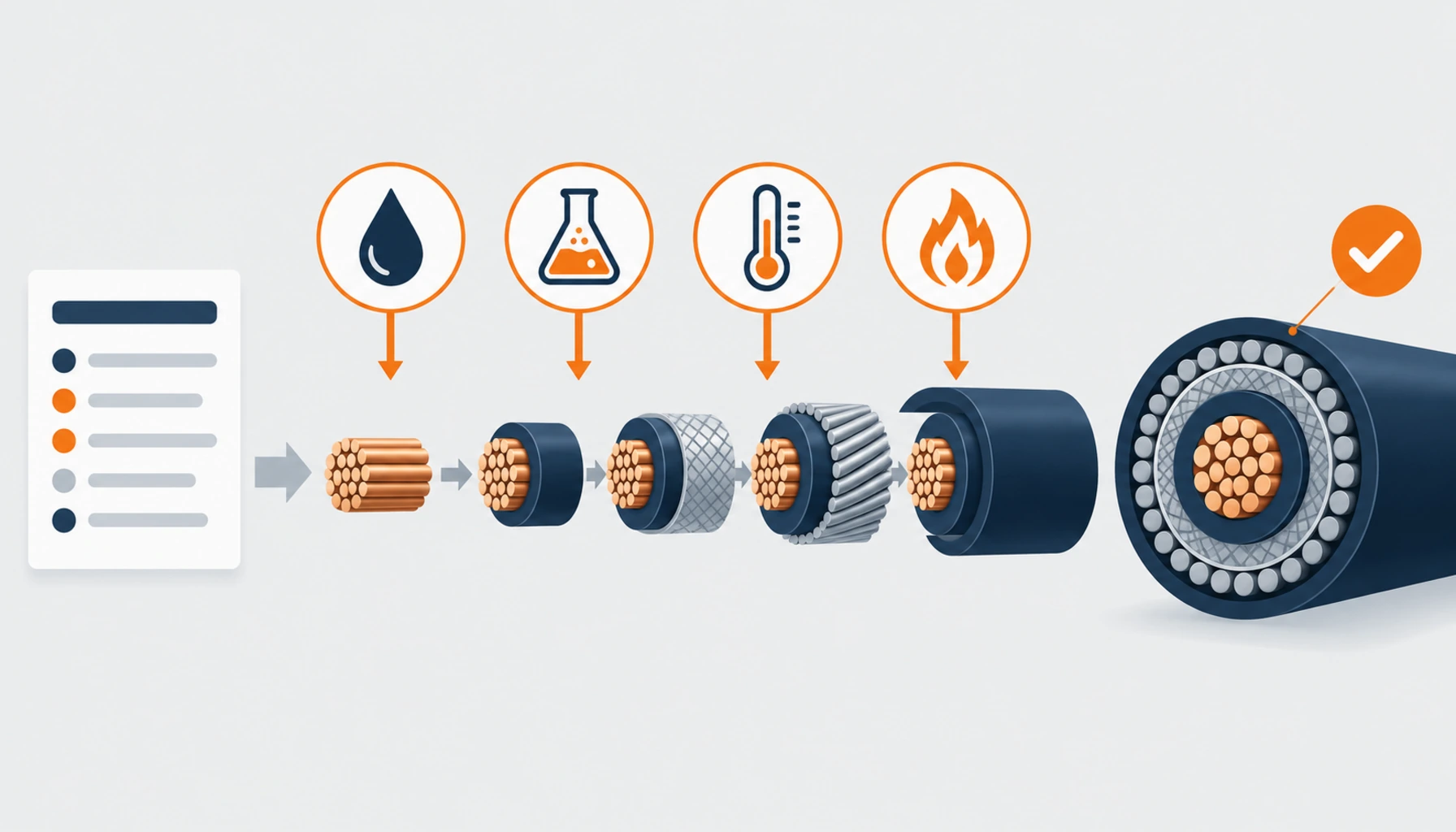
Quick Answer: Instrumentation and control cables for Turkmenistan’s industrial projects are bought against the environment they will live in, and the environment is specified in names and numbers, not adjectives. The cables that last carry the right cores and pairs, the screening the signals need, armour and sheath matched to the route, compounds proven against the specific oils, chemicals and temperatures present, fire requirements specified as their own line, and terminations designed with the cable rather than after it. This guide walks that specification path, and ends with what the RFQ must state so the quotes that come back describe the same product.
Introduction
Turkmenistan’s industrial landscape, hydrocarbon processing, gas chemistry, power and water infrastructure, puts instrumentation and control cables in some of the least forgiving company cable keeps: hydrocarbons on tray runs, washdown and condensation, summer heat over steel, and fire scenarios the facility’s own rules describe. The cables themselves are modest, small sections and small voltages, and their failures are disproportionately expensive, because the signals they carry are what the plant’s operators steer by.
This guide is for project buyers, EPC engineers and facility owners buying instrumentation and control cables for projects in Turkmenistan. It covers cores and pairs, individual and overall screening, armour and sheath against the route, specifying the oils, chemicals and temperatures by name, keeping fire requirements as a separate specification line, planning terminations, and assembling the RFQ data. The supplier preselection for Turkmenistan projects is covered by the industrial supplier checklist in this series, and the quotation stage that follows screening is covered by the quotation guides in this series. The distinction between the two cable families is set out in our note on control versus instrumentation cable, and the product families this guide applies to are shown in our control cable range.
Specify Cores and Pairs From the Signal Schedule
Control cores come from the termination schedule; signal pairs come from the loop list. The control cables’ multicore counts, sizes and spares follow the panel terminations, and the instrumentation cables’ pair counts follow the instrument loops, each pair carrying its signal or its group of signals. Both schedules exist before the cable is bought, and the RFQ attaches them, because a cable schedule that lives only in the buyer’s head produces quotations that live nowhere at all.
Pair discipline is the instrumentation cable’s core requirement. Signals travel in twisted pairs, with the pair’s construction, insulation and any individual screen chosen for the signal’s sensitivity and the interference it will meet. Where the plant’s loops mix sensitive measurement signals with switching transients in adjacent circuits, the pair construction carries more of the engineering than the conductor size does.
Spares are designed, not incidental. Spare cores and spare pairs, stated per cable in the schedule, are the cheapest expansion the plant will ever buy, and they are cheap exactly once, at specification. Cables ordered without spares expand by pulling new ones, through the same trays, at installation prices.
Name the Screening Arrangement and Its Earthing
Individual and overall screens are separate decisions. A screen on each pair protects the pair within the cable; an overall screen protects the whole cable from its routing environment, tray runs beside power circuits and the plant’s electrical noise. The two are often both required in industrial instrumentation, and the specification states which per cable, with the selection logic set out in our note on shielding and EMC selection.
The screen’s earth is part of the cable specification. Where the screen is earthed, at one end or both, and how the screen is brought out for the gland, decide whether the screening works as designed, and the termination hardware that keeps it effective is covered in our note on shielded connectors and EMC. The RFQ asks suppliers to state the screen bring-out per construction so the gland design can close before delivery.
Screen continuity is verified, not assumed. The quotation commits to screen continuity in the batch reports tied to drum numbers, and the plant’s commissioning reads against it. Screening that fails its first continuity check in the cabinet is a claim; screening that was never checked is a mystery that arrives months later wearing a process upset’s clothes.
Match Armour and Sheath to the Route
Armour answers mechanical exposure, and the route names it. Instrumentation and control cable runs along pipe racks, in trenches and ducts, and through areas where impact and rodent or termite exposure are real. Where the route requires armour, the type and sizing follow the threat, and the selection logic is set out in our note on steel wire armour selection; where it does not, the armoured premium is saved. The per-route decision is set out in our note on armoured versus unarmoured cable.
The sheath answers the chemistry the cable actually touches. Cable in these plants meets hydrocarbons, oils, cleaning agents, washdown and condensation, and sheath compounds differ in all of these. The specification names the exposures per route area, and the supplier answers with a compound and its evidence, because the trade space between compounds is real and is set out in our note on sheath materials compared.
Outdoor desert service adds its own requirements. Heat, UV and the temperature swing between day and night act on every exposed sheath, and the temperature class the cable is bought for is checked against the site’s realities rather than the datasheet’s headline, in the way our note on temperature class and site conditions sets out.
Specify Oils, Chemicals and Temperatures by Name
“Oil resistant” is not a specification until the oil is named. Compounds resist specific media: an oil-resistant sheath is proven against particular oils under particular test conditions, and resistance to one oil does not transfer to another, let alone to solvents, fuels or process chemicals. The RFQ lists the actual media the cable meets, the crude, condensate, lubricant, chemical or washdown agent, and the concentration and contact duration where known, and the supplier answers per medium with the compound and its test basis. The test logic is set out in our note on oil resistance testing.
Temperatures are named as operating, installation and excursion. The sheath that survives summer surface heat on a pipe rack still needs to install at the morning’s temperature and survive a process excursion or a steam trace, and each of the three is a separate line in the specification. Compounds answer all three differently, and the datasheet that carries one temperature figure for all uses is answering none of them.
Resistance to one medium is not resistance to the plant. This is the specification discipline that saves the most rework: oil resistance is not chemical resistance, chemical resistance is not solvent resistance, and none of them is a hazardous-area rating. Where the project’s rules require explosion protection or other area qualifications, those are stated as their own requirement with their own evidence, and they are never inferred from a sheath compound’s oil data.
Keep Fire Requirements as Their Own Specification Line
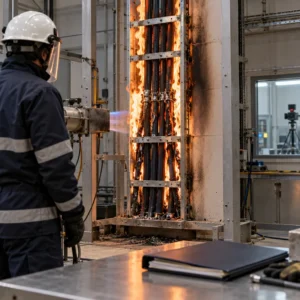
Fire performance is specified separately, per circuit. Where the facility’s rules require flame retardance, low smoke or fire survival for particular circuits, each requirement is written on its own line with the evidence it needs, because fire performance is a family of distinct tested properties, not a sheath adjective. The product families that carry fire survival constructions are shown in our fire-resistant cable range, and the construction logic of one common fire survival approach is set out in our note on fire resistant cable construction.
Fire requirements do not migrate between cables. A flame retardant sheath does not make a cable fire survival, and a fire survival construction does not extend its rating to the cable beside it. The circuits that must keep working in a fire are identified in the facility’s design, and their cables are specified against that requirement alone, with the reports to prove it.
Fire, oil and environment combine as separate requirements on one construction. Where a circuit needs resistance to hydrocarbons and fire survival and outdoor heat, the specification states all three, and the supplier engineers the construction that meets them together, evidence per requirement. Collapsing the three into one adjective is how plants discover, in an audit, that they bought none of them.
Plan Terminations With the Cable, Not After It
Glands, screens and cores meet at the panel, and the design must agree. The termination plan states the gland type per cable, how screens are brought out and earthed, how cores and pairs are dressed and identified, and the cabinet layouts reserve the space. Where the gland design waits until the cable arrives, the screen’s effectiveness waits with it.
Pair dressing is a workmanship specification. Signal pairs keep their twist to the terminal, pairs are not split across terminals casually, and the identification at both ends matches the loop list. The purchase states the termination standard the installers work to, because the cable’s screening investment is spent or saved at the last half metre.
End sealing during construction is part of the plan. Cables cut and waiting for termination, in desert dust and occasional condensation, need their ends sealed, and the site’s working rules say so. Water or dust in a screened instrumentation cable announces itself as an intermittent fault that no one can find, at the worst possible hour.
The Environment Exposure and RFQ Table
The table is the working sheet for the RFQ: each exposure, the construction question it drives, and the evidence that answers it.
| Exposure Named in the RFQ | Construction Question It Drives | Evidence That Answers It |
|---|---|---|
| Named oils and hydrocarbons, with contact duration | Sheath compound proven against the named media, not a generic oil claim | Oil resistance test basis per named medium, on the offered compound |
| Named chemicals and washdown agents | Sheath compatibility per agent; drainage and washdown routing reflected | Chemical compatibility data per agent, with concentrations stated |
| Operating, installation and excursion temperatures | Compound and insulation rated for all three conditions separately | Per-property temperature data, not one headline figure |
| Outdoor desert heat and UV | UV-stable sheath, temperature class checked against site reality | UV ageing evidence and site-matched temperature class |
| Mechanical exposure on racks and in trenches | Armour type and sizing per threat, or unarmoured where the route allows | Armour decision recorded per route with its reasoning |
| Fire requirements per circuit | Flame retardant, low smoke or fire survival specified as its own line per circuit | Test reports naming the property, the specimen and the conditions |
| Signal integrity beside power circuits | Pair construction, individual and overall screens, earthing arrangement | Screen continuity evidence in batch reports tied to drum numbers |
Cost and Lead Time in Instrumentation Cable Supply
Screening, armour and specialty compounds each carry cost, and each carries a reason. The evaluation prices the construction against the exposures it answers, and a quote cheaper by one screen or one armour layer is answering a different specification. Where the exposures are genuinely absent, removing the requirement is the honest saving; where they are present, the requirement is the cheaper half of the trade.
Specialty constructions run on production slots. Screened pair constructions with armour and specialty sheaths are made to order, and the lead time follows the sample round and the production queue. The RFQ that names everything at once gets one honest date; the RFQ that reveals requirements in stages gets several dates, none of them binding.
Fire survival and specialty compounds justify staged acceptance. Where the requirements are demanding, a sample round with verification before the full run is cheap insurance, and the staged acceptance also gives the plant’s inspectors a reference to read production against.
The as-built file is the next project’s head start. Constructions proven against the named media, compounds and their evidence, termination details and batch records: the next Turkmenistan project inherits all of it, and its specification phase shrinks accordingly. Buyers who archive the file specify faster and buy better than those who re-research each time.
| Adjective in Play | What It Suggests | What Must Actually Be Stated |
|---|---|---|
| "Oil resistant" | The sheath withstands any oil or hydrocarbon | The named oils or media, contact conditions, and the test basis per medium |
| "Chemical resistant" | General chemical immunity | Each chemical, concentration and duration, with compatibility data per agent |
| "Suitable for hazardous areas" | Explosion protection inferred from the sheath | The area qualification as its own requirement with its own evidence, never inferred from oil data |
| "Fire resistant" | One fire property covers all circuits | Per circuit: flame retardant, low smoke or fire survival, each with its own report |
| "Screened" | Any screen arrangement suffices | Individual, overall or both per cable, with the earthing arrangement and bring-out |
When a Specialty Instrumentation Specification Is Not the Answer
When the environment is benign. Indoor, clean, temperature-stable rooms do not need armour, oil compounds or fire survival, and loading the specification with inherited requirements buys cable the project does not use.
When the media list is a guess. Specifications written from plant-type assumptions rather than the project’s actual media list over- and under-specify at random; the media list is gathered from the process design before the cable is specified.
When the fire requirement belongs to a different circuit. Fire survival constructions serve the circuits that must function in fire; extending them across the whole instrumentation scope taxes the project for a property most circuits never invoke.
When no evidence can exist yet. A novel medium or combination no test data covers is a development question, and it is answered by a sample programme and agreed acceptance criteria, not by a datasheet promise, however confident.
RFQ Checklist
- Cable schedule attached: control cores and instrumentation pairs from the termination and loop lists, spares stated
- Screening arrangement per cable: individual, overall or both, with earthing and bring-out stated
- Armour decision per route, with the mechanical threat named, or unarmoured where the route allows
- Sheath compound answered against the named exposures, with trade-offs stated
- Oils, chemicals and washdown agents named, with concentrations and contact durations where known
- Operating, installation and excursion temperatures stated as three separate requirements
- Fire requirements as their own line per circuit, with the property and evidence named
- Termination plan included: gland types, screen bring-out, pair dressing standard, end sealing rules
- Batch evidence committed: resistance, insulation, screen continuity, tied to drum numbers
- Sample round agreed for demanding constructions, sealed references before the full run
Conclusion
Buying instrumentation and control cables for Turkmenistan projects is the discipline of specification by name: the oils named, the chemicals named, the temperatures separated into their three conditions, the fire requirements given their own line, the screening and its earthing treated as a system, and the terminations designed before the cable ships. Adjectives are cheap and evidence is specific, and the plants that run quietly are the ones whose buyers knew the difference.
Kexingyu Cable Group (KXYE) manufactures instrumentation, control, oil-resistant and fire-resistant constructions in Quanzhou and answers Turkmenistan project enquiries at the level the environment demands: media named and answered per compound, screens and earthing stated per cable, fire requirements evidenced per circuit. Send us your media list, cable schedule and destination, or upload your technical specification, and we will quote against the environment, not the adjective. A request for quotation is the fastest route to start.