Industrial Cable Procurement: A Ten-Year View for Site Owners
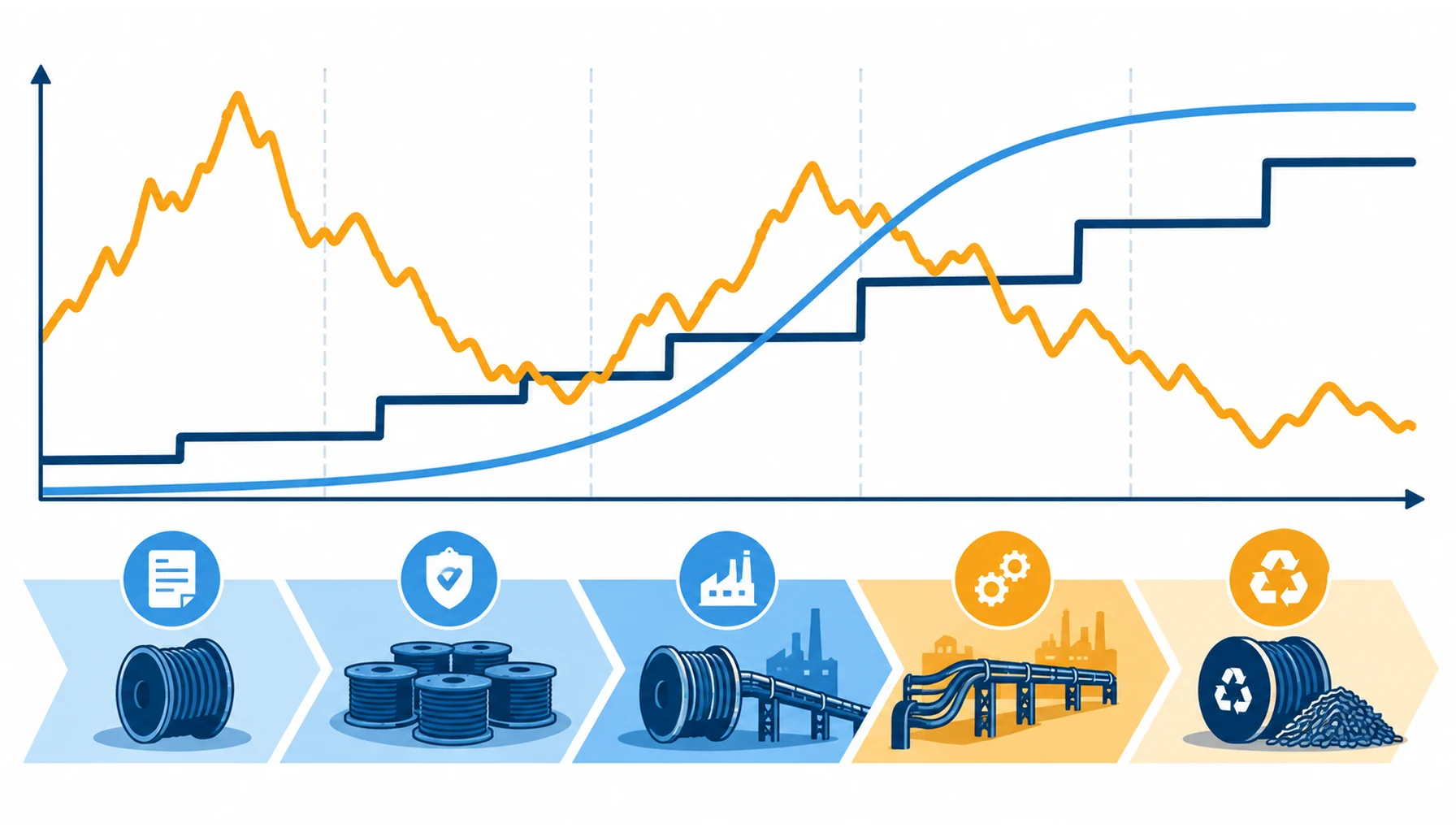
Quick Answer: Three curves decide what cable costs and how hard it is to buy over ten years, and they move at different speeds. Copper moves weekly, standards and certification move over years, and the supply base moves somewhere in between. A buying plan that assumes all three are stable is the plan that gets rewritten most often.
Introduction
Most cable procurement is done one order at a time, which is fine until an owner sits down and looks at what the site has actually spent over a decade. The same constructions are bought again and again, the same problems recur at receipt, and the same argument about a moving metal price is had every time the market turns.
This closing guide is for site owners, plant managers and procurement leads responsible for cable across several projects and years, not just the next delivery. It sets out the three curves that shape the next decade, what each one changes, the decisions that belong to a horizon rather than an order, what to hold standard, how to contract for a moving copper price, how to build a supplier base that survives staff changes, and the eight decisions to freeze now. It closes the industrial cable series with the long view rather than the next shipment.
What the Next Decade Actually Changes
More cable, in more places, at higher duty. Electrification of plant, conveyor and haulage, more variable-speed drives, more sites running on constrained grids. The volume goes up and the electrical environment gets harder, which pushes more of the specification towards screened, armoured and higher-temperature constructions than sites bought ten years ago.
Certification becomes a moving target rather than a fixed gate. Markets continue to add or tighten their own schemes, and a construction that was accepted on a project five years ago may need a different certificate on the next one in the same country. What was a one-off paperwork task becomes a rolling item on the procurement calendar.
Supply consolidates, and the smaller flexible sources disappear. As the larger factories fill their lines with volume work, the willingness to run short and awkward orders falls. That makes the qualification of a reliable source a longer-term asset than it used to be, and it makes losing one more expensive.
The Copper Curve: A Metal Price in the Contract
Copper is the largest single element of cost, and it is the one nobody controls. On a power cable the conductor can be the majority of the material value, so a ten per cent move in the metal translates into a visible move in the price. Every long-horizon buying decision is really a decision about how to carry that exposure.
The price can be carried by the buyer, the seller or the contract. A firm price transfers the risk to the supplier and buys certainty at a premium. A formula tied to an index keeps the price honest and leaves the buyer exposed. A fixed metal element separates the metal from the conversion, which is often the cleanest arrangement where both sides understand it. These mechanisms are set out in our note on copper price lock contracting.
The buying response is structural, not tactical. Standardising on fewer constructions, holding a metal-price mechanism that both sides accept, and timing bulk orders around the order book rather than the headline price saves more over a decade than any single well-timed purchase. Where the price actually sits within a cable cost is set out in our note on the structure of a cable price.
The Standards Curve: Certification as a Rolling Item
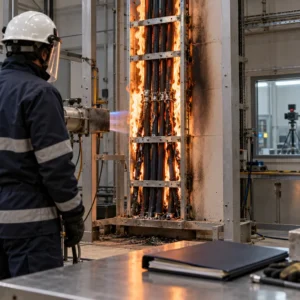
Standards move slowly and then arrive all at once. A fire performance classification, a smoke and halogen requirement or a market registration scheme can take years to write and then apply to everything bought afterwards. A site that discovers this at tender stage pays for it in time and in options.
Build the certificate roadmap before the project list. For each market the owner builds in, the accepted certification for the main constructions should be known in advance and reviewed annually. The market-by-market picture is in our note on cable import certification by country, and the project-level set is in our note on product certifications for cable.
Certificates have scope, and scope is where projects fail. A certificate that covers a product family does not automatically cover the construction being delivered, and a management-system certificate says nothing about a specific drum. Ask what the certificate covers, and keep the answer in the project file alongside the drawing, because the question returns at every handover.
The Substitution Curve: Where Supply Comes From
Substitution is a qualification exercise, not a price exercise. Moving a construction from one source to another is only safe where the construction has been specified fully and the alternative has been qualified against the same standard. Where the specification was vague, the substitution happens quietly and the difference arrives at site as a thinner conductor or a different compound.
Chinese supply is now a mainstream option, with conditions. Factories building to IEC for export markets cover the industrial range competently, and the commercial case is strong on many projects. The conditions are a written specification, an accepted certification for the destination and evidence that the goods match the approved construction. The buying process is described in our note on buying cable from China.
Keep at least one qualified alternative. A second source that has been sampled, tested and approved is an asset that costs a little to maintain and a great deal to create under pressure. The qualification process itself is set out in our note on qualifying a second source.
Three Curves, One Buying Plan
Separate the decisions by how fast they move. Metal price decisions are made order by order and measured in weeks. Certification decisions are made once and reviewed annually. Supply-base decisions are made over a project cycle and revisited when a source changes hands or a line fills up.
Give each one the contract instrument it needs. A price mechanism for the metal, a certificate roadmap for the market, a framework for the recurring constructions, and a qualification file for the alternatives. Trying to solve all three with a single annual tender is where most owners end up rewriting the same plan every year.
Write down what stays standard. The constructions that recur across sites are the ones worth standardising, because they are what the stock, the spares, the training and the supplier relationship are all built around. Standardisation is the quiet source of savings over a decade, and it costs nothing but discipline.
Review the plan against what actually happened. Once a year, compare the constructions actually bought against the standard set, the claims raised against the warranty frame, and the lead times promised against those delivered. Three small adjustments a year keep a decade plan honest, and the review takes an afternoon rather than a project team.
Decisions by Horizon Compared
The table sets out the horizons a cable owner is buying against, what changes in each one, what to specify, the evidence to hold, what drives cost and time, and how each horizon fails.
| Horizon | What changes | What to Specify | Evidence to Hold | Cost and Lead-Time Driver | How It Fails |
|---|---|---|---|---|---|
| This order | The metal price, the delivery date and the drum schedule | Construction, quantity, delivery basis and price mechanism | A compliant quotation and a dated dispatch plan | Copper movement and the production slot | A price accepted without checking the metal basis behind it |
| Next project cycle | Certification for the destination and the standard in force | The accepted certificate for each construction | Current certificates scoped to the goods | Testing and registration time, not money | A certificate that does not cover the construction delivered |
| Asset life | Maintenance, spares and the availability of matching cable | A standard construction set and a stock policy | Test records and retained samples by construction | Holding cost against the cost of a stopped asset | A replacement length that no longer matches the installed cable |
| Replacement programme | The rate of ageing, failure and planned renewal | The replacement interval and the condition assessment method | Condition records and a renewal schedule | The size and timing of renewal batches | Reactive replacement at a premium, on the plant's schedule |
| End of asset life | The recovery value in the installed copper | The recovery route and the records needed to release it | A disposal record with quantities and condition | The recovered metal offset, less handling | Installation records lost, so recovery becomes guesswork |
What to Keep Standard Across the Decade
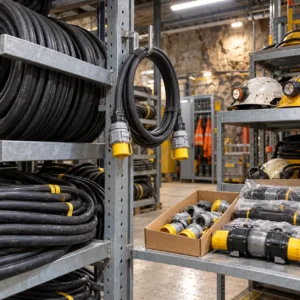
A small construction set that covers most of the site. Three or four power constructions, two or three control and instrumentation constructions, and the accessories that terminate them. Every additional variant dilutes the spares holding, the training and the supplier’s understanding of what the site actually needs.
The specification and the test regime, written down. The construction, the conductor class, the compounds, the ratings and the standard each is tested to, held in one document that all sites use. A specification that lives in three different project folders is a specification that will be interpreted three ways.
The documentation and traceability requirements. Drum numbering, test records tied to the drum, marking and labelling, and a retained sample per construction. Over ten years the replaced cable outlives the people who bought it, and the paperwork is what the next engineer has to work from. Our note on cable life prediction shows what those records are used for later.
Contracting for a Moving Metal Price
Decide who carries the metal risk, and say so. Firm price, index-linked formula or a fixed metal element with a conversion charge. Each is a transfer of risk, and each has a price. The mistake is to leave the mechanism unwritten and discover the arrangement when the market moves against the side that assumed it had protection.
Set the validity window deliberately. A quotation open for thirty days and an order placed in ninety is not a price, it is an option the supplier gave away. Agreeing a realistic validity window and a mechanism for movement beyond it removes the argument that follows a sharp move, and the mechanics are covered in our note on copper price and cable procurement. Comparing the resulting offers is a discipline in itself, described in our note on comparing cable quotes.
Use a framework for the repeating items. A framework fixes the construction, the price basis and the lead time for the cable bought most often, which removes a negotiation from every breakdown. It is the single most effective long-horizon instrument available to a site owner, and how one is put together is set out in our note on framework agreements.
Building a Supplier Base That Lasts
Look at who owns the line, not only who owns the brand. A relationship with a trading company that cannot answer a technical question degenerates over time, because every question about a construction, a test or a substitution has to travel. Knowing where the cable is actually made changes the quality of the answers, which is the point our note on manufacturers compared with trading companies returns to.
Relationships outlive the people who built them. Site staff move on every few years, so the value of a supplier relationship has to be held in documents rather than in a contact’s memory. A qualification file, an approved construction set and a purchase history make the relationship transferable, which is what keeps the next buyer from starting again.
Measure the relationship, not the price. Rejects at receipt, on-time delivery, how quickly a technical question is answered and how a claim is handled. A supplier that is slightly more expensive and much easier to work with is usually the cheaper option over a decade, and the support side of that is described in our note on after-sales support.
What to Freeze Before the Order Goes Out
Eight decisions carry across the decade. Each belongs in the specification, the framework or the purchase order, and each one is cheaper to settle now than to revisit under pressure.
| Decision | What to State | Evidence to Attach | Cost of Leaving It Open |
|---|---|---|---|
| Standard construction set | The constructions and accessories the site buys by default | A site specification covering the full set | A different cable on every project and a spares store that matches none |
| Price mechanism | Firm, index-linked or fixed metal element, and the validity window | The clause, with the index and the review point named | A price argument every time the metal moves |
| Qualification file | Which sources are approved, for which constructions | Sample and test records for each approved source | A scramble for a second source during a supply problem |
| Certification roadmap | The certificate each market requires, and who reviews it | Current certificates with their scope recorded | Cable refused at inspection on a project already in build |
| Spares and stock policy | What is held, where, against which failure and lead time | A stock list with criticality and review dates | A stopped plant waiting for a cable that could have been held |
| Traceability requirement | What links drum number to batch, test and release | A worked example from the supplier's records | A claim that fails for want of evidence years later |
| Warranty and liability frame | The period, the exclusions and where risk transfers | The clause set, agreed once and reused | A dispute renegotiated on every order and lost on most |
| End-of-life recovery | How cable is decommissioned and its copper recovered | A disposal route with records and quantities | Value scrapped and installation records lost |
Cost and Lead Time Over the Long Run
Standardisation is the largest untapped saving. Fewer constructions mean fewer drawings, fewer spare lines, smaller stocks that rotate faster and a supplier who knows exactly what the site buys. None of it requires a negotiation, and most sites have never done it because each project bought independently.
Lead time is a long-run cost, not a per-order inconvenience. A source that delivers reliably in six weeks allows a leaner stock and a tighter programme than one that averages twelve with a wide spread. Over a decade the reliability of the date is worth more than the difference in unit price, and the structure behind it is covered in our note on cable MOQ and lead time.
Plan the end as well as the start. Cable removed at the end of an asset’s life still carries recoverable copper, and a planned route returns value that an unplanned one gives away. Renewal is also cheaper when it is planned, which is the case made in our note on planned cable replacement, and the recovery side is covered in our note on recovering copper at end of life.
When a Ten-Year Plan Is Not the Answer
When the asset itself is short-lived. A temporary installation, a short mine life or a facility with a known closure date does not need a decade of standardisation. Buy for the life of the asset and keep the inventory light.
When the site is one project and nothing follows it. Standardisation pays back across repeated buying. On a single standalone project, the effort belongs in the specification and the qualification for that project, not in a catalogue for a future that does not exist.
When the plan becomes an excuse to over-buy. Framework agreements and standard sets are there to remove friction, not to justify inventory. Holding cable that ages in a store because a plan says so is the same mistake as holding none, just more expensive.
When nobody owns the plan. A decade-long view needs a named owner and an annual review, otherwise it becomes a document that describes a site that no longer exists. Where the plan is reviewed, it should be short, current and tied to the next three orders rather than to a theory. Our note on using one coordinated supplier covers how much of that continuity a single source can carry.
RFQ Checklist
- The standard construction set for the site, with the accessories for each
- The full specification for each construction, including the test regime
- The price mechanism, the index it references and the validity window
- The certificate required by each market, with its scope recorded
- The documentation package issued with every drum of every order
- The traceability requirement linking drum number to batch and test
- The shelf of approved sources, by construction, with sample records
- The spares and stock policy, with criticality and review dates
- The framework terms for the constructions bought most often
- The warranty period, the exclusions and the risk transfer point
- The condition assessment method used for renewal planning
- The end-of-life recovery route and the records it needs
Conclusion
Cable procurement over a decade is three problems wearing one coat. The metal moves fast and needs a mechanism. Standards and certification move slowly and need a roadmap. The supply base moves quietly and needs a qualification file and a relationship that outlives the people in it. Sites that separate those three buy better than sites that treat every order as a fresh negotiation.
Kexingyu Cable Group (KXYE) has manufactured cable in Quanzhou since 1996, works to IEC and national standards for export markets, and keeps the drum-level records that a ten-year replacement programme depends on. Where a site is standardising its construction set or setting up a framework, we will work through the specification, the price basis and the documentation once, so the orders that follow are straightforward. A request for quotation is the fastest route to start.