
Thermal Runaway in Lithium Batteries: What BESS Buyers Should Understand
How thermal runaway starts, how it propagates, and which evidence buyers should require before approving a battery storage system.
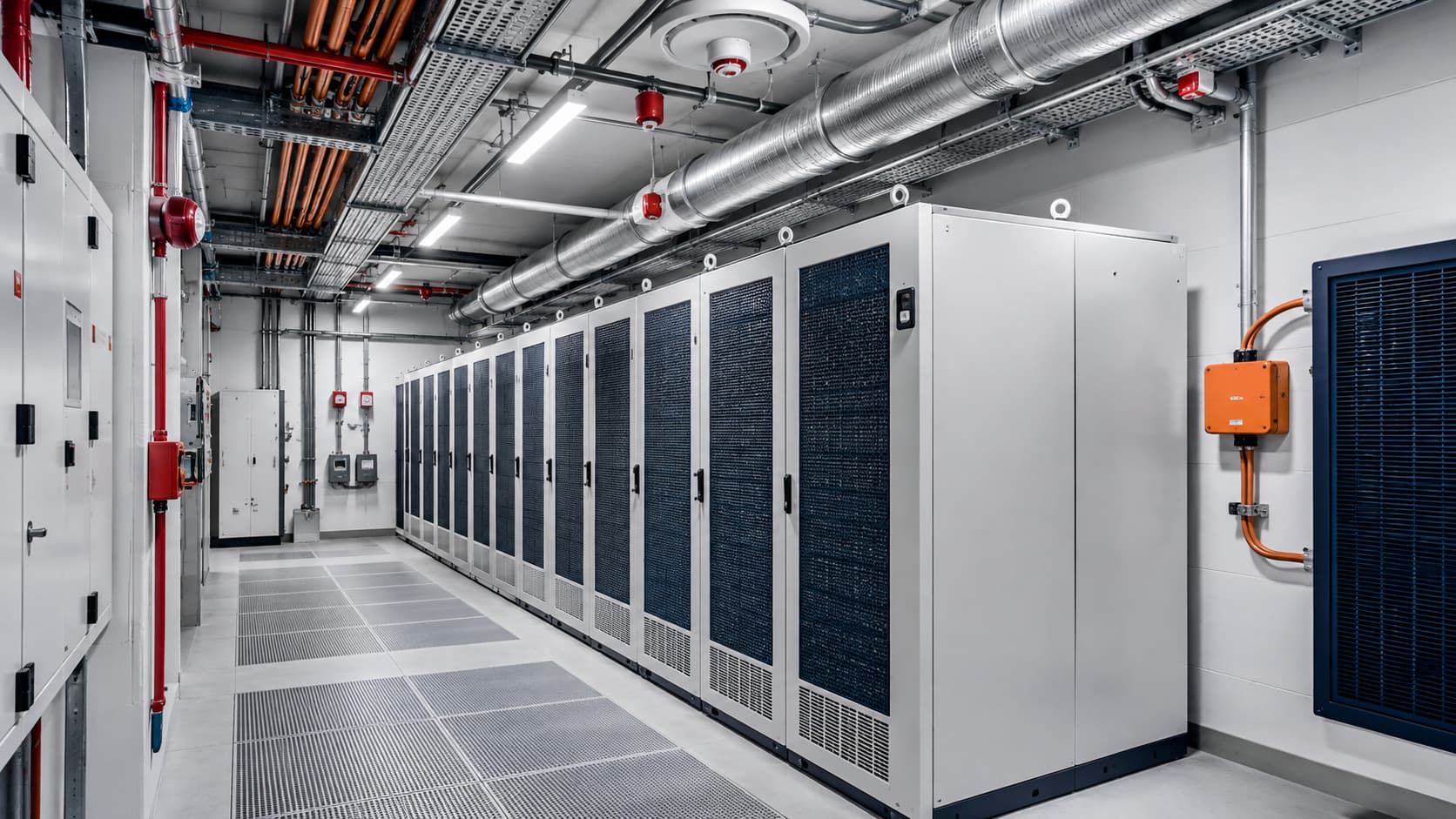
What Thermal Runaway Actually Is
Thermal runaway is an uncontrolled self-heating process inside a battery cell. Heat generated by internal reactions exceeds the heat the cell can dissipate, accelerating further exothermic reactions and causing temperature and pressure to rise rapidly. The event may produce hot particles, smoke, flammable or toxic gases, fire, and heat transfer to neighboring cells.
Thermal runaway is therefore both a cell-level failure mode and a system-level design challenge. A safe battery energy storage system (BESS) must reduce the likelihood of initiation, detect abnormal conditions, limit propagation, manage released gases and heat, and support a site-specific emergency response.
No single component can guarantee safety. Cell quality, mechanical design, electrical protection, BMS logic, thermal management, gas detection, ventilation or explosion control, enclosure layout, fire protection, commissioning, maintenance, and operating procedures must work as layers.
What Can Trigger Thermal Runaway
Internal defects and aging
Manufacturing contamination, separator damage, dendrite growth, or other latent defects can create an internal short circuit. Aging, vibration, repeated cycling, and unsuitable storage conditions can reduce margins, so incoming quality controls and field monitoring both matter.
Electrical abuse
Overcharge, external short circuit, overcurrent, deep discharge followed by unsuitable recharge, and failed insulation can generate abnormal heat. Contactors, fuses, insulation monitoring, charger and PCS limits, and BMS thresholds should provide independent protection rather than relying on software alone.
Mechanical abuse
Crushing, puncture, impact, incorrect lifting, loose mounting, water ingress, and transport damage can compromise a cell or electrical connection. Damaged equipment needs a controlled quarantine and assessment process; visual appearance alone does not prove that a cell is safe.
External heat and cooling failure
A nearby cell failure, external fire, blocked airflow, failed HVAC, extreme ambient temperature, or localized hot connection can heat otherwise healthy cells. Thermal design must address temperature uniformity as well as average enclosure temperature.
From One Cell to a System Event
The initiating cell may vent before visible flame appears. Released gases can accumulate inside a cabinet, room, or container, creating toxicity and deflagration hazards. Ignition can occur immediately or after a delay. This is why a smoke detector or flame detector alone may not provide the earliest actionable signal.
Propagation occurs when heat, flame, hot particles, or electrical faults cause adjacent cells or modules to enter thermal runaway. Cell spacing, thermal barriers, module construction, vent paths, enclosure geometry, active cooling, suppression, and the battery state of charge can all affect the result.
The sequence and severity are configuration-specific. Test results from a different cell, module layout, cabinet, HVAC arrangement, firmware version, or state of charge should not automatically be applied to the offered system.
The BMS Is Essential, but It Is Not a Complete Fire-Safety System
The BMS monitors signals such as cell voltage, module temperature, current, insulation status, and communications health. It can issue alarms, restrict charging or discharging, and command contactors to open when measured values cross defined limits. See BMS vs EMS for the distinction between battery protection and site-level dispatch.
However, an internal cell defect can develop locally or rapidly without producing an early external voltage or temperature signal. Opening contactors also cannot stop chemical reactions that have already become self-sustaining inside a cell. Buyers should treat the BMS as one prevention and detection layer, not as proof that propagation, fire, or gas hazards have been controlled.
Layers of Protection Buyers Should Evaluate
- Cell and supplier quality: chemistry, manufacturing controls, traceability, incoming inspection, and change management.
- Electrical protection: fuses, contactors, current limits, insulation monitoring, grounding, coordination, and safe isolation.
- Thermal management: sensors placed at meaningful locations, cooling redundancy, temperature uniformity, failure alarms, and derating.
- Propagation resistance: cell and module spacing, barriers, vent direction, and structural containment validated in the offered configuration.
- Off-gas, smoke, heat, and flame detection: detection philosophy linked to alarm and shutdown actions.
- Gas management: ventilation, deflagration venting or explosion prevention designed from test data and local code requirements.
- Fire protection and exposure control: suppression, water supply where applicable, separation distances, access, drainage, and protection of adjacent equipment.
- Operations and emergency planning: remote alarms, shutdown boundaries, responder information, re-entry rules, damaged-unit handling, and post-event monitoring.
Thermal Runaway Protection Layers
Use this table to check whether prevention, detection, mitigation, and emergency response are all covered.
| Protection layer | Typical measures | What the buyer should verify | Evidence |
|---|---|---|---|
| Cell quality | Qualified cell supplier, traceability, incoming inspection and change control | Exact cell model and manufacturing controls | Audit records, specifications and certificates |
| Electrical protection | Fuses, contactors, current limits, insulation monitoring and coordination | Independent protection and safe isolation sequence | SLD, protection study and FAT records |
| Thermal management | Temperature sensors, HVAC, airflow monitoring and derating | Sensor locations, uniformity and cooling-failure response | Thermal model, test report and cause-effect matrix |
| Early detection | Cell monitoring, off-gas, smoke, heat and pressure detection | Alarm thresholds, coverage, backup power and calibration | Detector design and commissioning procedure |
| Propagation control | Spacing, thermal barriers, module design and controlled vent paths | Applicability to the offered cell, module, cabinet and SOC | Complete UL 9540A or equivalent report |
| Gas and explosion control | Ventilation, deflagration venting or explosion prevention | Design based on measured gas and pressure data | Hazard analysis and fire engineer calculations |
| Fire and exposure control | Suppression, separation, water supply, drainage and adjacent-unit protection | Site-specific code and authority requirements | Fire protection plan and approved layout |
| Emergency response | Remote alarms, isolation, access control, responder information and re-entry rules | Who acts, what is isolated and when the area can be approached | Emergency response plan and training records |
Important: A listed component or completed test does not replace a site-specific hazard analysis and approval by the authority having jurisdiction.
Chemistry Changes the Risk Profile, Not the Need for Engineering
Lithium iron phosphate (LFP) is widely used in stationary storage because of its thermal stability and long cycle life. Compared with many nickel-rich lithium-ion chemistries, it can provide a wider thermal margin and may release less heat under comparable conditions. Our LiFePO4 vs Other Battery Chemistries guide explains the purchasing trade-offs.
LFP is not non-combustible and should not be marketed as “thermal-runaway proof.” Cell format, state of charge, module construction, defect type, propagation barriers, gas behavior, enclosure design, and installation conditions remain important. Chemistry selection reduces or changes risk; it does not eliminate the requirement for system testing and site protection.
What UL 9540A Does—and Does Not—Tell You
UL 9540A is a test method for evaluating thermal runaway fire propagation and associated fire and explosion hazards in battery energy storage systems. It generates data that authorities, fire-protection engineers, designers, and owners can use when evaluating the tested configuration and the proposed installation.
UL 9540A should not be described as a general product certification or a guarantee that a system cannot burn. Buyers should request the complete report—not only a summary or marketing statement—and verify the tested cell, module, enclosure, state of charge, spacing, ventilation, detection, suppression, and other configuration details against the equipment being offered.
Applicable requirements depend on jurisdiction and project type. NFPA 855 addresses stationary ESS installation hazards in the United States, while other countries and authorities may use different codes. Our BESS Certification Checklist provides a broader procurement framework, but the authority having jurisdiction and qualified fire-protection professionals should confirm the final code path.
Site Design Must Use the Test Data
Equipment-level safety features do not replace site engineering. Designers may need to evaluate separation from buildings and other BESS units, fire-apparatus access, exposure protection, water supply and runoff, gas dispersion, explosion control, emergency isolation, drainage, environmental loads, noise, security, and responder approach routes.
Indoor, rooftop, cabinet, and container installations have different confinement and exposure conditions. A ventilation or suppression strategy that is suitable for one arrangement may be unsuitable for another. Changes made after testing—such as tighter spacing, additional racks, modified ductwork, or a different cell—require formal review.
Detection and Automated Response Sequence
- Detect and validate the abnormal condition using the available cell, thermal, gas, smoke, pressure, and electrical signals.
- Alarm locally and remotely with a severity level and an unambiguous equipment location.
- Place charging and discharging equipment in the defined safe state; isolate only where the protection philosophy calls for it.
- Activate ventilation, suppression, or other mitigation only according to the engineered sequence and test-supported design.
- Prevent automatic restart until inspection, diagnostics, and authorization criteria are satisfied.
The control matrix must also define what happens after loss of BMS communications, detector power, HVAC, fire alarm, EMS, or external network connectivity. Essential safety functions should not depend solely on cloud access.
Documentation to Request Before Purchase
- The complete UL 9540A or equivalent test report applicable to the offered configuration.
- System and battery certifications required by the destination market, with model numbers and scope.
- Cell manufacturer, chemistry, form factor, traceability system, and engineering change-control procedure.
- Cause-and-effect matrix for alarms, shutdown, ventilation, suppression, and emergency isolation.
- Gas composition, generation rate, heat-release, propagation, and pressure data needed by the fire engineer.
- Layout assumptions, required clearances, installation limitations, maximum state of charge, and environmental limits.
- Fire-protection design basis, emergency response plan inputs, and safety data sheets.
- Commissioning, inspection, sensor calibration, HVAC maintenance, firmware control, and end-of-life procedures.
FAT, SAT, and Maintenance Checks
Do not attempt destructive thermal-runaway testing at the project site. FAT and SAT should verify the non-destructive functions that support the tested safety concept: sensor plausibility, alarm routing, interlocks, contactor and breaker operation, HVAC failure response, emergency stop, fire-panel interfaces, communications loss, backup control power, data logging, and prevention of unauthorized restart.
Maintenance should include detector calibration or replacement, airflow and filter inspection, thermal-imaging checks where appropriate, torque and insulation inspections, firmware and settings control, review of cell imbalance and temperature trends, and confirmation that emergency contacts and responder documents remain current.
Questions Buyers Should Ask
- Is the offered cell, module, cabinet, firmware, SOC, spacing, and fire-protection configuration represented by the test report?
- What were the observed gas species, heat release, flame behavior, ejected material, and propagation results?
- Which assumptions must the site designer preserve for the results to remain applicable?
- What happens if cooling, gas detection, BMS communication, suppression, or auxiliary power fails?
- Which functions are passive, and which require power, communications, or software?
- Who reviews design changes, replacement cells, firmware updates, and field modifications?
- What information and training will be supplied to the local authority and emergency responders?
Where Kexingyu Power Fits In
Kexingyu Power can support BESS projects with technical submittals covering the proposed battery, BMS, enclosure, thermal management, PCS interfaces, switchgear, and project-specific options. Availability and applicability of certifications, UL 9540A reports, detection, ventilation, suppression, and propagation-mitigation features must be confirmed for the exact model and destination market in the technical offer.
For an effective review, provide the site layout, installation type, required capacity and power, ambient conditions, applicable code, authority requirements, fire-protection concept, operating SOC range, access constraints, and emergency-response expectations. These inputs allow safety evidence to be matched to the real installation instead of reviewed as a generic brochure claim.
Frequently Asked Questions
Recent Posts
Energy Storage for Data Centers: A Growing Backup Power Option
Energy Storage for Data Centers: A Growing Backup Power Option Batteries have always backed up data centers in the form of UPS strings. Grid-scale BESS
Switchgear Lead Times in 2026: A Buyer’s Planning Guide
Switchgear Lead Times in 2026: A Buyer’s Planning Guide Realistic timelines vary significantly by voltage class and type — here’s how to plan procurement without
What Is BESS? A Guide to Battery Energy Storage Systems for C&I Buyers
What Is BESS? A Guide to Battery Energy Storage Systems for C&I Buyers A clear explainer on what BESS systems actually are, how the pieces